You are here:Home » Blog » Technical Guides » Receiver-Cycle EV Heat Pumps: Gas-Injection Compressors, Water-Cooled Condensers, Separators, and LIN Expansion Valves
Receiver-Cycle EV Heat Pumps: Gas-Injection Compressors, Water-Cooled Condensers, Separators, and LIN Expansion Valves
Views: 0 Author: Site Editor Publish Time: 2026-09-14 Origin: Site
Receiver-cycle is an architecture description, not a universal parts catalog. A correct replacement must match refrigerant, pressure class, gas-injection compressor design, receiver or gas-liquid separator function, water-cooled condenser or other heat exchangers, port mapping, electronic expansion valves, LIN or other communication, sensors, high-voltage range, oil and electrical insulation, software calibration, mounting, and every operating mode.
This guide is written for engineering teams, fleet operators, distributors, and aftermarket buyers evaluating emerging thermal products. It connects the new architecture to familiar sourcing controls used for a electric A/C compressor, condenser, and liquid heat exchanger, while keeping high-voltage, software, and battery or fuel-cell boundaries explicit.
New thermal components should be identified as complete mechanical, fluid, electrical, and control systems.
1. Start with the vehicle's actual circuit
EV heat pumps can combine cabin cooling, cabin heating, battery cooling, dehumidification, defrost, waste-heat recovery, and charging thermal control. Similar-looking modules can route refrigerant differently. Draw the circuit from authoritative service information and identify component function in each mode.
The term receiver-cycle may be used differently across technical or supplier material. Preserve the vehicle maker's terminology and do not convert it into an interchange claim.
2. Gas injection increases cold-weather capability
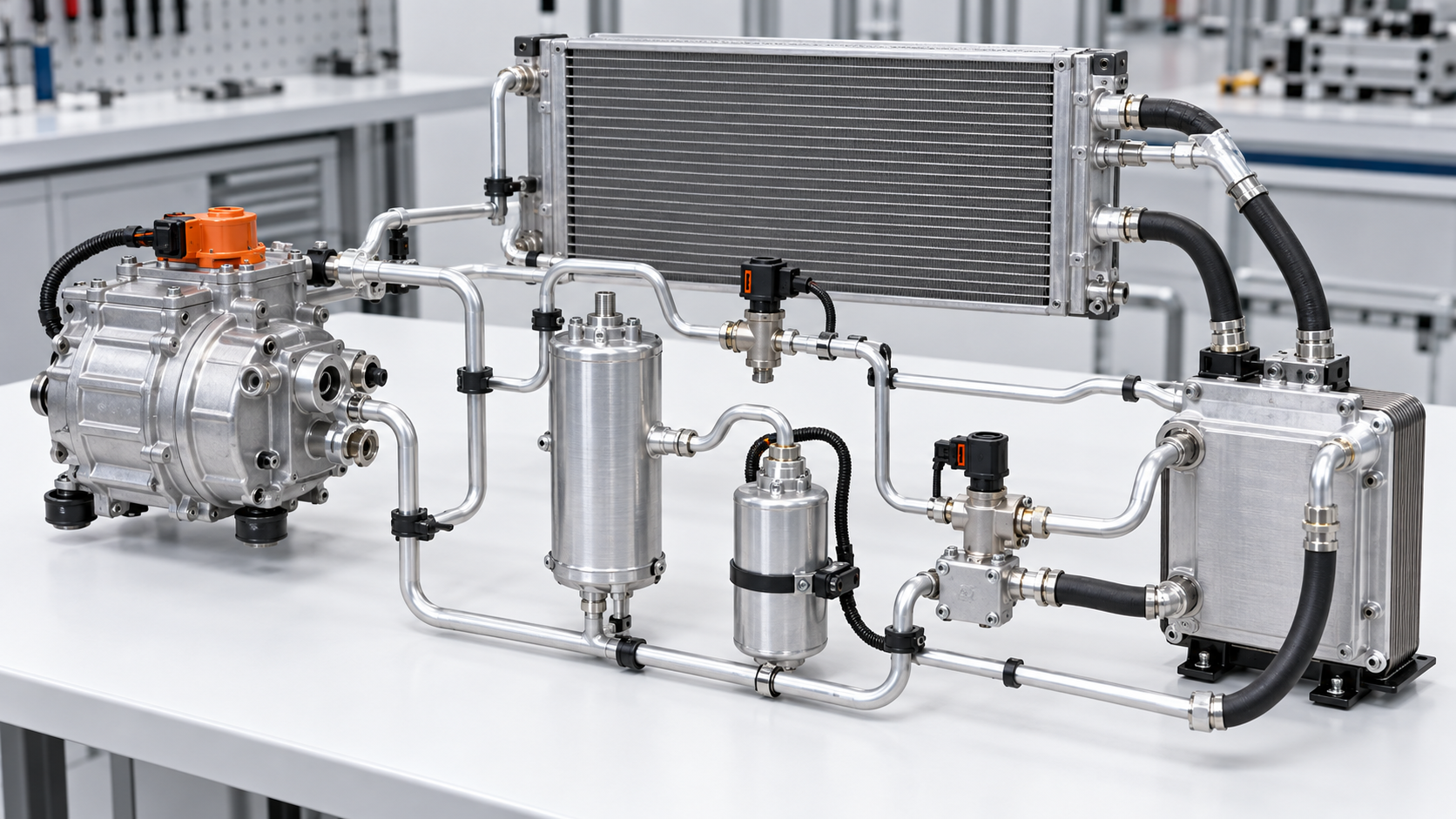
DENSO publicly explains a heat-pump system that separates high-density vapor and injects it into an electric compressor to increase circulating refrigerant mass and heating performance in cold conditions. A gas-injection compressor therefore has additional internal and external interfaces beyond a conventional suction and discharge pair.
Match main suction, discharge, injection port, refrigerant, displacement, speed range, voltage, inverter, cooling, connectors, communication, oil, mounts, noise, and calibration. A normal electric compressor is not an automatic substitute.
3. The separator is an active system component
A gas-liquid separator can create the vapor stream used for injection while managing liquid routing. DENSO describes a compact separator with an integrated valve in its system. Separation efficiency depends on flow, pressure, state, geometry, and valve control.
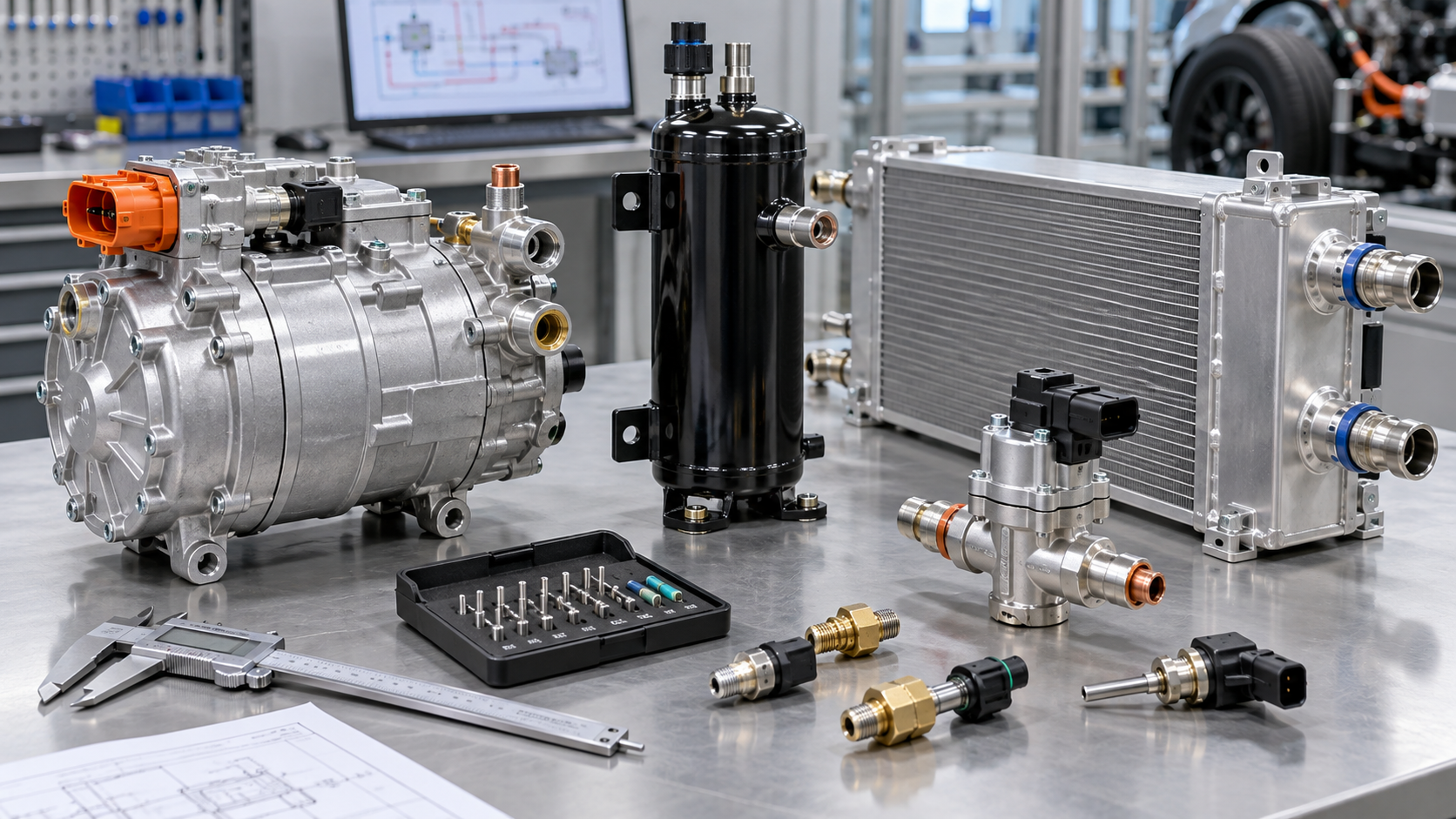
Match every port and internal function. A black cylindrical vessel with the same diameter may be a receiver, accumulator, separator, or combined module with different internal tubes and valves.
4. Water-cooled condensers connect two controlled loops
A refrigerant-to-coolant heat exchanger can reject heat into a coolant loop for cabin heating, battery warming, or another thermal consumer. Refrigerant passages, coolant passages, flow direction, pressure classes, ports, materials, and internal leakage control all matter.
Test each circuit and the separation between them. A cross-leak can contaminate coolant with refrigerant or introduce coolant into the refrigerant circuit.
5. Electronic expansion valves need mechanical and digital matching
An electronic expansion valve is selected by orifice and flow capacity, pressure range, refrigerant, stepper or actuator design, port direction, connector, sensor context, and control calibration. A LIN valve additionally depends on message and diagnostic compatibility.
Confirm address, bitrate, wake, commands, feedback, default state, learning, end stops, counters, timeouts, and software part numbers. Physical installation cannot prove that the vehicle controller can operate the valve.
6. Port mapping is a mode-by-mode task
Multi-port valves can connect different heat exchangers in cooling, heating, defrost, dehumidification, or battery modes. Label photographs and count alone are insufficient. Build a port-state matrix from the service source and compare internal routes.
A single swapped line can create plausible pressure in one mode and failure in another. Bench pressure testing should verify commanded routes and internal leakage across blocked paths.
Bench validation must reproduce the relevant boundary conditions and record all interacting variables.
7. Refrigerant and pressure class are foundational
R-1234yf, R-744, R-290, and other refrigerants lead to different pressures, materials, compressor oils, service fittings, safety controls, and component designs. Do not use a component because the pipe diameter matches.
Read labels and current service information. Use trained personnel and equipment appropriate to high voltage and the refrigerant's flammability, pressure, and regulatory requirements.
8. Oil supports mechanics and electrical insulation
Electric-compressor oil can contact motor windings and must meet lubrication, refrigerant, material, moisture, and electrical requirements. Gas injection and heat-pump modes widen operating conditions. An unapproved oil or dye can reduce insulation or reliability.
Reconcile compressor prefill, total circuit oil, component replacement, recovered oil, and service procedure. Keep containers closed and tools clean.
9. Sensors define the controller's view
Pressure and temperature sensors, coolant sensors, humidity, ambient, cabin, battery, and powertrain data influence valve and compressor commands. A sensor can fit mechanically but use different range, signal, calibration, or digital protocol.
Diagnose plausibility and wiring before replacing a controlled refrigerant component. Capture command and response in every failed mode.
10. Water and refrigerant sides have different commissioning needs
The coolant loop requires correct fluid, vacuum fill or bleeding, flow, pump control, and leak checks. The refrigerant loop requires approved pressure testing, evacuation, measured charge, moisture control, and oil discipline. Completing one side does not commission the other.
Run modes only after both circuits pass. Trapped gas on the coolant side can make a water-cooled condenser appear undersized.
Hardware suffixes can correspond to inverter calibration, compressor maps, valve addresses, sensor scaling, and thermal-control logic. Updates may require programming or vehicle authorization. Record all hardware and software IDs before removal.
Avoid energizing an unmatched module to see whether it works. A wrong message or valve position can create high pressure, liquid return, isolation faults, or damage.
12. Aftermarket supply is a module-level evidence problem
For many new EV architectures, safe independent interchange data is limited. The correct sourcing response may be OE service supply, an authorized remanufactured module, or engineering validation rather than a catalog cross-reference.
Require provenance, part and software numbers, sealed ports, oil statement, insulation data, leak tests, shipping orientation, and return process. Do not dismantle sealed warranty components without authorization.
Evidence matrix for a sourcing decision
Layer
Evidence to retain
Approval question
Application
Vehicle or machine, architecture, duty, environment, revision
Worked example: cabin cooling works but low-temperature heating fails
A replacement valve module and compressor allow normal summer cabin cooling. During cold-weather heating, compressor speed rises but discharge temperature and cabin heat remain insufficient, and a valve communication fault appears intermittently.
The compressor has the right main ports and voltage but lacks the intended gas-injection calibration. The replacement electronic valve uses a different LIN address and defaults to a route that approximates cooling but cannot establish the medium-pressure separation state. A summer test therefore missed the mismatch.
The correct validation identifies every port and software number, verifies LIN communication, checks separator routing and internal leakage, confirms oil and refrigerant charge, and runs cabin cooling, battery cooling, heating, defrost, dehumidification, heat recovery, charging, and fault modes under controlled conditions.
Recommended validation workflow
Capture VIN, market, software, labels, refrigerant, oil, high-voltage data, and the authoritative circuit diagram.
Map every component and port in each thermal operating mode.
Match compressor main and injection ports, voltage window, inverter, communication, oil, mounts, and calibration.
Match receiver or separator internal function, integrated valves, orientation, and routes.
Match water-cooled condenser or chiller on both circuits, including cross-leak protection.
Confirm expansion-valve flow, direction, connector, LIN or control data, and software.
Bench-test leak, route, sensor, communication, insulation, and actuator functions without unsafe improvisation.
Commission coolant and refrigerant circuits separately with measured fluids and controlled bleeding or evacuation.
Validate all vehicle modes, transients, ambient ranges, charging states, diagnostics, and fail-safe behavior.
Approve provenance, packaging, caps, traceability, software control, and change notification.
Run a formal review after each layer. A visually correct sample should not advance if its software, fluid, safety, or duty evidence is unresolved. Deviations need named owners and closure criteria rather than informal promises.
Interfaces, software, ports, and traceability belong in the approval record.
What an RFQ should include
Send the platform, annual volume, development phase, target market, duty cycle, ambient and altitude range, heat loads, electrical architecture, networks, fluids, packaging envelope, mounts, ports, sensors, safety requirements, standards, validation responsibility, sample stages, production timing, service concept, and change-control expectations. Mark confidential data and use controlled revisions.
Ask the supplier to distinguish available product, configurable family, and new engineering. Request the exact tested configuration and conditions. Do not treat a promotional product-family range as a commitment that one SKU covers the full range. For early concepts, agree which values are targets and which are demonstrated results.
Commercial comparison should include engineering, tooling, samples, validation, software support, warranty evidence, service parts, lead time, quality response, and lifecycle changes. Unit price alone cannot represent the risk of a safety-related integrated thermal component.
Receiving and change-control plan
Verify labels, hardware and software revision, connectors, ports, caps, seals, mounts, visible damage, moisture protection, and traceability at receiving. Use risk-based sampling for dimensions, leak, insulation, communication, or functional tests. Keep new or revised lots quarantined until required evidence passes.
Require written notice before changes to materials, wetted components, geometry, tooling, joining, electronics, semiconductors, motor, sensors, firmware, communication, manufacturing plant, end-of-line testing, or packaging. Decide which analysis, bench tests, and vehicle tests must be repeated. Retain representative samples and data for each approved revision.
Common approval mistakes
Selecting by nominal voltage or headline capacity alone
Assuming physical connectors guarantee electrical or digital compatibility
Comparing thermal figures at different boundary conditions
Ignoring pressure drop, pump or fan power, and control derating
Testing one operating mode while the product serves several modes
Using passenger-car evidence for heavy-duty or off-highway duty without validation
Dropping software and diagnostic revisions from the parts record
Approving a prototype without production end-of-line and change controls
Each shortcut substitutes a visible attribute for a system requirement. When information is missing, document the uncertainty and stop before energizing, charging, filling, or ordering production quantities.
Frequently asked questions
Can a similar-looking component be cross-referenced?
Only after architecture, ports, internal function, fluids, pressure class, voltage, control, software, safety, mounts, and performance are confirmed. Appearance can start identification but cannot finish it.
Are supplier product-family ratings enough for approval?
No. They show capability boundaries. Approval requires the exact SKU or configuration, test conditions, application, interfaces, and documented limitations.
Should aftermarket buyers bench-test high-voltage parts?
Only qualified teams with appropriate isolated equipment, procedures, safety controls, and technical data should do so. Otherwise use authorized test and service channels.
What data is most valuable after a field problem?
Preserve identity and software, operating mode, commands and feedback, voltages, currents, flows, pressures, temperatures, faults, fluids, installation images, and the timeline leading to the event.
When should the complete module be replaced?
Follow the vehicle or system maker's service boundary. Integrated products may contain non-serviceable or calibrated assemblies; unauthorized disassembly can create safety, contamination, and warranty risk.
Build a mode-state matrix before replacing parts
Create columns for cabin cooling, battery cooling, heating, dehumidification, defrost, charging, waste-heat recovery, cold start, and shutdown. For each mode record compressor state and injection, every valve route, heat-exchanger role, coolant pumps, fans, target pressures or temperatures from service data, sensors used, and expected diagnostic status. This turns an unfamiliar network of pipes into testable states.
Run the matrix on a healthy reference when possible. A component may be dormant in summer but essential during winter heating, or active only during charging. Matching and commissioning must cover every mode the vehicle enables, not only the customer's current complaint.
Interpret pressure data through component states
High and low readings alone are insufficient when the cycle includes intermediate-pressure separation and gas injection. Capture pressure and temperature at available service points together with compressor speed, injection command, valve positions, heat-exchanger inlet conditions, coolant flow, fan operation, and ambient. Use the vehicle's diagnostic method and refrigerant properties.
An unexpected value can result from wrong charge, non-condensables, a stuck valve, internal route leakage, poor coolant flow, weak outdoor airflow, sensor bias, or compressor mismatch. Do not adjust refrigerant mass to compensate for a control or routing error.
Receiving inspection for integrated heat-pump parts
Check provenance, hardware and software number, refrigerant and oil markings, high- and low-voltage connectors, LIN or network pins, port count and clocking, mounts, caps, shipping orientation, moisture indicators where used, and evidence of impact. Keep sealed refrigerant components closed until installation. A missing cap can introduce moisture even when no visible debris is present.
For heat exchangers, verify both fluid circuits and ensure labels cannot be swapped. For valves and separators, preserve orientation markings and port maps. For compressors, reconcile shipped oil and application procedure. Quarantine mixed revisions until the vehicle or supplier confirms compatibility.
Key conclusion
Receiver-cycle is an architecture description, not a universal parts catalog. A correct replacement must match refrigerant, pressure class, gas-injection compressor design, receiver or gas-liquid separator function, water-cooled condenser or other heat exchangers, port mapping, electronic expansion valves, LIN or other communication, sensors, high-voltage range, oil and electrical insulation, software calibration, mounting, and every operating mode. The right buying decision connects component evidence to the complete vehicle or machine duty and retains enough traceability to manage later changes.
For an Elecdura sourcing review, send the platform, part and software numbers, diagrams, labels, interfaces, quantities, destination, and required validation. Early clarity helps determine whether the request is a catalog match, a controlled equivalent, or a new engineering program.
Separate component replacement from system diagnosis
A weak-heating complaint can be caused by refrigerant charge, outdoor-core icing, fan operation, coolant flow, air doors, a valve route, separator performance, gas-injection control, compressor derating, sensors, software, or battery power limits. Identify the failed operating mode and capture the controller's requested states before disconnecting anything. Replacing the most unfamiliar component first can erase useful evidence.
Compare live data with physical measurements. A controller may command a valve without confirming its actual position, or report a pressure from a biased sensor. Temperature differences across refrigerant and coolant heat exchangers help show where heat is moving. Use approved equipment and remember that some modes can start automatically for battery conditioning or charging even when cabin A/C appears off.
Supplier evidence for a controlled equivalent
A candidate dossier should include original and candidate hardware and software numbers, circuit and port maps, refrigerant and oil approval, pressure classes, leak and route tests, compressor displacement and injection behavior, inverter voltage window, valve flow and LIN data, heat-exchanger performance and cross-leak control, sensor ranges, mounts, packaging, and validated vehicle modes.
Where proprietary data cannot be shared, obtain a controlled application approval identifying vehicles and software revisions. A generic statement that the compressor or valve “supports heat pumps” is not enough. The equivalency boundary should list excluded markets, production dates, refrigerants, and module revisions.
Post-repair evidence protects the next diagnosis
Record recovered refrigerant, oil actions, components opened, seals, leak tests, evacuation, charged mass, coolant fill and bleed, insulation status, programming, faults, ambient, and results in every thermal mode. Save pressure, temperature, valve, compressor, coolant-flow, and fan data long enough to compare if the customer returns in another season.