Top 10 AC Condenser Suppliers in Japan for Asian Aftermarket Buyers
Views: 0 Author: Elecdura Publish Time: 2026-09-01 Origin: Site
Japan gives aftermarket buyers access to two very different condenser supply routes: OE thermal-system groups with deep engineering capability, and specialist or export-oriented channels that are easier to approach for mixed, lower-volume orders. DENSO, Valeo Japan, MAHLE Behr Japan, Japan Climate Systems, Mitsubishi Heavy Industries Thermal Systems, Sanden, Marelli, T.RAD, Daiwa Radiator, and Nikkei Kin ALMO form a practical ten-company longlist. They are not interchangeable. Some focus on vehicle-maker programs and controlled service networks; others are better prospects for replacement heat exchangers, Japanese-application references, or export discussions.
A distributor should therefore compare more than a familiar Japanese name. Confirm who manufactures the condenser, who owns the catalogue data, whether the quoted part is OE, OE-equivalent, or an independent replacement, and which organization will support claims. For a broader sourcing route covering Japanese and global applications, Elecdura's wholesale AC condenser program can be used as a benchmark for drawings, samples, packaging, and mixed-order requirements.
Japan AC condenser supplier comparison
Supplier
Primary role
Best procurement fit
Buyer check
DENSO
Global OE thermal manufacturer and aftermarket brand
OE-referenced Japanese applications and premium service parts
Confirm market-specific availability and sales channel
Valeo Japan
OE thermal-system group with Japan operations
System expertise and selected service coverage
Separate Japan OE activity from open aftermarket supply
MAHLE Behr Japan
OE thermal-management manufacturer
European and Japanese platform knowledge
Verify condenser line, brand tier, and regional catalogue
Japan Climate Systems
Japanese vehicle HVAC system manufacturer
OE engineering and Mazda-related platform knowledge
Ask whether independent export purchasing is supported
MHI Thermal Systems
Vehicle air-conditioning system manufacturer
Technical and OE-program discussions
Do not assume an open replacement catalogue
Sanden
Japanese automotive climate-system and compressor group
HVAC system expertise and established international channels
Confirm condenser availability, not only compressors
Marelli
Global supplier incorporating Calsonic Kansei heritage
Japanese-platform thermal-system knowledge
Identify the actual service-parts route
T.RAD
Japanese heat-exchanger manufacturer
Radiator and heat-exchanger engineering programs
Verify passenger-car condenser scope and MOQ
Daiwa Radiator
Japanese replacement heat-exchanger specialist
Aftermarket condenser enquiries and Japanese applications
Request current export catalogue and terms
Nikkei Kin ALMO
Japanese aluminium heat-exchanger manufacturer
Condenser engineering and manufacturing discussions
Confirm service-part versus custom-program availability
1. DENSO
DENSO is the most recognizable starting point for buyers who want Japanese OE-level thermal-system knowledge. The company develops air-conditioning and engine-cooling products, and its aftermarket organization lists condensers alongside compressors, expansion devices, evaporators, receiver-driers, and radiators in relevant markets. This breadth matters because condenser matching is connected to refrigerant, compressor, fan, pipe, and control-system design rather than being only a core-size exercise.
DENSO is strongest when a distributor needs a premium, application-specific line and can buy through the correct regional organization. It is not automatically the easiest route for a private-label project or a mixed container of slow-moving references. Availability can differ by country, and an OE number does not guarantee that the corresponding DENSO service part is released in every destination. Ask the responsible sales channel to confirm catalogue status, pack quantity, warranty route, country-of-origin marking, and whether the part is new production or a superseding reference.
2. Valeo Japan
Valeo Japan participates in the country's vehicle air-conditioning industry and benefits from Valeo's global thermal-systems experience. For international distributors, that makes it useful when the target vehicle population crosses Japanese and European platforms or when an account values a recognized OE supplier. Valeo can bring engineering context around heat rejection, airflow, refrigerant pressure, packaging, and integrated receiver-drier arrangements.
The key qualification is commercial access. Valeo Japan's OE engineering presence should not be interpreted as proof that every locally engineered condenser is available to independent wholesalers. Request the precise Valeo service number, the entity that invoices the order, the distribution territory, and the approved warranty process. If a trader offers “Valeo Japan” stock, verify labels, batch codes, box construction, and source documents to reduce substitution or counterfeit risk.
3. MAHLE Behr Japan
MAHLE Behr Japan represents a thermal-management group with extensive OE competence in cooling and air conditioning. It can be relevant to buyers serving Japanese vehicles, European vehicles in Asia, and workshops that prefer established thermal brands. MAHLE's wider aftermarket structure also helps buyers compare related products and installation guidance rather than purchasing a condenser without considering the rest of the circuit.
Before placing an order, distinguish a genuine MAHLE or Behr service product from an independently sourced unit described only as “MAHLE type.” Confirm which product tier is quoted, the exact brand printed on the carton, whether the drier is included, and which seals or protective caps are supplied. Buyers should also ask whether the catalogue image is representative or shows the actual port and bracket arrangement for the ordered reference.
4. Japan Climate Systems
Japan Climate Systems develops and manufactures vehicle climate-control systems and components. Its value in a supplier comparison is engineering credibility: it understands complete HVAC performance, vehicle packaging, controls, and thermal loads. Buyers researching Mazda-related or other Japanese platforms may encounter the company through OE documentation and should recognize it as a system manufacturer rather than a generic trading house.
For independent aftermarket procurement, access must be checked early. An OE system manufacturer may not maintain an open global replacement catalogue or accept small distributor orders. A productive enquiry should state the target vehicle, OE condenser number, annual volume, territory, and whether the requirement is for an original service part, an engineering project, or a cross-reference. If the company refers the buyer to an authorized service channel, use that route instead of pressing for a factory-direct quotation that does not fit its business model.
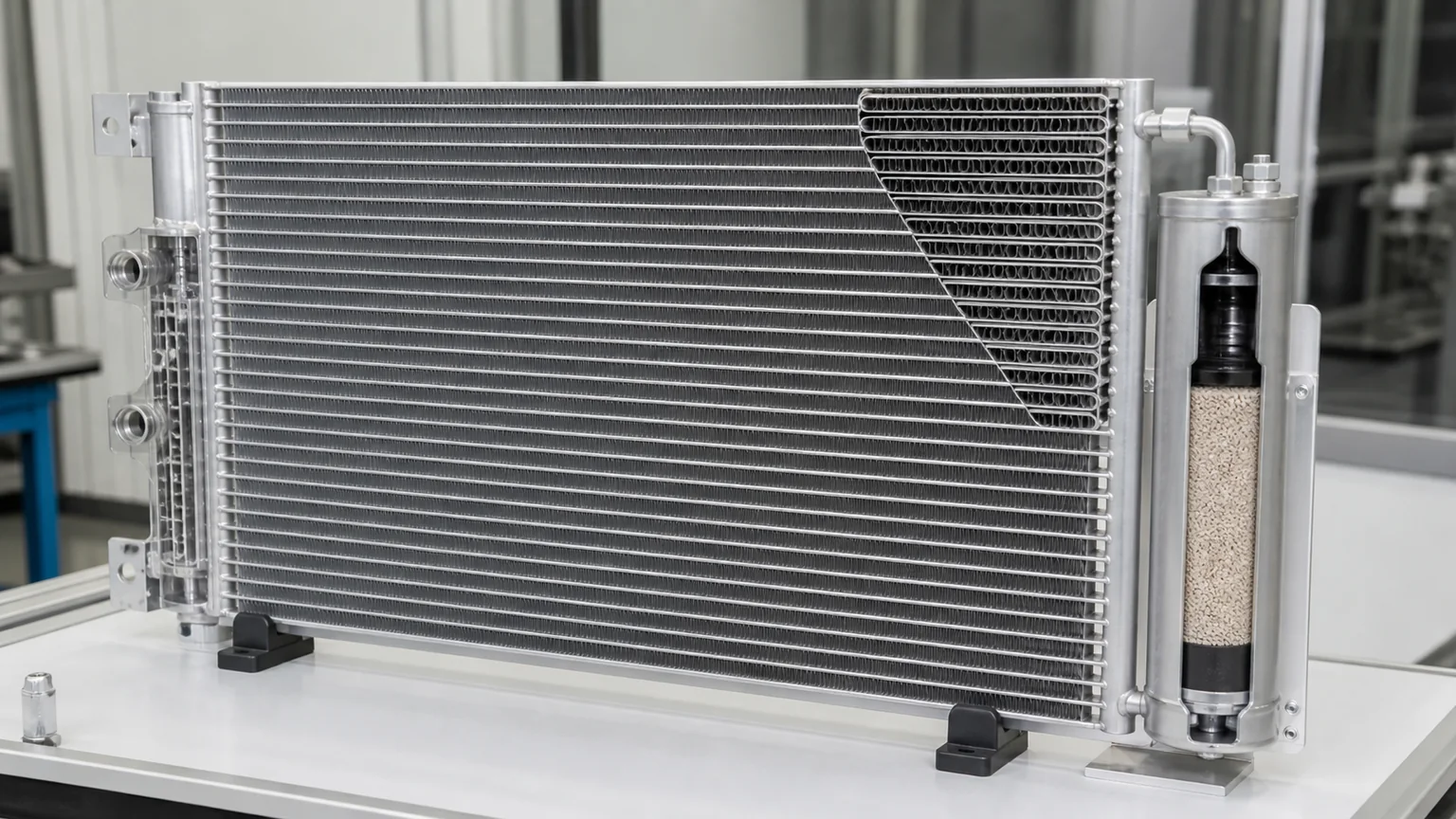
Parallel-flow condenser verification should cover tube and fin geometry, manifold layout, integrated drier, brackets, and ports.
5. Mitsubishi Heavy Industries Thermal Systems
Mitsubishi Heavy Industries Thermal Systems is another Japanese organization with vehicle air-conditioning capability. It belongs on the longlist for buyers evaluating serious system engineering, especially where commercial vehicles, specialist equipment, or platform-level development is involved. Its name signals thermal expertise, but procurement suitability depends on the program.
Do not treat the company as a conventional online replacement-parts wholesaler. Ask whether it supports the particular vehicle segment and whether the enquiry belongs with an OE, service, or industrial team. If a third party offers an MHI-related condenser, require a traceable part number and packaging evidence. A quotation carrying a famous group name without a current catalogue link, invoice chain, or warranty owner is not sufficient purchasing evidence.
6. Sanden
Sanden is strongly associated with automotive air conditioning and has an international aftermarket footprint. Although buyers often know Sanden first for compressors, the company's broader climate-system history makes it relevant when mapping Japan's condenser and HVAC supply base. Sanden can be a useful contact for system compatibility, compressor-condenser relationships, and regional channel guidance.
The buying question is whether the required condenser is actually in the available aftermarket range. Never infer condenser supply from compressor coverage alone. Send a structured request containing vehicle application, refrigerant, original compressor and condenser numbers, left- or right-hand-drive market, and destination. Ask whether the quoted unit is sold by Sanden, distributed for another manufacturer, or referenced only for system information. This distinction affects claims, packaging, and reorder continuity.
7. Marelli
Marelli incorporates the thermal heritage of Calsonic Kansei, a major name in Japanese vehicle climate and cooling systems. It is particularly relevant for buyers studying Nissan and other Asian applications, complete front-end modules, and the integration of condenser, radiator, fan, and airflow management. That system perspective can help explain why two condensers with similar frontal dimensions are not necessarily functionally equivalent.
Commercial access again needs verification. Identify whether the required reference is offered through Marelli Aftermarket, a vehicle-maker service channel, or another approved distributor. Confirm branding and the physical manufacturer shown on the unit and carton. For consolidated orders, ask about carton sizes, pallet pattern, minimum order, and whether mixed references can be supplied from one warehouse.
8. T.RAD
T.RAD is a Japanese heat-exchanger manufacturer serving automotive and industrial applications. Its engineering base makes it relevant for buyers who need more than a catalogue cross-reference, including discussions about aluminium brazing, tube-fin construction, vibration, corrosion, and thermal validation. It may be best suited to program business, OE/OES relationships, or higher-volume development rather than an immediate small mixed order.
Buyers should confirm the exact scope of passenger-vehicle and light-commercial condenser products offered to their market. Send a target list rather than a general request for “all Japanese condensers.” Include OE references, forecast, service environment, salt-corrosion expectations, packaging standard, and required validation. If the opportunity is aftermarket distribution, ask directly whether T.RAD supplies service products under its own brand, through partners, or only under customer programs.
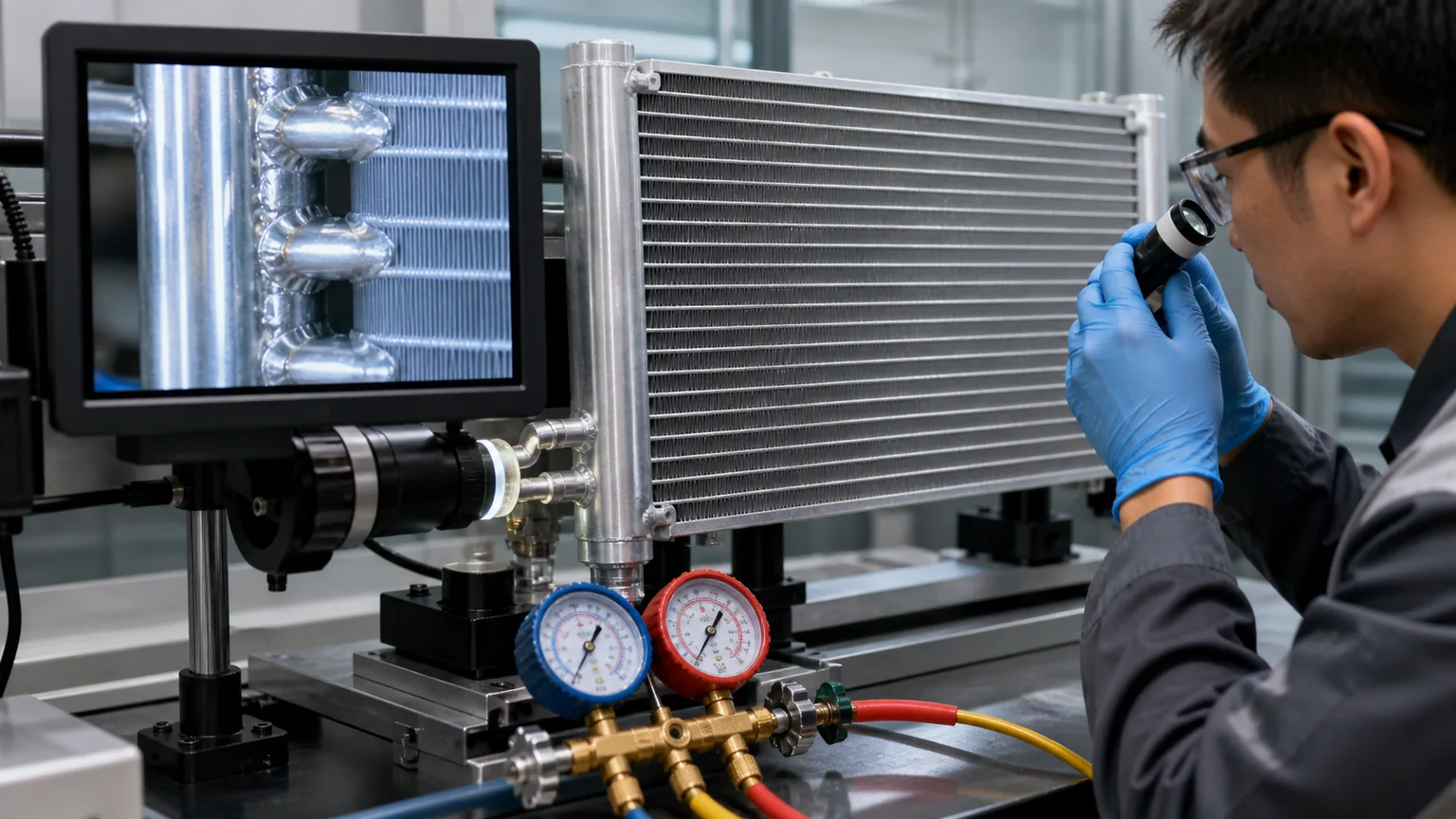
A credible sample review includes brazed joints, manifold-to-tube consistency, pressure decay or helium leak evidence, and cleanliness.
9. Daiwa Radiator
Daiwa Radiator is a useful specialist candidate for aftermarket buyers because it publicly presents automotive condenser products in addition to its radiator activity. Compared with a large OE system group, a focused heat-exchanger supplier may offer a more direct conversation about replacement references, Japanese vehicle coverage, and practical sales requirements. Its position should still be confirmed for each destination and order size.
Ask Daiwa for a current export catalogue or searchable application data, not an old PDF passed between traders. Check whether the list includes OE cross-references, vehicle model and year, transmission, engine, refrigerant, core dimensions, port photographs, and drier information. Determine whether the company manufactures every listed unit, outsources selected lines, or acts as a brand owner for some references. The answer is commercially acceptable when disclosed; the risk comes from assuming one supply model across the entire range.
10. Nikkei Kin ALMO
Nikkei Kin ALMO presents condenser products and aluminium heat-exchanger capability. It is a strong research lead for buyers seeking a Japanese manufacturing conversation, particularly when drawings, material choices, joint quality, or custom requirements matter. It can also help a distributor understand how core architecture and manufacturing controls differ from low-information commodity offers.
Qualification should establish whether the company supports replacement-part exports, custom/OE projects, or both. Provide drawings and annual demand, then request production location, tooling ownership, development lead time, sample cost, test plan, and change-control procedure. A technically capable manufacturer may have a higher project threshold than a replacement-parts distributor, so match the enquiry to realistic volume.
How to match a Japanese condenser correctly
Begin with the OE number, but do not stop there. Japanese vehicle platforms frequently vary by engine, model year, trim, destination, and transmission. A condenser can fit the front panel yet have the wrong refrigerant ports, pipe angle, pressure-sensor provision, drier configuration, or mounting detail. Request an actual-product drawing with core width, core height, thickness, overall dimensions, bracket coordinates, port diameters, port orientation, and drier location. Elecdura's automotive AC condenser range illustrates the kind of application-led product grouping buyers should expect.
Ask for clear photographs of both faces, both end tanks or manifolds, every bracket, inlet and outlet, drier cap, label, and carton. Compare these against an OE sample whenever the application is high risk. A supplier's cross-reference may be correct at family level but miss a mid-year port or bracket change. For uncertain references, approve one physical sample before committing to production packaging.
Confirm construction and heat-transfer design
Most current condensers use aluminium parallel-flow construction, but tube count, microchannel geometry, fin density, manifold design, and internal pass arrangement vary. These details affect pressure drop and heat rejection. A supplier does not need to disclose proprietary design calculations, but it should demonstrate that the proposed replacement is validated for the application rather than copied only from exterior dimensions.
Ask what benchmark was used, how thermal performance was compared, and whether testing was conducted with representative airflow and refrigerant conditions. If the condenser is sold for severe hot-climate use, discuss idle performance and contamination sensitivity. The vehicle's condenser fan and airflow system must also be healthy; a strong core cannot compensate for a weak fan, blocked grille, missing seals, or incorrect shroud.
Verify the receiver-drier and cleanliness controls
An integrated receiver-drier should be identified explicitly in the quotation. Confirm whether the desiccant cartridge is installed, whether it is serviceable, and whether caps prevent moisture entry until installation. Ask for the allowed time between opening the protective seal and evacuating the system. Reject samples with damaged caps, exposed ports, loose debris, excessive brazing residue, or evidence of oil contamination.
Cleanliness is especially important after a compressor failure. Debris trapped in modern microchannel passages may not be removable by routine flushing, making condenser replacement necessary. A buyer assembling a repair package may also need the correct passenger-vehicle AC compressor, expansion device, drier, seals, oil, and flushing instructions. Supplier documentation should keep these application relationships consistent.
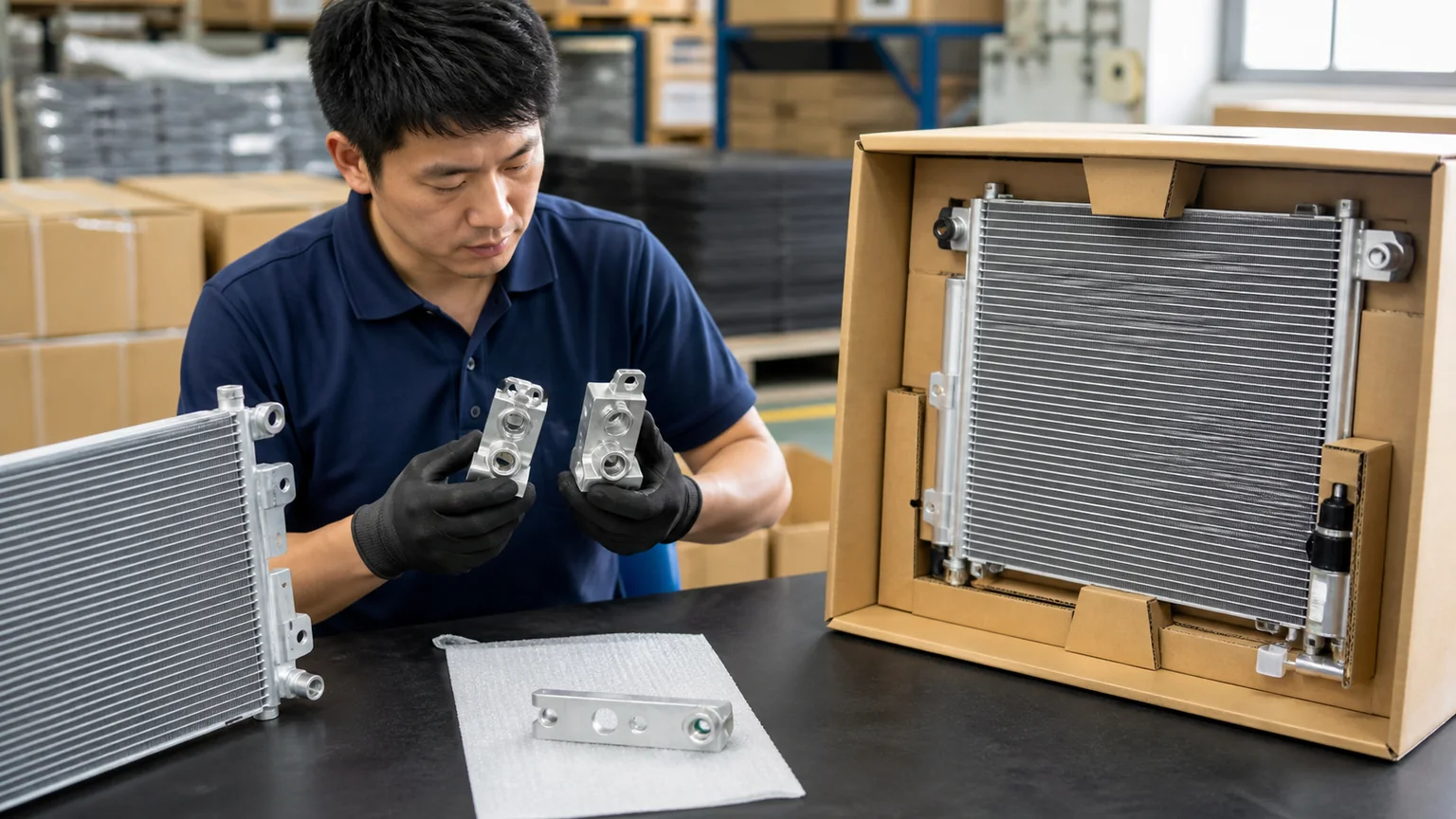
Port direction, sensor provision, drier placement, brackets, caps, and crush-resistant packaging must match the approved sample.
Quality evidence to request before approving a supplier
A factory certificate is a starting point, not proof for a specific condenser. Request the control plan for the quoted product family and sample evidence for brazing, leakage, dimensional accuracy, pressure resistance, vibration, thermal cycling, corrosion, and packaging. Ask which tests are performed on every unit and which are periodic type tests. The method, acceptance limit, equipment identification, and record retention period should be clear.
For leak control, determine whether the supplier uses dry air underwater, pressure decay, helium, or a combination. The test gas, pressure, hold time, and reject threshold matter. For dimensional control, require a marked drawing linked to the sample. For salt exposure, ask for the standard and hours rather than accepting “anti-corrosion tested.” If coating is proposed, verify that it does not block fins or alter heat transfer beyond the approved condition.
Packaging requirements for Asian distribution
Condenser damage often occurs after production. Thin fins, long brackets, manifolds, and ports require support without creating pressure points. Specify port caps, a moisture barrier where needed, corner and bracket protection, a fitted inner tray, strong outer carton, handling symbols, and pallet limits. Test the packed sample through the actual delivery route, including parcel handling if distributors sell individual units online.
Labels should carry the approved brand, part number, batch or trace code, quantity, country of origin, and scannable barcode. If the destination requires local language, recycling marks, or importer information, settle the artwork before mass production. Obtain written approval for any carton-size or label change because warehouse slotting and barcode masters may depend on the original specification.
Commercial questions that reveal the right supply route
Request MOQ per reference, mixed-order MOQ, sample terms, production lead time, available stock, Incoterm, payment terms, warranty period, claim evidence requirements, and compensation method. Ask how long low-volume Japanese references remain active and how supersessions are communicated. A low initial price can be expensive if the supplier frequently changes the core, brackets, or source without notice.
Clarify territory rights and brand use before investing in catalogue work. Buyers planning a private label need artwork responsibility, minimum print quantities, tooling ownership, exclusivity conditions, and rules for using OE numbers. Buyers choosing a recognized brand need documented channel legitimacy and a warranty path acceptable in the destination country.
Recommended RFQ format
Send a spreadsheet containing your item number, OE number, vehicle, engine, model years, transmission, refrigerant, target quantity, annual forecast, destination, desired brand, barcode format, and required delivery date. Attach front and rear sample photographs and dimensioned drawings for sensitive references. Request suppliers to return their own part number, product status, price, MOQ, lead time, net weight, carton dimensions, production site, drier inclusion, test standard, and any mismatch they find.
Shortlist suppliers on confirmed application coverage, sample conformity, test evidence, communication discipline, packaging performance, and total landed cost. Japan's strongest engineering names are valuable, but the best distributor partner is the organization whose commercial route fits the order and whose documentation remains reliable after the first shipment. To request a cross-reference review, send Elecdura the OE list, Japanese application data, port and drier photos, sample quantity, annual forecast, and destination.