You are here:Home » Resources » Blog » Industry Insights » Top 10 Hydraulic Oil Cooler Suppliers in Thailand for Construction Equipment Buyers
Top 10 Hydraulic Oil Cooler Suppliers in Thailand for Construction Equipment Buyers
Views: 0 Author: Elecdura Publish Time: 2026-09-01 Origin: Site
Thailand gives construction-equipment buyers three hydraulic oil-cooler sourcing routes: local heat-exchanger manufacturing, Thai engineering distributors for international cooler brands, and OEM/dealer service channels. A practical shortlist is Chonprasit Group, Siam ASK, Sritong Engineering, B-TAC Industrial Automation, Richpower Equipment, Thai Agency Engineering, Pneumax Thailand's KTR channel, Nandee Inter-Trade's asa channel, Parker Thailand, and HYDAC's Thai channel. Only Chonprasit clearly presents local cooler manufacturing in this group; the others primarily distribute, integrate, or support branded hydraulic products.
Selection must start with machine and circuit data rather than only core dimensions. Send machine model and serial, OE number, fluid, viscosity, working and peak pressure, return flow, heat load, allowable oil temperature, ambient temperature, contamination level, ports, envelope, fan voltage or hydraulic drive, and destination. Elecdura's wholesale hydraulic oil cooler program can support OE cross-reference, drawings, sample approval, and volume supply for common construction-equipment applications.
Thailand hydraulic oil cooler supplier comparison
Supplier
Role
Best fit
Critical check
Chonprasit Group
Thai manufacturer and repair specialist
Local custom, replacement, and mixed-material coolers
Approve design and pressure duty for the actual circuit
Siam ASK
Thai hydraulic distributor and service channel
Kamui coolers and industrial support
Confirm brand model, sizing, and service scope
Sritong Engineering
Thai multi-brand engineering distributor
Air-oil and water-oil selections
Identify the manufacturer behind each quoted series
B-TAC
Thai automation and fluid-power solution provider
Bondioli air coolers and Kompass water-oil units
Match fan drive, flow, pressure, and environment
Richpower Equipment
Thai hydraulic parts distributor
Sesino and Coolbit stocked accessories
Verify current model and technical documentation
Thai Agency Engineering
Thai hydraulic system integrator
Complete machine and power-unit projects
Define responsibility for cooler sizing and controls
Pneumax Thailand / KTR
Local channel for international cooler products
Documented mobile and industrial oil-air series
Check static/dynamic pressure and fan specification
Nandee / asa
Thai channel for specialist cooler manufacturer
Mobile machinery and engineered packages
Confirm local availability and approved model selection
Parker Thailand
Global fluid-power brand and local organization
Integrated hydraulic systems and engineered cooling
Confirm product division and service-parts route
HYDAC Thai channel
Global hydraulic brand supported by local representation
Filters, accumulators, cooling, and condition control
Verify the current authorized Thai contact and cooler scope
1. Chonprasit Group
Chonprasit Group is the clearest Thai manufacturing candidate in the shortlist. The Chonburi-based group presents decades of heat-exchanger experience, manufacturing and repair for radiators, intercoolers, oil coolers, air coolers, and related products. It describes copper-brass and aluminium capabilities and shows hydraulic cooler packages with electric fans for mixing trucks and other systems.
Local fabrication can be valuable for damaged legacy equipment, custom envelopes, short lead times, and applications without an available OE service part. However, a custom build still needs a controlled specification. Ask which group company and facility will make the cooler, the material and construction, design pressure, test pressure, fan duty, motor protection, vibration provisions, drawing revision, and warranty. A successful repair example is not automatically validation for a high-pulsation excavator circuit.
2. Siam ASK
Siam ASK distributes hydraulic and lubrication products in Thailand and lists Kamui oil coolers. It also provides installation and oil-cooler cleaning work, which can help industrial customers diagnose fouling and service needs. The company is best viewed as a local technical and commercial channel rather than the manufacturer of the Kamui cooler.
Send the operating data and ask Siam ASK to return the selected Kamui model, performance point, pressure limit, materials, oil-side pressure drop, fan or water-side requirements, and stock status. If cleaning is proposed instead of replacement, require an inspection for external damage, internal blockage, corrosion, and leakage. Confirm how cleanliness is restored and how the cooler is capped after service.
3. Sritong Engineering
Sritong Engineering is a Thai hydraulic and industrial equipment distributor that lists heat exchangers and oil coolers across air-cooled and water-cooled series. Its product pages identify several brands and constructions, making it useful when a buyer wants to compare oil-air and oil-water approaches through one local organization.
Record the actual brand and series for each quotation. “Sritong oil cooler” does not identify the physical manufacturer or technical limits. Ask for the maker's datasheet, selected model code, correction factors, materials, connections, design pressure, fan electrical data, noise, dimensions, weight, delivery time, and warranty. For a replacement unit, ask whether adapters or mounting changes are needed.
4. B-TAC Industrial Automation
B-TAC operates as a Thai automation and solution provider and lists Bondioli aluminium heat exchangers with hydraulic or electric fan drives plus Kompass water-oil coolers. This range can suit mobile equipment, industrial power packs, or machines where the available drive source determines cooler selection.
Do not choose solely by catalogue flow range. Confirm oil viscosity at operating and cold-start temperatures, heat load, pressure drop, altitude, ambient, dust loading, fan direction, hydraulic-motor supply, electrical voltage, and IP protection. Ask B-TAC whether it will perform and stand behind the sizing or only supply the model requested by the buyer. Put that responsibility in the quotation.
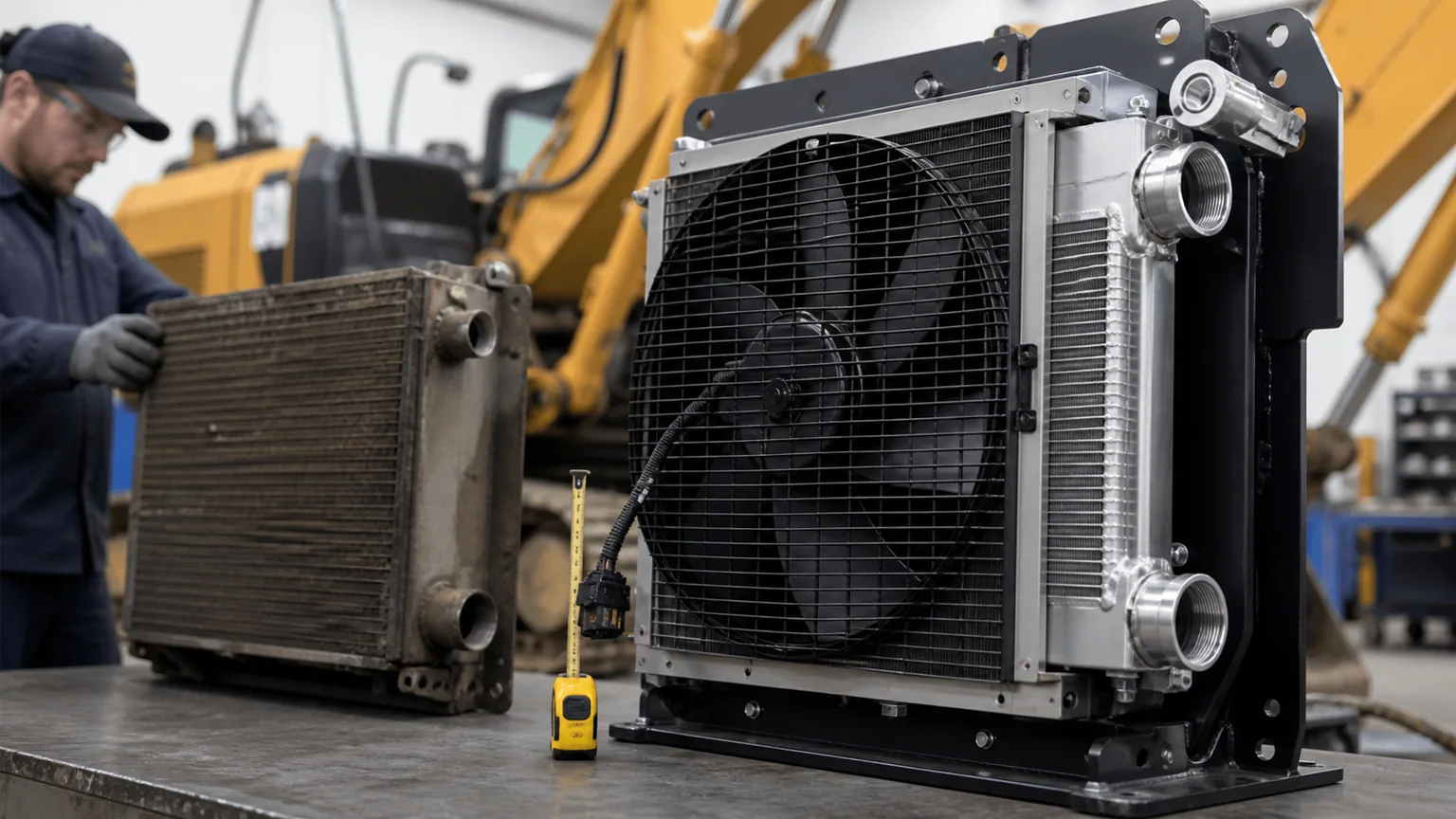
Ports, brackets, core depth, guard, fan, motor or connector, airflow direction, and service clearance define the physical interface.
5. Richpower Equipment
Richpower Equipment supplies hydraulic accessories in Thailand and lists oil and air coolers from brands such as Sesino and Coolbit. Its catalogue shows model-specific examples rather than claiming local manufacture. It can be practical for stocked industrial replacements and for buyers already consolidating pumps, valves, filters, accumulators, hoses, and power-unit parts.
Request the current manufacturer's datasheet because a short ecommerce entry is insufficient for engineering approval. Confirm model suffix, origin, flow rating basis, pressure, ports, fan supply, dimensions, mounting, stock, and replacement status. Determine whether the listed unit is a complete fan cooler or only the heat-exchanger core. If the item has been stored for a long period, inspect caps, corrosion, fins, motor, and wiring before installation.
6. Thai Agency Engineering
Thai Agency Engineering describes long experience in hydraulic, pneumatic, agricultural machinery, consultation, and system manufacturing. It is relevant when the buyer needs a cooler integrated into a hydraulic power unit or a machine modification rather than a simple like-for-like spare. A system integrator can consider reservoir, pump, relief, filtration, controls, and piping together.
Define the engineering boundary. State who calculates heat generation, selects the cooler, designs the bypass, specifies the temperature switch, verifies fan current, and commissions the machine. Request a hydraulic schematic, thermal assumptions, bill of materials, control logic, drawing, test procedure, and service documentation. A complete integration quote should not hide the cooler brand and model.
7. Pneumax Thailand / KTR channel
KTR oil-air cooler catalogues are available through Thai fluid-power channels including Pneumax-related distribution. The documented series cover different electric and hydraulic fan configurations, sizes, flow ranges, protection classes, noise levels, and permissible pressures. This is useful when a construction-equipment buyer needs traceable engineering data.
Verify that the Thai seller is the current source for the selected KTR product and request an official quotation tied to the full model code. Pay attention to static versus dynamic pressure ratings; mobile hydraulic circuits can impose recurring pulses that are more demanding than a steady return pressure. Confirm fan voltage, frequency, speed, protection class, hydraulic motor displacement where used, and expected oil pressure drop.
8. Nandee Inter-Trade / asa channel
asa Hydraulik specializes in oil-air, oil-water, shell-and-tube, plate, conditioning, and customized cooling solutions, including mobile machinery. Thai buyers may access the range through a local industrial distributor such as Nandee Inter-Trade, subject to current channel confirmation. asa is the manufacturer; the Thai company provides local commercial access and possibly application support.
Ask the local channel to identify its authorization status, engineering capability, stock, and warranty route. Request the asa selection output or datasheet for the actual operating point. Mobile packages may include protective housing, fan controls, vibration isolation, connectors, and bypass options. Ensure every included component and its installation responsibility appears on the purchase order.
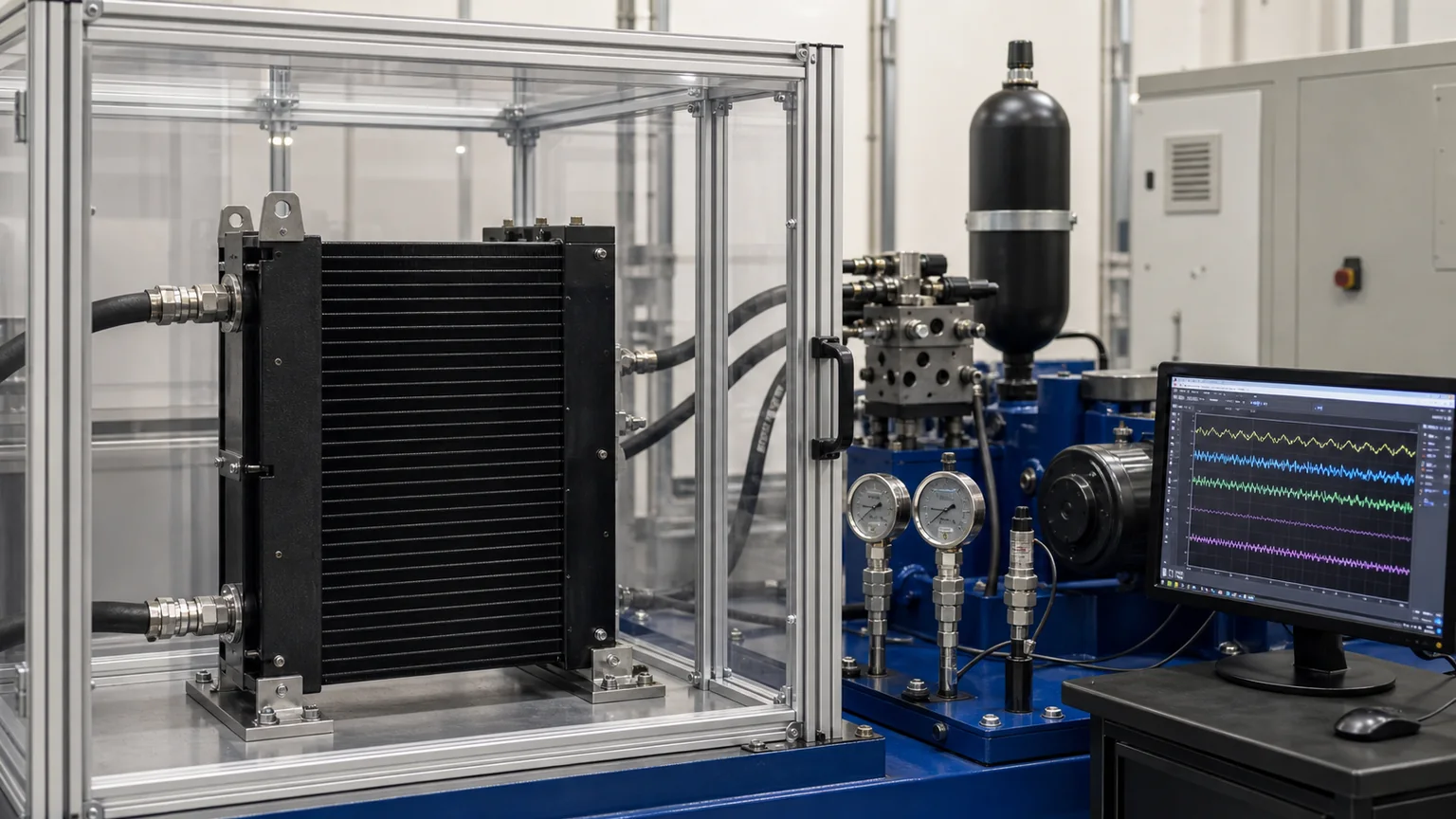
Working, proof, burst, and pulsation conditions are distinct; a regulated test must represent the correct circuit and acceptance criteria.
9. Parker Thailand
Parker has extensive hydraulic, filtration, control, and thermal-management capability and a local presence in Thailand. It can be a strong engineering route when the cooler is part of a wider fluid-power package or when the buyer needs documented global product support. The relevant product and organization must still be confirmed because Parker operates many divisions.
Send a structured request and ask the Thai team to route it to the correct cooling specialist. Confirm whether the solution is a Parker-manufactured cooler, an integrated package, or a partner product. Request the model, sizing basis, pressure limits, materials, fan or water connections, filters or bypass components, delivery location, and service path. Do not infer open aftermarket availability from a global brand's general hydraulic presence.
10. HYDAC's Thai channel
HYDAC supplies hydraulic filters, accumulators, cooling systems, and condition-monitoring products globally. Its documentation identifies representation in Thailand, but buyers should verify the current authorized contact before ordering. The brand can suit demanding construction and industrial systems where cooling interacts with filtration, contamination control, and reservoir design.
Ask the verified Thai representative for a HYDAC selection based on heat load, oil, flow, viscosity, pressure, ambient, and duty. Confirm the cooler model, fan and controls, bypass, clogging margin, materials, protection, noise, and maintenance access. Require traceable brand documentation and establish whether warranty inspection occurs in Thailand or another regional center.
Choose the circuit location before choosing pressure class
A cooler placed in a low-pressure return line sees different conditions from one installed in a hydrostatic charge circuit, case drain, or pressurized loop. The average gauge pressure does not capture cold-start restriction, valve switching, pump ripple, shock, blocked-line events, or elevation head. Obtain the machine schematic and identify normal, transient, and fault pressures at the cooler ports.
Ask for allowable working pressure, proof pressure, burst pressure, and pulsation rating as separate values. Confirm the test fluid, temperature, cycle profile, number of cycles, and acceptance criteria. The broader hydraulic oil cooler range should be filtered by circuit and machine evidence, not treated as a collection of interchangeable cores.
Thermal sizing for Thailand's construction environment
Determine the heat to reject in kilowatts from measured temperatures and flow or from a defensible machine energy balance. Provide oil type, viscosity, desired outlet temperature, maximum tank temperature, minimum and maximum flow, ambient design temperature, altitude, and available airflow. Add margin for fouling, but do not compensate for weak data with an arbitrarily oversized core.
Construction sites expose fins to dust, fibers, mud, seeds, insects, and pressure-washer damage. Fin spacing and guard design must balance heat transfer with cleanability. Consider reversible fans, debris screens, hinged access, or wider fin pitch where the duty requires them. Verify performance at the dirty-core condition expected between maintenance intervals.
Fan package and controls
For 12V or 24V mobile fans, confirm voltage range, starting current, steady current, connector, polarity, speed control, ingress protection, vibration, airflow direction, guard, and temperature-switch logic. For hydraulic motors, specify displacement, supply flow, pressure, drain, rotation, and contamination class. For AC industrial motors, confirm voltage, phase, frequency, power, IP class, and local electrical standard.
A cooler may be thermally adequate but fail because the fan draws more current than the harness can support or rotates in the wrong direction. Test the complete assembly in the intended installation. Record the fan, motor, sensor, relay or controller, harness, and software setting as controlled parts of the cooler specification.
Ports, mounting, and machine fitment
Record port standard, thread, size, sealing method, orientation, and allowable fitting torque. BSPP, NPT, metric, SAE O-ring, and flange connections are not interchangeable. Adapters can add pressure drop, leak points, and unsupported weight. Long fittings or hoses should not load the cooler manifold under machine vibration.
Use machine model, serial range, OE number, and photographs for direct replacements. For Komatsu demand, start with a controlled Komatsu hydraulic oil cooler cross-reference; for Caterpillar equipment, use the corresponding Caterpillar hydraulic oil cooler range. Final approval still requires ports, brackets, core, guard, and fan evidence because serial breaks and regional packages can differ.
Internal cleanliness and port protection
A new cooler can damage pumps and valves if it contains chips, brazing residue, dust, water, or fibers. Specify a cleanliness limit or an agreed extraction-and-analysis method, then require clean, sealed ports immediately after testing. Caps should resist transport vibration and prevent moisture entry without shedding plastic into the circuit.
Ask how the factory cleans, dries, samples, and records the cooler. For a repaired unit, define flushing, contamination verification, corrosion inspection, and capping. A pressure test proves containment but does not prove internal cleanliness. Store units indoors with caps installed and use first-in, first-out controls for motors, seals, and coatings.
Cold-start bypass and pressure-drop control
Hydraulic oil can be much more viscous at morning start than at normal working temperature. A cooler sized only at hot viscosity may create excessive restriction when the machine starts, especially if dust already blocks part of the air side. The result can be opened relief valves, damaged seals, collapsed passages, slow functions, or oil bypassing the intended filtration path.
Ask the system designer whether an internal or external thermal bypass is required and what cracking pressure and flow capacity it needs. Confirm whether the cooler's quoted pressure drop uses the same oil grade, temperature, and flow as the machine. The bypass should not remain open after warm-up or allow uncontrolled pressure spikes at the cooler inlet. For variable-flow equipment, evaluate idle, travel, simultaneous function, and relief conditions rather than one nominal operating point.
Instrument the first installation with temperatures and pressures on both sides of the cooler. A rising differential pressure can indicate cold viscosity, internal blockage, undersized ports, or contamination. Document the acceptable range so service technicians can distinguish a cooling problem from a hydraulic restriction.
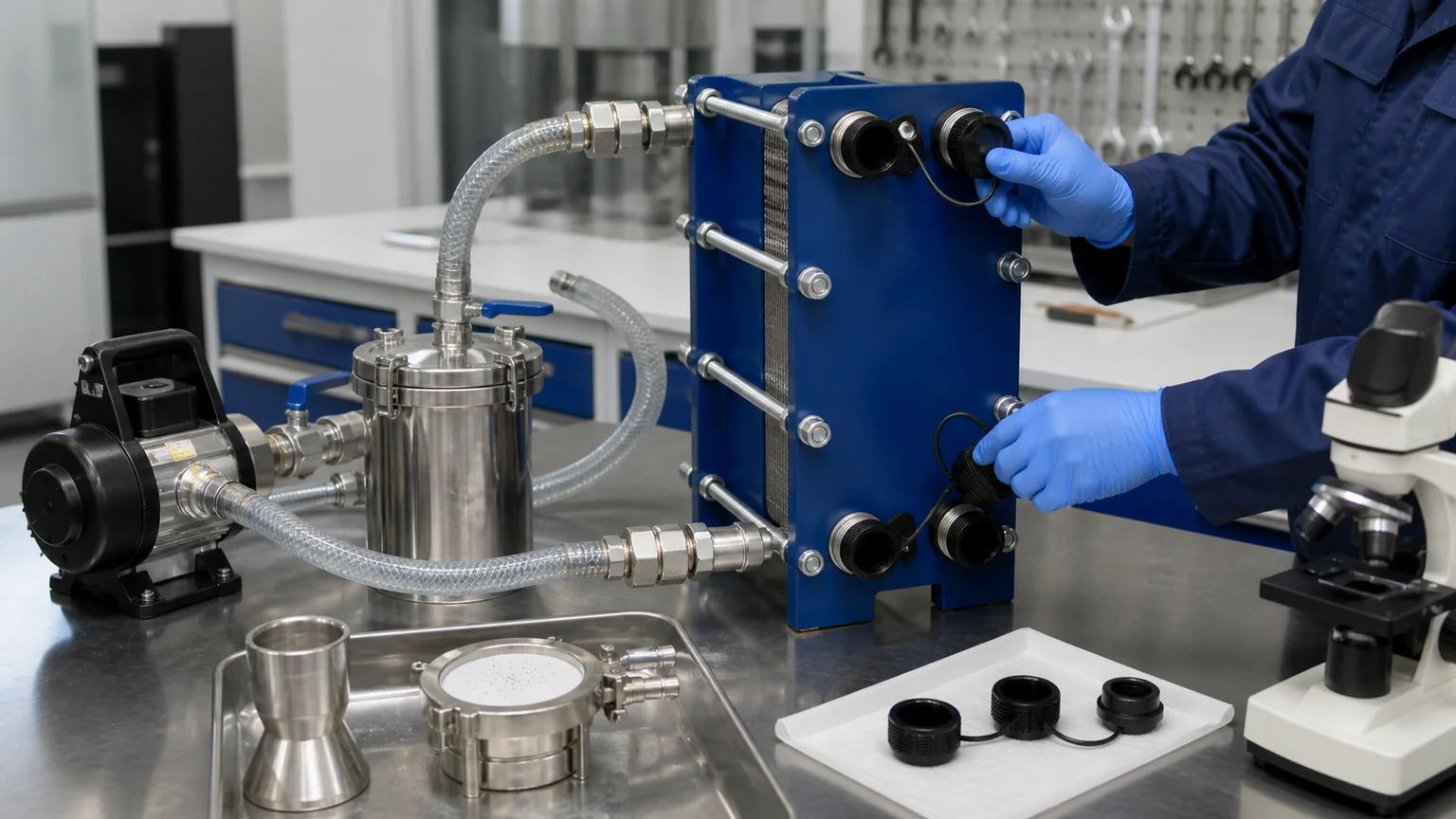
Controlled fluid extraction, particle assessment, drying, and secure caps protect pumps, valves, and bearings after installation.
Quality evidence and sample approval
Request a marked drawing, material specification, brazing or welding controls, dimensional report, production leak-test method, proof and burst evidence, pulsation test, vibration, thermal cycling, corrosion, fan endurance, motor protection, and cleanliness records. Identify which tests apply to every unit and which are type or audit tests.
Install a representative sample on the machine or a controlled rig. Monitor inlet and outlet oil temperature, ambient, flow, pressure drop, fan speed, current or hydraulic consumption, leakage, noise, vibration, and control behavior across warm-up and peak duty. Retain the approved unit and data under a revision-controlled specification.
Commercial and service evaluation
Compare engineering responsibility, MOQ, custom tooling, sample time, Thai stock, imported lead time, Incoterm, payment, warranty, field service, spare fans and motors, cleaning or repair support, and export documentation. Local technical response can justify a higher price when equipment downtime is expensive.
Send the same RFQ to all candidates: machine model and serial, OE number, drawing and photographs, fluid, flow, working and transient pressure, heat load, ports, fan voltage or drive, ambient and contamination duty, volume, and destination. Require supplier role, manufacturer, model, production location, sizing result, deviations, test evidence, price, lead time, and warranty in return. This creates a fair comparison between Thai manufacture, local engineering channels, and international brands.