Top 10 Radiator Fan Suppliers in South Korea for Global Distributors
Views: 0 Author: Elecdura Publish Time: 2026-09-01 Origin: Site
South Korean radiator-fan sourcing includes genuine service-parts channels, OE thermal-system manufacturers, specialist motor/module companies and independent exporters. Buyers must first define whether the requirement is a complete shroud assembly, fan motor, blade, controller/resistor or full cooling module. These pieces can share one catalog description but have different validation, warranty and packaging needs.
Elecdura supports global distributors with wholesale condenser and cooling fan sourcing based on OE number, voltage, connector, control and dimensions. The ten Korean channels below are grouped by role and application value rather than treated as a universal quality ranking. Current product availability, authorization, origin and export terms require direct confirmation.
Heat-exchanger, BLDC motor and module manufacturer
Cooling modules and electrified-vehicle fan technology
6
DY Auto
Korean automotive DC motor manufacturer
Motor-level sourcing and engineering RFQs
7
Modine Onegene
Legacy/current thermal manufacturing channel to verify
Existing cross-references and program continuity checks
8
Hanna Corporation
Korean aftermarket/export parts distributor
Multi-brand Korean application consolidation
9
GMP Korea
Independent Hyundai/Kia parts exporter
OE-number export orders and mixed references
10
HNS Korea
Independent Korean vehicle-parts exporter
Multi-marque Korean parts consolidation
Supplier-role accuracy protects the purchase. Hyundai Mobis supplies service parts but does not necessarily manufacture the fan. DY Auto manufactures automotive motors but must confirm whether it offers the complete shroud assembly. Exporters can source genuine or branded components but need to identify the actual brand, part number and chain of custody.
1. Hyundai Mobis
Hyundai Mobis manages service-parts supply for Hyundai, Kia and Genesis vehicles through a large global logistics network. Its parts-search channels make it a primary reference for OE radiator-fan assembly numbers, supersessions and genuine service packaging.
Use the VIN or chassis number, market, engine, production date and OE fan number. Korean domestic and export-market vehicles can use different cooling modules. Confirm whether the service unit includes motor, blade, shroud, controller/resistor, wiring and seals, because service boundaries vary.
Mobis is a service-parts source rather than proof of component manufacturing location. For wholesale export, verify authorized seller, genuine-part documentation, MOQ, lead time, territorial rules and warranty. Reject cartons with inconsistent labels or broken traceability.
2. Hanon Systems
Hanon Systems is a Korean-headquartered thermal-management manufacturer serving global vehicle programs. Its history includes high-voltage cooling-fan-module technology and broad HVAC/thermal-system engineering. This makes it relevant to integrated cooling modules, electrified-vehicle systems and OE-oriented development.
Aftermarket access may be program-specific. Ask whether the requested fan is available as a service assembly, supplied through a vehicle-maker channel, or integrated into a radiator/condenser module. Request the exact hardware and software revision for brushless or network-controlled fans.
For engineering RFQs, provide airflow/system resistance, voltage range, current/power, acoustic target, environment, shroud space claim, connector/control protocol and duty cycle. Do not request “a Hyundai fan” without the vehicle and thermal-system data.
3. Doowon Corporation
Doowon’s official product information explicitly lists cooling modules composed of radiator, condenser and fan motor, along with separate radiator, condenser, fan/motor and resistor products. This clear product scope makes Doowon a strong Korean manufacturing candidate for complete module or fan-level inquiries.
Clarify the supply boundary. A cooling module can include several heat exchangers and fan hardware, while a fan/motor offer can omit shroud, controller or wiring. Request a bill of material, drawing and photographs of the exact sale unit.
For aftermarket export, confirm active references, minimum order, labeling and whether supply is OE service, Doowon-branded aftermarket or program-direct. Ask for motor endurance, blade balance, airflow/current and environmental test conditions.
4. Doowon Electronics
Doowon Electronics manufactures automotive cooling and heating system components in Korea and operates automotive quality and R&D systems. It is a credible company for motor/control-adjacent thermal projects, but its exact radiator-fan assembly range must be confirmed before inclusion in a product program.
Send the OE number and ask whether the company manufactures the fan motor, controller, complete assembly or another HVAC component. Do not convert corporate capability into an unsupported product claim. If the quotation is through an affiliate or trading company, record that entity separately.
This channel is better suited to direct technical or program inquiries than to an assumed open-stock catalog. Require IATF/quality scope, part drawing, validation, MOQ, production location and service strategy.
5. ONEGENE Group
ONEGENE Group presents cooling modules, heat exchangers, BLDC motors and modules. Its electronics division describes battery-cooling fan motors and 48 V integrated-energy-pack blower assemblies, while group information covers radiator and module activities. This makes ONEGENE relevant to both traditional cooling and electrified-vehicle air-moving systems.
Do not confuse a battery cooling blower with a front radiator fan. Ask for installation location, airflow direction, static pressure, voltage, IP/environmental rating, acoustic limits and controller. A rear-console blower or battery fan has different blade, shroud and duty requirements.
For radiator-fan sourcing, require exact fan/motor or cooling-module part numbers, vehicle programs, control type and connector data. Confirm whether Modine Onegene legacy references remain supported under the current group structure.
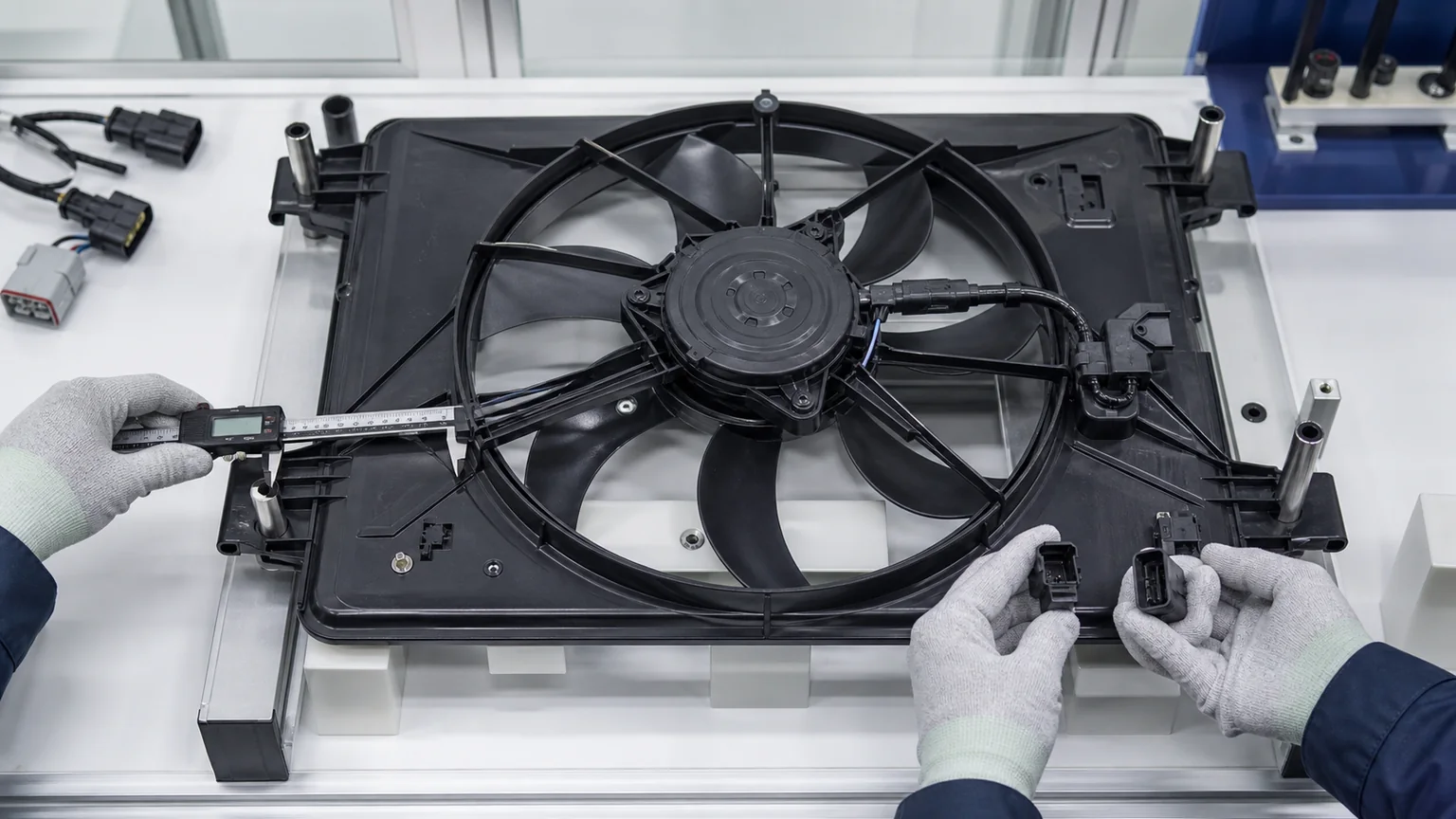
Complete assembly matching covers shroud envelope, mounts, blade diameter/depth, motor position, connector, controller and clearance to radiator hoses.
6. DY Auto
DY Auto operates Korean production for automotive DC motors. Its motor-manufacturing role can support component-level inquiries, but buyers should not assume that every motor is a radiator-fan motor or that a complete shroud assembly is available.
A motor RFQ needs rated voltage, continuous and peak current, torque/speed curve, rotation, shaft and hub, bearing load, connector, thermal protection, brush or brushless design, duty cycle and environment. The fan blade and shroud determine the actual aerodynamic load.
If DY offers a complete fan for the target program, request airflow/current/noise maps and balance evidence for that assembly. If only the motor is supplied, validate it with the production blade, shroud and controller before purchase.
7. Modine Onegene
Modine Onegene appears in Korean thermal-supplier directories and legacy program references. Because ownership, naming and product responsibilities can change, it should be treated as a continuity and cross-reference channel rather than assumed to be separate from current ONEGENE operations.
Ask which legal entity will quote and manufacture the part, whether the reference is active, and whether the drawing, tooling or service supply moved to another company. Require written supersession evidence for any brand or entity change.
This route is most relevant when a distributor already has a Modine Onegene label or OE reference. Send clear label photographs, production date and vehicle program. Do not order against a company name alone.
8. Hanna Corporation
Hanna Corporation operates as a Korean automotive-parts exporter/distributor with coverage across Korean vehicle brands and multiple component brands. Its catalog indicates relationships with several Korean and international parts names. It can help consolidate mixed aftermarket orders.
For each fan, require the delivered brand, manufacturer number, OE cross-reference and exact included components. “For Hyundai/Kia” is not sufficient. Ask whether the product is genuine service, Korean aftermarket, remanufactured or another origin.
Evaluate export carton, pallet, country-of-origin documents, warranty, sample availability and change control. Independent consolidation can reduce shipment complexity, but technical traceability must stay at part level.
9. GMP Korea
GMP Korea publishes Hyundai/Kia/Mobis parts lists that include radiator cooling fan motors, fan blades and condenser-fan assemblies across Korean applications. Its role is independent export and parts consolidation, not fan manufacturing.
The detailed OE-number catalog is useful for locating service references, but availability and supersession need current confirmation. Provide VIN and OE number, then request a label photo of the actual stock before payment when brand identity matters.
Confirm genuine-part evidence, source, packing condition, minimum order, mixed-carton policy, export documents and warranty. Fan assemblies are bulky; verify volumetric freight and pallet stacking before comparing landed cost.
10. HNS Korea
HNS Korea presents itself as an exporter of Hyundai, Kia, Genesis, KGM, Renault Korea and GM Korea parts to global distributors and workshops. This broader marque scope can suit buyers consolidating Korean-vehicle fan references under one export order.
Request exact OE numbers and state whether genuine, OE-supplier or aftermarket alternatives are acceptable. The quotation must identify the brand and unit boundary. A motor-only offer should not be substituted for a complete assembly without approval.
Check warehouse photographs, labels, export packaging, lead time and claims procedure. For high-value brushless modules, require sealed connector protection and electrostatic/moisture handling appropriate to the electronics.
Define the unit before comparing price
Unit
Included hardware
Key matching fields
Blade only
Molded impeller/fan
Diameter, depth, blade count/pitch, hub, rotation and balance
Motor only
Brushed or BLDC motor
Voltage, current, torque/speed, shaft/hub, connector and control
Motor + blade
Rotating assembly
All motor/blade fields plus runout, retention and airflow load
Complete fan assembly
Shroud, motor, blade, wiring and possibly controller
OE, envelope, mounts, connector, airflow, current and clearance
Cooling module
Radiator/condenser/intercooler plus fans
Complete thermal stack, ports, software and vehicle integration
A current radiator cooling fan assembly should be ordered under a definition that matches the invoice and inspection. Distributors lose time when a supplier quotes a “fan” and the buyer expects shroud, resistor and harness.
Electrical and control matching
Traditional brushed motors can use relays and series resistors for one or more speeds. Modern brushless assemblies can integrate a controller and receive PWM, LIN or another command. Match nominal and allowed voltage, power/ground terminal size, signal pinout, frequency or protocol, feedback and fail-safe behavior.
Connector shape and pin count are not a pinout. Two similar connectors can reverse power and signal assignments. Do not bench-apply voltage to unknown pins. Request a circuit drawing or use the vehicle service procedure.
For a separate radiator fan motor, measure motor current with the intended blade and shroud. Free-running current does not represent installed load. Capture cold start, stabilized high speed and commanded low-speed operation.
Airflow direction, blade and shroud
Most front cooling modules pull air from grille to engine side, but pusher arrangements and multi-fan stacks exist. State the viewing direction when recording clockwise/counterclockwise rotation. A reversed motor or blade can move little air despite spinning rapidly.
Blade geometry is paired with shroud inlet, tip clearance and motor speed. A near-fit blade can cause recirculation, noise or motor overload. Compare diameter, axial depth, hub offset, blade count and pitch direction. Inspect for cracks, molding voids and missing balance corrections.
Shroud sealing directs air through the heat exchangers rather than around them. Match every mount, flap, air guide and hose clearance. A warped shroud can contact the blade during engine movement or heat soak.
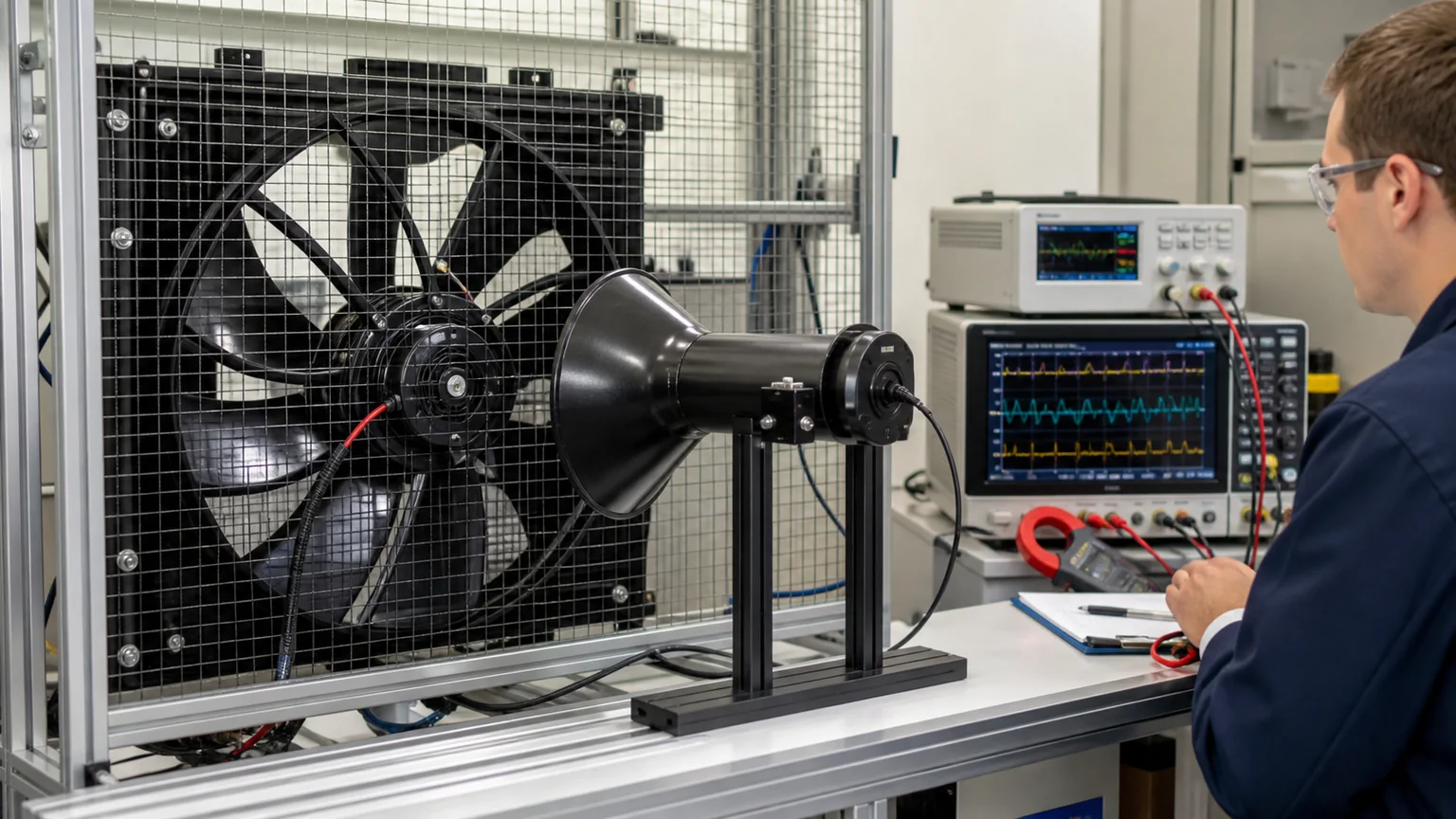
A controlled fixture records supply voltage, current, PWM or network command, motor speed and airflow direction with the production blade and shroud.
Test evidence for wholesale approval
Electrical performance
Request current, speed and airflow at defined voltage and system resistance. Record ambient and motor temperature. Test low/high commands and controller feedback where applicable. Maximum current alone does not describe performance.
Motor endurance
Endurance should represent heat, vibration, dust, water, salt and start/stop cycling for the installation. Ask about brush life for brushed motors and electronics/thermal cycling for BLDC units. Define failure and derating criteria.
Balance and vibration
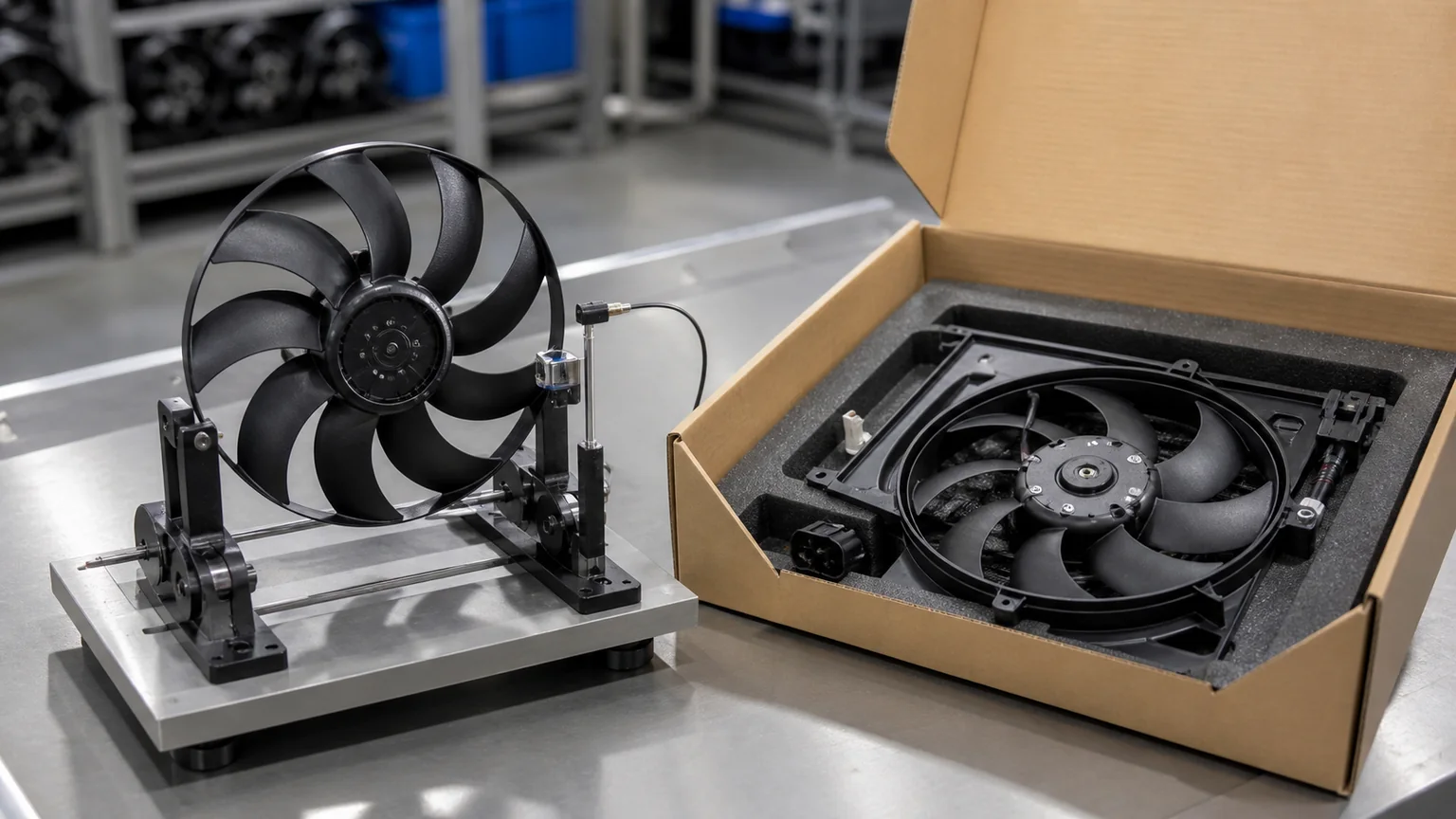
Specify blade or assembly balance method, runout and vibration limits. A fan can pass airflow while transmitting damaging vibration to a radiator or condenser. Check after environmental conditioning and transport simulation when required.
Connector and environmental sealing
Request water/dust ingress, terminal retention, temperature rise and corrosion evidence. Validate drain and vent paths. A generic IP statement needs the exact test configuration and connector mate.
Sample and vehicle validation
Freeze OE number, vehicle, engine, market and production date.
Define blade, motor, assembly or complete module supply boundary.
Approve drawing, connector/pinout, voltage/control and packaging.
Inspect label, dimensions, mounts, blade, shroud and wiring.
Run current/speed/control and airflow-direction checks safely.
Install without drilling, bending brackets or stretching wiring.
Confirm shroud seal, blade clearance and hose/heat-exchanger spacing.
Command all fan speeds while monitoring current and faults.
Validate A/C high-side and coolant temperatures under controlled load.
Freeze the golden sample and change-notification fields.
Receiving control checks blade cracks/runout, shroud distortion, connector protection, motor support, labels and carton spacing that prevents transport load.
Packaging and landed cost
Complete fan assemblies occupy large volume and can be distorted by stacking. Packaging should support the shroud at strong points, keep the motor from loading the blade, protect the connector and prevent another carton from pressing the fan face.
Compare volumetric freight, pallet quantity, mixed-reference policy, duties, damage allowance and warranty freight. A low ex-works price can become expensive when shrouds arrive warped or blades are cracked.
Receiving inspection should photograph pallet condition, compare label and order, manually check safe blade clearance with power disconnected and inspect mounting tabs. Do not energize unknown wiring. Quarantine impact or moisture damage.
Cross-reference and supersession traps
Korean OE fan numbers can be superseded when a blade, motor, shroud, resistor or controller changes. A catalog may connect the old and new numbers because the later complete assembly services the vehicle, while the individual motor or connector is not interchangeable. Request the supersession scope and compare the complete bill of material.
Hyundai, Kia and Genesis models sharing an engine do not automatically share the cooling package. Grille area, radiator stack, air conditioning, towing option, hybrid battery circuit and market calibration affect airflow and control. Record the VIN and export market for every sample approval.
Aftermarket catalogs sometimes reuse a photograph across several references. Treat the image as illustrative until a drawing or actual-stock photograph confirms the connector, mounts and controller. Ask the exporter to photograph the label and connector face next to the carton number before dispatch for high-risk references.
If a new number replaces an older brushed two-speed assembly with a brushless controlled design, verify whether the vehicle needs a harness, controller or software update. Physical mounting agreement cannot authorize an electrical architecture change.
Maintain an approved-cross-reference record containing old number, replacement number, date, source, differences, required accessories and sample result. This prevents an ERP substitution from silently changing the delivered unit after the first successful order.
RFQ checklist
For dual-fan modules, record each motor and blade separately. The left and right positions may use different diameters, rotation, control channels or connector lengths. A supplier that tests only one motor does not prove complete-module current, airflow or noise. Validate simultaneous startup, staged commands and any fan-to-fan aerodynamic interaction with the production shroud.
For electric and hybrid vehicles, also state whether the fan cools a front heat-exchanger stack, battery compartment, inverter or charger. These locations demand different airflow and environmental protection, even when both are called cooling fans.
VIN/chassis, Korean or export market, model, engine and production date.
OE fan, motor, controller and cooling-module numbers.
Exact unit boundary and photographs of all included components.
Voltage, brushed/BLDC type, current/power and command protocol.
Connector face, pinout, harness and controller/resistor details.
Blade diameter/depth, rotation with viewpoint and airflow direction.
Shroud envelope, mounting points and radiator/hose clearance.
Airflow/current, endurance, balance, vibration and ingress evidence.
Annual quantity, opening order, destination and delivery target.
Brand, origin, label, packaging, warranty and change notification.
Application collections such as Hyundai radiator fan assemblies narrow the search but do not replace VIN, OE and electrical confirmation.
Key conclusion: South Korea offers strong radiator-fan sourcing through genuine service parts, OE thermal manufacturers, motor/module specialists and exporters. The safest shortlist starts by defining the supplied unit, then verifies voltage/control, blade/shroud geometry, airflow/current evidence and traceability. Company name or connector appearance alone cannot approve the assembly.