You are here:Home » Resources » Blog » Industry Insights » Types of Automotive Thermostats in the U.S.: Wax, Map-Controlled, and Housing Assemblies
Types of Automotive Thermostats in the U.S.: Wax, Map-Controlled, and Housing Assemblies
Views: 0 Author: Site Editor Publish Time: 2026-09-23 Origin: Site
An automotive thermostat is not interchangeable simply because it fits inside the same hose opening. The replacement must match the cooling-system architecture, opening behavior, housing geometry, sealing interface, bypass arrangement, sensors or heater circuit, and the exact engine application. For U.S. distributors, repair networks, and parts buyers, recognizing the thermostat type is therefore the first step—not the final proof of fitment.
This guide separates the major thermostat designs used in passenger cars and light trucks, explains what each design controls, and shows which evidence should be collected before a replacement is ordered. It is a component-identification and sourcing guide, not a substitute for the vehicle manufacturer's service procedure.
What Every Automotive Thermostat Actually Controls
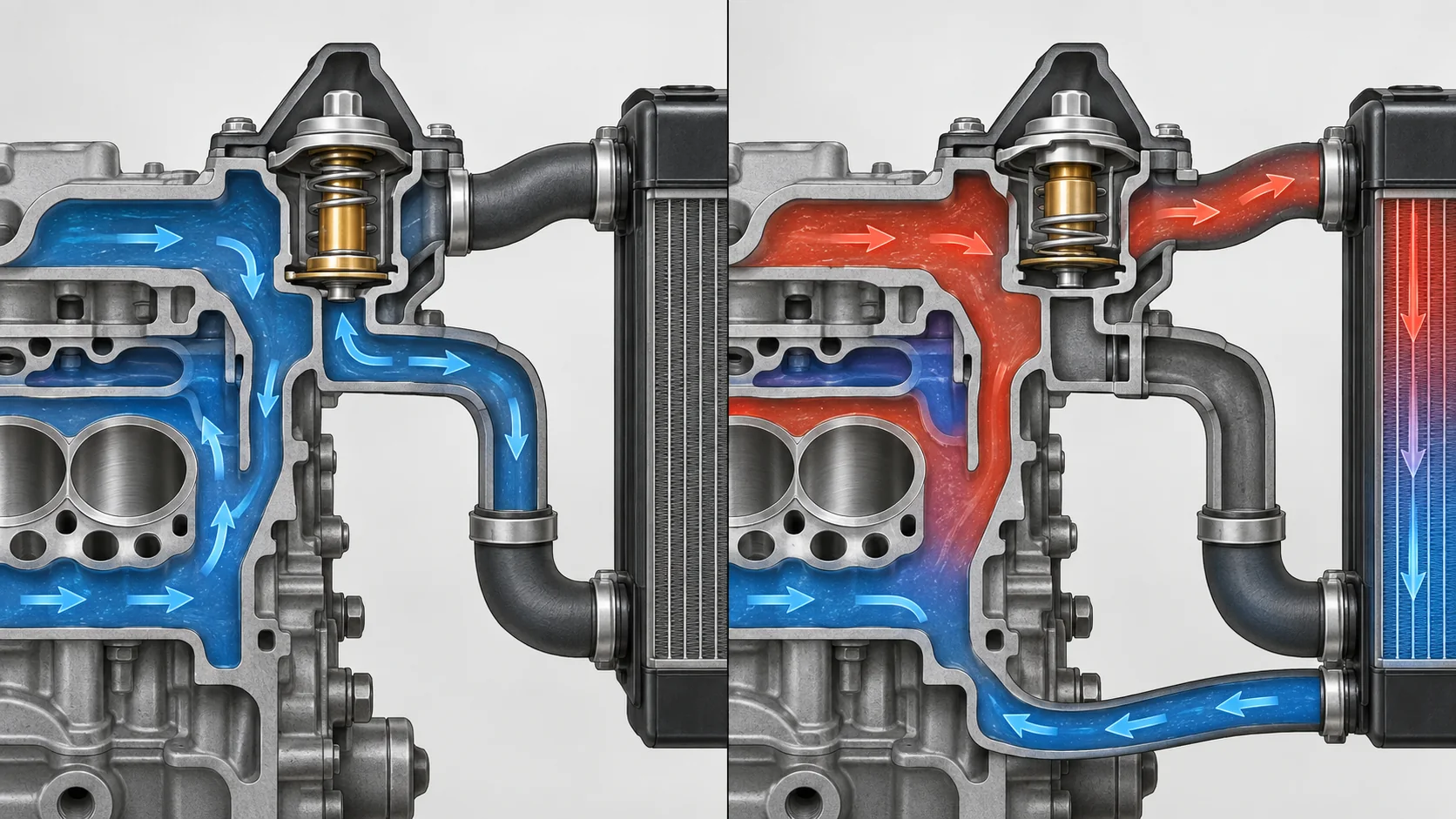
The thermostat regulates coolant routing according to temperature. During warm-up, it restricts the route to the radiator so the engine reaches its intended operating range efficiently. As temperature rises, the valve progressively opens the radiator circuit. Many systems also coordinate a bypass passage, cabin-heater flow, or electronically commanded heating element.
A thermostat should not be treated as a simple on/off plug. Valve lift, response rate, bypass geometry, pressure balance, and the surrounding housing all influence coolant distribution. A replacement that opens at a plausible temperature can still be wrong if it blocks the wrong passage or places the main valve at the wrong depth.
A thermostat changes coolant routing as it moves from warm-up bypass operation toward radiator flow.
Conventional Wax-Pellet Thermostat Inserts
The familiar thermostat insert uses a temperature-sensitive wax element to move a piston and valve. It may be supplied as a separate metal unit installed in an engine outlet or removable housing. This architecture remains common because it is compact, passive, and well understood.
What must match
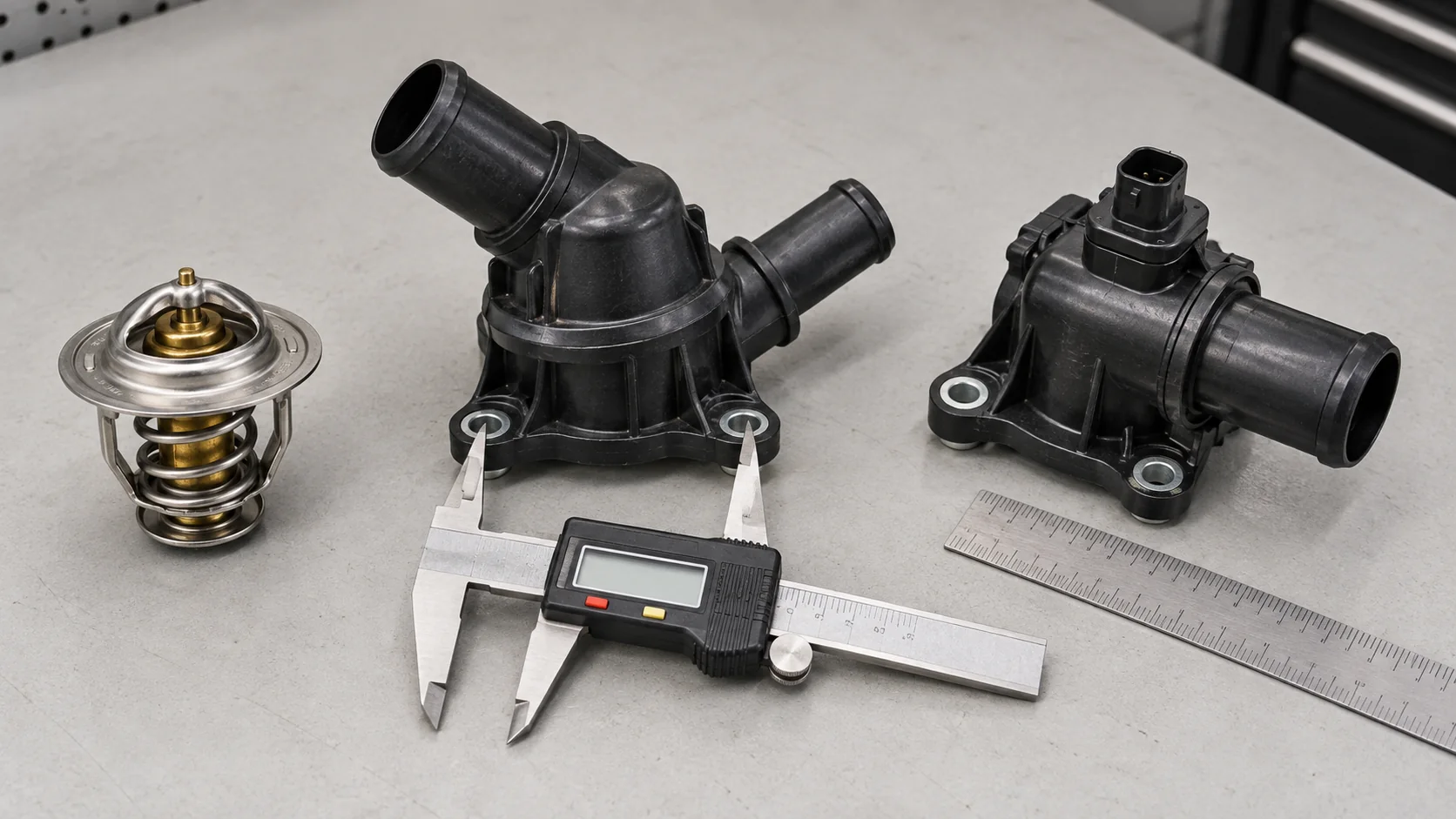
Outer diameter alone is insufficient. Buyers should compare the valve-seat diameter, installed height, flange shape, spring side, jiggle valve or bleed feature, opening-temperature specification, and whether a secondary bypass disc is present. The gasket may be an O-ring around the flange, a molded seal, or a separate housing gasket.
The thermostat's orientation also matters. A bleed valve may need to face a specified direction, and the sensing element normally must be exposed to the intended hot-coolant stream. Installation should follow verified service information for the exact engine.
Where matching commonly fails
A visually similar insert has a different flange diameter or installed height.
The replacement lacks the bypass disc required by the engine.
The opening-temperature rating is assumed from appearance.
An old seal is reused or the new seal is placed in the wrong groove.
The thermostat is installed backward or the bleed feature is misoriented.
If the failure question is whether the valve is mechanically stuck, use a dedicated stuck-open versus stuck-closed diagnosis. The matching decision still requires application evidence after the failed condition is confirmed.
Thermostats with a Bypass Valve or Secondary Disc
Some engines use a thermostat that operates two flow paths. As the main radiator valve opens, a secondary plate or sleeve closes an internal bypass. The dimensions and travel of that secondary element are part of the calibrated cooling circuit.
Replacing this design with a basic single-valve insert can leave the bypass open when the engine is hot. Coolant may circulate through the easier internal route instead of being directed effectively through the radiator. Conversely, an incorrectly sized secondary disc can obstruct flow or contact the housing.
Record the secondary-valve diameter, distance from the main flange, and overall installed depth. Do not bend or modify a bypass plate to make it fit. The separate guide to thermostat bypass-valve symptoms and coolant flow provides diagnostic context.
Integrated Thermostat Housing Assemblies
Many modern vehicles package the thermostat inside a plastic or aluminum housing with hose necks, mounting points, seals, sensors, or electrical connections. The assembly may simplify vehicle production, but it increases the number of interfaces that must match.
Housing geometry is functional
Compare every hose outlet by outside diameter, bead shape, direction, and clock position. Record the number and spacing of mounting holes, locating dowels, gasket profile, mating-surface shape, and clearance around nearby components. A housing that appears correct from the front may point a branch hose into a bracket or place the connector against the intake system.
Plastic housings also deserve a careful inspection for seam quality, flatness at the mounting face, molded port condition, and damage around threaded inserts. A new thermostat cannot compensate for a warped or cracked housing.
Sensors and connectors are not decoration
An integrated coolant-temperature sensor must match connector keying, pin count, retention style, sealing method, and the vehicle's expected electrical characteristic. Appearance does not prove signal compatibility. If the sensor is supplied separately, confirm whether it is included in the quotation and whether its seal is included.
Housing outlets, connector keying, gasket grooves, and bolt patterns should be documented before interchange is approved.
Map-Controlled and Electrically Heated Thermostats
A map-controlled thermostat retains a thermal element but adds an electrical heater. The engine control system can energize that heater under selected operating conditions, changing the thermostat's response relative to its passive behavior. The connector is therefore part of the control strategy, not merely an accessory.
Never infer pin function from pin count or wire color alone. The replacement must be cataloged for the engine and control system. Verify the OE reference, connector housing and key, number of terminals, physical orientation, heater specification when reliable documentation is available, and any diagnostic requirements in the service information.
An open heater circuit does not automatically prove that the wax element is stuck, and a mechanically functioning valve does not prove that the heater circuit is correct. The map-controlled thermostat diagnosis separates electrical and coolant checks.
Electronically Actuated Coolant Valves Are a Separate Category
Some current thermal-management systems use motorized rotary or linear coolant valves with several ports. These devices may distribute flow among the engine, radiator, heater, battery, charge-air circuit, or other heat exchangers. Although they may be described informally as electronic thermostats, their architecture and control logic differ from a wax thermostat with a heater.
Do not combine the two categories in a parts catalog unless the vehicle manufacturer does so. A motorized coolant valve requires exact port mapping, actuator and connector identification, software/control compatibility, and application confirmation. This article's interchange workflow applies primarily to engine thermostats and integrated thermostat housings.
Opening Temperature Is Necessary but Not Sufficient
The temperature marked on a thermostat or listed in a catalog usually describes the start of opening under defined conditions, not the complete vehicle operating temperature. Engine load, coolant mixture, pressure, radiator airflow, fan control, sensor location, and control strategy affect the temperature observed in service.
Do not choose a lower-temperature part as an automatic cure for overheating. That can mask the real fault and may change warm-up, emissions, fuel control, heater performance, or diagnostic behavior. Use the specified part for the application unless a documented engineering change applies.
Thermostat type
Primary identifying evidence
Typical matching risk
Wax-pellet insert
Flange, height, valve and opening specification
Similar diameter but wrong depth or bypass design
Bypass or dual-valve insert
Secondary disc/sleeve geometry and travel
Internal bypass remains open or becomes restricted
Integrated housing
Ports, bolt pattern, gasket, sensor and connector
Hose direction or electrical interface mismatch
Map-controlled thermostat
Application, heater connector and verified control data
Mechanical fit without electrical compatibility
Motorized coolant valve
Port map, actuator, connector and control architecture
Misclassified as a conventional thermostat
A Repeatable Matching Workflow
1. Establish the application boundary
Collect VIN where appropriate, model year, make, model, engine code or displacement, fuel type, transmission if it changes the cooling package, and the market in which the vehicle was sold. Record any engine replacement or cooling-system modification.
2. Recover the OE reference
Photograph labels, molded numbers, cast marks, and any number on the original housing or sensor. Search verified catalogs using the complete application and cross-reference information. A partial casting number may identify only a housing family.
3. Photograph every interface
Take front, rear, side, mounting-face, connector-face, and hose-port views. Include a scale reference without obscuring sealing surfaces. Mark the installed orientation before removal if port clocking is difficult to interpret on a bench.
4. Measure the functional geometry
Record flange and valve diameters, overall height, installed depth, bolt spacing, hose-neck diameters, mounting-face dimensions, bypass-disc position, and connector orientation. State the units and measurement points. A dimension without a reference surface is hard to reproduce.
5. Confirm included components
Clarify whether the quotation includes the thermostat, housing, sensor, heater, O-ring, gasket, fasteners, pipe, or clips. Product photographs can show accessories that are not included, so the written scope must control the order.
6. Approve a sample before volume ordering
For a new source, compare the sample with the approved drawing and original part. Inspect mating surfaces, seals, connectors, molded ports, valve movement where appropriate, packaging protection, and traceability. Vehicle or bench validation should follow a documented procedure suited to the exact application.
How to Build a Useful Thermostat RFQ
A strong request for quotation gives the supplier enough evidence to reject a wrong match. Include the target OE number, vehicle and engine application, annual quantity, required contents, photos of the original, connector close-ups, critical measurements, packaging requirements, and the intended sales market. Ask the supplier to state any unresolved assumption.
No. Wax-pellet elements are widespread, including in many map-controlled thermostats, but some thermal-management systems use separately actuated coolant valves. Catalog the component by the vehicle's actual architecture.
Can a thermostat with the same opening temperature replace the original?
Not by temperature alone. Valve geometry, installed depth, bypass function, housing, seal, connector, and application must also match.
Is a thermostat housing assembly better than a separate insert?
It is a different packaging approach. An assembly can simplify replacement of aged housing and seals, but it creates more mechanical and electrical interfaces that require verification.
Can a map-controlled thermostat be tested like a basic thermostat?
Its mechanical and electrical functions should be assessed separately under the vehicle manufacturer's procedure. A generic hot-water observation cannot validate the complete control system.
What information prevents the most ordering errors?
The OE reference plus complete vehicle/engine data is the strongest starting point. Clear interface photographs and repeatable measurements provide the evidence needed when references are missing or conflicting.
Choose the Architecture Before the Part Number
The safest selection sequence is architecture, application, interfaces, dimensions, included components, and sample validation. This prevents a familiar-looking thermostat from being approved before its bypass behavior, housing, connector, or calibration has been confirmed.
For wholesale thermostat enquiries, send Elecdura the OE reference, vehicle and engine information, clear photographs, required quantity, and any measured differences that must be resolved. The goal is not to find the closest-looking part; it is to build a documented match that can survive installation and after-sales review.