
English
Views: 0 Author: Site Editor Publish Time: 2026-08-25 Origin: Site
Parts obsolescence should be managed before stock reaches zero. A cooling or HVAC programme needs to connect supplier notices, product lifecycle, installed base, demand, inventory, repair options and technical alternatives to one controlled baseline. The response can then be a last-time buy, alternate source, redesigned component, repair or remanufacturing route, harvested subassembly, or planned retirement.
An OE number appearing in an old catalogue does not prove continued production, and a superseding number does not prove physical or functional interchangeability. Radiators, condensers, fans, pumps, valves and compressors can change ports, mounts, core construction, connectors, voltage, control, refrigerant, oil or calibration while retaining a family resemblance. Every resolution needs evidence and a dated decision.
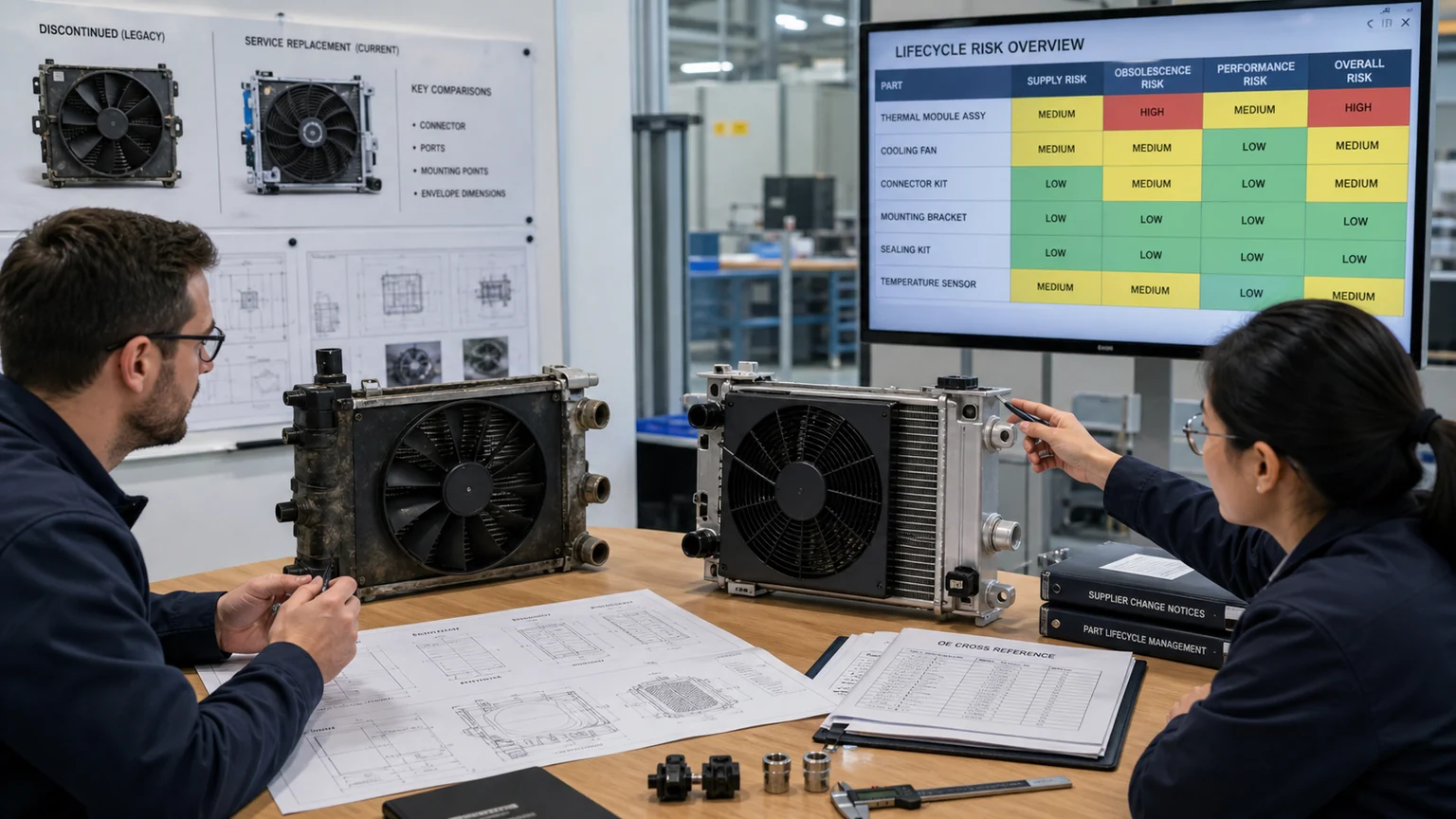
Obsolescence management combines supply, interface, performance and service-life risk.
A supplier may issue an end-of-life or product-discontinuance notice with last-order and last-ship dates. Risk can also appear earlier: minimum orders increase, lead time becomes unstable, a material or process disappears, tooling wears out, a sub-tier motor or controller ends production, software support stops, or a regulatory/chemical change affects the design. A product can remain orderable yet no longer be practical for the programme.
Mechanical parts are not immune. A specific tank tool, brazing alloy, port extrusion, clutch pulley or seal can disappear. Low annual demand can make a radiator core or condenser uneconomic. Electronic content often accelerates risk: brushless fan controllers, high-voltage compressor inverters, pressure sensors and communication devices have shorter component lifecycles than the vehicles they support.
Effective obsolescence management treats the issue as a lifecycle process with policy, ownership, plans, design strategies, resolution and improvement. For distributors, that means an ongoing register and decision rhythm, not an emergency purchase performed after a customer order fails.
Data group |
Minimum fields |
Decision supported |
|---|---|---|
Identity |
Supplier part, distributor SKU, OE references, revision, application and included content |
Prevents a notice from being applied to the wrong variant |
Lifecycle |
Active/at-risk/notice/last-buy/obsolete, notice source, dates and supplier contact |
Creates a time horizon |
Demand |
History, forecast, installed base, failure/replacement rate, service horizon and uncertainty |
Sizes exposure without assuming past sales continue |
Supply |
Inventory by lot/location, open orders, lead time, MOQ, tooling and sub-tier dependency |
Shows real coverage and concentration |
Technical |
Drawings, ports, mounts, media, performance, voltage/control, validation and alternatives |
Defines what an acceptable resolution must preserve |
Decision |
Risk score, owner, chosen strategy, approval, cost, milestones and residual risk |
Makes the resolution auditable |
Keep supplier evidence attached: formal notices, dated emails, portal screenshots, quotation validity and tooling statements. Record notice revision because last-buy dates can change. When a notice names a supplier number, map every customer SKU, kit and application that contains it, including private labels and modules.
Ask strategic suppliers for lifecycle status and product-change/discontinuance notification in the contract. Review quotations for shortening validity, longer lead time, new minimum order, tooling charges or removal of test support. Track rejected purchase orders and fill rate by exact part, not only supplier.
For controlled products, monitor sub-tier electronics and software. A brushless cooling fan can be mechanically available while its controller IC or LIN implementation changes. A high-voltage compressor may retain the housing but lose firmware or vehicle-communication support. Require the supplier to declare critical changes and affected date/lot.
Watch demand shape. A declining average can hide concentrated demand from one fleet; a vehicle population can decline while ageing increases failures. Separate scheduled replacement, collision, climate, severe duty and new-market demand. Mark uncertainty rather than producing a single precise forecast.
Score time to shortage, installed-base/service obligation, consequence of unavailability, number and maturity of alternatives, validation lead time, tooling/data ownership, regulatory or safety relevance, storage life and counterfeit exposure. Add switching cost and customer approval time. A low-value connector can stop a high-value module and deserve high priority.
Create risk tiers using a documented internal framework rather than implying a universal industry scale. For example, a red item can mean a confirmed notice, short coverage, long validation and no approved alternate; amber can mean warning signals or limited options; green can mean stable authorised supply or an approved interchangeable source. Green does not mean “never review”; supplier and demand conditions change.
Coverage should include usable inventory, not gross units. Subtract quarantine, damaged packaging, expired or condition-sensitive stock, reserved contracts and unresolved variants. Add open orders only when accepted and within the delivery horizon.
Assign an obsolescence process owner and a cross-functional review group. Supply-chain staff detect notices and lead-time changes; product and application specialists own the technical baseline; quality owns supplier/process evidence and deviations; sales provides installed-base and customer commitments; finance evaluates inventory and redesign; legal or compliance reviews contractual and market obligations.
Define approval thresholds by risk and cost. A catalogue clean-up can be handled by the data owner, but a one-way supersession with an adapter, a large lifetime buy or a controller redesign needs named authority. Meeting notes should record evidence, decision, dissent, conditions and review date. Do not leave approval only in personal email.
Contract requirements should flow to suppliers: lifecycle status, advance change/discontinuance notice, last-order details, sub-tier impact, final-run controls, data/test retention, tooling disposition and cooperation on alternates. A contractual notice period cannot guarantee that a sub-tier crisis never occurs, but it provides a process and accountability.
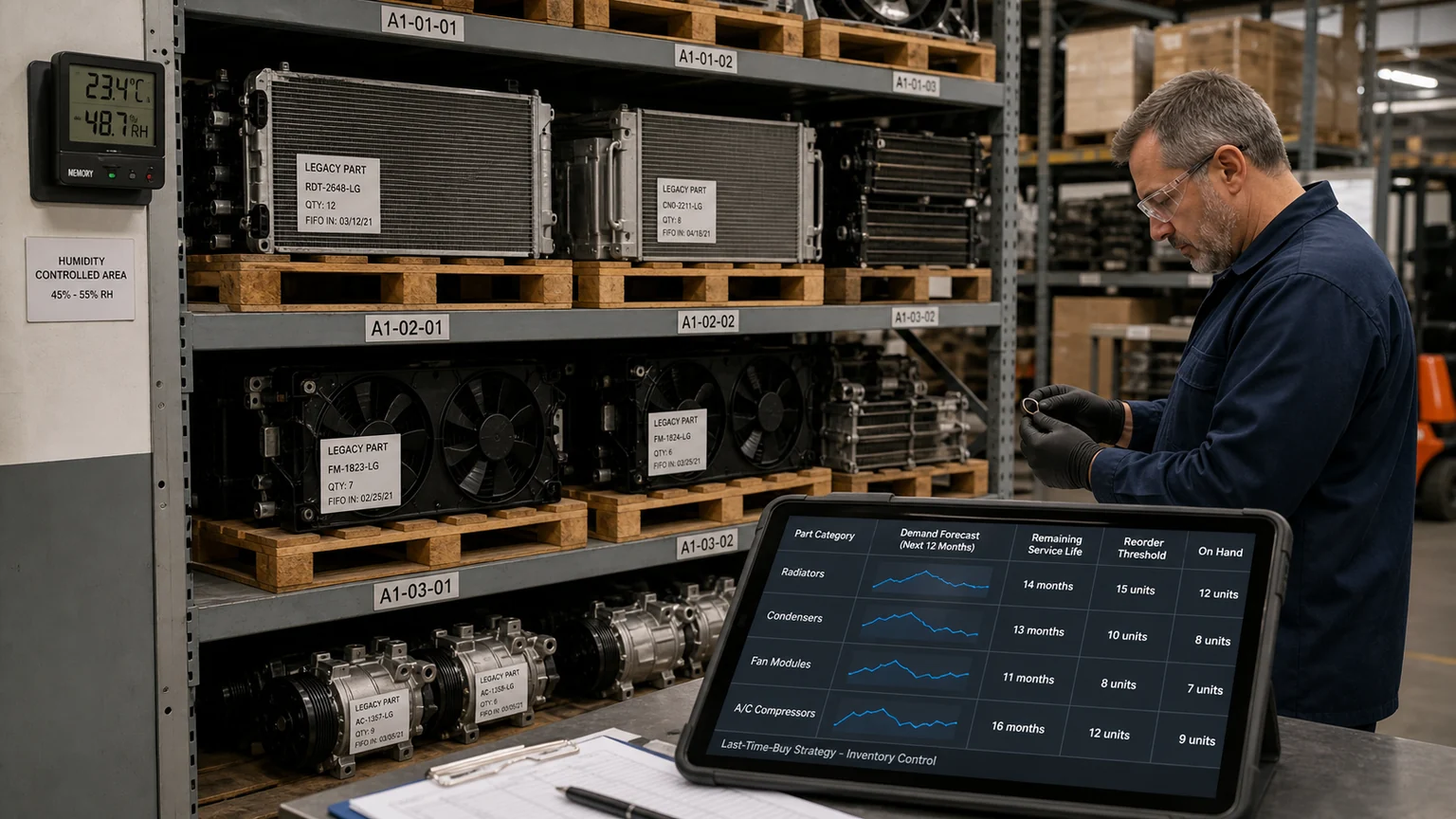
A last-time buy is an engineered inventory decision, not a simple multiplication of annual demand.
A last-time buy or lifetime buy purchases stock before the order window closes. Calculate demand across the remaining service horizon with low/base/high scenarios, existing usable inventory, expected returns, failure trends, alternative approval date, scrap or ageing, pack quantity and safety stock. State assumptions and review customer commitments.
Buying every forecast unit is not automatically safest. Excess stock ties cash, consumes space and may degrade. Elastomers, desiccants, corrosion protection, lubricants, electronic moisture sensitivity, labels and packaging have storage limits. Model carrying cost, inspection, insurance, tax, obsolescence after redesign and disposal as well as acquisition.
Negotiate partial deliveries, raw-material reservation, tooling transfer, bridge production or extended support when they reduce risk. Confirm whether the last production uses the same materials, processes and tests as approved stock. A final run is not permission for uncontrolled substitutions.
Define environmental limits, shelf orientation, stacking, port caps, moisture barrier, desiccant where justified, corrosion protection, first-in/first-out or condition-based issue, periodic inspection and traceability. A large compressor inventory can be ruined by open ports, oil leakage or damaged connectors. Heat-exchanger fins, tanks and mounts can deform under prolonged poor stacking.
Retain production lot, date, supplier, test status and package revision. Sample older stock at planned intervals using non-destructive and functional checks appropriate to the product. Rotate or recondition protective packaging under an approved method. Do not open sealed clean components simply to satisfy a generic visual check.
Hold reference samples, drawings, photographs, port/connector gauges and approved test methods. Throughout the planned service horizon, staff must be able to distinguish the correct variant and interpret a return. Data retention is part of the buy.
Start with monthly or quarterly demand by exact variant and customer type. Apply installed-base decay, vehicle age, climate, duty and failure-rate scenarios. Include known service contracts and exclude demand that will move to an approved supersession. Show confidence bands. A ten-year straight-line extrapolation from the last twelve months is rarely defensible.
Then model inventory flow: opening usable stock, confirmed receipts, forecast issues, expected scrap or returns, safety stock and the date coverage becomes negative. Run sensitivity for alternate approval delay, supplier short shipment and high-demand climate events. The earliest negative month is more informative than a single “years of stock” ratio.
Align customer messages with the chosen scenario. Do not offer indefinite availability based on an unapproved last-time buy. Where allocation is required, document and communicate an internal allocation policy based on contracts, installed fleet or order history, and prevent duplicate speculative orders from consuming the plan. Review coverage after the final run is physically received and inspected.
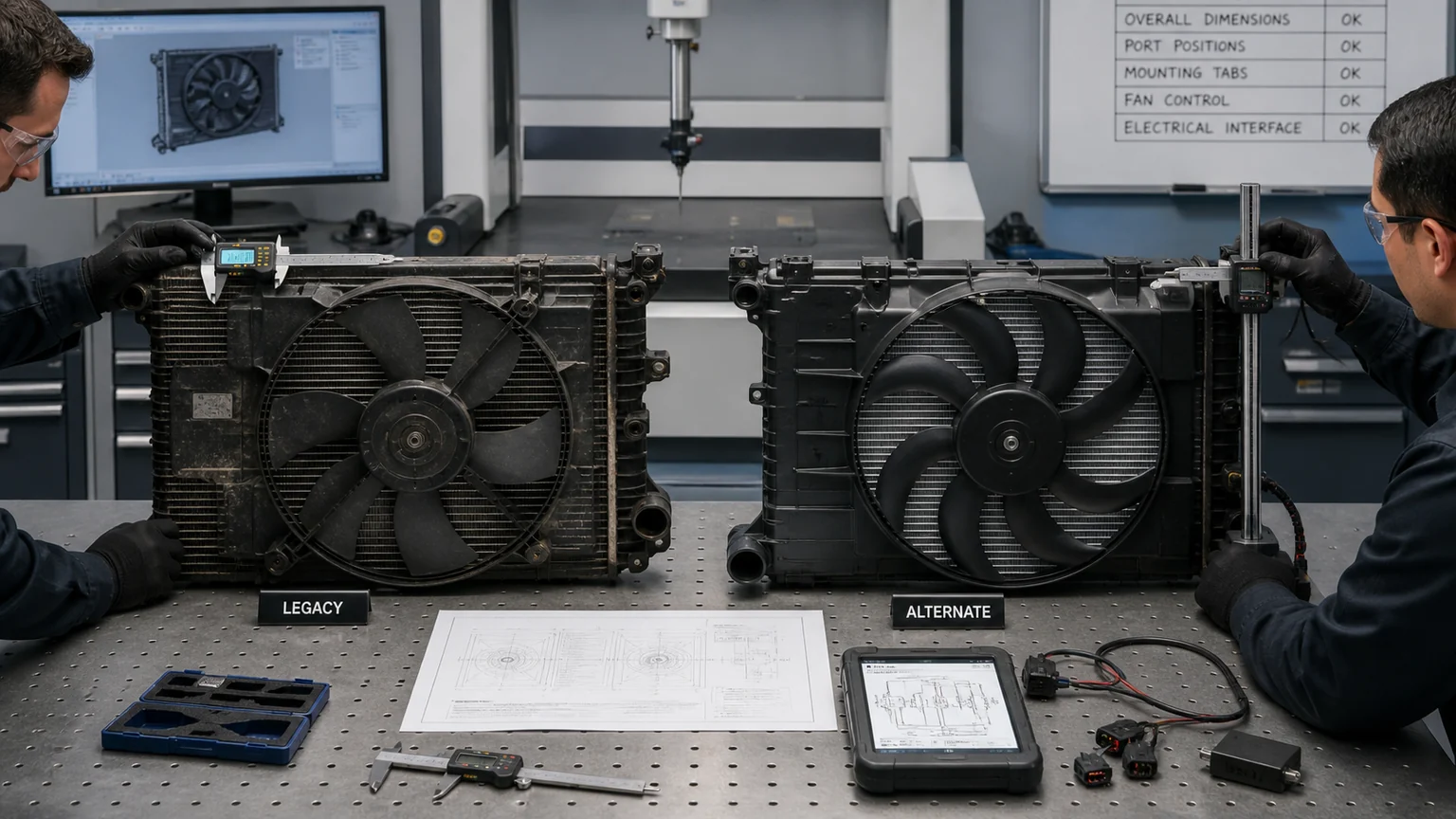
An alternate becomes valid only after dimensional, fluid, electrical and performance verification.
An alternate can be a second supplier to the same drawing, an aftermarket replacement, a revised OE number or a redesigned assembly. Begin with function and interface. Compare thermal duty, fluid and air pressure drop, operating pressure, leak integrity, media compatibility, ports, mounts, envelope, vibration, corrosion, durability, package and service access.
For a fan, compare airflow-pressure operating points, speed, current/power, noise, shroud/sealing, connector, control, diagnostics and fault behaviour as applicable to its architecture. For an A/C compressor, compare the applicable items for the specific mechanical or electric architecture: displacement/control, refrigerant and oil, speed/operating envelope, ports, mounts, clutch/pulley or high-voltage connector, communication and commissioning.
Create a delta table rather than writing “same as old part.” Classify each difference as no impact with evidence, acceptable by analysis, requires test, requires vehicle/customer approval, or unacceptable. Fit checks close geometry only. Performance, control and durability need separate evidence.
A supersession record should identify old and new numbers, effective date, direction of substitution, application limits, required adapter or kit, installation instructions, software/calibration dependency, test evidence and approval. Some substitutions are one-way: the new part may replace the old after a bracket change, while old stock cannot fit the revised vehicle.
Do not overwrite the old record. Customers need to trace what they bought, and warranty teams need the revision in the vehicle. Search should return the current option plus the historical chain. If inventory of both exists, warehouse scanning must keep them separable.
Give customers notice proportional to impact. Include affected part/application, dates, reason category, replacement status, differences, remaining stock policy, last-order terms and support contact. Avoid sharing proprietary supplier details that are unnecessary, but do not hide a material functional change.
Repair can extend support when a defined subcomponent fails and the assembly remains testable. Remanufacturing can sustain compressors, motors or selected modules when recoverable cores, process capability and final tests exist. These routes require identity, disassembly, cleaning, component limits, replacement rules, traceability and warranty.
Do not use untested salvage as an emergency substitute. A used fan that spins or a compressor that turns by hand does not prove performance. Contamination, fatigue, corrosion and controller history may remain hidden. Define product status honestly on quotation, label and invoice.
Core supply becomes a lifecycle asset. Forecast returns, publish grades, protect ports/connectors, and separate accepted, review and rejected cores. If the installed base declines faster than core recovery, remanufacturing capacity can also become obsolete.
When authorised supply ends, buyers may turn to independent distributors. Risk rises for counterfeit, remarked, used-as-new, mishandled or incorrectly stored electronics and parts. Know the source, preserve chain of custody, inspect labels and packaging, and apply risk-based authentication and functional testing. A low price does not offset unknown provenance.
Mechanical parts can be counterfeit or misrepresented too: a repaired compressor sold as new, an altered OE label, a lower-spec motor, or a heat exchanger with different core construction. Compare physical and test evidence to controlled references. Quarantine discrepancies and do not return suspected counterfeit material into general commerce without an appropriate disposition process.
Set approval authority before the shortage. Procurement should not make a technical substitution alone, and engineering should not approve a source without commercial, quality and traceability review.
A redesign can replace an obsolete motor, controller, connector, heat exchanger or complete module. It may reduce repeated risk by using current interfaces or multi-source components. It also creates tooling, validation, documentation, inventory transition and vehicle/customer approval work.
Define the redesign boundary. Changing only a connector can alter sealing, pin current and harness service. A higher-output fan changes power, noise and system balance. A lower-pressure-drop radiator can change warm-up or control behaviour. Test the system, not only the new item.
Plan cut-in by serial/VIN/date/lot and service instruction. Decide how old and new inventory coexist, whether adapter kits are allowed, and how claims identify the installed revision. Retire obsolete drawings only after historical access and warranty retention are secured.
Example 1: mechanical radiator with discontinued tank tooling. Demand is low but stable for an agricultural fleet. The supplier offers one final run or a new welded-aluminium design. The team compares lifetime-buy storage and tank ageing against redesign fit, pressure, heat rejection, vibration and repairability. It secures a bridge quantity, validates the redesign and records a one-way supersession rather than assuming the new core is identical.
Example 2: brushless fan controller end of life. The blade and shroud remain current, but the controller’s sub-tier electronics are discontinued. A new controller fits the housing yet uses revised LIN messages and diagnostic behaviour. The programme buys a limited bridge, obtains message definitions, validates current, airflow, applicable electromagnetic compatibility (EMC), failsafe response and vehicle communication, then changes the module number and service instruction.
Example 3: variable compressor family loses one control valve. Brokers offer old valves with weak provenance, while the compressor manufacturer proposes a revised unit. The team rejects uncontrolled valve substitutions, checks OE supersession and control response, validates refrigerant/oil and vehicle operating conditions, and qualifies the revised complete compressor. Remaining old stock is segregated by revision for matching claims.
“Same dimensions” is not a thermal or control qualification. “Same OE family” is not proof of bidirectional interchange. “Newer design” is not proof of compatibility with older software. “Supplier says equivalent” is incomplete without conditions and evidence. “Stock available online” is not proof of authorised, authentic or properly stored supply.
Another false resolution is a last-time buy with no service horizon, storage plan or financial owner. The purchase delays the shortage but creates hidden scrap. Likewise, a repair programme without spare subcomponents, test fixtures or recoverable cores moves obsolescence to another point rather than resolving it.
Finally, removing a number from the web catalogue does not retire the installed base. Preserve inquiry routing, historical identity and a clear status. Customers searching the old reference should reach a truthful explanation: available stock, validated supersession, repair/reman route, investigation required or no supported option.
Metric |
Purpose |
Warning |
|---|---|---|
Notice lead time |
Days from reliable warning to last order |
Averages can hide suppliers with no notice |
Time to approved resolution |
Shows engineering and decision speed |
Do not approve weak substitutes to improve the number |
At-risk demand coverage |
Quantifies service exposure |
Use usable stock and scenario demand |
Emergency buys |
Signals reactive management and source risk |
Classify cause, not just count |
Excess/expired last-buy stock |
Tests forecast and storage decisions |
Balance against shortages avoided |
Alternate field performance |
Confirms resolution quality |
Separate application, installation and product causes |
In the first days, verify authenticity and affected numbers, freeze uncontrolled substitutions, map inventory/open orders/customers, and capture last-order terms. Assign technical, supply, quality and commercial owners. Within weeks, build demand scenarios, inspect data and stock, request supplier options, search authorised alternatives and define validation.
Before the order deadline, approve the resolution and funding: buy quantity, alternate, bridge, redesign, repair or retirement. Contract the final run and changes, communicate affected customers, and create storage/test plans. Afterward, track delivery, validate alternatives and review residual risk until the old item no longer threatens service.
Elecdura can support the technical part of an obsolescence response for cooling and HVAC components. Send the OE and supplier references, application, notice and dates, demand horizon, inventory, drawings or photographs, interfaces and performance evidence. The goal is continuity with controlled risk—not a rushed cross-reference after the final unit has shipped.


