English
Views: 0 Author: Site Editor Publish Time: 2026-08-25 Origin: Site
Cooling-parts packaging reduces returns when it controls the load path, movement, abrasion, impact, stacking and atmosphere that can damage the actual product. A thicker carton or more foam is not automatically better. A radiator needs its frame and tanks supported without crushing the core. A condenser needs fin and manifold clearance. A compressor needs mass restraint, capped clean ports and connector protection. A fan module needs blade and shroud clearance.
Validation must use the complete product-package combination in the intended parcel, pallet or mixed distribution route. Define failure before testing: leakage, blocked or bent ports, crushed fins beyond an agreed area, distorted mounts, blade contact, connector damage, contamination, corrosion, loose fasteners, label loss or unacceptable package collapse. Passing a generic test without product inspection does not prove the part can be installed.
Packaging design begins with the product’s fragile zones and the real distribution route.
Document every main stage: factory handling, export warehouse, palletisation, container or air freight, deconsolidation, distributor storage, parcel carrier, workshop delivery and customer return. Record whether packages remain unitised, are clamped, conveyored, hand-carried, stacked, exposed to rain or humidity, or travel in partially filled trucks. A pallet-tested carton may later be shipped alone; that change creates a different hazard profile.
A sound transport-test plan begins by understanding the real route because shock, vibration, compression, temperature and humidity vary by channel and region. Select a recognised procedure, such as an appropriate ISTA or ASTM distribution-cycle method, only after the route, package mass, shipment configuration and handling are known; the programme and test level must match the actual distribution environment. When field damage disagrees with laboratory results, measure or observe the route and update the test plan.
Do not claim a package is “ISTA certified” merely because an internal test resembles one sequence. Certification marks have programme and laboratory/report requirements. More importantly, the selected procedure and damage limits must be appropriate. A valid test report for one part, box size, cushion and closure does not cover every heavier variant.
Part family | Preferred support/load path | No-contact or fragile zones | Hidden post-shipment risk |
|---|---|---|---|
Radiator | Strong frame, side plates or qualified tank/mount regions | Core fins, filler neck, drain, small ports, sensors and thin brackets | Tank seam stress, microleak, port distortion, internal debris |
Condenser | Side rails, end structures or designed mounting areas | Microchannel core, manifolds, integrated drier, fittings and brackets | Tube/manifold crack or restriction despite acceptable appearance |
Compressor | Housing and robust mounting feet with multi-direction restraint | Ports, clutch/pulley face, control valve and labels; HV/LV connectors where equipped | Impact to shaft/front bearing, moisture or particles inside sealed circuit |
Fan module | Shroud perimeter and reinforced mounts where qualified | Blade sweep, motor/controller, connector, thin shroud sections | Blade-shroud contact, cracked mount, electronics or balance damage |
Oil cooler | Frame, tanks or brackets based on design | Fins, threaded/quick-connect ports and stacked-plate edges | Port damage, internal contamination, plate-seam leak |
Create a packaging drawing that marks green support zones, red no-contact zones, centre of mass, permitted orientation and lifting points. Verify those zones with the product engineer. Cardboard that rests lightly on fins at the packing station can abrade through repeated vibration or transfer stacking load after humidity weakens the carton.
Structural supports should carry loads through strong frames, not fragile fins or tubes.
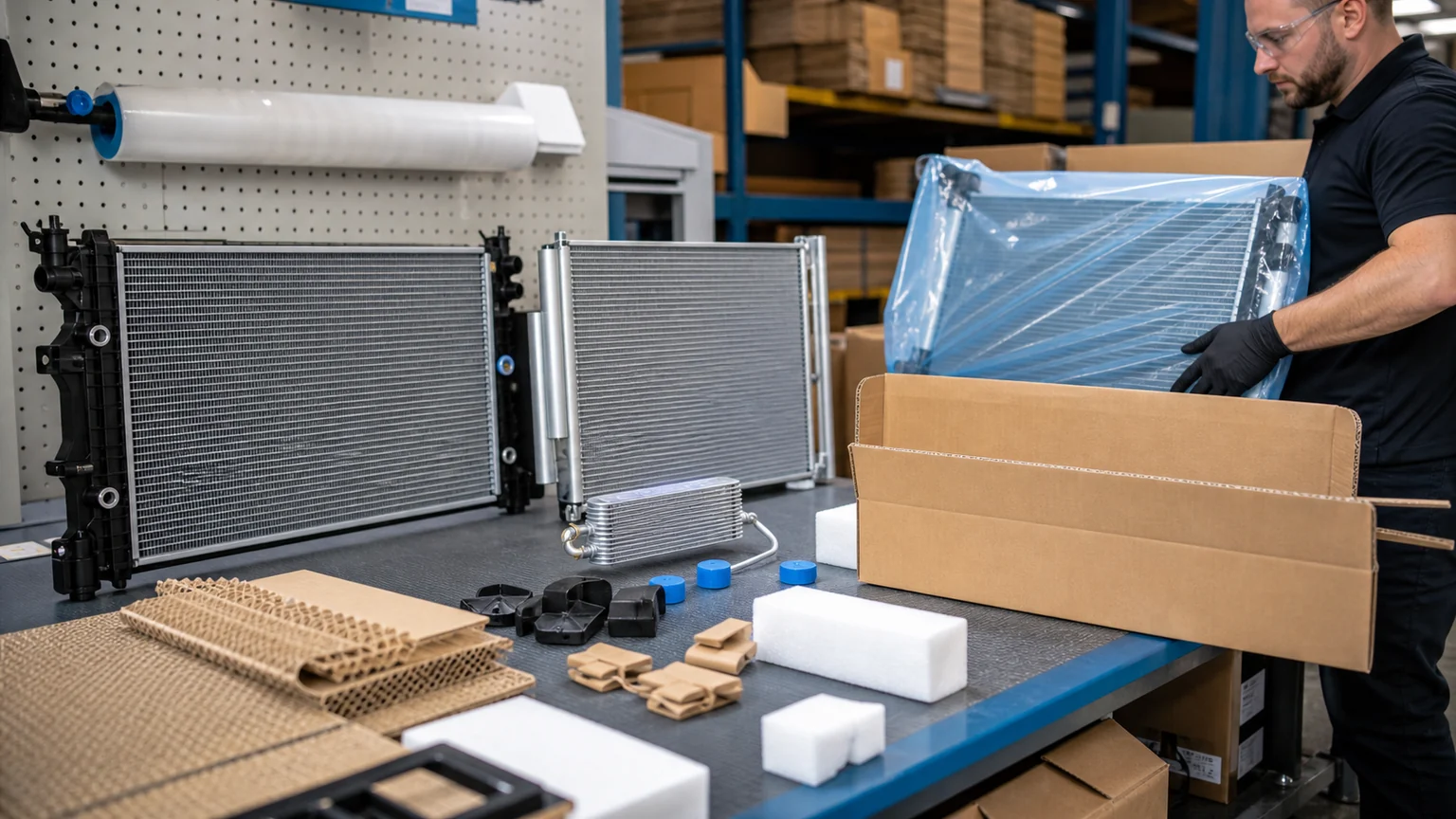
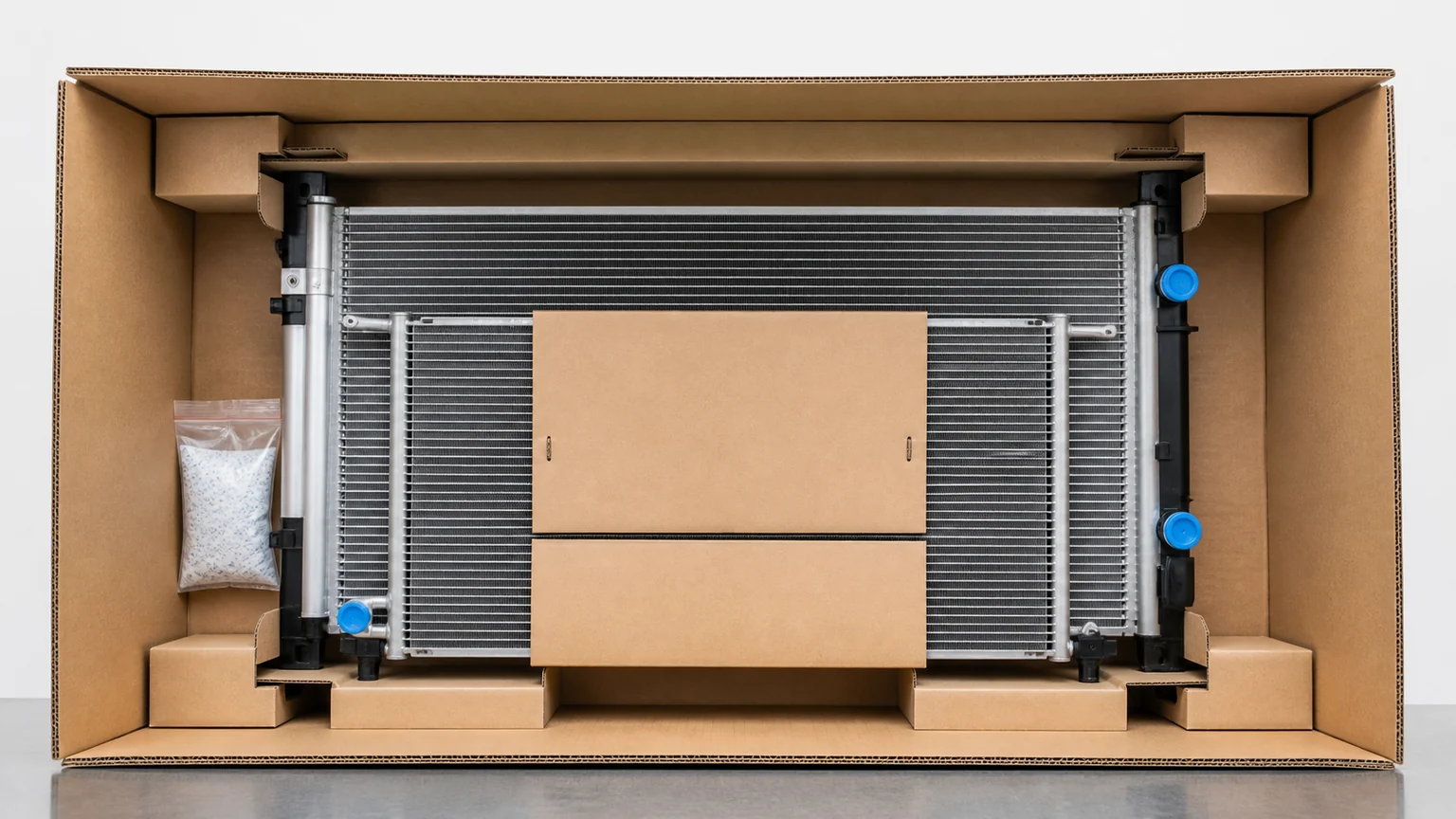
For a radiator or condenser, corner blocks or side supports should create clearance around the core and route loads into stronger structures. The insert must stay positioned during shock and vibration. A full flat pad pressed against fins may prevent visible impact marks but can flatten a large area under compression.
Fin guards can be corrugated bridges, formed fibre, foams with qualified density, polymer caps or reusable frames. Select material for load, abrasion, dust and humidity behaviour. Ensure cut edges, staples, fasteners or loose particles cannot reach the core. A bag protects against dust and scratches but is not a structural cushion unless designed and tested as one.
Set an agreed fin-damage limit connected to airflow or appearance requirements. A few locally displaced fins may be serviceable, while crushed tubes, manifold movement or a large blocked area is not. Post-test inspection should compare defined zones, photograph damage and repeat leak or flow checks where risk justifies it.
A compressor concentrates mass in a small volume. During a drop or truck vibration, it can break through weak inserts, strike its pulley or ports, or turn until a connector carries the load. Use shaped restraints around qualified housing or mounting locations and provide clearance for clutch, shaft, valves and connectors. Confirm the unit cannot migrate longitudinally, laterally or vertically.
The box and insert act together. A strong cushion inside a weak carton can still escape through panel failure; a strong carton with a rigid unqualified insert can transfer high shock to the component. Consider package mass, cushion area, static load, expected shock, repeated impacts and temperature. Do not copy a foam thickness from a lighter compressor.
Ports need caps or plugs compatible with thread, seal and fluid context. Caps must remain secure yet not damage sealing surfaces or leave particles. Add a secondary clean barrier when the storage and route require it. The purpose is to keep moisture, dust and loose packaging material out of the refrigerant and oil circuit—not to make unsupported claims of indefinite dry storage.
Corrugated packaging loses strength as atmospheric conditions change, and metal/electronic parts may face condensation or corrosion. Begin with route duration, climate, container condition, warehouse controls and product cleanliness requirements. A moisture barrier can help only when it is sealed, remains intact and encloses an appropriate initial condition.
Desiccant quantity and barrier selection require engineering calculation based on material permeability, enclosed air, residual moisture, duration and conditions. A loose sachet can abrade fins, block a port or be mistaken for a component. Secure and label it. A humidity indicator can show exposure inside a suitable barrier, but it does not prove the compressor or heat exchanger is clean or functional.
Prevent liquid water entry with closures and pallet/container practices rather than relying on desiccant to absorb rain. Avoid trapping a wet part inside a low-permeability bag. Define drying after leak or cleaning tests, cap installation timing and maximum open exposure. Oil coolers, compressors, receiver-driers and integrated-drier condensers may need stricter internal cleanliness controls than an external bracket.
A cooling fan assembly is large, light relative to its volume and often geometrically flexible. Support the shroud at qualified reinforced areas without bending it into the blade path. Use a blade-sweep gauge or functional rotation check after packaging validation. Do not use the fan blade or motor connector as a handhold.
Integrated controllers and connectors need clearance, electrostatic controls where applicable, and protection from concentrated loads. Secure loose harnesses so their connectors do not hammer the shroud under vibration. Connector caps should protect pins and seals without forcing latches. Depending on the motor/controller architecture and available production method, a post-test electrical inspection can include pin condition, motor current at controlled voltage or command, rotation, vibration and airflow or a correlated production check.
Large fan modules can act as levers inside a carton. A small movement at one edge becomes high stress at a distant mount. Restraint should control the whole assembly without preloading it into a distorted shape. Verify fit across production tolerances, not only the nominal sample.
Warehouse and vehicle stacks place long-duration loads on cartons. Pallet overhang, misalignment, voids, humidity and mixed box sizes reduce strength. The product should not become an unintended load-bearing column through fins, ports or brackets. Use inserts and box panels that route compression around fragile zones.
For pallet shipments, define layer pattern, maximum layers, pallet quality, edge protection, stretch-wrap or strapping, anti-slip measures and permissible overhang. Straps must not crush a radiator core or cut a carton corner until the load reaches the product. Unit-load stability and individual-carton protection are separate: a stable pallet can still contain damaged parts.
If distributors break pallets and reship units, validate the individual package for that next route. A master carton or crate may be necessary for export but irrelevant to the parcel customer. Put the final shipping configuration in the part master or warehouse rule so staff do not assume every inner carton is courier-ready.
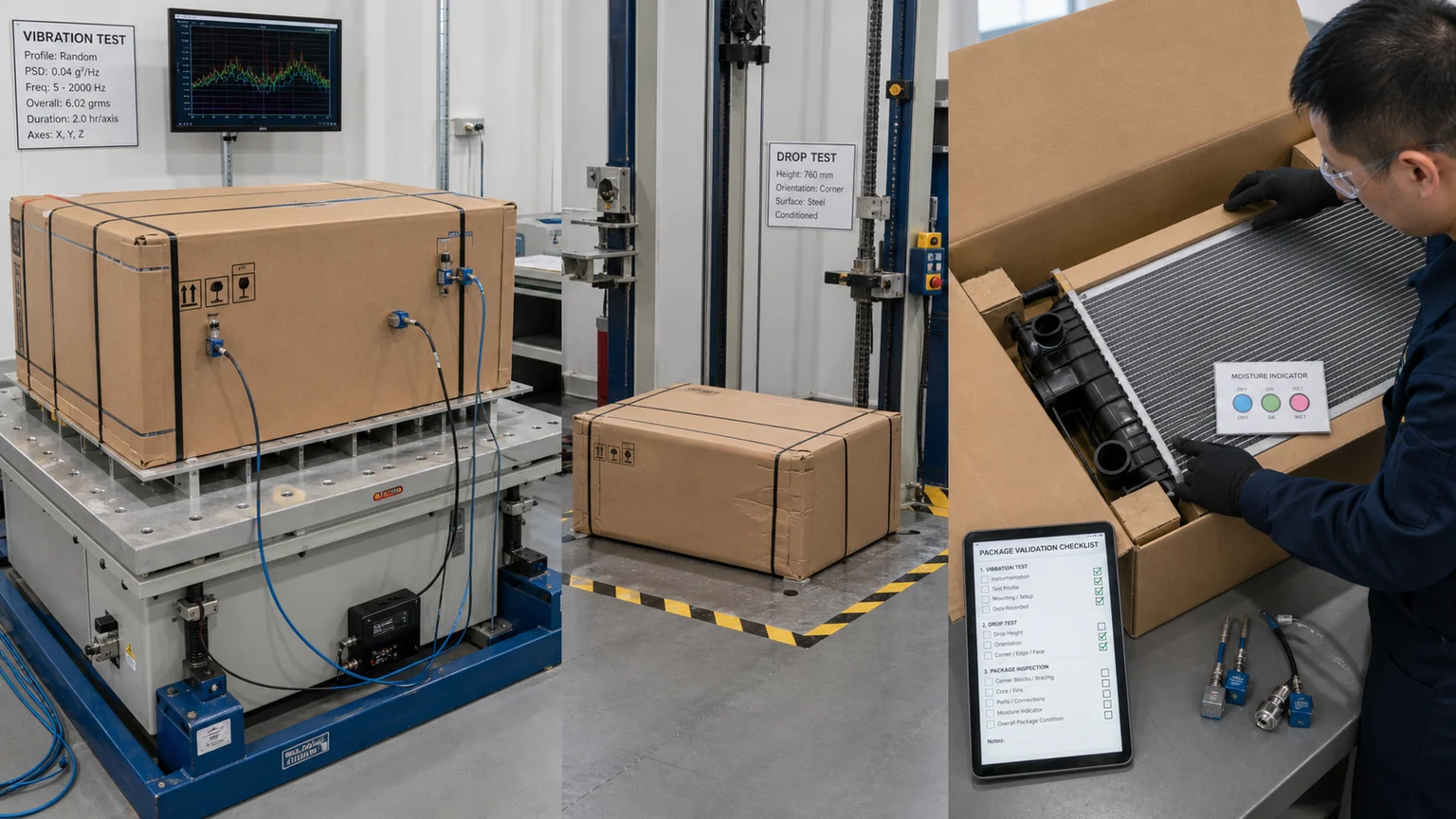
Sequential vibration, drop and inspection tests reveal accumulated packaging damage.
Transport hazards interact. Atmospheric conditioning can weaken corrugated material before compression. Vibration can settle inserts and loosen caps before a final shock. A drop can alter support before later vibration. Use the selected procedure’s sequence or a justified route-specific plan and record any deviation. Do not test each hazard on a fresh perfect sample and combine the results as if one package survived all of them.
Use production-intent products, inserts, cartons, tapes, staples, bags, caps, labels and palletisation. Record material grade, supplier, dimensions, mass, closures and conditioning. Test multiple samples where risk and variability justify it. One unusually strong carton should not define release.
After testing, inspect both package and product. Repeat the component checks selected during the risk assessment, which may include leak integrity, pressure or flow, port gauge, mount geometry, blade clearance, electrical function, noise or contamination inspection. Not every check applies to every component or packaging change. A box can look damaged while the product remains protected; a box can look clean while a hidden microleak has formed.
Area | Example criterion type | Weak wording to avoid |
|---|---|---|
Package | Closure retained, no product exposure, stack geometry within limit | “Box looks good” |
Heat exchanger | No leak; ports and mounts gauge; fin damage within mapped limit | “Minor damage acceptable” |
Compressor | Ports sealed, connector intact, no housing/mount impact, specified functional checks pass | “No obvious problem” |
Fan module | No blade contact/crack; connector and controlled electrical/rotation checks pass | “Fan spins” |
Cleanliness | Barrier and caps intact; no specified foreign material or moisture indicator breach | “Keep dry” |
Identification | Labels readable/scannable and match part, lot and carton | “Label attached” |
Changing foam density, corrugated grade, insert die line, cap supplier, tape, bag thickness, pallet pattern or unit count can alter performance. Create a packaging bill of materials and revision. Define which changes require engineering review, fit check, partial test or full revalidation. Seasonal material substitutions should not happen silently.
At packing, use visual standards for orientation, insert placement, cap presence, bag seal, accessory location, closure and label. Poka-yoke features can make a compressor fit only in the correct orientation or prevent a connector from facing a wall. Sample finished packs for movement, weight and scan accuracy.
Mounting hardware, seals, adapters, sensors and instruction sheets need dedicated locations. A loose bolt can puncture a heat-exchanger tube, mark a pulley or damage a fan controller during vibration. Seal small parts in a labelled inner pack and restrain it outside the fin or blade zone. Confirm the accessory pack cannot migrate into a port opening if its bag tears.
Separate protective caps from installation components. A workshop should not mistake a transport plug for a service seal or leave a shipping brace installed. Use shape, colour, label or instructions to distinguish “remove before installation” items. Count accessories at packing and receiving, and map the included kit to the exact product revision.
Place papers where moisture and oil cannot make them unreadable, but do not put them inside a sealed clean circuit. Digital instructions can reduce paper, yet a QR-only system needs a human-readable part identity and a durable fallback. Installation warnings essential to safety or cleanliness should remain visible without requiring a personal login.
Warranty and core returns often travel through a harsher path than outbound products. The original inserts may be missing, wet or damaged; ports may be open; residual oil or coolant may leak; and the sender may not know the required orientation. Provide simple return instructions, replacement caps or bags where appropriate, and a method to prevent a failed heavy unit from moving.
Do not tell customers to return refrigerant-containing components without lawful recovery and safe preparation. Define fluid handling, evidence preservation and dangerous-goods review for the destination. The return pack should protect carrier personnel and other freight while preserving the failure evidence needed for analysis.
If original packaging is required for a warranty, state that condition before sale and make it practical for the expected period. Consider a foldable return insert or service kit for high-value compressors. Photograph the packed return when custody begins so damage caused on the reverse route can be separated from the original complaint.
Train unpacking as well as packing. A workshop can cut through a core or harness when opening a deep box. Mark safe cut zones, lifting points and return instructions. Avoid staples or straps in likely hand-access areas. Packaging that protects in transit but causes removal damage has not completed its job.
Require photographs of all package faces, shipping label, internal supports and damaged product before disposal. Record part/SKU, package revision, route, carrier, shipment configuration, location and type of product damage, carton condition and whether caps or restraints remained in place. Separate wrong part, manufacturing defect, installation damage and transport damage.
Look for location patterns. Repeated manifold cracks can indicate an unsupported mass or side impact. Polished rub marks show vibration contact. Crushed fins in the same quadrant show insert migration or stacking load. Wet lower cartons point to pallet/container exposure. Broken fan mounts with intact boxes can indicate assembly preload or insufficient internal clearance.
Contain first: isolate affected packaging revisions and routes, add interim protection based on evidence, and inspect stock. Then reproduce the failure, change one controlled design and retest. Track damage per shipped unit and cost per failure, not only total returns. A heavier package is not an improvement if damage remains unchanged and freight rises.
Material reduction is valuable only after functional protection is maintained. Optimise by removing material from non-load paths, improving geometry, right-sizing the carton, increasing recyclable mono-material content where suitable, or using recoverable frames on closed routes. Report weight and cube alongside damage rate and return cost.
Reusable packaging fits repeated, controlled routes with return volume, inspection and cleaning. Define ownership, return ratio, maximum uses, damage criteria and parts availability. Do not reuse a cracked insert or moisture-contaminated container because it still looks serviceable. Single-use systems may remain more practical for fragmented export or remote aftermarket distribution.
Avoid unsupported environmental claims. Recyclable material is useful only where collection and processing exist; reusable packaging is useful only when it returns. A transparent packaging decision shows product damage avoided, material, cube, freight, return performance and end-of-life route.
Provide the exact part or family, mass and centre of gravity, dimensions and tolerances, strong and fragile zones, clean/opening requirements, included accessories, permitted orientation, annual volume and packing-site capability. Add every shipping configuration: individual parcel, master carton, pallet, crate or mixed load.
Describe origins, destinations, modes, transfers, storage time, climate, stack height, pallet pattern, carrier limits and known damage. Define tests and product-level acceptance criteria, sample quantity, report format, approved materials, labelling, change control and target cost/cube. For returnable packaging, include reverse route and cleaning.
Send Elecdura the cooling-part family, package and pallet dimensions, route, shipment mode, fragile zones and damage photographs. A useful packaging plan will protect fins, ports, seals, connectors and load-bearing structures through the real distribution chain—and prove success with functional inspection, not a carton-only pass.