English
Views: 0 Author: Site Editor Publish Time: 2026-08-25 Origin: Site
Automotive thermal-management training for distributors should be based on role and authorised task. This competency framework is for distributor sales, receiving, warehouse, application, technical-support and warranty personnel; it is not a service qualification or licence. Sales, receiving and warehouse teams need accurate product identity, handling and escalation. Application specialists need loop, interface and variant knowledge. Technical and warranty teams need measured evidence. Opening refrigerant circuits, energising unknown high-voltage components and performing live vehicle diagnostics require competent, equipped and legally qualified personnel.
A course-completion certificate is not a universal licence to repair every system. In the United States, technicians who repair or service motor vehicle air-conditioning systems for consideration fall under Clean Air Act Section 609 technician-certification and approved-equipment requirements; the exact activity and equipment must be checked against the current EPA rules. Refrigerant-containment training does not by itself prove diagnostic skill, and general electronics knowledge does not make a person qualified for high-voltage vehicle work. Build separate competencies and verify them.
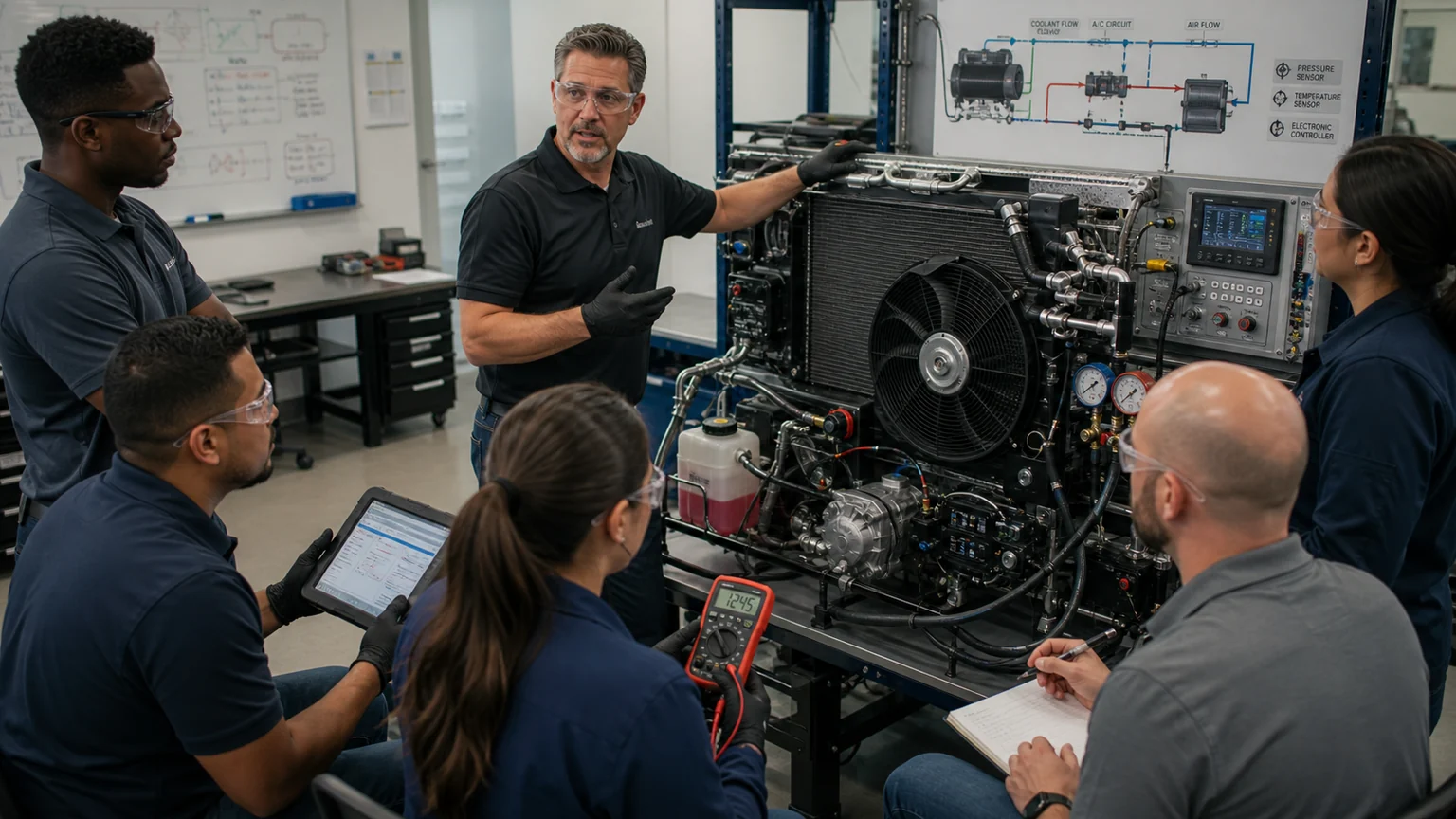
Modern cooling work combines mechanical fitment, refrigerant circuits, sensors and control logic.
A radiator or condenser remains a heat exchanger, but the system around it includes sensors, variable fans, pumps, valves, controllers and software. A brushless cooling fan may use PWM or LIN commands, monitor faults and enter a failsafe. A variable compressor may respond to a control valve. An electric compressor can integrate inverter electronics, high-voltage connections and vehicle communication.
EVs can reconfigure refrigerant and coolant loops for cabin heating, battery conditioning, charging and power-electronics cooling. A battery chiller, condenser and radiator can look like “coolers” yet handle different media and pressures. A parts employee who matches only overall dimensions can create a leak, communication failure, poor thermal performance or unsafe service situation.
Even a familiar A/C compressor now spans belt-driven fixed displacement, variable displacement with control valve, and electric high-voltage architectures. Training must separate mechanical fit from refrigerant/oil, control, electrical and operating-envelope compatibility.
Training should make staff better at collecting evidence and knowing when to stop. It should not encourage warehouse employees to apply power to an unknown fan, remove compressor caps, connect gauges or probe orange high-voltage wiring.
Classrooms and warehouses are not automatically service bays. Establish where low-voltage demonstration, refrigerant equipment, pressure testing and high-voltage training may occur. Use barriers, signage, supervision, emergency controls, ventilation and equipment inspection appropriate to the task. Keep saleable stock out of exercises unless the activity is a non-invasive receiving check.
Training rigs should have known schematics, current limiting, fusing, accessible emergency isolation and labelled test points. Fault insertion must not create uncontrolled heat, pressure or touch hazards. Refrigerant demonstrations belong with approved equipment, qualified instructors and applicable recovery/containment. High-voltage practical work requires a purpose-designed facility and authorised programme.
Maintain tool control. Record meters, leads, adapters, scan tools, recovery machines, cylinders, leak detectors, insulated tools and PPE assigned to training or work. Include inspection, calibration where required, compatible refrigerant/voltage range and storage. A correct procedure performed with an unsuitable tool is not competence.
Role | Required capability | Typical authorised action | Escalate/avoid |
|---|---|---|---|
Sales/customer service | Product families, application questions, evidence intake and honest status | Collect OE/VIN/application, photos, media, connectors and destination | Diagnosis promises, refrigerant advice beyond approved information, live tests |
Receiving/warehouse | Identity, labels, port caps, clean barriers, damage and segregation | Non-invasive inspection, scanning, quarantine and correct storage | Opening sealed circuits, energising components, draining unknown fluids |
Application specialist | Architecture, interfaces, cross-reference evidence and revision control | Match controlled data, document assumptions and request missing fields | Unsupported interchange claims |
Technical support | Measurement context, circuits, controls, safe test boundaries and procedures | Guide evidence collection and interpret qualified test reports | Remote instructions that bypass safety or legal service requirements |
Warranty/quality | Failure modes, claim evidence, traceability and corrective action | Cause-code returns and request proportionate data | Declaring defect from a DTC or photograph alone |
Manager | Competency governance, equipment, legal scope and change management | Authorise roles, training, audits and escalation | Using attendance as proof of task competence |
Everyone who handles cooling parts should understand heat sources, heat transfer and the difference among coolant, oil, air and refrigerant circuits. Teach what a radiator, condenser, evaporator, charge-air cooler, oil cooler, chiller, pump, fan and compressor normally does—while showing that vehicle architectures vary.
Use physical samples. Staff should identify ports and sealing surfaces, mounts, core, tanks/manifolds, integrated drier, sensors, motor/controller, clutch/pulley, connectors and labels. They should know that similar appearance does not establish pressure, media, voltage, rotation, communication or performance.
Assessment should require an evidence-based intake: given an unknown part, the learner photographs the label, whole component, ports, connector and mounts; records dimensions without damaging it; separates confirmed facts from inference; and routes open questions to the correct specialist.
Sales language can create risk before a part moves. Replace “direct fit” with a statement supported by application and variant evidence. Replace “the code means the fan is bad” with “the code identifies a condition; please provide status, freeze-frame and circuit tests.” Replace “drop-in refrigerant” with the approved vehicle/refrigerant information and referral to qualified service.
Give staff scripts for stopping safely: “We cannot confirm the connector/control from this photograph”; “Do not energise the unit; send the label and vehicle data”; “Refrigerant recovery must be performed by appropriately qualified service personnel”; “The returned part will remain capped and quarantined until its media is identified.” Practice these in role-play.
Technical translation matters across languages and markets. Maintain a controlled glossary for compressor, condenser, chiller, radiator, oil cooler, fan controller, PWM, LIN, refrigerant and oil terms. Attach units to every measurement and show connector-view direction. Do not translate a legal certification from one jurisdiction into an equivalent global credential without review.
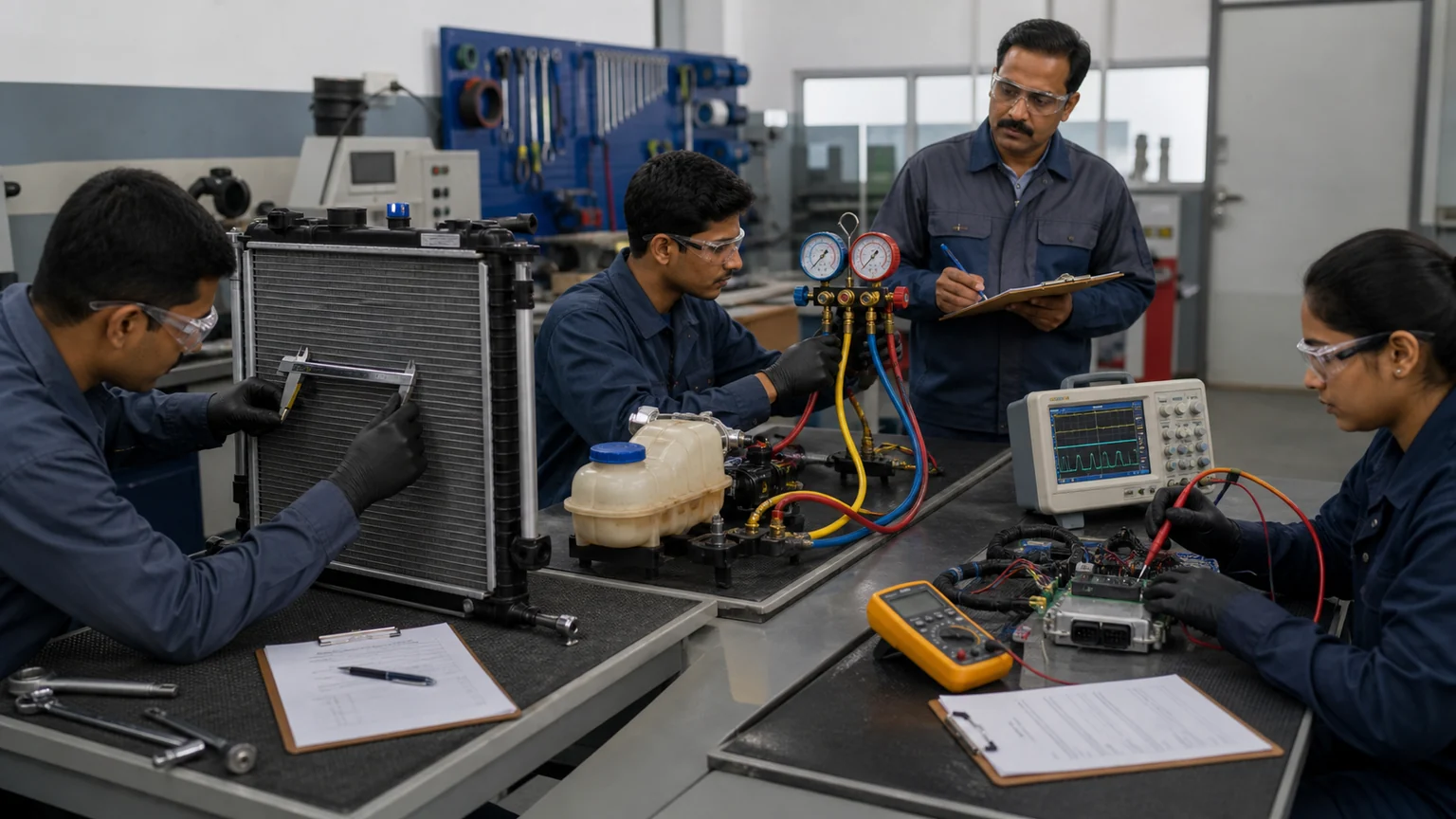
Competency develops through observed tasks across fitment, fluid and electrical stations.
Application staff need controlled OE references, supersessions, vehicle/market, engine or drive architecture, refrigerant, voltage, connector, control, ports, mounts, dimensions, stack position and included accessories. They must understand one-way supersessions and option codes. A cross-reference source and date should be retained.
Teach confidence levels: official or controlled data, supplier catalogue, validated sample, customer photograph, inference and unknown. Do not present a likely match as guaranteed. A VIN can help but may not reveal repairs or regional changes; physical evidence remains important.
Exercises should include deceptive pairs: fans with identical three-pin connectors but different control; condensers with one port clocked differently; electric compressors with similar housings but different voltage/communication; radiators with or without integrated cooler. Learners must find the blocker before approving the order.
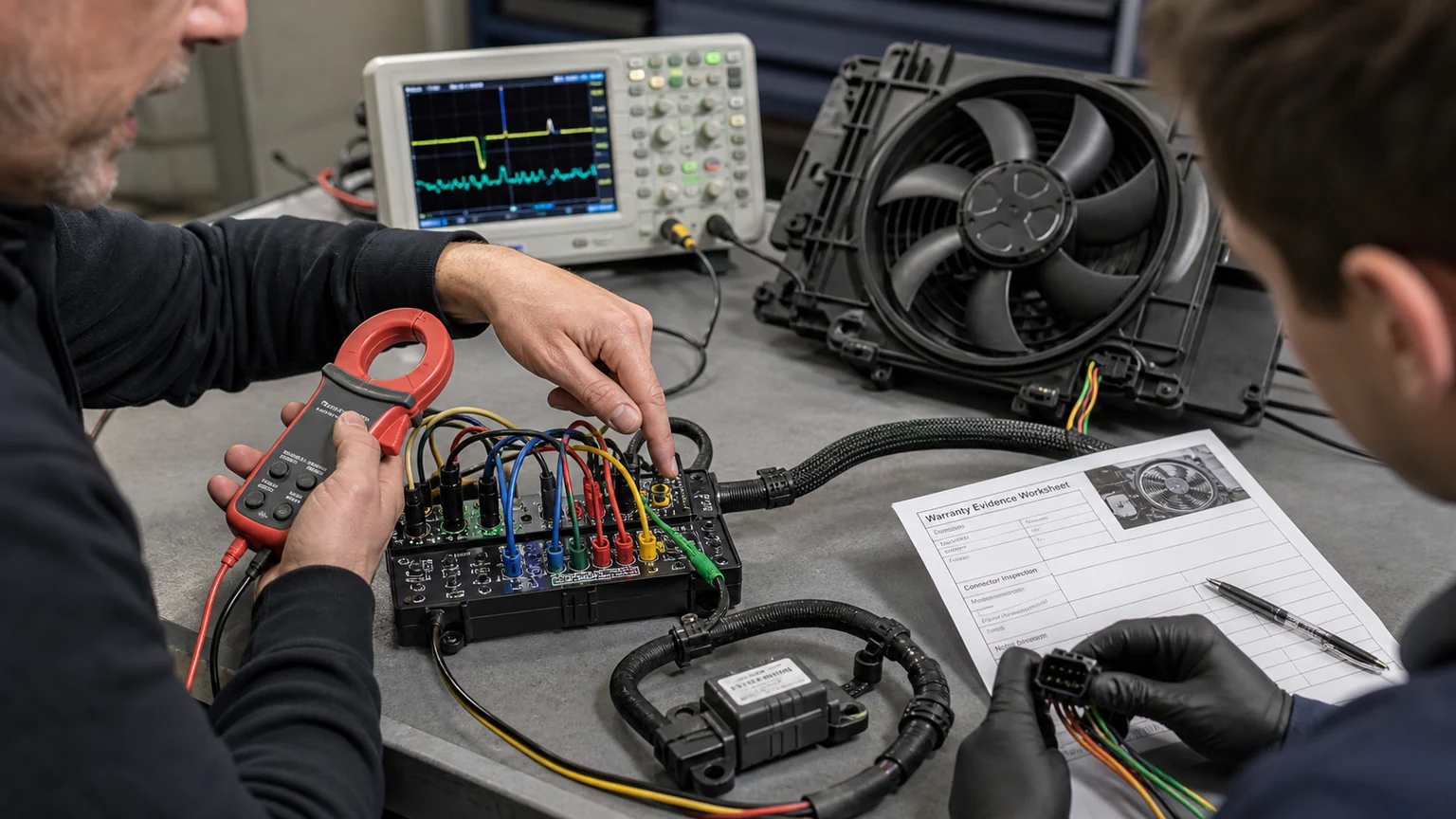
Safe breakout-harness testing links fan commands to current, waveform and connector condition.
Technical teams should understand voltage, current, resistance, power, voltage drop, ground, short/open circuits, PWM, frequency, duty cycle, LIN/CAN concepts, sensors and actuator feedback. They need not reverse-engineer every controller, but they must know why current without voltage/command is incomplete and why continuity tests on electronic pins can be unsafe or misleading.
Use de-energised training boards and protected low-voltage fixtures before real parts. Teach connector-view direction, pinout evidence, fused supplies, current limiting and correct meters. Oscilloscopes and scan tools require method, grounding and signal interpretation. Never improvise a live test on an unknown high-voltage compressor.
A fan case can combine command, speed, current, airflow and restriction. A commanded fan with zero speed can reflect supply, ground, command, controller, motor or mechanical obstruction. Training should require a decision tree and measurements, not part swapping.
All relevant staff need awareness of refrigerant identification, unique fittings/labels, contamination, oil compatibility, recovery, leak evidence, storage and transport. Sales should never describe an unapproved hydrocarbon blend as a drop-in replacement for R-134a or R-1234yf. Warehouse teams must segregate cylinders, equipment and returned components under applicable rules.
In the United States, EPA’s current MVAC servicing requirements state that technicians who repair or service MVAC systems for consideration must be Section 609 certified and use approved refrigerant-handling equipment. Refrigerant recovered from an MVAC must be recycled or reclaimed before it is recharged into an MVAC, including when it returns to the same vehicle. Other countries have different certification and fluorinated-gas rules; maintain a jurisdiction matrix.
Certification establishes a regulatory knowledge gate, but technical capability still needs practical assessment and employer authorisation. A technician may understand containment yet need additional training for R-1234yf equipment, leak detection, electric compressors, heat pumps or a specific vehicle. Keep certification numbers and expiry/status where applicable, training records and equipment capability.
Everyone needs visual awareness: orange is a common high-voltage cable convention, but colour alone is not a universal identifier. Treat cables and components identified by the vehicle information, labels or applicable procedures as high voltage and establish controlled boundaries. Only qualified personnel following vehicle/manufacturer and employer procedures should isolate, verify absence of voltage, handle HV connectors or perform live measurements. PPE and instruments must be selected, inspected and rated for the task.
Distributors often do not need to energise an electric compressor. Receiving can verify label, housing, ports, connector condition, caps and package without opening or powering it. Application specialists can match voltage/control data from controlled sources. Functional high-voltage tests belong in an equipped facility with written procedures and trained personnel.
Thermal training should cover battery, motor/inverter, cabin and charger loops, heat-pump valves, chillers, pumps and front heat exchangers. It must also teach architecture uncertainty: a diagram from one model is not universal. Learners should trace media and possible modes from service information before naming a component.
Teach every measurement with units, location, operating state, instrument and expected comparison. Temperature needs ambient, load, speed and probe position. Pressure needs refrigerant/fluid, high or low side, fan/compressor state and temperatures. Fan current needs voltage, command, speed and airflow restriction.
DTCs identify a detected condition, circuit or plausibility issue; they do not automatically name the failed part. Preserve code status and freeze-frame before clearing. Build a cooling claim record with application, symptom, chronology, labels, codes, temperatures, pressures, currents, connector/port photos, leak/debris evidence and corrected external causes.
Practical assessment should present incomplete data. The learner must ask for the missing condition, propose safe next checks and refuse an unjustified parts order. Reward accurate escalation, not the fastest guess.
Supplier sessions are valuable when they disclose exact product architecture, interfaces, tests, installation boundaries, change notices and claim evidence. Retain the deck revision and verify claims against controlled documents. A promotional webinar should not become the only source for critical voltage, refrigerant or compatibility data.
Customers and workshops can receive intake and evidence training without being authorised by the distributor for regulated service. Show how to photograph labels, connectors and ports; preserve codes and measurements; cap returns; and package cores. Refer refrigerant, pressure and high-voltage work to qualified personnel.
Feed recurring questions back to product data and training. If multiple customers omit fan command or compressor oil context, improve the RFQ form. If warehouse teams confuse two cap colours, improve labels and segregation. Training should remove ambiguity from the system, not merely repeat warnings.
After formal assessment, sample real inquiries, receiving records, quotations and claims. Check whether staff used the current application source, captured revision and evidence, respected stop rules, and escalated correctly. Give immediate coaching and correct the underlying form or database if it encourages an error.
Observe tasks without turning the audit into a speed contest. A careful employee who pauses an uncertain high-voltage match is performing better than one who ships quickly. Review team workload and incentives; unrealistic response targets can drive unsafe shortcuts and unsupported substitutions.
Revoke or narrow authorisation when competence lapses, equipment changes or procedures are not followed. Provide retraining and reassessment. Keep disciplinary decisions separate from honest near-miss reporting so employees continue to surface risk.
Returned compressors can fail from product defect, contamination, oil/refrigerant error, external control, airflow or installation. Heat exchangers can be wrong application, transport-damaged, externally impacted, corroded, restricted or leaking from a process issue. Fans can have power, ground, command, obstruction, shroud or controller causes.
Use consistent cause codes: confirmed product defect, application mismatch, shipping/handling, installation/system cause, no fault found, insufficient evidence and under investigation. Evidence requests must be proportionate and published before sale. “Claim rejected” is not a root cause.
Have learners perform a mock investigation: verify returned identity and lot, compare claim part to sale, preserve oil/debris or leak evidence, review measurements, decide containment and draft supplier feedback. Include a case where the correct outcome is more information rather than approval or rejection.
Evidence | What it proves | Limitation |
|---|---|---|
Knowledge quiz | Terminology, rules and concepts | Does not prove hands-on performance |
Observed practical task | Can perform a defined action safely and accurately | Valid only for the assessed scope/condition |
Work sample/case | Can produce a correct RFQ, diagnosis handoff or claim record | Needs review for real-world consistency |
External certification | Meets the certification programme’s defined requirements | Not a universal task authorisation |
Supervisor authorisation | Employer permits named tasks under stated controls | Must be kept current after changes |
Create a competency matrix by employee, role, product family, task, achieved evidence, assessor, date, refresher and restrictions. Colour alone is insufficient; store the actual scope. A person can be authorised for R-134a receiving and data intake but not MVAC service, or for low-voltage fan testing but not high-voltage compressor work.
Use modules around inquiry intake, application match, receiving, storage, supplier RFQ, technical support, warranty, core return and product change. Each module begins with risks, demonstrates a controlled process, lets the learner practise, assesses evidence and provides escalation contacts.
Training assets should use current products, connectors, labels, service restrictions and market rules. Keep samples intentionally damaged or de-energised and clearly marked so they cannot enter saleable inventory. Version course content and retire outdated cross-reference or legal statements.
Link learning to tools: photo standard, measuring guide, connector-view template, refrigerant matrix, evidence sheet, quarantine label, claim form and high-voltage stop rule. Staff remember a workflow they use more reliably than a slide deck.
Refresh on a schedule based on risk, and when a trigger occurs: new refrigerant or market, EV/high-voltage product, controller protocol, legal change, equipment change, serious incident, repeated matching error, audit failure or long absence from a task. A short targeted reassessment can be more useful than repeating every module.
Review near misses. An R-1234yf compressor placed in an R-134a bin, an HV connector opened at receiving, a wrong-control fan quoted, or a warranty code cleared before capture are training signals even if no injury or claim occurred. Correct the process and verify competence.
Measure outcomes: wrong-part returns, technical clarification cycle time, refrigerant/voltage data completeness, quarantine accuracy, evidence-complete claims, no-fault-found rate, safety observations and corrective-action recurrence. Do not reward fewer escalations; appropriate stopping is a success.
Use a master technical curriculum with controlled local modules for law, refrigerants, labels, units, certification, transport and emergency contacts. Translate through technical review and practical pilot, not literal text replacement. Keep diagrams and photographs consistent while localising warnings and procedures.
Track where each employee supports customers, not only office location. A remote salesperson serving the EU and Middle East may need separate rule awareness and application data. A central warranty team needs enough jurisdiction context to avoid requesting an illegal or unsafe service action.
When rules or acceptable refrigerants change, issue a dated bulletin, update tools and web content, then assess affected roles. Archive the previous version for claim chronology, but remove it from active use. Regulatory awareness should be refreshed from primary authorities.
Weeks 1–2: map roles, tasks, products, countries, legal/certification gates and current incidents. Weeks 3–4: baseline assessments and gap ranking. Weeks 5–8: teach fundamentals and role modules using samples and cases. Weeks 9–10: practical assessment and supervisor authorisation. Weeks 11–12: audit live work, correct tools/data and set refreshers.
Managers should fund equipment and time. Training cannot compensate for missing authorised refrigerant machines, unsafe HV test areas, outdated catalogues or no quarantine space. Remove the systemic blocker rather than blaming the learner.
Elecdura can help distributors structure product and evidence content for this programme: cooling-part identification, application fields, connectors and controls, refrigerant context, receiving standards and warranty handoffs. Start with a role-task matrix and the exact products and markets served, then verify competence at the level each employee is actually authorised to perform.