English
Views: 0 Author: Site Editor Publish Time: 2026-08-25 Origin: Site
Circular procurement for automotive cooling parts means keeping components and materials at their highest defensible value while preserving application fit, performance, cleanliness, durability and safety. It does not mean buying a used part because it appears less wasteful, adding recycled-content language to a quotation, or choosing a repair when evidence cannot show that the repaired unit will meet its duty.
The right route can be maintenance, repair, direct reuse, remanufacture, refurbishment, material recycling or a new component. The decision depends on the part, failure mode, remaining structure, contamination, test capability, traceability, logistics and applicable rules. A distributor needs measurable criteria for each route and must compare lifecycle cost and risk, not only purchase price.
A circular programme adds controlled recovery paths while retaining engineering specifications.
A radiator still needs the correct ports, mounts, core duty, pressure integrity and media compatibility. An A/C condenser still requires refrigerant-side cleanliness, leak integrity, manifold geometry and airflow performance. A compressor still needs the right displacement or control strategy, refrigerant and oil context, mounts, ports, connector and tested output. A fan still needs verified voltage, rotation, shroud, connector, controller and airflow.
Circular criteria sit beside those requirements. They ask whether a product is designed for disassembly, whether wear elements can be replaced, whether materials can be identified and separated, whether a used core can be recovered, whether test evidence follows a remanufactured unit, whether packaging can be reused, and whether the supplier can take products or materials back. None of these answers makes an incompatible part acceptable.
The purchasing team should therefore maintain two gates. The technical gate confirms the component will perform in the intended vehicle and duty cycle. The circularity gate compares resource retention, recovery route, verified content, service life, packaging, returns and end-of-life options. A product must pass the technical gate before a better circularity score influences selection.
Route | Typical meaning | Cooling-parts question | Evidence required |
|---|---|---|---|
Repair | Correct a defined fault in a specific unit | Can the leak, connector, control or replaceable subcomponent be restored without hiding other damage? | Fault diagnosis, repair method, materials, post-repair tests and traceable unit identity |
Direct reuse | Use an existing component again with limited processing | Is history, condition, cleanliness and remaining performance sufficient for the new application? | Source, inspection, cleaning, identity and functional test |
Refurbishment | Restore specified functional condition, and sometimes appearance, without necessarily completing a full remanufacturing process | Which functions and wear items were evaluated, and is any work merely cosmetic? | Published functional scope, cosmetic scope and acceptance criteria |
Remanufacture | Industrial process returning a used core to a defined performance level | Are core grading, disassembly, component limits, replacement rules, assembly and final tests controlled? | Process definition, lot/serial traceability, test coverage and warranty |
Material recycling | Recover constituent material as feedstock | Can aluminium, copper, steel, polymers, oil and electronics be safely separated and directed to suitable streams? | Material declaration, authorised treatment route and mass records |
Suppliers and buyers should use these terms consistently on quotations, invoices, labels and warranty records. A repaired used compressor is not automatically remanufactured. A cleaned radiator removed from a vehicle is not automatically qualified for reuse. Recycled aluminium in a new heat exchanger is a material attribute, not evidence that the complete part itself has been reused.
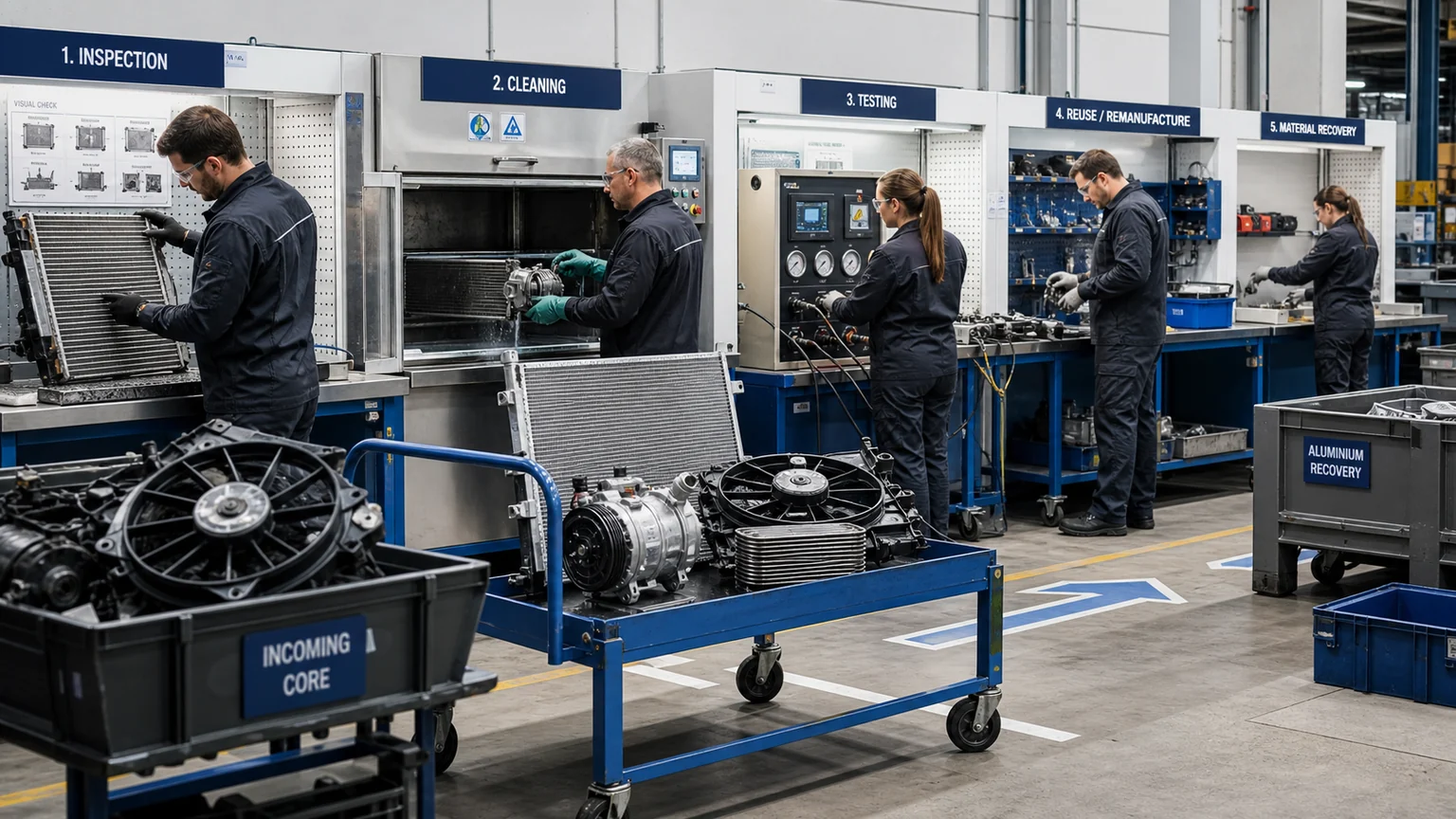
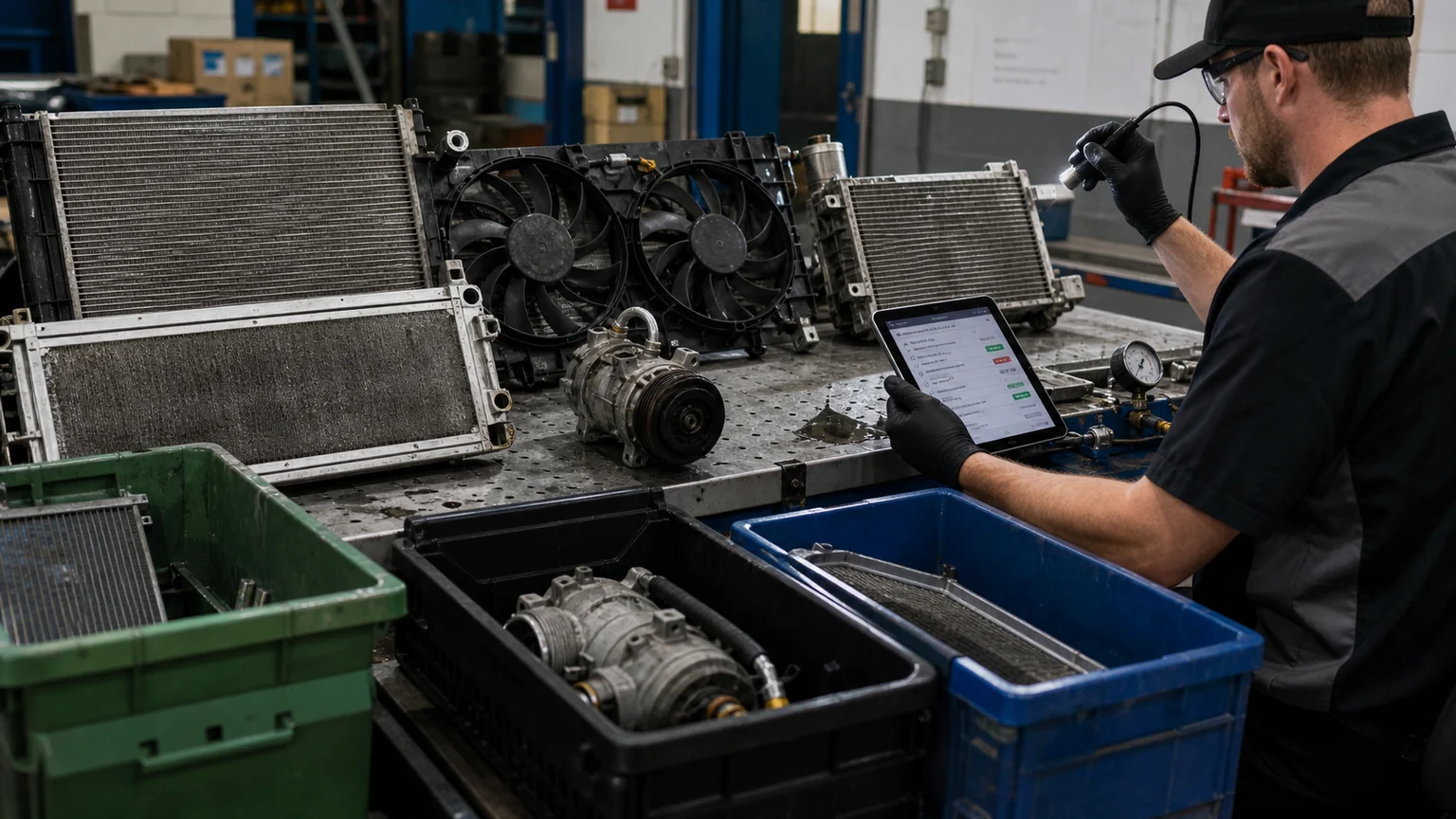
Condition-based triage directs each returned part toward reuse, repair, remanufacture or recycling.
Cooling parts do not share one recovery path. A robust bracket may be visually and dimensionally inspected. A fan shroud can have hidden fatigue around mounts. A motor or integrated controller needs electrical and functional testing. A heat exchanger may look straight while retaining internal restriction, corrosion, mixed fluids or a leak that appears only under defined pressure and temperature. A refrigerant component adds moisture and contamination sensitivity.
Start by classifying each product family for pressure, electrical energy, refrigerant, coolant/oil media, cleanliness, thermal duty, vehicle criticality and consequence of failure. Then define eligible circular routes. A policy may allow repaired mounting brackets, remanufactured belt-driven compressors and recycled-content packaging while prohibiting direct reuse of contaminated microchannel condensers without a validated cleaning and test process.
Do not use age as the only condition rule. A newer component can be collision-damaged or contaminated; an older core can remain structurally recoverable. Equally, a passing leak test does not prove adequate heat transfer or flow. Combine history, inspection, dimensions, cleanliness and performance tests appropriate to the product.
Repairability begins with access and information. Are serviceable subcomponents available? Can fasteners be removed without destroying the housing? Are connectors, seals, bearings, brushes, control modules or valves separately identifiable? Does the supplier provide safe disassembly limits, torque, fluids, calibration and post-repair tests? Can the unit be opened and resealed without introducing contamination?
A buyer can create a local screening score across five practical fields: disassembly, information, spare elements, testability and economic viability. This is a procurement tool, not an industry-standard repairability rating. One transparent option is to assign 0 for unavailable, 1 for partly available and 2 for verified in each field, producing a 0–10 screening total; buyers should publish any different weights and keep the underlying evidence with the result.
Avoid awarding points only because a product uses screws. A screwed housing with no available seal, no diagnostic method and no test specification is not meaningfully repairable. Conversely, a sealed heat exchanger can still support a circular programme through durable design, controlled collection and material recovery even when field repair is unsuitable. The total should guide questions and comparisons, not override safety limits, technical qualification or lifecycle cost.
Include time and skill. A design that requires specialist high-voltage isolation, refrigerant handling or pressure testing may be repairable only in an equipped facility. The procurement record should name the authorised route rather than imply every workshop can perform it. Training, tools and safety controls are part of the system.
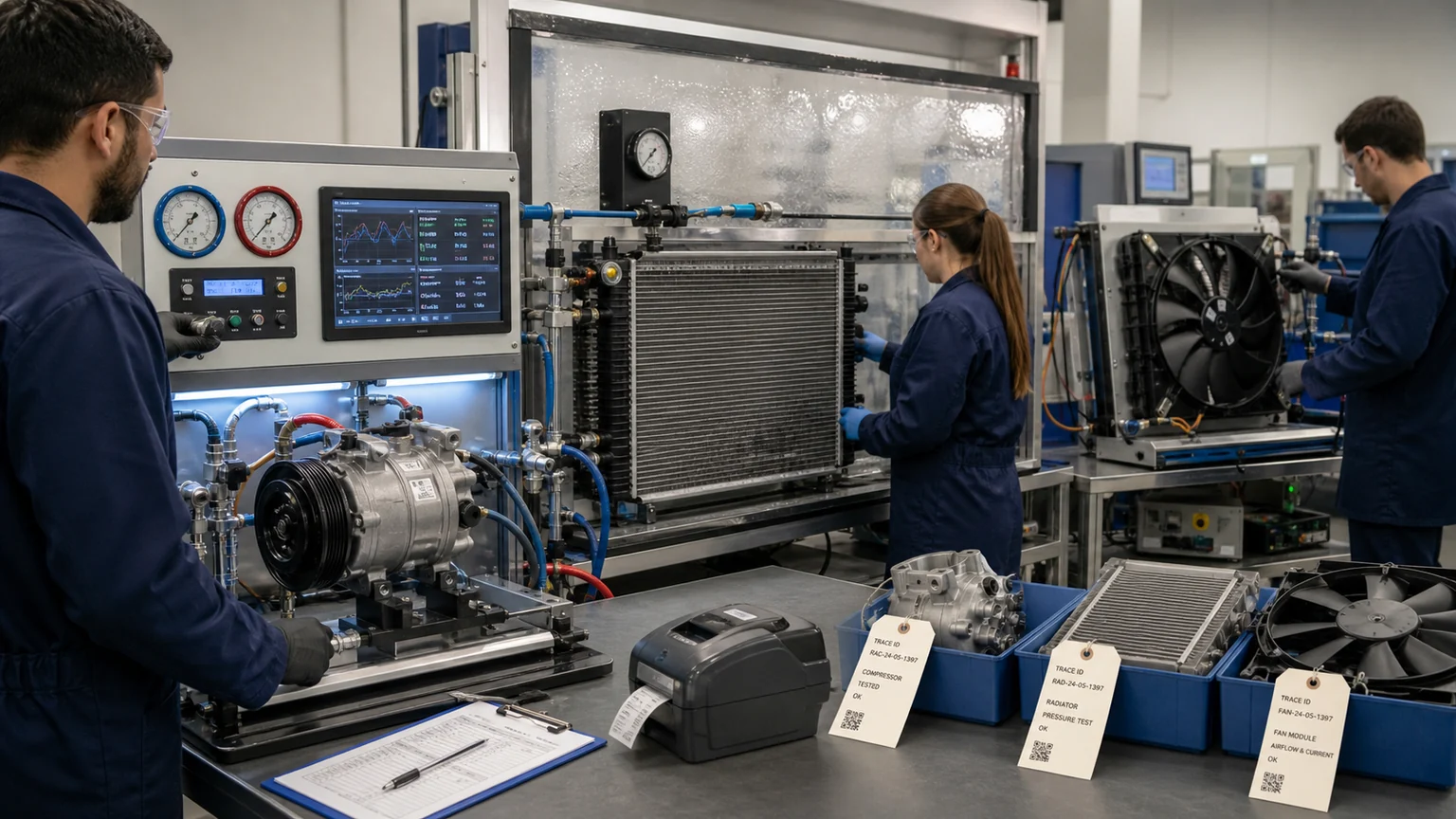
Recovered parts need performance, leak, electrical and traceability evidence before release.
For heat exchangers, possible test-plan items include identity, core and port dimensions, visual fin and tube inspection, pressure integrity, leak rate, flow or pressure drop, cleanliness and, where justified, thermal performance sampling. The applicable items depend on the design, media, failure risk, recovery route and release claim; they are not a universal checklist for every heat exchanger. Test media and drying must not create corrosion or leave residue. Acceptance pressure and method must follow the product design; one universal workshop value is inappropriate.
For a remanufactured A/C compressor, the evaluation may cover core identity, disassembly and rejection criteria, restored or replaced wear components, cleanliness, oil control, leak integrity, displacement or flow, noise, torque or power, clutch or control response and traceability. Select tests by compressor architecture, refrigerant, control method and intended application. Electric compressors require architecture-specific electrical safety, insulation and control evidence. Ask what “100% tested” actually measures.
For a cooling fan or fan module, inspect blade and shroud integrity, bearings, connector and loom, motor/control electronics, current at known voltage and command, rotation, vibration and airflow or a correlated production test. A motor that spins freely by hand is not qualified. A cosmetic repaint can conceal corrosion without proving electrical or mechanical condition.
Keep results linked to lot or serial identity. Sampling may suit stable new production, while a recovered high-value assembly can justify unit-level testing. The supplier should disclose whether results are individual, lot-based or type-validation data. The buyer should not describe a sample test as proof for every unit.
The record should connect supplier part number, distributor SKU, OE cross-reference, revision, source category, production or remanufacturing site, lot/serial, test status, shipment and warranty. For a reused unit, retain the source and condition grade without exposing unnecessary personal data. For recycled content, retain the material, percentage basis, pre- or post-consumer classification, calculation boundary and verification source.
A QR code may link to this information, but the code itself proves nothing. Human-readable identity must remain available when labels are damaged or systems are offline. Control duplicate serials, label replacement and data retention. If a part is repaired again, the record should preserve its history rather than overwrite the previous lifecycle.
Traceability also enables targeted action. When a leak-test fixture is found out of calibration, the distributor can isolate the affected lot. When one returned fan controller shows a common electrical failure, serial-linked installation evidence helps distinguish a supplier issue from incorrect vehicle voltage or command.
Total cost includes acquisition, inspection, core charge, freight, packaging, inventory, installation, downtime, return administration, rejected cores, repeat failures and end-of-life treatment. A lower-cost recovered part with variable condition can be more expensive if it raises diagnostic labour or vehicle downtime. A higher-priced remanufactured unit may be attractive when the exchange loop, tests and warranty are reliable.
Estimate service life conservatively. Treat supplier statements about service life, durability or lifecycle benefit as claims until they are supported by comparable test methods, field data or a documented assessment boundary. Do not claim that reused, remanufactured or recycled-content products automatically last as long as a particular new product without comparable evidence. Compare failure and return data by product class, duty, supplier lot and confirmed cause. Separate wrong application, shipping damage, installation cause, no-fault-found and verified product defect.
Environmental comparisons need the same discipline. State the boundary: product, package, transport, core collection, remanufacturing energy, avoided material or end-of-life recovery. A mass of reused aluminium is not a complete carbon footprint. Prefer supplier-specific, method-documented data over broad percentage claims. When data are estimates, label assumptions and range.
The most circular component is not necessarily the one with the highest recycled-content percentage. A product that fails early can consume another part, another shipment, more refrigerant or coolant, additional labour and vehicle downtime. Set durability evidence that reflects the intended environment: vibration, pressure cycling, thermal cycling, corrosion, dust, salt, moisture, electrical transients and long idle or high-load operation as applicable.
Translate vehicle duty into component stress. Urban buses can experience frequent fan speed changes and long low-speed heat rejection. Mining or construction equipment adds dust, impact and cleaning exposure. Coastal markets add corrosion. Hot regions combine high condenser inlet-air temperature with heavy A/C load. A supplier should explain which validation represents these conditions and what is type validation, routine production control or a special customer test.
Design changes need control over the life of the programme. A thinner material, different polymer, revised brazing process, alternate motor or new controller may improve cost or circularity but alter performance and serviceability. Require advance notification for defined changes, new sample approval where risk warrants it, and traceability that keeps old and new revisions separable.
A take-back programme is weak if most cores are rejected after expensive transport. Reusable packaging is weak if workshops cannot store it cleanly or carriers will not return it. Easy disassembly is weak if opened units release residual fluids without a safe collection method. Recycled material is weak if variation causes leaks, brittle mounts or shorter service life. Review the full chain from removal to next use or material recovery.
Use a mass-balance worksheet for pilots. Record products shipped, packages issued and returned, cores offered, cores accepted, units remanufactured, units directed to material recovery, fluids captured and disposal residues. Add distance and mode for the main transport legs. The numbers reveal where a circular claim depends on an unrealistic return rate or unreported reject stream.
Social and operational capacity also matter. Recovery partners need safe work instructions, suitable equipment and stable demand. Workshops need time and labels. Distributors need clean segregation areas and data fields. A programme that shifts unpaid inspection or hazardous handling to the least-equipped participant will not remain reliable.
Core return and parts recovery fail when packaging, fluid handling and ownership are undefined. Specify lawful refrigerant recovery, controlled draining, capped ports, protective bags, fin and connector guards, shock-resistant cartons, labels and segregation. Do not ship a contaminated heat exchanger beside a tested product. State who owns the core, when credit is issued, how rejects are evidenced and where unusable units go.
Reusable packaging can reduce waste only if it survives the route and returns at a useful rate. Track loss, cleaning, damage and reverse freight. A heavy container that travels empty over long distances may not deliver the assumed benefit. Match packaging design to part value, damage sensitivity, route frequency and local recovery partners.
For material recycling, map the treatment chain. Cooling assemblies can contain aluminium, copper, steel, engineered polymers, rubber, residual oil/coolant/refrigerant and electronics. Depollution and separation affect both safety and material quality. Use authorised facilities and retain transfer records where required.
Regulation (EU) 2026/1738, adopted on 8 July 2026 and published on 24 July 2026, addresses circularity requirements for vehicle design and the management of end-of-life vehicles. Its subject matter includes type-approval-related design and production requirements, information and labelling for parts, components and materials, extended producer responsibility, collection and treatment, and used-vehicle exports. Scope and timing are specific: it covers defined vehicle categories, extends some coverage from 1 September 2029 or 1 September 2031, and applies particular design requirements to vehicle types approved from later dates such as 1 September 2032.
This regulation is therefore relevant context for supplier data, material information, recoverability and end-of-life planning, but each obligation must be mapped to the exact article, vehicle category, responsible party and application date. It should be read with implementing or delegated measures where the article depends on them; this article is a procurement framework, not legal advice.
It is not accurate to say that every aftermarket radiator, condenser, fan or compressor worldwide has immediately become subject to one universal recycled-content or repairability rule. Distributors should monitor obligations that apply to their role, products and destination, while using the broader direction to improve data, recoverability and supplier readiness. Legal review is appropriate before making compliance claims.
Depending on the market, component, refrigerant, lifecycle status and transaction, other legal categories may also apply, including product safety, chemicals and restricted substances, refrigerant handling, waste classification, dangerous-goods or general transport rules, producer responsibility, type-approval relationships, consumer or commercial warranties and cross-border shipment. Buyers should verify which rules and responsible-party duties apply rather than assuming every category governs every cooling part. A circularity claim does not by itself displace an otherwise applicable obligation.
Area | Minimum question | Strong evidence |
|---|---|---|
Technical fit | Does the exact variant meet application and duty? | Controlled drawings, references, samples and validation |
Lifecycle route | Is the product new, repaired, reused, refurbished or remanufactured? | Consistent definition on process, label and invoice |
Quality | Which inspections and tests support release? | Acceptance ranges, calibrated equipment and lot/serial results |
Materials | What content or recovery claim is made? | Defined boundary, calculation and verification |
Repair and spares | What can be serviced, by whom and with what information? | Parts, instructions, tools, tests and availability commitments |
Reverse logistics | How are cores, packaging and rejected units handled? | Ownership, grading, transport, credit and treatment records |
Improvement | How are returns converted into corrective action? | Cause-coded data, containment, corrective action and verified closure |
Replacement radiator: first pass application, media, core, port, cap/tank and duty requirements. Then compare durable new production, verified recycled material, packaging recovery and any local repair route. Direct reuse needs source, corrosion, contamination, pressure, flow and thermal evidence that is often difficult to establish economically.
Compressor exchange: compare a new unit with a controlled remanufactured programme. Audit core identity and grading, contamination controls, restored parts, oil, tests, serial records, core freight and warranty. The vehicle system still requires root-cause correction and application-specific preparation.
Fan module: a replaceable motor or controller can improve repairability, but only if the connector, software/control, electrical protection, balance and airflow remain validated. A recovered module requires more than a spin test. Track energy/current and noise as well as physical condition.
Select one product family, defined applications and a small group of customers or workshops. Establish the new-part baseline: returns, transport damage, lead time, packaging, warranty handling and cost. Train participants on identification, fluid handling, core protection and evidence capture. Agree on core grades and test criteria before the first return arrives.
During the pilot, review every reject and repeat failure. If labels are missing, change the capture point. If fins are damaged in reverse transport, improve guards. If the remanufacturing facility cannot separate variants, strengthen the master data. If a test does not correlate with field performance, revise the validation plan instead of simply tightening visual inspection.
Scale only after accepted-core supply, release quality, lead time and economics are stable. Preserve a new-part route for unsuitable cores, urgent downtime and applications outside the validated scope. Circular procurement is strongest when it expands qualified options rather than forcing every return through the same recovery process.
State the exact application, technical specification, duty cycle, destination and annual volume. Ask the supplier to identify the lifecycle category, facility, process, material claims, tests, traceability level, warranty, repair information, spare-element availability, packaging, core or take-back programme and end-of-life route. Require exceptions to be declared before award.
Set a baseline and improvement targets: verified content, return rate, accepted cores, packaging recovery, cause-coded warranty data, service information or repair-element availability. Avoid rewarding a percentage that encourages weaker products or excessive transport. Use technical quality, total cost, environmental evidence and supply resilience together.
Elecdura can help buyers build this evidence schedule for radiators, condensers, coolers, fans and compressors. Send the OE reference or specification, operating duty, expected quantity, destination, preferred lifecycle route and the tests or traceability you require. The result should be a technically qualified parts programme with defensible circular benefits, not a sustainability label attached after the purchasing decision.