English
Views: 0 Author: Site Editor Publish Time: 2026-08-10 Origin: Site
Semi truck radiator replacement commonly costs about $1,500 to $4,500 for parts and labor in many North American repair scenarios, but the real number can move outside that band when the truck has poor access, corrosion, cooling-stack damage, dealer-only parts, emergency roadside work, or extended downtime. The radiator itself may be only one part of the bill. Coolant, hoses, clamps, cap, thermostat, fan clutch checks, charge-air cooler removal, A/C condenser access, towing, and lost work time can change the total quickly.
This article explains the cost drivers behind semi truck radiator replacement so fleet buyers, repair networks, and parts distributors can quote more accurately. It covers parts cost, labor scope, downtime, core size, tank layout, packaging, and sourcing evidence. Elecdura supports truck and automotive radiators, cooling fan assemblies, fan clutches, and thermostats for buyers who need reliable cooling-system replacement parts.
Cost Area | Typical Planning Range | Why It Changes |
|---|---|---|
Radiator part | $800-$2,500+ | Truck make, core size, OEM vs aftermarket, heavy-duty construction |
Labor | 3-8 hours in many jobs | Access, corrosion, cooling-stack removal, shop rate |
Coolant and supplies | $100-$400+ | Coolant capacity, hoses, clamps, cap, disposal |
Related repairs | $100-$1,000+ | Hoses, thermostat, fan clutch, mounts, damaged brackets |
Downtime | Highly variable | Route interruption, load delay, towing, missed revenue |
Use the table as a planning framework, not a fixed quote. A clean planned replacement in a well-equipped shop may stay near the lower part of the range. An emergency job with corrosion, backordered parts, or front-end stack damage can climb quickly.
Semi truck radiators vary by truck make, engine, year, cooling package, core size, tank material, mounting layout, and supplier type. A radiator for a common Freightliner, International, Kenworth, Peterbilt, Volvo, Mack, Western Star, or medium-duty platform may have several aftermarket options. A less common application may require a higher-priced source or longer lead time.
OEM radiators may cost more but can reduce fitment uncertainty for newer trucks or warranty-sensitive fleets. Aftermarket radiators can offer better value when the supplier matches the OE dimensions and construction correctly. Direct import programs can reduce unit cost for distributors, but only when sample approval, pressure testing, packaging, and part-number control are strong.
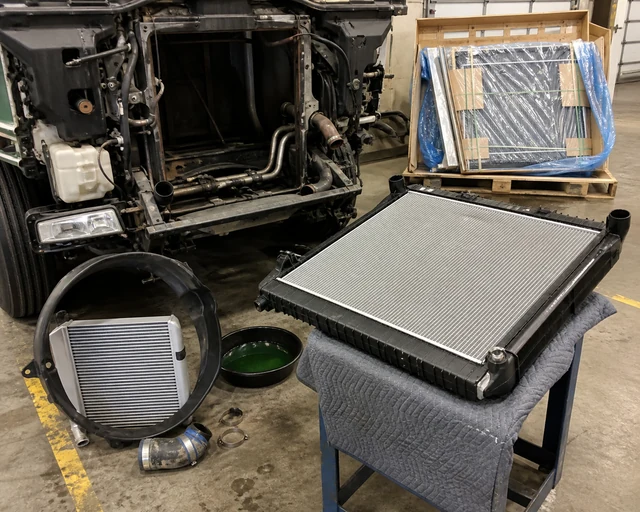
Radiator replacement is not always a simple remove-and-install job. The shop may need to drain coolant, remove shrouds, move charge-air cooler components, remove brackets, disconnect hoses, handle transmission cooler lines where applicable, transfer mounts, clean debris, install the new radiator, refill coolant, bleed air, pressure-test the system, and road-test the truck. Rusted fasteners and tight access can add time.
Labor rates also vary by region and shop type. Independent shops, dealership service departments, mobile repair, and emergency roadside work can have very different hourly rates. For quoting, record expected labor hours separately from shop rate. This makes it easier to compare a planned repair with an emergency repair.
For a fleet, downtime can be more expensive than the radiator. A truck waiting for a part may miss a delivery, require load transfer, create driver rescheduling, or occupy a repair bay. If the failure happens on the road, towing and emergency labor can add quickly. This is why planned replacement and accurate parts sourcing matter.
Fleet buyers should track which radiator numbers are used in their vehicles and where they can be sourced quickly. A distributor that can confirm core size and tank layout before shipment may save more money than a supplier with a slightly lower unit price but higher wrong-part risk. Downtime turns fitment accuracy into a financial issue.
Core size affects material cost, shipping size, and cooling capacity. A larger or heavier-duty radiator may cost more but may be necessary for the truck's engine and duty cycle. Tank layout affects installation. Inlet and outlet position, cap neck, drain, sensor ports, lower pins, side brackets, and shroud fit must match. A wrong layout can add labor or stop the job completely.
Before quoting, collect photos and measurements of the old radiator. Record core height, width, thickness, overall dimensions, hose neck diameter, mounting points, and any fittings. A quote based only on truck model is less reliable. This is especially true when several cooling packages were available for the same truck platform.
Planned replacement allows the fleet to compare suppliers, confirm fitment, schedule labor, and order related parts. Emergency replacement often forces the buyer to accept available stock, pay higher labor, or wait for freight. The same radiator can therefore produce very different total costs depending on timing.
For high-use trucks, inspect radiator condition during scheduled maintenance. Look for tank seepage, fin damage, coolant residue, loose mounts, hose swelling, cap problems, and debris between cooling-stack layers. Replacing a weak radiator before it fails on the road can be cheaper than waiting for a breakdown.
Radiator replacement often reveals related issues. Hoses may be brittle, clamps may be weak, the cap may not hold pressure, the thermostat may be old, the fan clutch may not engage properly, or the shroud may be damaged. If these parts are ignored, the new radiator may be blamed for continued overheating.
Include a line in the quote for possible related parts. This helps the customer understand why the final bill may change after inspection. For distributors, stocking related parts next to fast-moving radiators can help workshops complete the repair without waiting for small items.
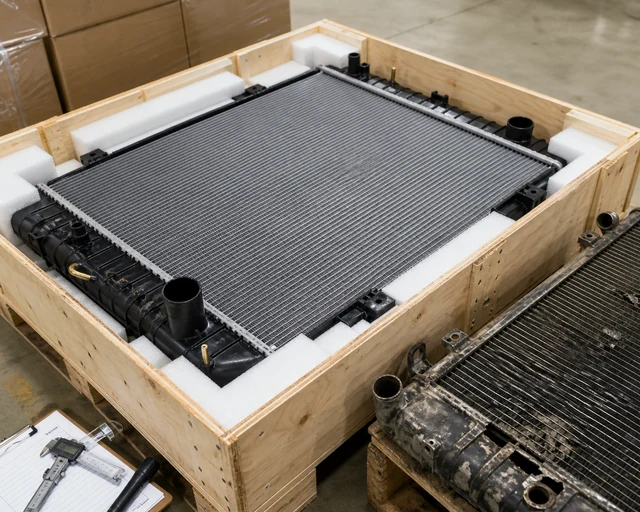
Semi truck radiators are large and damage-prone. Freight cost depends on size, weight, distance, urgency, and packaging. A cheap radiator shipped poorly can arrive with crushed fins, bent brackets, cracked tanks, or damaged necks. Freight damage creates downtime and claim handling even if the radiator was correct.
When evaluating suppliers, ask for packaging photos. Look for edge protection, internal supports, carton strength, and pallet method. If a distributor ships directly to repair locations, packaging must survive more than one handling step. Freight reliability should be included in the sourcing decision.
Example one: a planned independent-shop replacement uses an aftermarket radiator for a common truck. The part is available, access is normal, and related hoses are acceptable. The job may land near the lower-to-middle range because labor and sourcing are controlled.
Example two: a radiator fails on the road. The truck needs towing, the shop has limited part options, and corroded hardware increases labor time. Even if the radiator part price is ordinary, emergency service and downtime push the total higher.
Example three: a fleet replaces a radiator but ignores a weak fan clutch and blocked cooling stack. The truck overheats again. The first radiator quote looked cheaper, but the total cost rises because diagnosis was incomplete.
Truck make, model, year, engine, VIN, and cooling package if known.
Old radiator OE number or label photo.
Core height, width, thickness, and overall dimensions.
Inlet, outlet, cap neck, drain, fitting, and bracket photos.
Transmission cooler fitting status where applicable.
Complaint: leak, overheating, impact damage, restriction, or preventive replacement.
Required timing: planned repair, urgent shop repair, or roadside emergency.
Destination and packaging requirements.
Distributors can reduce total cost for customers by keeping accurate fitment records and packaging standards. For each fast-moving radiator, maintain an approved photo sheet with dimensions, tank layout, bracket positions, and related notes. Train sales staff to ask for measurements when fitment is uncertain. Keep similar radiators separated in the warehouse.
Review claims by category: leak, freight damage, wrong fitment, overheating after installation, or customer ordering error. Each category requires a different response. Leak claims may require supplier review. Freight damage may require packaging improvement. Overheating claims may require system-diagnosis support. Wrong fitment may require catalog correction.
A higher-priced radiator can be cheaper when it prevents downtime, fits first time, arrives undamaged, and survives the duty cycle. For trucks that operate under heavy load or far from the repair base, reliability has financial value. A lower-priced radiator that creates a second repair can erase the savings immediately.
Use total-cost thinking. Compare part price, labor risk, shipping reliability, warranty support, and downtime exposure. For fleets, the best radiator is the one that keeps the truck working, not the one that wins the first invoice line by a small margin.
Two shops can quote very different prices for the same radiator replacement because they may not be quoting the same work. One quote may include only the radiator and basic labor. Another may include coolant, hoses, clamps, cap, pressure testing, cooling-stack cleaning, and road testing. A dealer quote may use OE parts and a higher labor rate. An independent shop may use aftermarket parts and a lower rate. A mobile repair may add travel and emergency charges.
When comparing quotes, ask what is included. Does the quote include coolant disposal? Does it include inspection of fan clutch and thermostat? Does it include cleaning debris between the condenser, charge-air cooler, and radiator? Does it include pressure testing after installation? A cheaper quote that skips these steps may not be cheaper if the truck returns with overheating.
A regional delivery truck, long-haul tractor, vocational truck, and owner-operator vehicle may all need different radiator decisions. A long-haul truck far from base has higher downtime risk. A vocational truck working in construction or refuse service may suffer more debris and vibration. A regional delivery truck may idle frequently with A/C load. These use cases affect how much durability and supplier support matter.
For medium-duty trucks, access may be easier and the radiator may be less expensive. For heavy-duty tractors, the front cooling module may be larger and more complex. For older trucks, corrosion and brittle hoses can add labor. For newer trucks, dealer-only data or emissions-related packaging can affect access. The quote should reflect the vehicle, not only the word "radiator."
Downtime Factor | Question to Ask | Why It Matters |
|---|---|---|
Load schedule | Will the truck miss a delivery or route? | Lost revenue can exceed part cost |
Repair location | Is the truck at base, shop, or roadside? | Towing and travel increase cost |
Part availability | Can the correct radiator arrive today? | Wrong part adds another delay |
Driver time | Is the driver waiting or reassigned? | Labor planning affects total cost |
Repeat failure risk | Were related cooling faults checked? | Second repair multiplies downtime |
Fleet cost control should include these items because the invoice alone understates the problem. A radiator that saves $150 but delays the truck by another day may be a poor decision. A supplier with better fitment confirmation can reduce downtime even if the unit price is not the lowest.
Radiator construction affects price. Tube design, fin density, tank material, bracket strength, pressure rating, and manufacturing quality all influence cost. A heavy-duty radiator may use stronger materials or construction features that support vibration and heat load. A lower-cost radiator may be suitable for lighter service but not ideal for severe duty.
Buyers should ask suppliers to explain the construction, not only the application. If two radiators have the same OE cross-reference but different core thickness or tank design, the buyer should understand the difference. Sometimes the lower-cost version is acceptable; sometimes it reduces margin by increasing claims. For fleet programs, choose the specification based on actual operating duty.
The radiator may sit behind or beside other heat exchangers and shrouds. Depending on truck design, the technician may need to move or protect the charge-air cooler, A/C condenser, fan shroud, grille, brackets, or air guides. If those components are corroded or packed with debris, labor increases. If the shop finds a damaged condenser or charge-air cooler during the job, the quote may change.
For planned jobs, inspect the stack before quoting. Check whether fins are blocked with road debris, oil, insects, or dust. Check whether brackets are bent and whether the fan shroud is complete. A clean cooling stack helps the new radiator perform. A neglected stack can make a new radiator look weak.
Preventive replacement is easier to control. The truck can be scheduled, the correct part can be ordered, and related parts can be inspected in advance. Failure replacement is reactive. The truck may already be overheated, the driver may be stranded, and the buyer may have limited choices. Preventive replacement is not always necessary, but it can make sense when a radiator shows seepage, weakened tanks, or repeated temperature complaints on a high-value route.
Fleets should track radiator age, mileage, operating duty, and failure history. If certain trucks repeatedly suffer radiator problems, review mounts, fan shroud, vibration, coolant maintenance, and route conditions. Replacing the radiator without understanding the pattern may hide a maintenance problem.
Line Item | Include in Quote? | Notes |
|---|---|---|
Radiator | Yes | OE or aftermarket reference and warranty |
Labor | Yes | Expected hours and hourly rate |
Coolant | Yes | Type, quantity, disposal |
Hoses and clamps | Inspect / optional | Replace if brittle or leaking |
Cap and thermostat | Inspect / optional | Important for pressure and flow complaints |
Cooling-stack cleaning | Often recommended | Improves heat exchange |
Pressure test and road test | Yes | Verifies repair |
Downtime or towing | Case by case | Fleet accounting item |
Importers can lower cost by planning demand, consolidating shipments, approving samples carefully, and reducing wrong-fit returns. The cheapest unit price is not the only lever. Better carton design reduces freight damage. Better labels reduce picking errors. Better photo records reduce wrong orders. Better supplier communication reduces emergency sourcing.
For each radiator program, keep a file with OE references, dimensions, approved photos, packaging photos, pressure-test expectations, and claim history. When a customer asks for a quote, the sales team can respond with confidence. When a supplier changes construction, the purchasing team can detect it. This operational discipline saves money over time.
Is the quote for planned shop work, mobile repair, or emergency roadside service?
Is the radiator OE, branded aftermarket, private label, or direct import?
Are coolant, cap, hoses, clamps, and thermostat inspection included?
Does labor include cooling-stack removal or cleaning if needed?
Has the old radiator been measured and photographed?
What happens if the delivered radiator is wrong or damaged?
How long will the truck be down, and what is the operational cost?
What warranty evidence will be required if overheating returns?
Sometimes the most professional answer is to delay a final quote until evidence is collected. If the buyer does not know the truck model, engine, VIN, radiator size, or failure type, the quote will be weak. If the truck is overheating but no one has checked fan clutch, thermostat, coolant level, or cooling-stack blockage, replacing the radiator may not solve the complaint.
A preliminary range can help the customer plan, but the final quote should follow measurements and diagnosis. This protects the shop from underquoting and protects the customer from buying the wrong part. For distributors, it also reduces urgent returns that damage margin.
Semi truck radiator replacement cost usually depends on part price, labor hours, shop rate, coolant and related parts, freight, and downtime. A practical planning range is often about $1,500 to $4,500 for parts and labor, but the real quote should be based on the truck, radiator dimensions, labor access, and repair condition.
Before ordering, send the OE number, VIN, old radiator photos, measurements, tank layout, mounting details, complaint, and timing requirement. Elecdura can help buyers source truck radiators and related cooling parts with the fitment evidence needed to reduce wrong orders, emergency delays, and avoidable downtime.