Top 10 A/C Condenser Suppliers in Poland for European Distributors
Views: 0 Author: Elecdura Publish Time: 2026-08-31 Origin: Site
Poland is an important European automotive-parts manufacturing, distribution and logistics market, but a search for an “AC condenser supplier” can mix car air-conditioning heat exchangers with building HVAC equipment and companies whose name contains AC. This unranked ten-option shortlist includes only automotive-relevant suppliers and clearly separates Polish manufacturers or brands, Polish distributors and international brands with a documented Polish channel. Its order is for navigation, not a quality or market-share score.
For a private-label or wholesale comparison, Elecdura’s automotive A/C condenser programme can evaluate OE reference, vehicle split, core and port geometry, integrated receiver-drier, sensor provision, pressure integrity, corrosion protection and export packing.
Quick comparison
Supplier
Role in Poland
Useful starting point
Verify before ordering
AS-TECHNIK
Polish vehicle heat-exchanger specialist
Automotive condensers and custom/B2B dialogue
Manufacturing scope, reference data and validation
ESEN SKV
Polish aftermarket brand/distributor
Catalogued condenser references
Factory identity, batch control and exact application
Thermotec
Polish thermal-parts brand/channel
Broad aftermarket cooling catalogue
Current condenser coverage and product origin
Polcar
Polish body and mechanical-parts distributor
Multi-brand automotive condenser access
Actual brand, contents and stock
Inter Cars Poland
Large Polish automotive distributor
Workshop logistics and brand choice
Seller reference, availability and returns
NRF Poland
International thermal brand with Polish operation/channel
Application-led aftermarket condensers
Part revision, dryer/sensor and local stock
Nissens Poland
International thermal brand with Polish company/channel
Automotive climate catalogue
Exact reference, product concept and availability
DENSO Aftermarket Poland
International OE/aftermarket brand channel
Selected OE-origin applications
Official DENSO number and authorized source
Valeo Service Poland
International OE/aftermarket brand channel
Selected European vehicle coverage
Current catalogue, supersession and contents
MAHLE Aftermarket Poland
International thermal brand channel
Selected A/C and engine-cooling applications
Condenser-specific reference and supply route
Availability in a Polish catalogue is not proof of Polish manufacture. Each quotation should identify the legal seller, product brand, manufacturing country or factory when required, stock location and warranty owner.
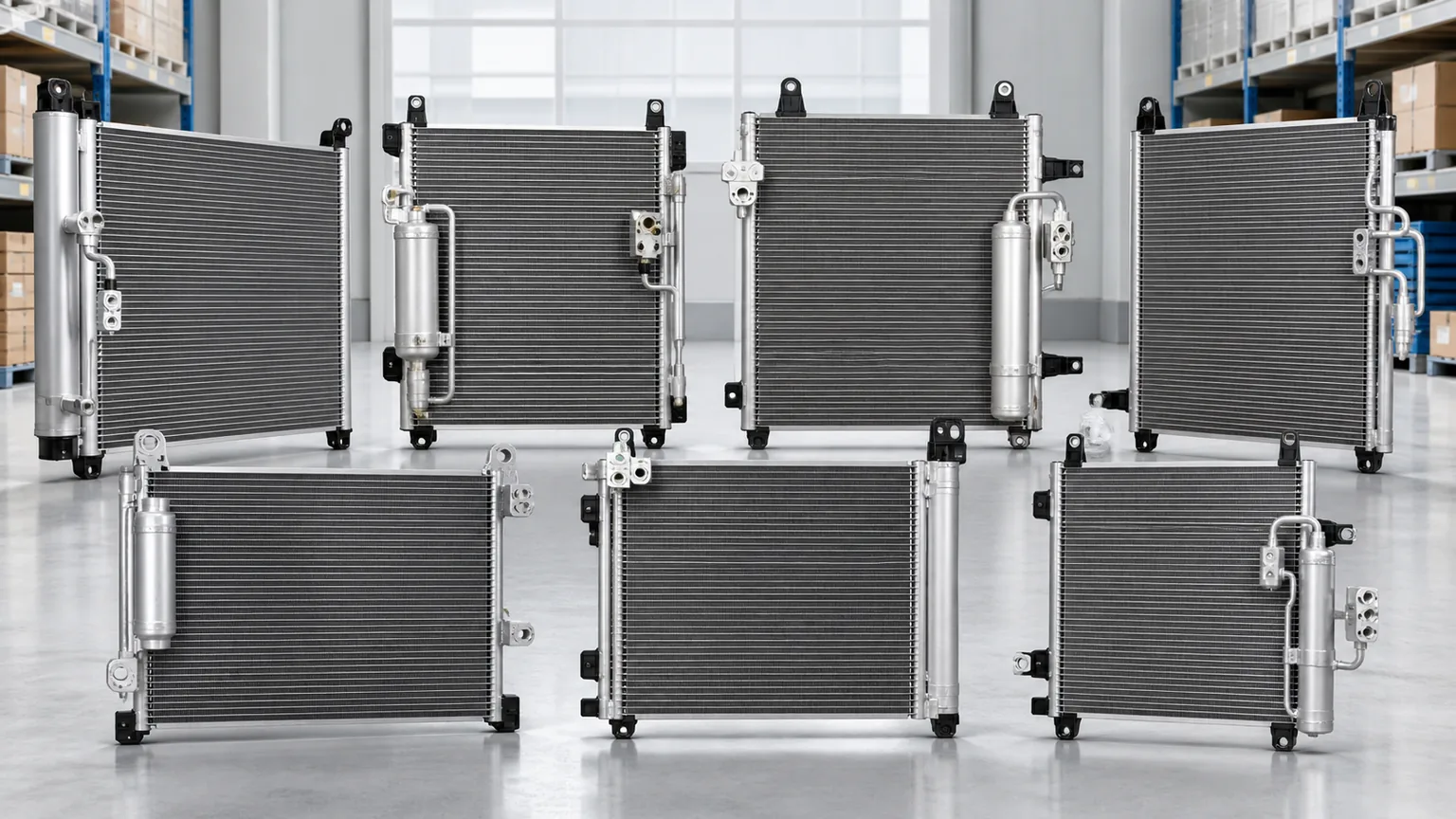
Condenser families differ in header, ports, receiver-drier, brackets, sensor fittings and fin protection.
Selection method and exclusions
Suppliers were evaluated for documented automotive condenser relevance, access for Polish buyers, catalogue or dimensional evidence, technical support, quality information, local or EU fulfilment and warranty handling. A business focused on building chillers, refrigeration cabinets or room air conditioning does not qualify merely because it sells a condenser. AC S.A., the Polish autogas/automotive-electronics company, is also not included without primary evidence of automotive A/C condenser supply.
The list is not a universal quality ranking. A strong option for a Polish workshop buying one unit may not suit a private-label importer ordering containers. Buyers need to match the supplier role to the purchasing model.
AS-TECHNIK
AS-TECHNIK is a Polish specialist that publishes vehicle heat-exchanger capability, making it a relevant first contact when buyers want direct technical discussion around automotive condensers. Its local engineering position can be valuable for dimensional verification, unusual applications and B2B programmes.
Request a current product list, OE crosses, drawings, material and manufacturing-process description, and evidence of leak, pressure, cleanliness and corrosion controls. Clarify which operations are performed in Poland, whether the offered unit is manufactured or sourced, and how engineering changes are approved. For a new programme, validate a labelled sample rather than relying on a family photograph.
Best fit: technically managed Polish B2B sourcing. Audit focus: actual manufacturing scope, product data, testing and repeatability.
ESEN SKV
ESEN SKV is a Polish aftermarket brand and distributor with automotive A/C condenser listings. It can provide broad vehicle coverage and an established European sales structure, but the brand role must be distinguished from the identity of the production factory for each family.
Ask for the exact ESEN SKV number, current application data, OE cross, dimensions and package contents. For distributor or private-label volumes, request factory qualification, incoming/batch inspection, traceability, change notification, claim rate and corrective-action process. Check whether drier cartridge, plugs, seals or sensor are included.
Best fit: broad aftermarket catalogue and regional distribution. Audit focus: source control, reference accuracy, batch data and warranty response.
Thermotec
Thermotec is a Polish-market thermal-parts brand associated with radiators, condensers and other cooling components. It is relevant where buyers need accessible aftermarket coverage through Polish and European channels.
Verify the legal supplier and current condenser range, because brand catalogues and sourcing arrangements change. Compare OE/application data, core and overall dimensions, header/port arrangement, receiver-drier and mounts. Ask whether the same brand number has had design or factory revisions and how old and new stock are distinguished.
Best fit: value-oriented multi-application aftermarket sourcing. Audit focus: current catalogue, origin, revision control and local claim route.
Polcar
Polcar is a Polish distributor known for a broad automotive-parts range, including body and mechanical categories. It can be a practical source for condensers across multiple brands and price positions, supported by domestic logistics.
A distributor listing should disclose the actual product brand and part number. Ask whether the unit is in local stock, what is included, how fitment was established and which party handles warranty. Inspect shipping condition before accepting a fin-damaged or bent assembly, and learn the return rule before protective caps or packaging are removed.
Best fit: Polish stock access and multi-brand purchasing. Audit focus: actual item identity, stock condition, data source and returns.
Inter Cars Poland
Inter Cars is a major Polish automotive distributor with workshop and regional logistics. Its platform can help professional buyers compare brands and consolidate climate-system parts, oils and workshop supplies.
Use VIN and full OE number where possible and request the manufacturer catalogue record behind the cross-reference. Confirm vehicle production split, engine, climate package and condenser revision. For recurring fleet or distributor orders, track return reasons by offered brand and reference instead of treating all catalogue options as technically identical.
Best fit: professional workshop logistics and broad brand access. Audit focus: exact offered brand, application evidence, local availability and claim process.
NRF Poland
NRF is an international thermal-management brand with a Polish-language presence and distribution support. Its automotive range includes condensers and related climate parts, making it a relevant application-led option for Polish buyers.
Confirm the current NRF reference and product configuration. Similar applications may use different ports, dryer location, brackets or pressure-sensor provision. Ask for dimensions and catalogue notes and establish whether the item is stocked in Poland or ordered from a regional centre. Brand availability should not be described as domestic manufacture.
Best fit: catalogued aftermarket climate parts through an established channel. Audit focus: precise variant, components supplied, stock and warranty.
Nissens Poland
Nissens has a documented Polish company/channel and a broad automotive climate and cooling catalogue. It is relevant to distributors that value application data, product-family support and European logistics.
Use the complete Nissens number and current catalogue. Review whether the product concept includes a receiver-drier, caps or fittings and whether installation notes apply. Check original-system contamination before replacing a condenser; a clean new component can be damaged by debris or incorrect oil/refrigerant practice.
Best fit: application-driven European aftermarket procurement. Audit focus: catalogue revision, supplied contents, installation requirements and channel.
DENSO Aftermarket Poland
DENSO is a global OE and aftermarket thermal supplier with Polish aftermarket access. It may be a strong option where a confirmed DENSO condenser number exists, especially on applications connected to DENSO climate-system engineering.
Do not assume that every DENSO-equipped vehicle has a DENSO aftermarket condenser. Verify the official part number and application through the current DENSO catalogue and purchase through an authorized source. Compare package authenticity, labels and the complete physical interface.
Best fit: selected OE-origin vehicle applications. Audit focus: official application, authenticity, availability and exact configuration.
Valeo Service Poland
Valeo has extensive OE and aftermarket climate-system experience and a service channel serving Poland. Its condenser range can suit selected European and international vehicles where a current Valeo reference is documented.
Request the official Valeo number, supersession information and catalogue notes. Confirm whether the receiver-drier and pressure-related fittings match the vehicle and whether new seals are supplied or separately required. A familiar OE name is not a substitute for verifying the seller and reference.
Best fit: selected European vehicle coverage with recognized brand support. Audit focus: current part number, contents, source and fitment.
MAHLE Aftermarket Poland
MAHLE offers engine-cooling and air-conditioning products through European aftermarket channels, including Poland. It can be relevant for selected condenser applications supported by the current MAHLE catalogue.
Confirm that the quoted MAHLE/BEHR reference is specifically an automotive condenser for the target vehicle, not a general thermal product or an obsolete OE association. Ask the distributor for official product data, stock location and warranty path. Verify any superseded number and changed mounting or connection detail.
Best fit: selected catalogued thermal applications. Audit focus: condenser-specific evidence, supersession, authorized supply and availability.
Match more than the core dimensions
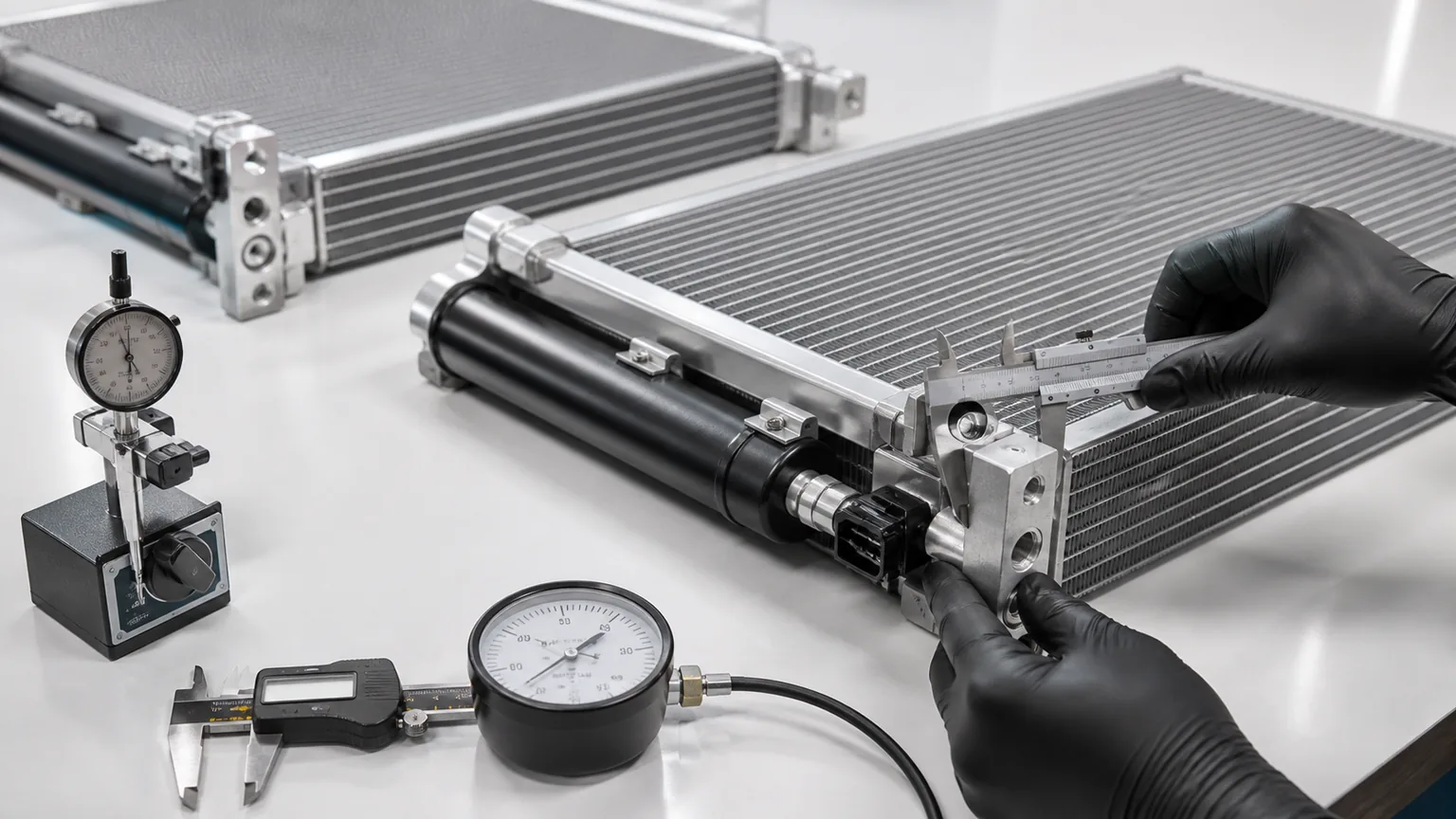
Begin with VIN, model, production date, engine, market and full original OE number. Photograph the original condenser label, both faces, ports, receiver-drier, brackets and any sensor or switch. Measure core width, height and thickness separately from overall envelope, and map mount and port centres from fixed edges.
Compare port type, diameter, block/manifold shape, orientation and sealing surfaces; header layout; drier diameter/location; pressure-sensor boss; bracket thickness; fan or module interfaces; and clearance to radiator, bumper and body. Elecdura’s A/C condenser product guide shows the component families buyers should identify.
Port, drier, sensor and bracket geometry determine whether a condenser is genuinely interchangeable.
Microchannel contamination changes the decision
Modern parallel-flow and microchannel condensers contain many small passages. After severe compressor failure, metal debris, degraded oil or desiccant can be difficult to remove and prove clean. Follow the vehicle and component supplier procedure; replacement is commonly safer where the construction cannot be reliably flushed or where contamination remains.
Do not use compressed air or an improvised solvent method. Identify the refrigerant and approved oil, isolate components that must not be flushed, replace the receiver-drier and expansion device where required, and document the recovery, contamination and cleaning work. See Elecdura’s microchannel condenser flush-or-replace guide.
Quality audit and validation
Audit aluminium material control, tube/fin and header dimensions, brazing profile, port machining, drier assembly, cleanliness, leak testing, corrosion protection, bracket fixtures and final inspection. Ask how the factory detects blocked or poorly brazed channels and controls cap installation and moisture exposure.
Agree the test standard and refrigerant-side pressures for the intended system. Evidence may include leak, proof/burst where specified, pressure cycle, thermal cycle, vibration, salt/corrosion and dimensional capability. Do not impose one pressure value across different refrigerants and vehicle architectures. Approve samples with traceable drawings and labels.
Packaging and incoming inspection
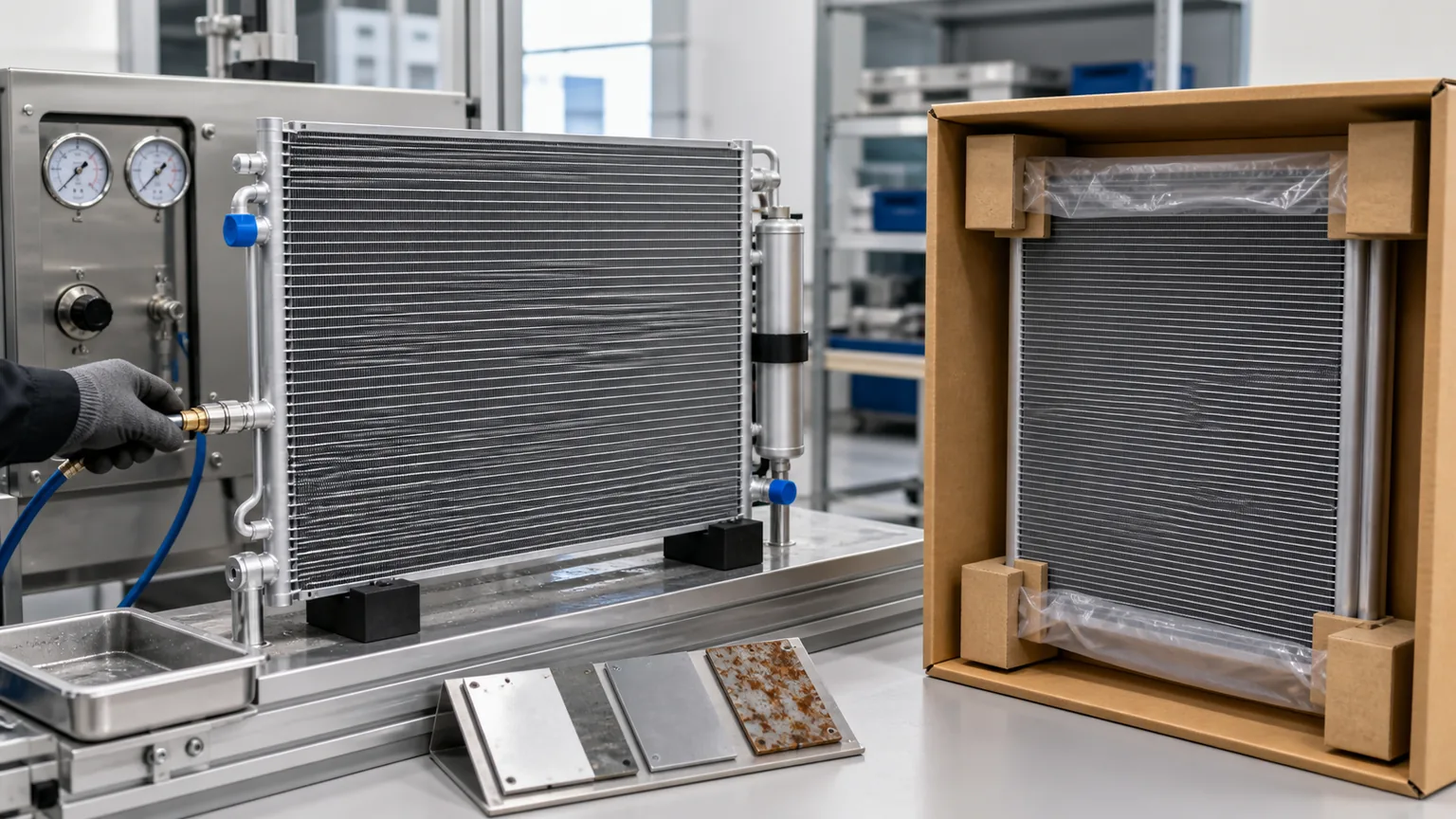
A condenser can be leak-tight at the factory and unusable after transport. Packaging must protect both faces from contact, prevent port blocks and brackets taking carton load, immobilize loose hardware and maintain clean sealed ports. Inspect carton impact, fin crush, twist, broken brackets, port damage, missing caps and drier exposure before installation.
For private-label orders, validate packed-product vibration, compression and drop exposure at the agreed distribution level. Elecdura’s automotive cooling-parts packaging guide provides evidence fields for damage reduction.
Pressure integrity, corrosion control, clean capped ports and load-path packaging must work together.
Build a Polish distributor range
Use local registration and sales history, workshop lost-sales records, seasonal demand, supplier lead time, return rate and carton volume to choose stock. Consolidate equivalent demand by OE application but preserve every production split. High-frequency references justify local safety stock; low-frequency variants may be supplied from an EU hub if the promised lead time is reliable.
Publish clear catalogue content: product brand, OE cross, dimensions, port and bracket images, dryer/sensor configuration, what is included and installation notes. Track wrong-application, transit-damage, contamination, installation and confirmed manufacturing claims separately. This data improves both supplier selection and workshop behaviour.
Installation and commissioning controls
Protect the new condenser until the moment of connection. Dry-fit it first without forcing ports or brackets, compare hose alignment and ensure that no screw, grille, fan or adjacent heat exchanger can contact the core. Replace disturbed O-rings with the specified material and size, lubricate only as required by the service procedure and torque fittings to the approved value. A fitting drawn into alignment by its bolt can preload the port block and create a delayed leak.
Where compressor debris or degraded lubricant is present, define the complete system recovery plan before connecting the clean condenser. Components that cannot be reliably flushed may need replacement, and serviceable lines or evaporators need an approved method followed by proof that contaminants and solvent are removed. Replace the drier/desiccant and metering device where the vehicle or component procedure requires it. Use only the specified refrigerant and oil type and account for oil retained in replaced components.
Evacuate and charge by the vehicle maker’s method, leak-check the completed system and record ambient conditions, static/off pressures where relevant, high- and low-side operating pressures, centre-vent temperature, fan command and condenser airflow. Pressure readings are not judged in isolation: engine speed, cabin load, humidity, recirculation, airflow and refrigerant architecture all matter. On electronically controlled systems, scan faults and compare commanded states.
After the initial operating cycle, inspect every connection, bracket, hose clearance and stack interface. A condenser that is dimensionally correct but poorly sealed to its ducting may allow air to bypass the core. A weak or incorrectly controlled fan can produce high pressure at idle even when the condenser itself is healthy. Record commissioning evidence against the supplier number and lot so later claims can distinguish installation, system and product causes.
Warranty terms for professional buyers
Before launch, agree the warranty period, labour and consequential-cost position, return authorization, inspection timeline and evidence needed for credit. Determine who owns the decision when the brand, distributor and factory are different companies. For international private-label supply, define whether destructive analysis is permitted and how an unreturned part is handled when shipping cost is disproportionate.
A useful claim report states the failure mode rather than “not working.” Include leak coordinates, dry photographs, test medium and pressure/method, vehicle and system condition, recovered refrigerant amount if documented, contamination findings, fan operation, install date and distance, plus packaging and label evidence. Trend claims by production lot and failure mode. One wrong-application return should correct catalogue data; repeated braze leaks from a traceable lot should trigger containment and supplier corrective action.
RFQ checklist
vehicle make, model, VIN/build date, engine and market;
full OE and original condenser numbers;
core and overall dimensions with fixed datums;
port block, orientation and sealing-surface photographs;
receiver-drier and pressure-sensor configuration;
brackets, mounts, adjacent-module interfaces and included hardware;
refrigerant/system and any contamination history;
leak, pressure, cleanliness, corrosion and change-control requirements;
label, caps, carton and export-packing specification;
quantity, destination, delivery need, warranty and sample plan.
Frequently asked questions
Are all ten suppliers Polish manufacturers?
No. The list separates Polish specialists or brands, Polish distributors and international brands with Polish channels.
Does a receiver-drier always come with the condenser?
No. It may be integrated, separately supplied, serviceable by cartridge or absent. Verify the exact package and system requirement.
Can a bent condenser be straightened and installed?
Minor fin deformation differs from structural twist, cracked brazing, damaged tubes, ports or brackets. Quarantine transit-damaged units and follow the supplier decision.
Is pressure testing alone enough?
No. Fitment, cleanliness, flow, corrosion durability, pressure cycling, vibration and packaging can also determine service life.
What should a warranty claim contain?
Include vehicle/application, OE and supplier numbers, lot/serial, refrigerant/oil and contamination record, installation photos, leak location/test method, packaging condition and retained part.
Source in Poland with clear roles and evidence
Polish buyers have useful domestic technical specialists, strong national distribution and established international thermal brands. The right choice depends on whether the order needs a local one-piece replacement, a controlled distributor range or a private-label production programme.
Send Elecdura the OE number, application, dimensions, ports, dryer/sensor arrangement, photographs, quantity and destination. We can compare the interface, prepare sample and test requirements, and quote protected wholesale supply.