English
Views: 0 Author: Site Editor Publish Time: 2026-07-28 Origin: Elecdura
South Korea fan clutch sourcing should be understood in two layers. The first layer is Korean vehicle applications such as Hyundai, Kia, GM Korea, Daewoo, SsangYong, KGM, Porter, Bongo, Starex, Mighty, buses, and export commercial vehicles. The second layer is the supplier route used to confirm and buy the correct viscous fan clutch, thermal fan clutch, genuine cooling fan clutch, or heavy duty cooling fan drive. A useful supplier is not only a name on a list. It must help the buyer verify OE numbers, bolt pattern, pilot diameter, clutch height, fan blade compatibility, thermal response, silicone fluid leakage risk, bearing quality, and packaging for export.
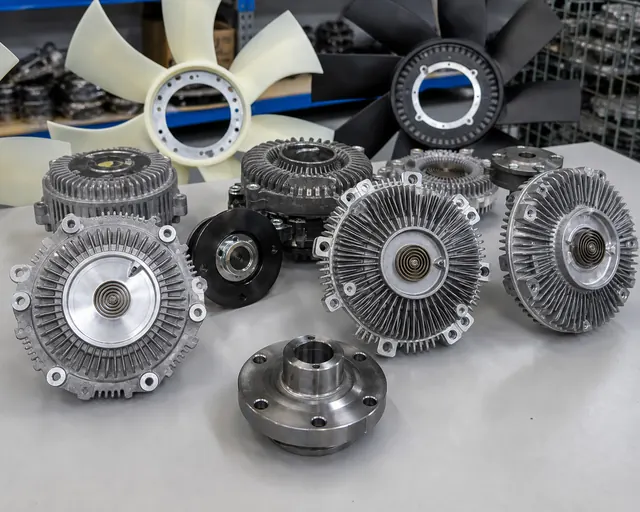
Fan clutch sourcing should compare hub design, thermal spring type, bolt pattern, and matching fan blade requirements.
This article compares the key supplier options for buyers working with South Korea and Korean vehicle fan clutch demand. The focus is on Korean manufacturers, Korean OE parts channels, Korean vehicle exporters, and qualified wholesale support for aftermarket programs. The purpose is to help importers, wholesalers, fleet buyers, and repair supply chains build a practical sourcing map without confusing fan clutch procurement with unrelated climate control parts or using weak list items only to reach a round number.
Supplier Option | Best Use | Procurement Strength | Risk to Check |
|---|---|---|---|
Hyundai Mobis and genuine parts channels | Hyundai and Kia OE references | Strong part number confidence | Price and availability for export markets |
GMB Korea | Korean and export aftermarket cooling parts | Fan clutch and water pump category credibility | Reference level coverage must be confirmed |
K Spare | Hyundai and Kia OE part exports | OE number listing and worldwide shipping route | Best for known part numbers, not private label manufacturing |
Spare Korea | VIN and OE based Korean parts search | Useful for Bongo, Porter, and Korean commercial references | Availability varies by exact part number |
Genuine Parts Korea and OE exporters | Direct Korean genuine part export | OE packaging and compatibility checks | Higher cost than aftermarket alternatives |
Parts Korea and similar Korean export houses | Mixed Korean vehicle spare parts | Broad Korean model support | Supplier vetting and documentation discipline |
Neo Korea Autoparts type channels | Genuine and OEM Korean auto parts | Useful for Hyundai, Kia, Daewoo, SsangYong, and Samsung references | Confirm whether fan clutch references are stocked or special order |
Elecdura wholesale sourcing support | Aftermarket import, private label, and mixed cooling programs | MOQ, lead time, and fitment evidence can be discussed before quotation | Not a Korean OE channel, so compare against genuine references |
Hyundai Mobis and genuine parts channels are the first reference point for many Korean fan clutch purchases. For Hyundai and Kia applications, genuine part numbers such as cooling fan clutch references in the 25237 family are often used by exporters and catalog channels to identify the exact unit. This is especially useful for Porter, Bongo, Starex, Mighty, H1, light trucks, vans, and market specific vehicles where small changes in fan drive layout can create wrong orders.
The procurement strength is part number confidence. A buyer that has a genuine OE number can compare aftermarket options more safely. Genuine channels also help confirm whether the application belongs to Hyundai, Kia, or another Korean vehicle family, and whether the part is linked to a passenger vehicle, light commercial vehicle, or truck application. For distributors that sell into Africa, the Middle East, Latin America, or Southeast Asia, this matters because Korean commercial vehicles often stay in service for many years.
The limitation is cost and flexibility. Genuine parts are useful for validation and high confidence replacement, but they may not always fit the buyer's price tier, MOQ target, private label plan, or mixed container strategy. Importers should use genuine channels as the fitment baseline, then compare aftermarket suppliers by dimensions, thermal behavior, material quality, and packaging.
GMB Korea is one of the strongest Korean names for fan clutch sourcing because its public product information includes engine cooling parts such as water pumps, oil pumps, and fan clutches. GMB describes the fan clutch as a component installed behind the radiator that controls cooling fan speed according to air temperature after the radiator. This is exactly the technical frame buyers need. A fan clutch is an engine cooling part driven by the water pump pulley or fan pulley.
GMB is useful as both a supplier option and a benchmark. Buyers can use GMB references to compare bolt circle, pilot diameter, height, shaft stability, housing finish, bimetal spring position, silicone fluid control, and cold versus hot resistance. If a private label supplier offers a lower cost alternative, the sample should be checked against a genuine or recognized benchmark rather than approved from one catalog photo.
For B2B procurement, the important question is not whether the fan clutch spins in the hand. The question is whether it transfers torque correctly when hot, releases enough when cold, avoids excessive fan roar, resists silicone fluid leakage, and supports the required fan blade mass. A weak sample can create overheating under load. An over locked sample can waste power, increase noise, and stress bearings.
K Spare is relevant as a Korean vehicle parts export channel, especially for Hyundai and Kia cooling fan clutch references. It can be useful when the buyer already knows the OE number and needs a Korean source that can ship internationally. For example, Korean vehicle fan clutch listings often show part numbers, vehicle models, and made in Korea positioning, which helps overseas buyers compare genuine and aftermarket options.
This route works best for known references. If the buyer has a complete OE number, vehicle application, and old part photo, an exporter can often help confirm whether the listing fits the target vehicle. It is less suitable when the buyer needs a custom private label line, a large factory direct program, or engineering level testing reports. In those cases, the exporter may still help with reference confirmation, while manufacturing and bulk sourcing need another partner.
For distributors, K Spare type channels can be used to validate demand. If Porter, Bongo, Starex, or Hyundai light truck fan clutch references appear repeatedly in Korean export channels, those references may be worth stocking for markets with high Korean vehicle populations. The buyer should track part number frequency, model coverage, and price level before building a bulk program.
Spare Korea is useful for OE number based searches and Korean vehicle fitment confirmation. Listings for parts such as Bongo cooling fan clutches show how Korean platforms are often sold by part number, model, and manufacturer code. For buyers outside Korea, this matters because vehicle names alone can be misleading. A Bongo, Porter, or Mighty application may change by engine, production year, export market, or fan blade setup.
The procurement value is application clarity. A buyer can use a Spare Korea style listing to confirm the OE reference, then compare suppliers on price, MOQ, availability, and shipping. This is particularly useful for commercial vehicle parts where downtime matters and wrong shipment costs are high. The buyer should still request photos of the old unit and compare mounting dimensions before approving an aftermarket substitute.
The limitation is availability by reference. Some part numbers may ship quickly. Others may be special order or unavailable. Buyers building a wholesale line should not depend only on live listing availability. Use it as a confirmation tool, then create a supplier matrix for fast movers, seasonal demand, and slow moving special orders.
Genuine Parts Korea type exporters are relevant for buyers who need Korean genuine parts with compatibility support. Many overseas repair networks use Korean genuine parts for Hyundai and Kia vehicles because they want direct replacement confidence. For fan clutch sourcing, this route is helpful when the customer has a specific OE number and wants to reduce fitment risk.
The procurement strength is verification. Korean vehicle specialists may support VIN based or catalog based checking, direct shipping, and genuine packaging. That can help distributors avoid costly mistakes when the old unit is worn, the label is damaged, or several similar references exist. For high value vehicles or urgent fleet repairs, genuine export channels can be worth the higher first cost.
The limitation is margin and bulk strategy. Genuine export channels are often not the best route for a private label aftermarket program. A wholesale buyer may use genuine parts to validate dimensions and demand, then source qualified aftermarket units for repeated replenishment. This avoids blind copying while keeping the program commercially viable.
Parts Korea and similar Korean auto parts export houses can be useful for buyers that need a broad basket of Korean vehicle parts. These suppliers often focus on Hyundai, Kia, GM Korea, Daewoo, SsangYong, KGM, and related Korean applications. For fan clutch buyers, the value is not only one part number. It is the ability to combine fan clutch references with water pumps, belts, pulleys, fan blades, radiators, thermostats, and other cooling system parts in one inquiry.
This route fits importers that serve markets with a large Korean vehicle population. A distributor in the Middle East, Africa, Central America, or Southeast Asia may need mixed Korean references rather than a single fan clutch. Export houses can help with part number searches and combined shipments. The buyer should still vet the supplier carefully, because export houses vary in documentation quality, packaging standard, stock ownership, and claim support.
A strong inquiry should include OE numbers, target market, quantity by reference, preferred quality tier, packaging needs, and acceptable substitutions. Without those details, the supplier may quote whatever is easiest to find, not what best fits the buyer's program.
Neo Korea Autoparts type channels are relevant because they position around genuine and OEM Korean parts for Hyundai, Kia, Daewoo, SsangYong, and Samsung applications. For a fan clutch buyer, this type of source can help when the vehicle population is Korean but the buyer does not have a complete local catalog. The channel may be useful for confirming whether a fan clutch reference belongs to a passenger vehicle, van, truck, or older export model.
The strength is Korean application breadth. Buyers can use this route to search across several Korean brands and obtain part number direction before comparing aftermarket alternatives. This is valuable when a fleet maintains mixed Korean vehicles or when an importer sells Korean spare parts as a category, not just a single cooling component.
The risk is assuming every export house stocks every reference. Fan clutches can be less common than filters or suspension parts, so buyers should ask whether the reference is in stock, sourced from a partner, genuine, OEM, or aftermarket. The quotation should clearly state brand, packaging, lead time, and whether the part can be repeated in future orders.
Elecdura is not a Korean OE channel, so it should not be used as a substitute for Hyundai Mobis, GMB Korea, or a Korean genuine parts exporter when the buyer specifically needs Korean original packaging. Its role is different. Elecdura can support importers and wholesalers that need aftermarket fan clutch alternatives, mixed reference sourcing, related cooling parts, and private label planning after genuine references have been confirmed.
This route is useful when a buyer has already identified Korean vehicle demand but needs a commercial aftermarket solution. For example, a distributor may use genuine parts to validate a Porter, Bongo, Starex, or Hyundai truck reference, then ask Elecdura to compare aftermarket options by bolt circle, pilot diameter, total height, thermal spring position, fan blade compatibility, and packaging. This keeps the sourcing process tied to evidence rather than guesswork.
For B2B planning, Elecdura can discuss MOQ, sample needs, packaging, labeling, and production timing before a buyer commits to a broader program. For many wholesale projects, a 60 day standard lead time is a realistic planning reference, while selected heavy duty or engineering equipment fan clutch models can be discussed from an MOQ of 20 units per model when the application data is clear. Final terms should always be confirmed by reference, quantity, and production schedule.
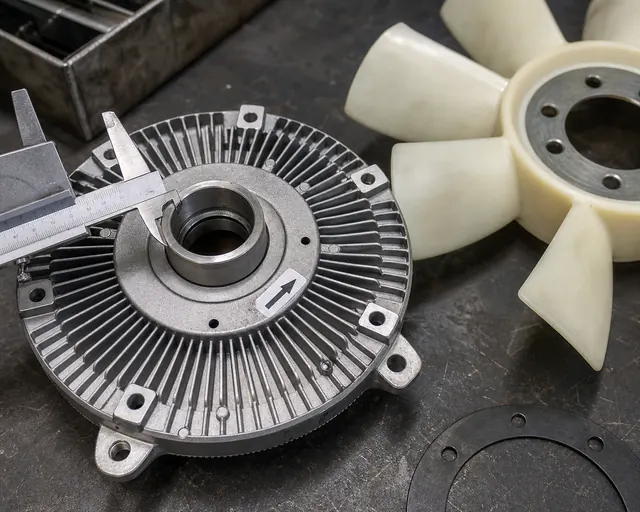
Pilot diameter, bolt circle, offset, and rotation direction are key details to confirm before quoting fan clutch replacements.
Check Item | Why It Matters | Evidence to Request |
|---|---|---|
OE number and vehicle model | Korean commercial vehicles often have close variants | OE cross, vehicle application, catalog screenshot |
Bolt circle and pilot diameter | Small mounting differences cause vibration or no fit | Measured photo or technical drawing |
Overall height and fan blade position | Incorrect offset can hit the shroud or reduce airflow | Side view photo and dimension sheet |
Thermal response | The clutch must engage when radiator outlet air is hot | Hot and cold resistance test, sample report |
Leakage and bearing control | Silicone fluid loss and bearing play create repeat claims | Incoming inspection standard and warranty terms |
Export packaging | Rotating parts need protection from impact and corrosion | Carton photo, label format, inner support, pallet plan |
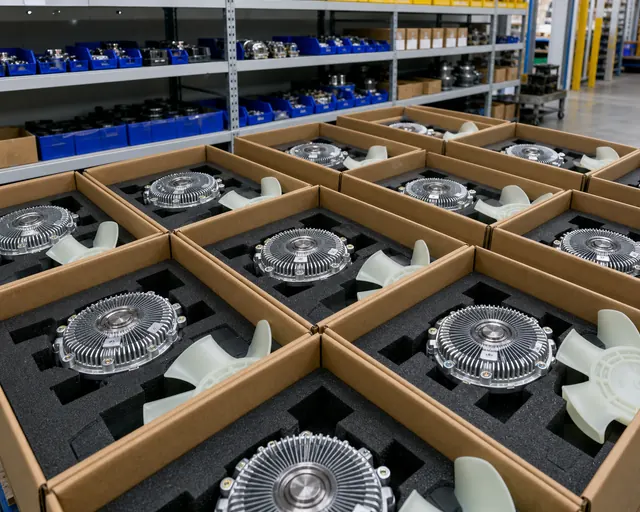
Foam-lined packaging reduces fin damage and helps keep fan clutch kits organized during export receiving checks.
Elecdura is not presented here as a Korean local supplier or an OE parts exporter. Its role is wholesale sourcing support for buyers that need Korean vehicle coverage, aftermarket alternatives, and related engine cooling parts in one procurement program. Buyers can use the fan clutch category for sourcing context. Related program categories include radiator fans plus thermostats and radiators when building a broader cooling system line.
For a fan clutch inquiry, send the OE number, old clutch photos, fan blade photos, bolt pattern, pilot diameter, total height, vehicle application, engine, target quantity, packaging needs, and target market. If the buyer is comparing genuine Korean parts with aftermarket alternatives, include the current genuine reference and the required price tier. This allows the quotation to focus on fitment and commercial suitability instead of a broad product name.
No. GMB Korea is a strong benchmark because it is directly associated with fan clutches and engine cooling parts, but buyers should also check Hyundai Mobis genuine channels, Korean OE exporters, K Spare type channels, Spare Korea type listings, and qualified aftermarket suppliers. The best route depends on whether the buyer needs genuine parts, aftermarket price levels, mixed references, or private label planning.
A ready inquiry includes OE number, vehicle model, engine, old clutch photos, fan blade photos, bolt circle, pilot diameter, total height, thermal spring position, quantity, target market, and packaging expectation. Without these details, a supplier may quote a visually similar clutch that does not match the real vehicle.
Yes, but symptoms should support procurement decisions rather than turn the article into a repair guide. Overheating under load, constant fan roar, silicone fluid leakage, bearing noise, fan wobble, or repeated fleet claims can help the supplier understand whether the buyer needs a standard thermal clutch, heavy duty unit, fan blade, or a broader cooling system review.
Elecdura is useful when buyers need aftermarket alternatives after confirming Korean OE references. The team can compare fan clutch dimensions, photos, related cooling parts, packaging needs, and target price tiers before quotation. For planned wholesale programs, buyers can discuss a 60 day standard lead time and, for selected heavy duty or engineering equipment references, an MOQ from 20 units per model when the technical evidence is complete.