Top 10 Fan Clutch Suppliers in the USA for Heavy-Duty Trucks
Views: 0 Author: Elecdura Publish Time: 2026-08-31 Origin: Site
The US heavy-duty fan-clutch market includes OE system manufacturers, new aftermarket brands, remanufacturers, rebuild-kit specialists, truck-brand service parts and national distributors. Those roles are not interchangeable. This unranked ten-option shortlist starts with clutch architecture and complete mechanical/control interfaces, then considers new or remanufactured condition, core policy, technical support and fleet availability. Its order is for navigation, not a quality or market-share score.
Elecdura’s wholesale fan-clutch programme supports heavy-duty buyers with OE/casting cross-reference, pilot and hub measurements, fan compatibility, control identification, samples, batch inspection and export supply.
Quick comparison
Supplier/brand
Role
Best starting point
Key check
Horton
Heavy-duty fan-drive manufacturer
OE/system-led new and service solutions
Exact drive family, controls and application
Kit Masters
Heavy-duty aftermarket/reman/rebuild specialist
Cross-reference, repair and fleet support
New/reman status, core and approved kit
BorgWarner Kysor
Heavy-duty fan-drive manufacturer/brand
Kysor-style truck fan-drive applications
Current service number and architecture
Hayden Automotive
Aftermarket thermal-control brand
Viscous and selected heavy-duty applications
Passenger/light/heavy-duty boundary
Dorman HD Solutions
Heavy-duty aftermarket brand
Application-specific replacement assemblies
Complete contents and cross-reference
Fleetrite
Truck service-parts brand/channel
International/Navistar fleet procurement
Application, supplier and warranty channel
Alliance Parts
Commercial-vehicle parts brand/channel
Daimler Truck dealer-network sourcing
Current cross, dealer availability and core
Automann
Heavy-duty aftermarket brand/distributor
Broad truck-parts catalogue and distribution
Exact fan-clutch family and data
S&S Truck Parts / NEWSTAR
Heavy-duty aftermarket supplier/brand
Independent distributor coverage
Part identity, application and service support
TruckPro
US heavy-duty distributor/service network
Local availability and fleet service
Actual supplied brand, condition and claim owner
Not every listed company manufactures the clutch it sells. Confirm manufacturer, brand, condition, source, core requirement and warranty owner on each quotation.
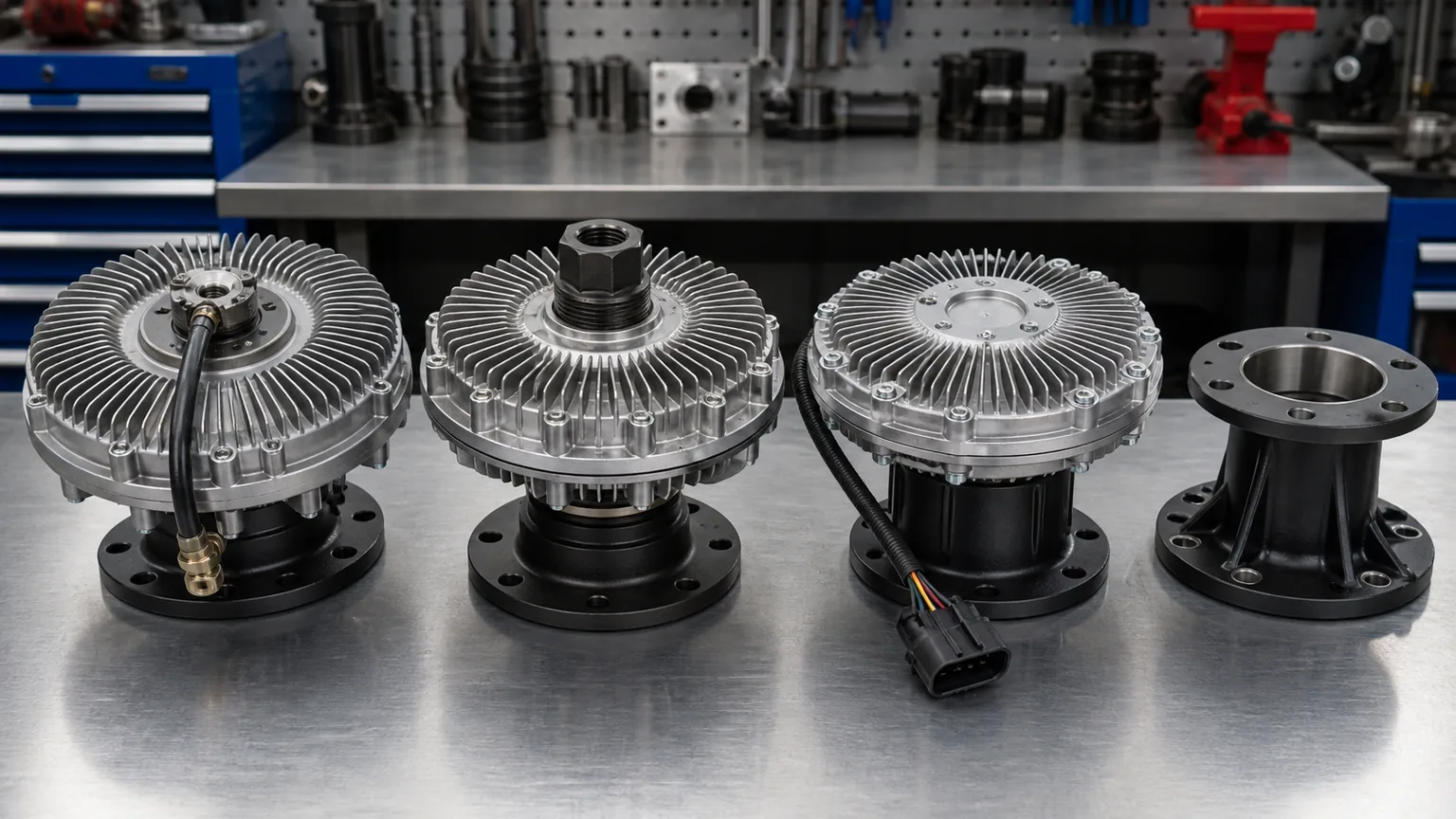
Pneumatic on/off, two-speed and electronically controlled viscous drives demand different identification and testing.
How the shortlist was built
Priority goes to documented heavy-duty fan-drive relevance, usable application or cross-reference information, technical service support, US availability, repair or reman capability where stated, and a workable warranty path. Passenger-car viscous-clutch volume does not by itself qualify a supplier for Class 6–8 truck work.
A fleet buying one emergency unit values local stock and installation support; a national distributor values data quality, batch consistency and fill rate; a reman programme values core recovery and failure analysis. Score suppliers against the actual purchasing model.
Horton
Horton is a foundational heavy-duty fan-drive manufacturer with truck, bus and off-highway systems. It offers fan drives, fans and controls across multiple architectures, making it a primary reference for OE-origin identification and system-level matching.
Identify the complete Horton model and part number from the clutch tag or casting and confirm vehicle/engine data. Do not select from bolt pattern alone. Verify pilot, mounting, pulley or bracket, fan pilot and bolt circle, rotation, air and electrical controls, fan mass/inertia limits and any control-module requirements. Use current service literature for repair decisions.
Best fit: OE/system-led heavy-duty applications and technically controlled service. Audit focus: exact family, authorized channel, supersession and installation procedure.
Kit Masters
Kit Masters specializes in heavy-duty fan clutches and repair solutions, with cross-reference, remanufacturing and rebuild expertise. It is particularly relevant where fleets need an economical repair strategy, responsive identification support or a structured core programme.
Confirm whether the quoted part is new, remanufactured or a rebuild kit, and whether a core charge applies. A rebuild kit must be approved for the exact clutch family and installed with the specified tools and inspection limits. Ask which hard parts are reused, how reman units are tested and what core damage triggers rejection or reduced credit.
Best fit: independent fleet repair, reman and rebuild programmes. Audit focus: part family, reman process, core terms, test evidence and installer requirements.
BorgWarner Kysor
Kysor heavy-duty fan drives are associated with BorgWarner and remain important across North American truck applications. Current BorgWarner/Kysor service information should guide identification, troubleshooting and replacement rather than an unverified legacy number alone.
Determine whether the drive is on/off, modulating or otherwise controlled and identify the valve, solenoid and control logic. Verify mounting, pulley, fan interface and air connection. For an old number, request the current supersession and any associated hardware or installation change. Never combine a clutch and fan outside approved load limits.
Best fit: Kysor-equipped heavy trucks and OE-style service. Audit focus: current part number, genuine source, control components and fan compatibility.
Hayden Automotive
Hayden is a recognized aftermarket thermal-control brand with viscous fan clutches and application information. It can serve relevant light-, medium- and selected heavy-duty vehicles, but buyers must not generalize a passenger/light-truck product family to pneumatic Class 8 drives.
Use the current application catalogue and product-type description. Check rotation, pilot, shaft/flange, bolt circle, fan spacing, engagement characteristics and thermal calibration. A viscous clutch that physically bolts on may engage at the wrong temperature or have insufficient fan capacity.
Best fit: catalogued viscous-clutch applications. Audit focus: vehicle class, calibration, physical interface and authentic distribution.
Dorman HD Solutions
Dorman HD Solutions provides aftermarket components for heavy-duty trucks, including application-specific cooling and fan-drive products where catalogued. Its strength is replacement access through established aftermarket distribution.
Request the complete Dorman HD number and cross-reference and inspect what is included: clutch only, mounting bracket, pulley, solenoid, fittings or hardware. Compare the product to the original at every interface and follow any technical bulletin. Confirm warranty labour terms and local stock before a vehicle is disassembled.
Best fit: application-specific heavy-duty aftermarket replacement. Audit focus: exact contents, application evidence, installation notes and support.
Fleetrite
Fleetrite is a commercial-vehicle service-parts brand associated with the International/Navistar channel. It can be useful to fleets seeking dealer-supported replacement and consolidated maintenance procurement.
Verify the Fleetrite number against VIN, engine and original clutch, and ask whether the part is new or remanufactured and whether a core applies. The service-parts brand may source from qualified manufacturers, so the buyer should focus on approved application, warranty and dealer support rather than infer who built the unit.
Best fit: International/Navistar-oriented fleet and dealer-channel purchases. Audit focus: official cross, condition, core and warranty.
Alliance Parts
Alliance Parts is a commercial-vehicle parts brand available through the Daimler Truck dealer network and covers multiple maintenance categories. It can provide a supported channel for selected Freightliner, Western Star and other truck applications.
Ask the dealer to confirm VIN/application, current Alliance reference, availability, core charge and package contents. Compare the offered clutch with the original tag and fan interface. If the replacement supersedes the original design, obtain the related installation instruction and any required control or bracket parts.
Best fit: dealer-network fleet procurement. Audit focus: current approved part, lead time, core policy and supersession.
Automann
Automann is a broad North American heavy-duty aftermarket supplier with extensive distributor reach. Its catalogue can offer fan-clutch and related cooling/control options for independent truck repair markets.
Broad coverage increases the importance of exact identification. Use the full OE/brand cross and application data, then verify dimensions, control connection, fan pilot and hardware. Ask whether the unit is new or remanufactured, what the warranty excludes and whether technical support can review photos before shipment.
Best fit: independent heavy-duty distribution and mixed fleet parts. Audit focus: catalogue precision, condition, technical evidence and local support.
S&S Truck Parts / NEWSTAR
S&S Truck Parts and its NEWSTAR branded range serve the heavy-duty independent aftermarket. A verified fan-clutch reference can be a useful alternative where distributor access, price and availability meet fleet needs.
Confirm the specific NEWSTAR/S&S number, OE cross and supported vehicle/engine. Request photographs and dimensions for uncertain legacy applications. Establish new/reman status, core requirement, country of origin if required, and the claim route through the supplying distributor.
Best fit: independent aftermarket alternatives. Audit focus: exact heavy-duty coverage, product identity, traceability and warranty.
TruckPro
TruckPro is a US heavy-duty parts and service network rather than a fan-clutch manufacturer. It is included because local access, technician support and sourcing across brands can be decisive when a revenue vehicle is down.
Ask which brand and part number is quoted, whether it is new or remanufactured, where it is stocked, whether a core must be returned and who decides warranty. Local installation support does not eliminate the need for OE/casting and dimensional checks, but it can reduce logistics and coordinate a complete repair.
Best fit: urgent local supply and fleet service. Audit focus: actual product, condition, core, labour and claim ownership.
Identify the architecture first
An air-operated on/off clutch receives pneumatic control and locks or releases through a defined mechanism. A two-speed drive may provide a lower fan speed when not fully engaged. An electronic viscous drive changes torque transfer according to a command and feedback strategy. Thermal viscous units use a temperature-responsive element. Their diagnostics, failure modes and safe bench procedures differ.
Record air line and valve arrangement, electrical connector and wire count, controller or speed-sensor presence, fault codes and commanded/actual fan behaviour. The electronic viscous fan-clutch diagnosis guide explains why resistance or direct-power tests cannot replace system-specific control information.
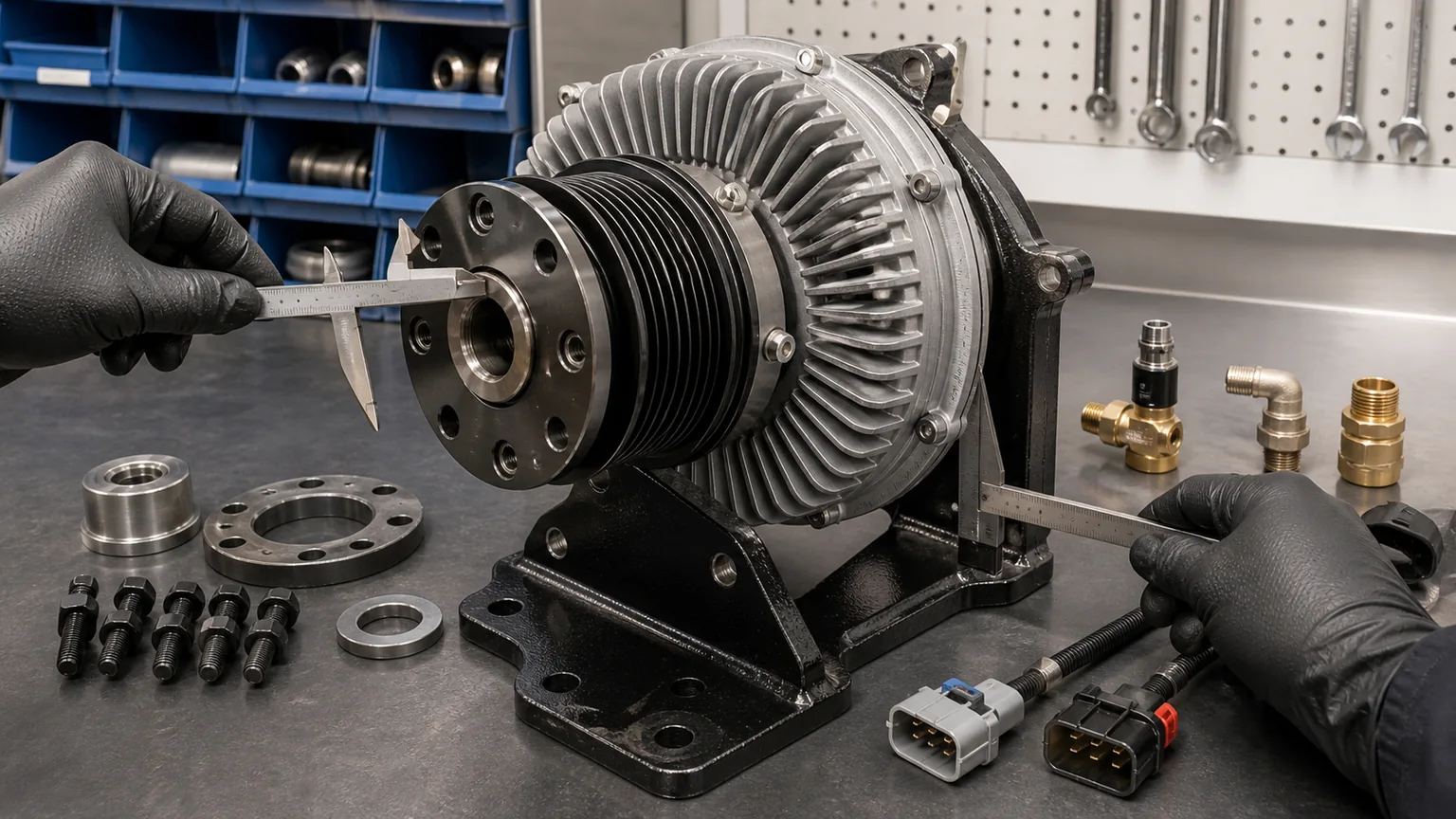
Architecture, pilot, hub, mounting, fan interface and control must all match the original system.
Mechanical identification matrix
Capture the complete tag, casting and customer/OE numbers before cleaning. Measure clutch-to-engine or bracket mount; pilot diameter and depth; bolt/thread size and circle; pulley grooves, diameter and offset where supplied; fan pilot, bolt circle and mounting face; overall length; and fan-to-radiator clearance. Record rotation from a defined viewing side.
The fan itself matters. Document diameter, blade count, pitch/design, material, part number, mass and condition. Inspect cracks, erosion, loose inserts and previous repairs. Never fit an unapproved heavier or larger fan to a clutch simply because the bolt circle matches.
Diagnose before replacing
Complaint descriptions such as “runs hot,” “fan always on” or “noisy” do not identify a failed clutch. Verify coolant level and condition, radiator/charge-air/condenser restriction, shrouds and seals, thermostat and pump operation, belt condition, air supply, solenoid/valve, wiring, command logic, sensors and fault codes. Inspect bearing play, runout, air leaks, fluid leakage and fan damage.
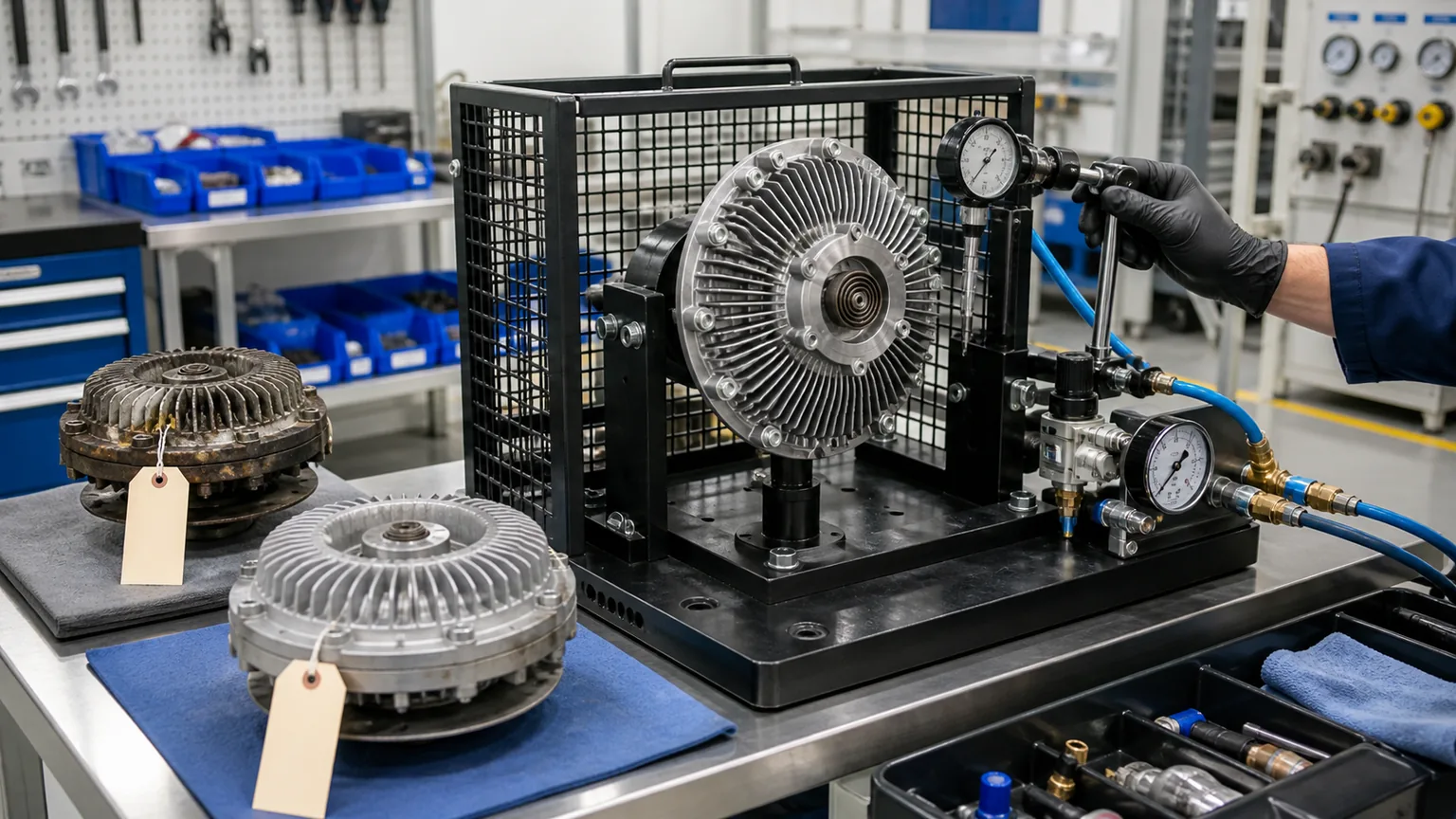
Test engagement under the manufacturer’s procedure with guarding and safe clearance. Record ambient, coolant or commanded temperature, engine speed, air pressure or electrical command, and fan response. Elecdura’s fan-clutch engagement test guide provides a structured evidence plan.
New, remanufactured or rebuild?
A new clutch minimizes reused-component uncertainty but may cost more. A properly remanufactured unit can be economical when the supplier controls disassembly, cleaning, hard-part limits, bearings, seals, friction or viscous elements, controls, balance/runout and end-of-line testing. “Rebuilt” without a defined process is not equivalent.
Field rebuilding is appropriate only for an approved serviceable family, with the correct kit, tools, measurements and technician competence. Reject cores with cracks, severe corrosion, damaged threads, distorted mounting or unapproved modifications according to supplier criteria. Include freight and forfeited credit in core economics.
Runout, leaks, engagement response and reusable hard-part condition determine repair and core value.
Supplier audit for a fleet or distributor
Review cross-reference governance, incoming materials, machining and assembly controls, bearing/seal traceability, balance/runout, air or electronic functional tests, labels, change control and warranty analysis. For remanufacturing, audit core segregation, reusable-part limits and replacement content. Link each shipped unit to production or reman lot.
Approve one sample on a representative truck. Verify fit without forcing, belt/pulley alignment, fan clearance, air/electrical routing, leak-free operation, engagement and release, temperature recovery, noise and fault status. Preserve the approved specification when sources or components change.
Control core returns without losing evidence
A reman programme works only when the core loop is visible. At purchase, record the core charge, eligible part families, return window, packaging rule, freight owner and rejection criteria. Tag the removed clutch to the vehicle and replacement invoice before it leaves the bay. Keep the manufacturer tag, fan-side and mount-side photographs, and note cracks, seized bearings, damaged threads, missing parts, fire or collision damage. Drain or cap the unit as instructed and use packaging that prevents the heavy casting from breaking through the carton.
Do not ship the core before collecting claim evidence when the failure may be disputed. If the replacement is a normal exchange rather than a warranty claim, the core can enter the return stream once its identity is documented. If it is a claim, obtain return authorization and preserve operating evidence, air/electrical components and related parts until the supplier defines what to send. Mixing ten unidentified cores in a pallet eliminates the vehicle-level learning that a fleet needs.
Reconcile the core ledger monthly: replacement invoice, vehicle, removed part number, return tracking, received date, accepted/rejected decision and credit. Compare the net reman cost after rejected cores and freight with a new-unit programme. A low list price can become expensive when incompatible cores, late returns or weak packaging erase credits.
Evaluate total fleet cost, not clutch price
Fan drives influence fuel use, noise, warm-up, A/C performance and protection against overheating. A clutch that remains fully engaged can consume power and shorten belt or bearing life; one that engages late can expose the engine and charge-air system to damaging temperatures. The cheapest part is not economical if it causes repeat diagnosis, fan damage or roadside downtime.
Build a fleet scorecard with correct-order rate, local fill rate, emergency lead time, installation time, core recovery, no-fault-found returns, confirmed product failures, warranty decision time and miles or hours in service. Segment by clutch family and duty. Refuse to compare a new OE-style assembly directly with an incomplete rebuild kit or a reman unit before labour, reusable-parts risk, core and support are included.
For critical trucks, stock by verified OE/application and architecture, not by a vague description such as “15-inch clutch.” Keep related solenoids, valves, air fittings, approved hardware and service information available where failure history supports it. Record supersessions and quarantine mixed old/new designs until technicians understand the installation difference. Supplier change notification should cover bearings, seals, friction materials, viscous fluid/calibration, castings, electronics, machining source and test method.
Safe handling and installation
Fan and clutch assemblies are heavy and have sharp edges. Isolate the vehicle, prevent starting, support the fan and clutch, and follow the engine/vehicle maker’s lifting and access procedure. Do not lever against the radiator. Inspect the hub or drive mount, pulley, belt tensioner, shroud, engine mounts and surrounding cooler stack before fitting the new unit.
Use specified fasteners, locking method and torque. Check pilot seating and runout; never pull a misaligned clutch into position with bolts. Route hoses and wiring away from blades, belts, heat and rub points. Rotate by hand only when permitted and verify full clearance. After commissioning, recheck leaks, fasteners, alignment, fault status and engagement under guarded conditions.
RFQ checklist
truck make, model, VIN/build, engine and market;
complete clutch OE, tag, casting and supplier numbers;
on/off, two-speed, thermal viscous or electronic viscous architecture;
mount, pilot, bolt/thread, pulley and offset dimensions;
fan pilot/bolt circle, diameter, blade, part number and condition;
air fitting/pressure or electrical connector/control details;
faults, commanded response, temperature and engagement evidence;
new, reman or approved rebuild preference;
core condition, charge, return deadline and freight terms;
quantity, location, downtime need, warranty and data requirements.
Frequently asked questions
Can a viscous clutch replace an air clutch?
Not as a simple substitution. Architecture, controls, mounting, fan and system calibration differ; only an approved engineered conversion is acceptable.
Is a reman clutch reliable?
It can be when the supplier defines reusable limits, replaces critical wear components, controls assembly and performs traceable functional testing. Audit the process, not the label alone.
Why does a new clutch stay engaged?
Possible causes include control command, air/solenoid faults, wiring, temperature inputs, incorrect part, break-in behaviour defined by the maker or mechanical installation problems. Diagnose the system.
Can the old fan always be reused?
No. It must be undamaged and approved for the clutch’s pilot, bolt circle, rotation, mass, inertia, speed and spacing.
What supports a warranty claim?
Application and numbers, lot/serial, installation photos, fan data, air/electrical command, temperature and speed response, runout/play/leak findings, core and retained-part condition.
Buy the complete fan-drive match
Horton, Kit Masters and BorgWarner/Kysor provide strong heavy-duty specialization; established aftermarket and truck-service brands broaden coverage; national distributors solve local availability. The correct choice still depends on exact architecture, interfaces, control and service strategy.
Send Elecdura the clutch labels, complete photographs, application, pilot/hub and pulley dimensions, fan data, control details, diagnosis and core preference. We can prepare a verified wholesale comparison rather than a bolt-pattern-only substitute.