Top 10 Heavy-Duty Radiator Suppliers in Turkey for Truck and Bus Fleets
Views: 0 Author: Elecdura Publish Time: 2026-08-31 Origin: Site
Turkey has a credible heavy-duty radiator supply base, but buyers should separate large OEM-oriented heat-exchanger manufacturers from aftermarket catalogue producers, custom radiator specialists, and repair/service suppliers. These ten options cover truck, bus, heavy-equipment or industrial-mobile cooling and are not ranked by sales, quality or market share. Fleets and distributors should verify the exact application, materials, test evidence, export terms and capacity before approval. Document whether the radiator is supplied alone or as a cooling pack: brackets, shutters, charge-air coolers, fan shrouds and hose adapters must be identified as included, excluded or reused parts in the purchase order.
The strongest supplier for an OE cooling module may not be the best source for a low-volume copper-brass replacement. A wide aftermarket catalogue may not support an engineered bus retrofit. The useful question is therefore: which Turkish supplier role matches the buyer’s fleet, product data, validation, volume, and delivery requirement?
Construction, duty, vehicle coverage, repair strategy, and test evidence should guide the shortlist.
Fleet supplier qualification criteria
Suppliers were evaluated from current product and company evidence using six practical criteria:
documented truck, bus, heavy-duty, construction, agricultural, or industrial-mobile radiator relevance;
manufacturer, custom specialist, stock supplier, and repair role stated accurately;
application and OE-reference depth, dimensions, technical drawings, or custom-engineering path;
material/process range including aluminum, plastic-aluminum, copper-brass, brazing, tanks, and cores;
quality, pressure/leak testing, traceability, packaging, and after-sales evidence;
export readiness, communication, lead time, and fit for fleet or distributor replenishment.
Building-heating radiator companies and vehicle manufacturers without a radiator supply offer are excluded. Buyers can extend this method with Elecdura’s radiator manufacturer audit framework.
Top 10 comparison
Reference
Supplier
Verified role
Notable fit
Buyer check
A
Kale Oto Radyatör
Large Turkish heat-exchanger manufacturer with OE and aftermarket capability
Truck/bus modules, broad thermal range and scale
Channel, MOQ, programme scope and application validation
B
AKG Turkey
Turkish plant in global cooling group; OEM/custom engineering
High-performance radiators/coolers for bus and off-highway duty
Project volume, engineering inputs and aftermarket access
C
Yetsan
Turkish radiator and heat-exchanger manufacturer
Dedicated truck, light-truck and bus catalogue; aluminum and copper products
Current part data, test evidence, stock and export terms
D
KADA Auto Radiator
Turkish manufacturer and export supplier
Commercial truck coverage, material range and packaging/traceability claims
Heavy-duty catalogue depth and batch validation
E
CHR
Manufacturer/stock supplier for heavy equipment and vehicle heat exchangers
Water radiators, oil coolers, intercoolers and aftercoolers
Truck/bus reference list, drawings and production-versus-resale role
F
RASA Aluminium Radiator
Turkish aluminum radiator manufacturer
Bus and truck radiator specialization
Construction details, application coverage and export support
Heavy-duty share of range and exact truck/bus fitment
H
Süperel Radiator
Custom manufacturer, repair/service and parts supplier
Truck/bus and construction-machinery radiators; sample/drawing work
New-versus-recore scope, warranty and repeatability for bulk supply
I
Kat-San
Turkish radiator/industrial cooling manufacturer
Machinery and selected vehicle applications with test/quality positioning
Live catalogue, heavy-duty road applications and export capacity
J
Copper Radiator
Copper/alloy custom manufacturer and repair/export specialist
Heavy vehicles, buses, machinery and non-standard work
Independent verification of certifications/claims, drawings and production audit
Kale Oto Radyatör
Kale Oto Radyatör is one of Turkey’s established heat-exchanger manufacturers, with reported products spanning radiators, heaters, condensers, intercoolers, oil and fuel coolers, HVAC systems, and complete engine-cooling modules for passenger and commercial vehicles. That breadth makes Kale a logical first investigation for high-volume buyers seeking OE-oriented engineering and system integration.
Scale does not guarantee that every aftermarket truck reference is stocked or open to every distributor. Ask for the current heavy-duty catalogue, supply channel, application validation, annual/MOQ expectations, material and process specification, PPAP or equivalent documentation where needed, and aftermarket warranty/packaging. Clarify whether the required item is serial production, service part, or a new development.
Best fit: larger programmes and buyers needing system-level capability. Audit focus: product access, engineering process, change notification, capacity, and service-part continuity.
AKG Turkey
AKG Turkey operates a Turkish production plant within the global AKG group and documents radiators, oil and air coolers, condensers, copper-brass and aluminum coolers, plus custom high-performance OEM solutions. It names automotive, bus, construction, forestry, and agricultural machinery among its markets.
AKG’s engineering depth may be especially relevant for demanding custom modules or off-highway/bus applications. However, a fleet searching for a single catalogue replacement should confirm aftermarket availability and project economics early. Provide heat rejection, fluids and flow, pressure/temperature, fan/air side, duty cycle, contamination, space envelope, mounts, ports, vibration, quantity, and validation requirement.
Best fit: OEM/custom engineering, high-duty and multi-cooler projects. Audit focus: aftermarket channel, design inputs, prototype timing, validation ownership and lifecycle support.
Yetsan
Yetsan’s current catalogue has a dedicated light-truck, truck and bus radiator collection alongside automotive, agricultural, construction, oil-cooler and intercooler products. The company describes Turkish manufacturing of copper-brass and aluminum heat exchangers and offers identifiable truck and bus applications.
Yetsan can suit distributors who need a recognizable catalogue plus manufacturing capability. Evaluate how complete the current product data is: OE number, application/engine/transmission, core and overall dimensions, port geometry, integrated cooler, construction, images, weight, carton, and EAN. Request test and traceability details for the target line rather than assuming they are identical across all product families.
Best fit: aftermarket truck/bus catalogue programmes and mixed cooling categories. Audit focus: live data, stock/fill rate, leak/pressure testing, corrosion control and export packaging.
KADA Auto Radiator
KADA Auto Radiator documents Turkish production of copper, aluminum and brass cooling products, serving passenger vehicles, commercial trucks, agriculture, forklifts and generators. Its company information also describes protective port plugs, heavy packaging, export activity and an authorized-dealer network.
KADA may fit buyers who want material flexibility and established export handling. Verify the exact commercial-truck catalogue, whether the supplied unit is complete or core-only, tank and fin material, integrated oil-cooler details, OE/data quality, pressure/leak test specification, corrosion protection, and batch traceability. For older copper-brass fleets, confirm repair/recore support separately from new production.
Best fit: distributors needing mixed commercial, agricultural and industrial coverage. Audit focus: truck application data, test records, packaging validation and dealer/export terms.
CHR
CHR, the brand of Başkent Radyatör, describes manufacturing, sales and after-sales service for water radiators, oil coolers, intercoolers and aftercoolers serving construction machinery, trucks, buses and the heavy-vehicle aftermarket. Its portfolio can be useful where a buyer wants multiple coolers from the same Turkish specialist.
The company appears to combine production with a strong stock/supply role, so buyers should identify which requested references are manufactured in-house and which are distributed. Ask for drawings, OE cross-references, materials, weld/braze process, cleanliness, leak/proof test, pressure class for oil/charge-air products, and common packaging across the mixed order.
Best fit: heavy-equipment and fleet distributors buying radiators plus oil/charge-air coolers. Audit focus: role by part number, application data, test process, stock and after-sales response.
RASA Aluminium Radiator
RASA Aluminium Radiator explicitly states specialization in radiators designed for buses and trucks and positions them for intensive transport duty. That direct heavy-vehicle focus earns it a place ahead of broader companies whose public evidence is mainly passenger-car oriented.
For sourcing, request the live bus/truck application list, core construction, tank type, alloy and corrosion protection, mounting and port drawings, integrated cooler details, rated conditions, leak-test method, serial/lot system, warranty, packaging and export markets. If the buyer needs a Temsa, Otokar, BMC, Mercedes, MAN, DAF, Iveco, Scania, Volvo or other application, the exact engine/transmission and production range still must be checked.
Best fit: fleets and distributors prioritizing Turkish bus/truck specialization. Audit focus: catalogue breadth, engineering data, validation, capacity and export fulfilment.
Oris Auto Radiator
Oris Auto Radiator describes Turkish production of brazed and mechanically assembled aluminum water radiators, heaters and condensers, with thousands of cooling/heating products and an export ambition. Its broad aftermarket manufacturing base can support a distributor looking for range and private-label potential.
Because Oris public positioning emphasizes passenger-car radiator origins, heavy-duty buyers should verify truck and bus coverage rather than infer it from total product count. Ask for a heavy-commercial application extract, core dimensions, tube/fin/header construction, tank tooling, integrated transmission cooler, tests, packaging, and export references relevant to fleet duty.
Best fit: aftermarket distributors evaluating broad aluminum ranges and potential private-label supply. Audit focus: confirmed heavy-duty references, product segmentation, process controls and data delivery.
Süperel Radiator
Süperel Radiator documents truck and bus radiators across numerous vehicle brands, construction-equipment cooling, copper and aluminum radiator cores, custom production from drawings or samples, repair, maintenance and sales. This makes it a different kind of partner from a catalogue-only manufacturer.
Custom and repair capability can solve obsolete or low-volume fleet needs, but bulk repeatability must be defined. Clarify whether the quote is a new radiator, recore, repaired unit or service exchange; specify drawing revision, materials, core and tank source, pressure test, finish, mounting datum, interchange evidence and serialized records. A sample-based copy should still become a controlled drawing before scale-up.
Best fit: obsolete, special, low-volume and repairable heavy-duty applications. Audit focus: new-versus-repair status, drawing control, repeatability, test certificate, warranty and batch capacity.
Kat-San
Kat-San is described in Turkish export evidence as an automotive and industrial radiator manufacturer with experience in machinery applications including Caterpillar, Ford, Fiat and Massey Ferguson. Its manufacturing and quality-control positioning makes it worth investigating for mixed industrial/off-highway buyers.
Public information is less detailed than for the leaders, so this is a due-diligence shortlist rather than an automatic approval. Request a current company record and factory address, live product catalogue, road-truck/bus references, capacity, quality certificates from issuers, test equipment, materials, exports, customer references, and sample documentation.
Best fit: buyers open to developing a supplier after a structured audit. Audit focus: corporate verification, active manufacturing scope, heavy-road product evidence, quality system and export performance.
Copper Radiator
Copper Radiator markets copper and aluminum radiators, custom manufacturing, and repair/maintenance for trucks, trailers, buses, heavy machinery and generators. Its focus may suit fleets that still value repairable copper-brass construction or need a non-standard core.
The site makes multiple scale, certification, export and warranty claims. Treat these as items to verify through certificate numbers/issuers, factory audit, equipment and capacity review, drawings, material certificates, customer references, sample inspection and test records. Confirm whether the company makes the complete radiator, core, tanks, or performs repair using sourced components.
Best fit: custom copper-brass work, repair support and non-standard heavy radiators. Audit focus: independent verification, factory/process ownership, controlled drawings, test capability and repeat-order consistency.
Construction and duty questions buyers must settle
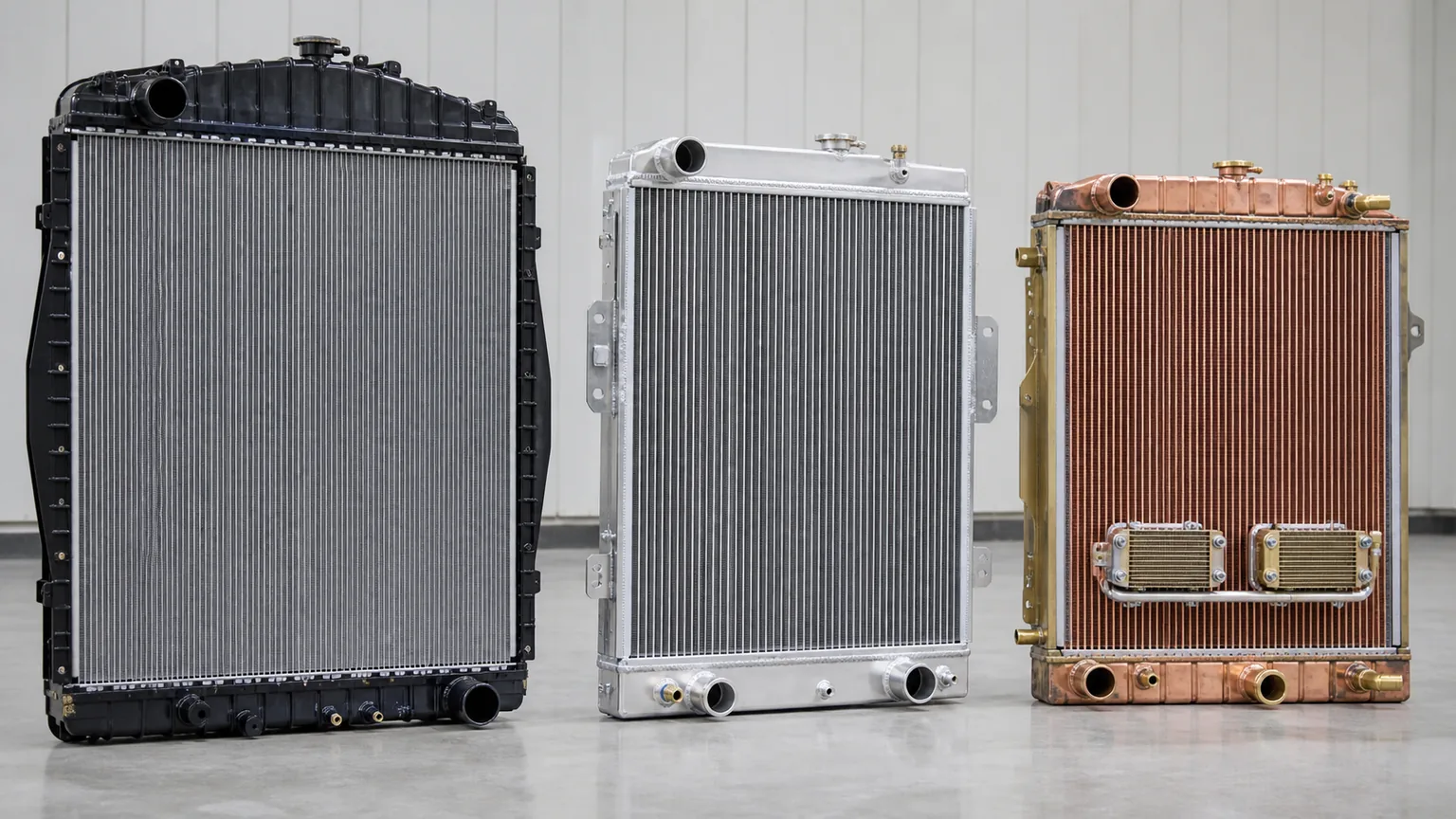
Heavy-duty radiators can use plastic-aluminum, all-aluminum, or copper-brass construction. None is universally superior. Plastic-aluminum can offer low mass and broad OE-style coverage; all-aluminum can support welded structures and high-duty designs; copper-brass can be repairable and valuable for legacy fleets. Tube geometry, fin design, header/tank support, mounting isolation, internal oil coolers, coolant chemistry, corrosion environment, vibration and maintenance decide performance.
Ask whether the unit is downflow or crossflow, core size and rows/tube arrangement, fin density, tank material, gasket/crimp design, filler neck/cap or remote-degas configuration, sensor/drain, inlet/outlet orientation, transmission or retarder cooler, frame/brackets, and fan/shroud interface. Elecdura’s radiator core types guide explains why row count alone does not predict heat rejection.
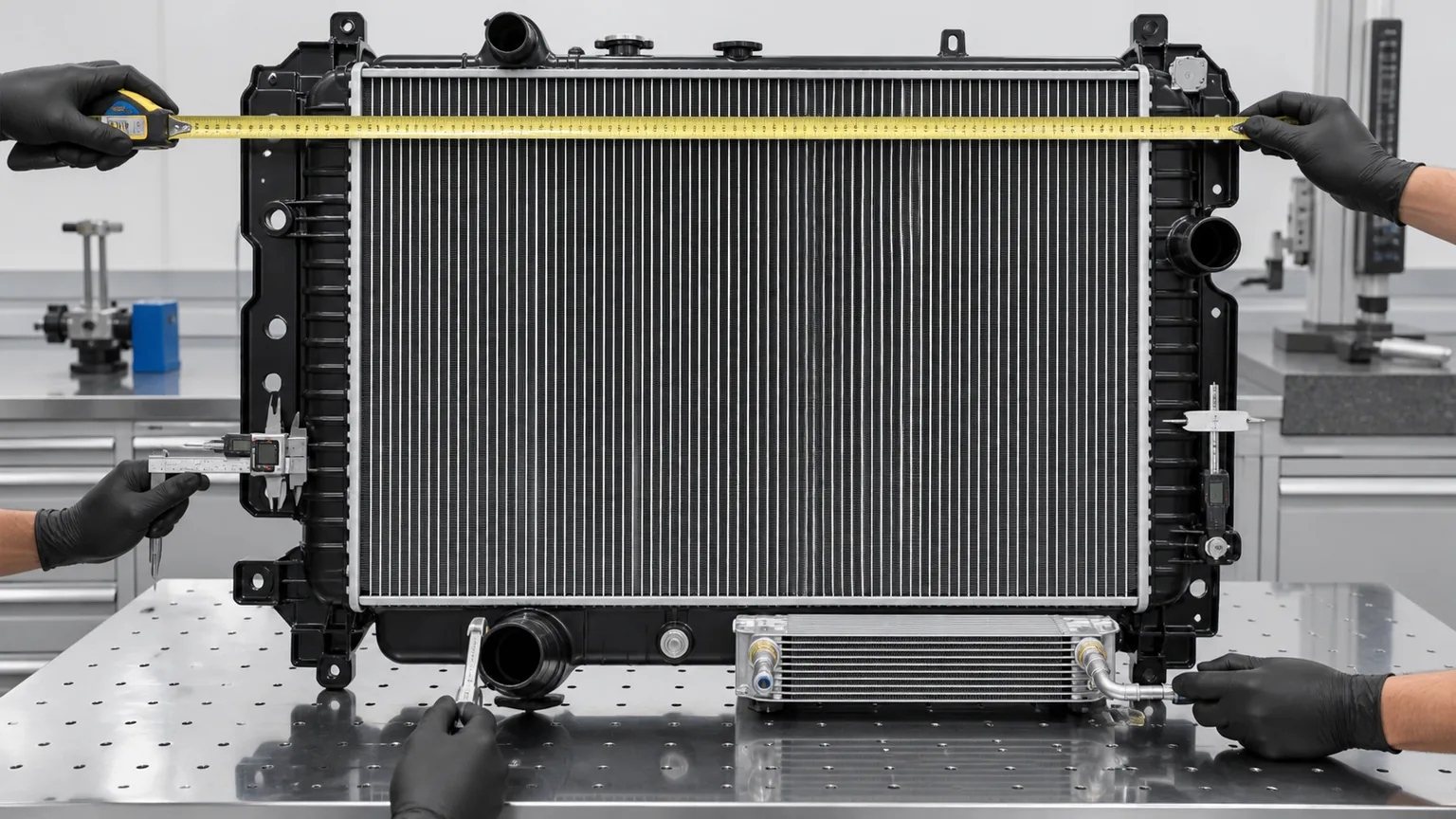
A controlled drawing links the OE reference to physical interfaces and functional construction.
Validation and audit checklist
Verify legal company, factory location, role and product ownership.
Review heavy-duty application catalogue and at least a sample of OE cross-references.
Compare drawing and golden sample: core, overall size, mounts, ports, tank, shroud and integrated coolers.
Review alloy/plastic/gasket/tube/fin specifications and approved sub-suppliers.
Observe stamping, tube/fin, brazing, welding, crimping, cleaning and final assembly as applicable.
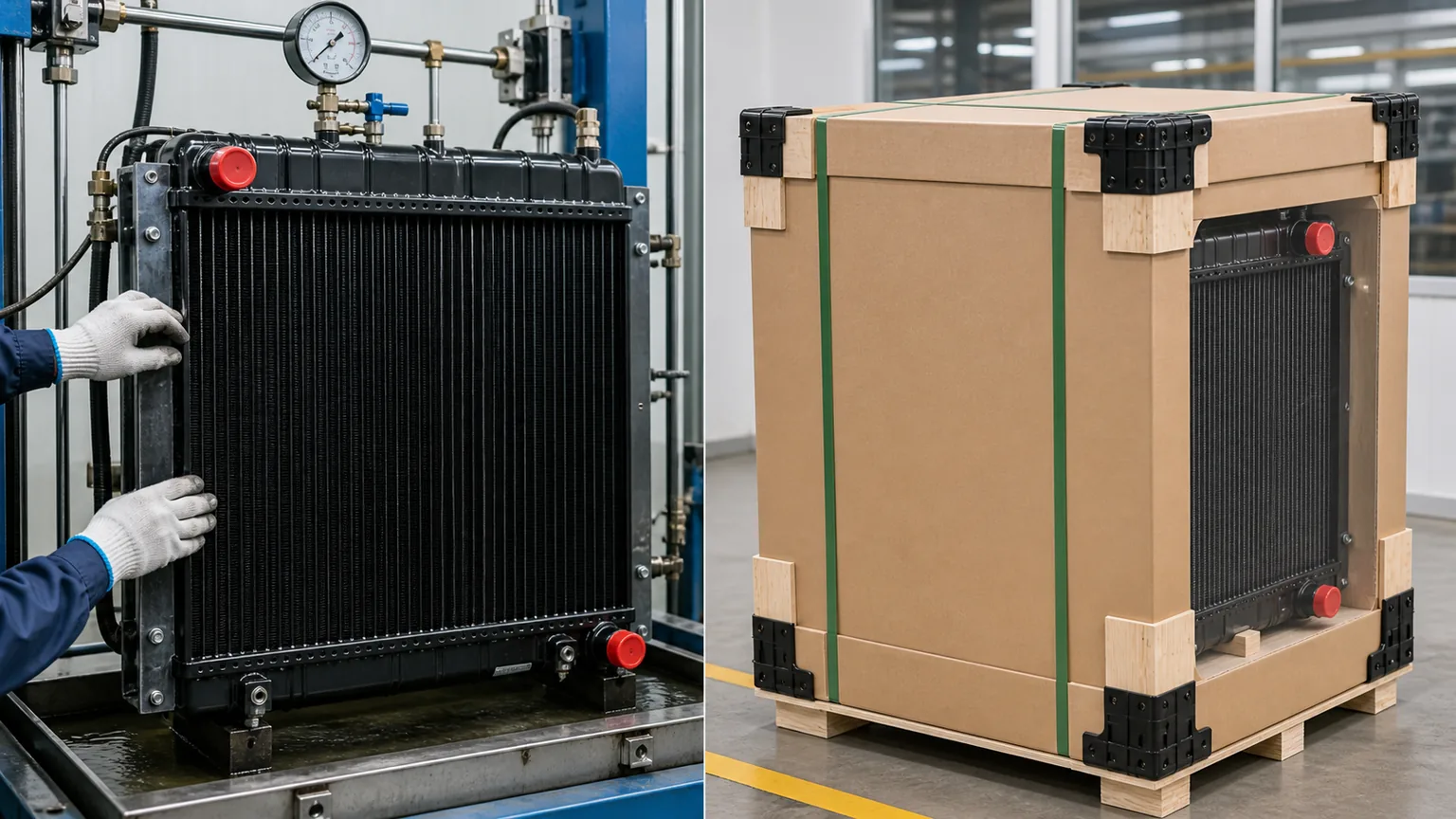
Confirm leak, proof, burst/pulsation or thermal/vibration tests appropriate to the product and application.
Review gauge calibration, work instructions, first/last-piece and nonconforming-product control.
Trace a finished radiator back to material, process, test, operator/date and packaging lot.
truck or bus make/model, VIN/chassis range, production date, engine and transmission;
complete OE and supplier reference with readable label photographs;
core and overall width/height/thickness plus mounting datums;
inlet/outlet diameter, angle and location; filler/degas, drain and sensor details;
integrated transmission, engine-oil, retarder, fuel or other cooler ports;
fan/shroud and complete cooler-stack relationship;
coolant, cap/system pressure, ambient, duty cycle, altitude, dust/corrosion and vibration;
construction/material preference only where technically justified;
sample and annual quantity, target schedule, destination and Incoterm;
drawing, test, traceability, packaging, label, warranty and private-label requirements.
Pressure integrity, dimensional fit, clean protected ports, fin protection, and traceability all affect fleet uptime.
Control supplier changes after approval
A radiator programme can drift after a good first sample if the purchase agreement controls only the part number. Define which changes require written notice and reapproval. Examples include tube, fin, header, tank resin, gasket, brazing sheet, internal oil cooler, coating, drain or sensor supplier, crimp tooling, welding process, leak-test method, factory location, carton support and label format. A change can affect heat transfer, corrosion, pressure integrity, installation or warranty traceability even when external dimensions remain unchanged.
Ask the supplier to retain a signed golden sample or master drawing and link each shipment to a revision and lot. For early production, compare first lots more intensively for dimensional capability, leak performance, fin condition and packaging damage. Review claim data by OE reference, vehicle, failure location, production lot and customer. A cluster of tank-seam leaks, cracked mounts or crushed fins should trigger containment and root-cause work rather than case-by-case credits.
Service continuity also matters for truck fleets. Agree how long catalogue references will be supported, how the supplier communicates supersessions, whether low-volume service batches are possible, and how an obsolete tool or tank will be handled. If a supplier proposes a replacement design, require a fitment and performance review rather than accepting “replaces” as sufficient evidence.
Frequently asked questions
Are all ten companies direct radiator manufacturers?
No. Most present manufacturing capability, but some also combine distribution, custom production, repair or service. Confirm the role for the exact part number and require transparency when a product is sourced rather than made in-house.
Should a fleet choose aluminum or copper-brass?
Choose from the application, weight, heat rejection, pressure, vibration, corrosion, repair network, expected life and total cost. Material alone does not decide quality.
Can a sample radiator be copied from dimensions?
A sample helps, but successful reproduction also needs internal construction, materials, port and cooler details, operating conditions, performance and pressure targets, mounting loads and a controlled drawing. Do not assume external size proves equal capacity.
What causes many shipping returns?
Crushed fins, bent brackets, cracked plastic tanks, loaded ports, missing caps, movement inside the carton and label confusion are common. Packaging should support structural points and isolate the core face and fittings. See Elecdura’s cooling-parts packaging guide.
Can Elecdura supply truck and bus radiators outside Turkey?
Elecdura supports wholesale radiator sourcing for global distributors and fleets. Submit the application, OE number, dimensions, port and mounting evidence, quantity, destination and validation requirements through the wholesale radiator programme.
Shortlist by role, then prove the part
Turkey offers a meaningful spectrum: large OE-oriented manufacturers, specialized truck/bus producers, broad aftermarket plants, heavy-equipment stock specialists, and custom repairable-radiator shops. A credible buyer does not choose from a logo list. It classifies the supplier role, verifies live application data, audits the relevant production path, approves a golden sample, and controls changes and packaging through the supply programme.
For a comparative Elecdura quotation, send the vehicle and engine, OE and supplier numbers, radiator and stack photographs, complete measurements, integrated cooler and port details, operating environment, sample/bulk quantity, destination and required evidence. The result should be a fitment- and duty-matched radiator programme rather than a generic “heavy-duty” claim.