Top 10 Hydraulic Oil Cooler Suppliers in Japan for Construction Equipment
Views: 0 Author: Elecdura Publish Time: 2026-08-31 Origin: Site
Japan has deep heat-exchanger engineering for excavators, loaders, forklifts, agricultural machines, rail and industrial equipment. It also has many oil-cooling products that are not vehicle parts. Importers must therefore separate an OE construction-equipment module, a custom mobile cooler, an aftermarket replacement and a stationary oil-cooling unit before comparing suppliers.
This guide profiles ten credible supplier paths and states where each one fits. For aftermarket equipment coverage, Elecdura’s wholesale hydraulic oil cooler programme can match machine serial range, OE number, module geometry, ports, pressure and cleanliness requirements for repeat export orders.
Quick supplier comparison
Supplier
Role
Most relevant route
Important limitation
T.RAD
Japanese OE heat-exchanger manufacturer
Off-highway hydraulic coolers and cooling modules
OE/custom access is not the same as aftermarket stock
Sumitomo Precision Products
Japanese custom heat-exchanger manufacturer
Plate-fin hydraulic oil coolers for machinery
Engineering project rather than catalogue replacement
Tokyo Radiator
Japanese OE cooling-module manufacturer
Construction/industrial machinery modules
Confirm hydraulic circuit and commercial access
Daiwa Radiator
Japanese radiator/oil-cooler specialist
Oil-cooler and heat-exchanger enquiries
Verify current mobile range and export terms
Najico
Japanese heat-exchanger manufacturer
EX oil coolers for hydraulic/agricultural machinery
Not automatically an excavator drop-in part
AKG Japan channel
Global off-highway cooling manufacturer
Custom oil coolers and integrated systems
Project qualification and channel must be confirmed
KTR Japan
Global cooling-system supplier with Japanese channel
Mobile-machine combi and oil coolers
Series selection requires operating data
LUNACO Japan
Japanese B2B cooling exporter
Aftermarket/OE-reference heavy-equipment coolers
Validate manufacturing source and each claimed certification
Daikin Oil Hydraulics
Japanese industrial oil-temperature specialist
Machine-tool and stationary hydraulic systems
Not a direct excavator cooler source unless engineered
NMI industrial oil-cooler channel
Japanese industrial cooling-equipment supplier
Self-contained air-cooled industrial units
Not represented as vehicle replacement equipment
The ten options form an unranked sourcing shortlist based on product evidence and engineering relevance, not company size. Their order is only for navigation, not a quality or market-share score. Product range, enquiry acceptance and export channel can change, so the buyer must obtain a current written quotation and approved drawing.
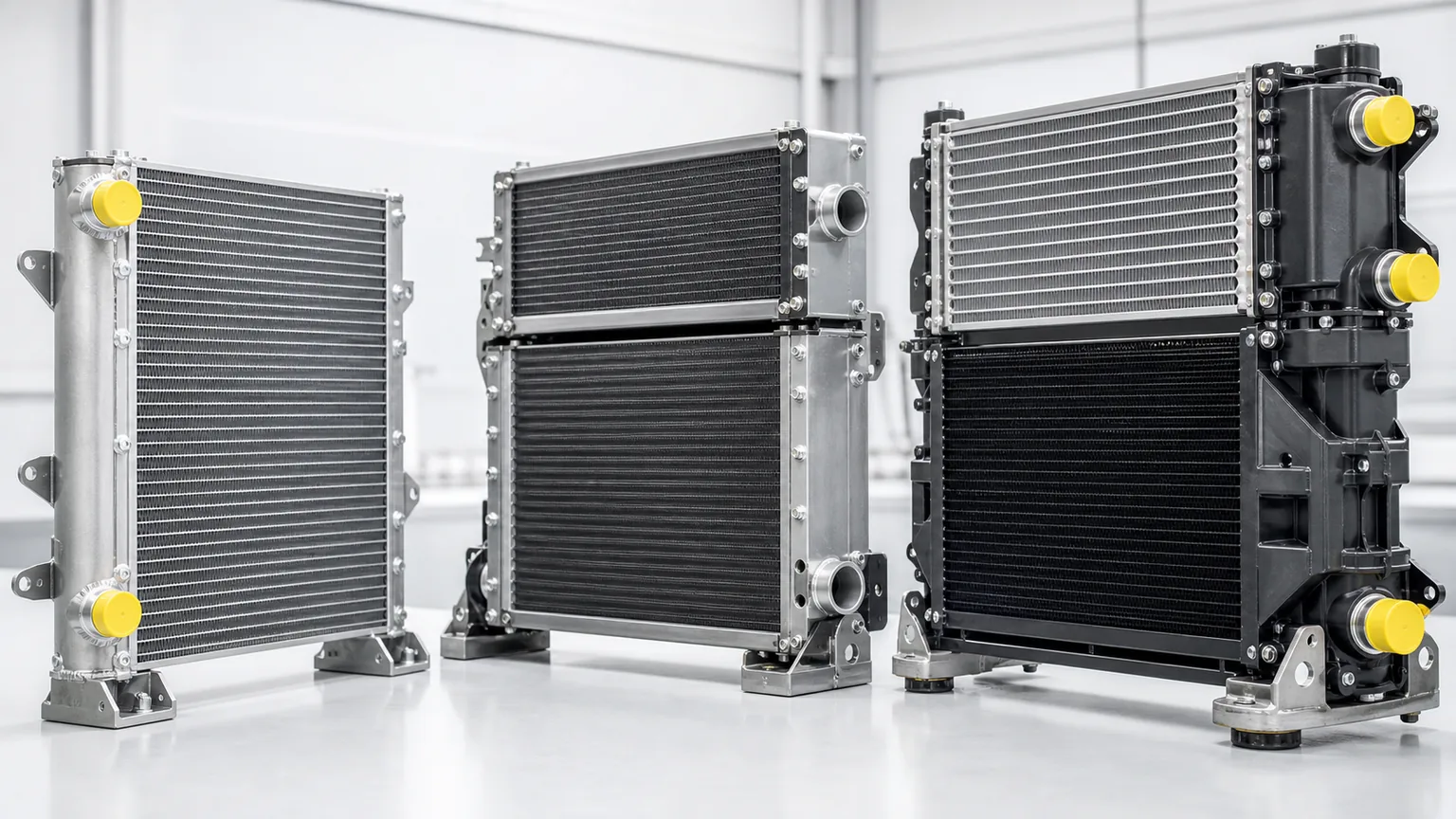
Stand-alone oil coolers, stacked cores and integrated modules require different sourcing and validation paths.
How suppliers were selected
Eligibility requires documented oil-cooling or off-highway heat-exchanger capability and a credible Japanese manufacturing, sales or export path. Strong candidates publish applications, product construction or engineering support. Industrial suppliers are included only as clearly labelled comparators because they can serve stationary hydraulic systems but should not be ordered as excavator replacements without a complete design exercise.
Buyers should score suppliers on application fit, drawing and performance data, material/process control, pressure and fatigue validation, internal cleanliness, port identification, sample approval, engineering-change control, export packaging and claim support. An attractive photograph or OE-number string is not sufficient.
T.RAD
T.RAD is a Japanese heat-exchanger manufacturer with explicit off-highway products. Its published construction-machinery portfolio includes high-pressure hydraulic oil coolers and integrated modules combining radiator, oil cooler and charge-air cooler functions. This makes it the clearest engineering benchmark in the shortlist.
The commercial route may be an OE or custom-development programme rather than a low-volume aftermarket order. Ask whether T.RAD can quote the project directly, through a regional entity, or only via an equipment maker. Provide heat rejection, oil flow and viscosity range, allowable pressure drop, working and transient pressure, air-side conditions, fan curve, contamination environment and envelope.
Best fit: OE-level off-highway development and high-volume modules. Audit focus: programme access, design ownership, validation scope, tooling and service-part plan.
Sumitomo Precision Products
Sumitomo Precision Products publishes custom aluminium plate-fin heat exchangers, including hydraulic oil coolers for construction machinery and oil coolers for industrial equipment. Its strength is engineered compact heat exchange rather than an online catalogue of excavator OE replacements.
Approach it with a thermal and mechanical specification. Define fluids, temperature limits, heat load, flow, viscosity, pressure, permissible drop, vibration/shock, corrosion, cleanliness and mounting. Clarify codes, prototypes, test evidence, minimum commercial volume and ownership of drawings and tooling. A technically capable custom supplier may still be unsuitable for a one-piece emergency replacement.
Best fit: new or redesigned compact cooler programmes. Audit focus: application engineering, qualification cost, validation and production volume.
Tokyo Radiator
Tokyo Radiator states that it supplies heat-exchanger parts for trucks and industrial construction machinery and publishes cooling-module capability combining radiator, intercooler and oil cooler around the fan and vehicle layout. This is relevant where system-level airflow and packaging matter.
Confirm whether the required hydraulic-oil circuit is within the proposed module and whether the company supports the target equipment maker, replacement market or custom project. Request a circuit map; core construction; oil-side pressure and drop; fan/airflow assumptions; vibration, thermal-cycle and leak validation; and service strategy for individual cores.
Best fit: integrated construction-machine thermal modules. Audit focus: hydraulic circuit applicability, customer access and module/service boundaries.
Daiwa Radiator
Daiwa Radiator is a Japanese heat-exchanger specialist with an oil-cooler product category. It is a relevant enquiry route for buyers seeking domestic radiator expertise, custom work or replacement support.
Product-category presence does not establish a match to a particular excavator. Ask for the current oil-cooler range, mobile/off-highway references, construction method, allowable pressure, port options, export capability and drawing. If a cooler is built from an original sample, agree how hidden damage, blocked passages and dimensional distortion will be handled and which characteristics the supplier will reverse-engineer.
Best fit: specialist Japanese oil-cooler enquiries and possible custom support. Audit focus: exact application evidence, pressure capability, reverse-engineering control and export.
Najico
Najico publishes EX-series oil coolers for hydraulic equipment and agricultural machinery. That evidence makes it relevant to mobile and industrial hydraulic applications, although the series should not be presented as a plug-in substitute for an unknown excavator core.
Ask for the model-selection data, heat-rejection range, oil flow, pressure drop, working pressure, fan/air requirements, mounting and port standards. Establish whether the product is a bare heat exchanger or a powered cooler package and whether the environment permits dust, vibration, shock and washdown. Validate any adaptation with a documented hose and structural design.
Best fit: engineered hydraulic or agricultural-machine oil cooling. Audit focus: series limits, environmental rating, interfaces and integration responsibility.
AKG through its Japanese channel
AKG is an international manufacturer with established off-highway cooling products, including oil coolers and complex integrated systems for equipment from compact loaders to mining excavators. A Japanese entity or authorized regional route can support local engineering conversations.
Confirm which AKG company will design, manufacture, ship and warrant the part. For a custom project, provide a complete application-requirements form and fan/stack data. For a replacement request, ask whether an existing part number is genuinely supported; do not infer availability from AKG’s general off-highway capability.
Best fit: custom mobile-machine coolers and modules. Audit focus: Japanese channel scope, production location, qualification volume and aftermarket availability.
KTR Japan
KTR supplies cooling systems for mobile machinery through global product families and has a Japanese sales presence. Its mobile-machine coolers can be relevant when a designer needs an oil cooler, combination cooler, fan package or configurable thermal subsystem rather than an OE-shaped replacement core.
Selecting a series requires real duty data: oil type and viscosity, continuous and peak flow, inlet/target temperature, ambient, heat load, pressure drop, hydraulic pressure exposure, fan drive, electrical voltage, noise, altitude, dust and installation recirculation. Ask the Japanese channel to confirm local technical support, lead time and the manufacturing entity.
Best fit: engineered mobile equipment and auxiliary cooling. Audit focus: duty-point selection, fan/control package, environmental derating and local support.
LUNACO Japan
LUNACO Japan markets B2B radiators and coolers for construction machinery, trucks and generator sets, including hydraulic and air-oil coolers. This makes it a possible export-oriented aftermarket route for Komatsu, Hitachi, Kobelco and other equipment references.
Because an exporter may coordinate factories rather than manufacture every item itself, request the actual production location, quality certificates for that facility, drawing revision, material, test plan, OE-reference basis and traceability. Verify marketing claims against current certificates and a sample. For a new code, specify that no port, bracket or core change is allowed without approval.
Best fit: OE-reference export sourcing and mixed cooling programmes. Audit focus: factory identity, certification scope, sample data, minimum order and lot control.
Daikin oil-temperature equipment
Daikin has deep Japanese hydraulic and oil-temperature-control capability, especially for industrial machinery. Its oil-cooling units can solve controlled factory-system heat loads, but they are not automatically suitable for an excavator engine bay or a direct replacement for an air-to-oil mobile core.
Use Daikin as an industrial-system option only when power supply, installation environment, reservoir circuit, control target and cooling capacity match the equipment. Mobile use would require explicit supplier approval for vibration, shock, orientation, dust, water exposure, voltage and regulatory conditions.
Best fit: stationary hydraulic machinery and precise oil-temperature control. Audit focus: application boundary, utilities, environmental limits and integration.
NMI industrial air-cooled oil units
Japanese suppliers such as NMI publish self-contained air-cooled oil-cooling equipment for industrial systems. These units illustrate a useful alternative when a stationary hydraulic power pack needs its own fan, enclosure and control rather than an excavator-shaped cooler.
Do not convert the industrial product into a vehicle claim. Confirm oil compatibility, flow, heat rejection, pump arrangement if any, electrical supply, control, noise, filter/maintenance access and indoor/outdoor limits. If the real need is a mobile machine, return to a mobile-rated supplier and validate shock, vibration, fan debris exposure and transient pressure.
Best fit: stationary industrial oil cooling. Audit focus: published rating conditions and a clear prohibition on unapproved mobile substitution.
OEM replacement or engineered cooler?
An OE-reference replacement must reproduce the physical and functional interfaces of the original machine. For example, the Komatsu, Hitachi and Kobelco hydraulic oil cooler programmes begin with machine model, serial range and OE number, then confirm dimensions and ports. A custom cooler begins with heat load and fluid/air duty and may use a new envelope or fan.
Do not choose a custom catalogue core only because its face dimensions fit. Excess oil-side pressure drop can increase energy loss and starvation risk, while weak structure, unsupported ports or unsuitable brazing can fail under pressure pulsation and vibration. Airflow recirculation or stack restriction can erase a free-air performance advantage.
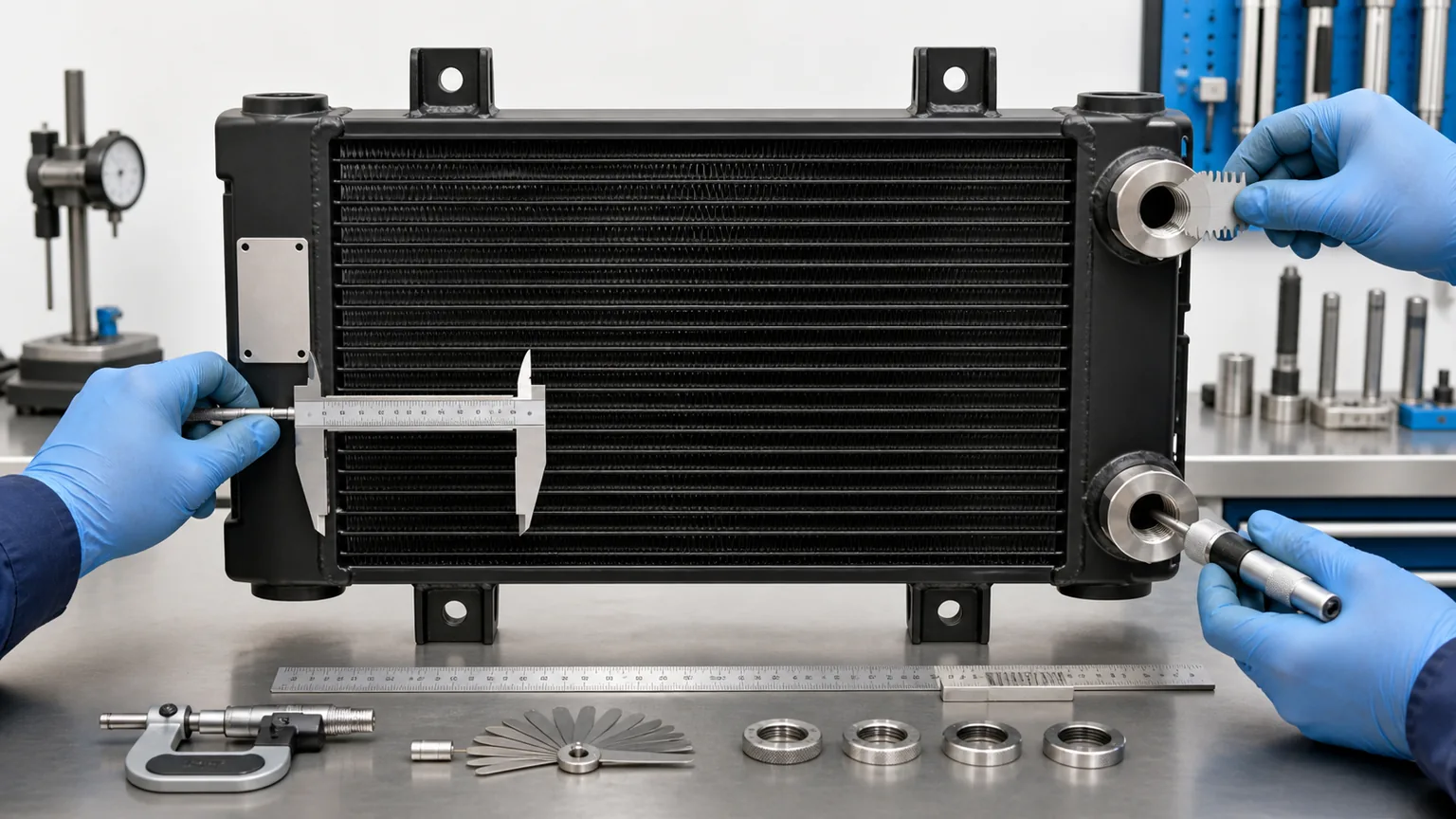
Port thread and sealing seat must be identified together with fixed-datum mounting and core measurements.
Technical data every RFQ needs
For replacement work, record machine manufacturer, model, serial number and configuration; original manufacturer and full OE number; complete module arrangement; core and overall dimensions; bracket locations; port centre positions; thread, pitch and sealing seat; and photographs from every side. Mark oil inlet/outlet only when confirmed by documentation.
For design work, define heat load, oil type and viscosity over temperature, continuous/peak flow, inlet and target temperature, ambient range, altitude, allowable pressure drop, working and proof pressure, pressure pulse, vibration/shock, air flow and restriction, fan/control, noise, fouling, corrosion, washdown, installation orientation and service interval. Elecdura’s oil cooler sizing guide explains why model name and outside dimensions cannot replace this duty data.
Cleanliness, pressure and durability validation
Agree internal cleanliness limits and the measurement method. A visually clean port does not prove that brazing debris, chips, flux or storage contamination is absent. Specify protective caps, drying or preservation where required, clean packing and capped handling through installation.
Testing should reflect the design: leak test, proof pressure, burst margin where specified, pressure pulsation, thermal cycling, vibration, corrosion and performance at representative air/oil conditions. Test pressure is not a universal multiplier; it must follow the approved engineering standard. Maintain serial or lot linkage between results, samples and shipments.
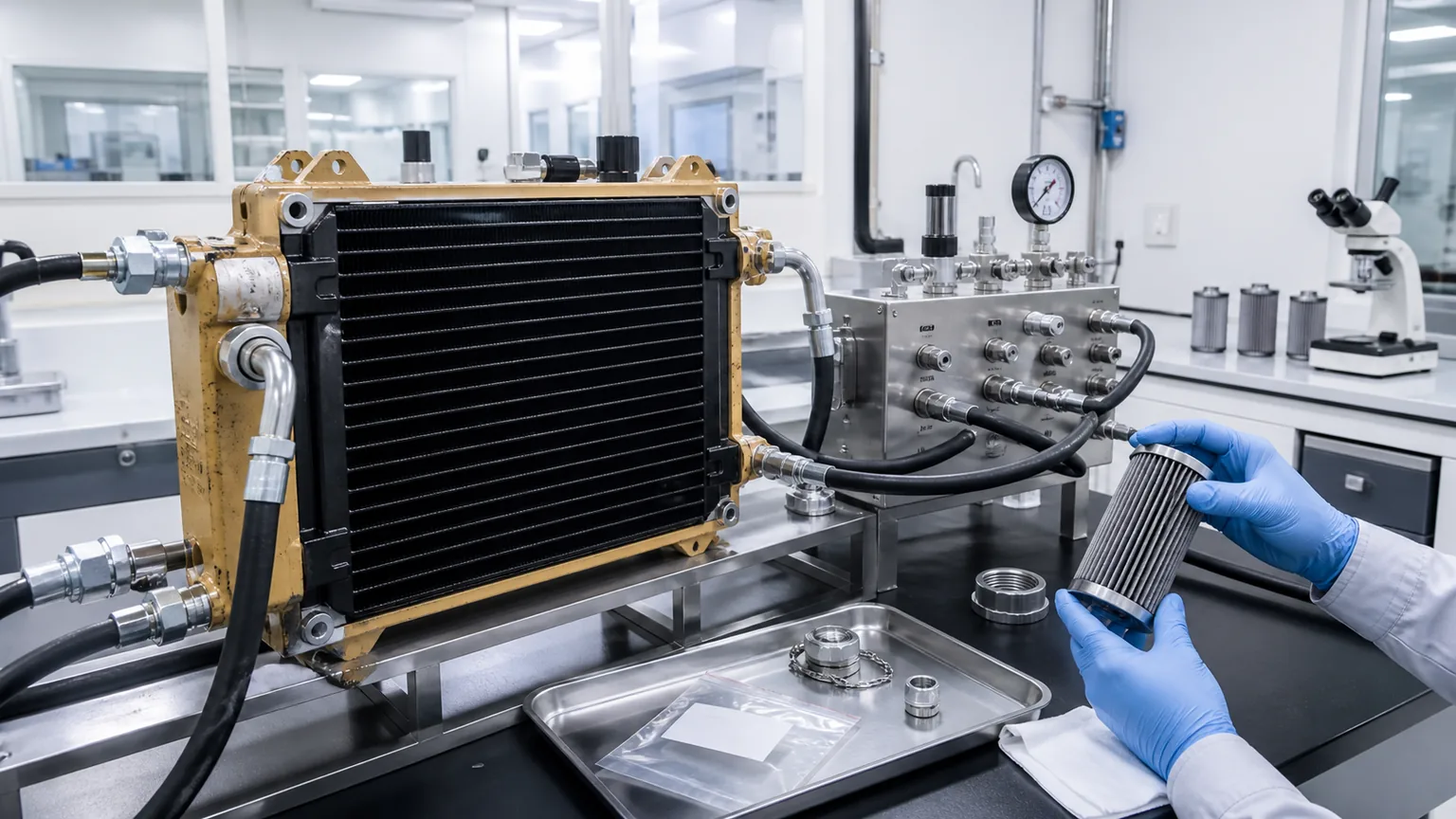
Cleanliness, leak integrity and pressure durability need documented methods and traceable results.
Supplier audit and sample approval
Audit material identification, tube/fin and header control, brazing or welding parameters, port machining, fixture calibration, cleaning, leak testing, final inspection, label traceability and nonconformance handling. For trading companies, identify the actual factory and establish whether factory changes require written approval.
Inspect the first sample dimensionally, verify ports with gauges, test cleanliness and pressure to the agreed plan, and install on a representative machine. Record oil temperature under repeatable duty, pressure drop where practical, fan/airflow status, leakage, vibration, mounting strain and clearance. Retain an approved golden sample and drawing.
Use failure evidence to improve the replacement
Before copying a failed cooler, determine why it failed. A rubbed or cracked tube can indicate a loose stack, missing isolator, distorted frame or fan contact. A fracture beside a port may come from a rigid hose, unsupported fitting, assembly torque or pressure pulsation rather than weak core material. Uniform external fin blockage points toward the duty cycle and cleaning plan; internal restriction may involve oxidized oil, hose degradation, seal debris or an earlier pump failure. Brazed-joint leakage after overheating can be the consequence of excessive system temperature, not its original cause.
Create a simple evidence pack before cleaning or cutting the returned part: machine hours, operating duty, oil and filter history, warning/fault record, temperature trend, pressure settings, fan condition, stack contamination, mount condition and photographs of the installed failure. Mark the exact leak or blockage area. Drain through a clean screen when contamination is suspected and retain representative fluid and debris under an agreed procedure. Do not circulate test debris through a clean hydraulic bench.
The findings should change the RFQ when appropriate. A high-dust machine may need accessible fin spacing, a reversible-fan strategy or improved guarding. A recurring port crack may require hose support or a stronger header interface. Excess temperature with a clean intact cooler may justify a new thermal calculation, larger air-side area or better fan and sealing control. A cooler supplier cannot correct a relief valve, pump, fan or installation problem that remains outside its scope, so the approved design and maintenance actions must identify ownership.
After replacement, flush and filter only according to the equipment maker’s procedure, use compatible oil, replace contaminated components as required and document commissioning. Establish a baseline temperature under a repeatable work cycle. Early reinspection for leaks, hose strain, loose mounts and fin blockage protects both the machine and the supplier relationship.
RFQ checklist
machine make, model, serial range, configuration and destination market;
full OE number and photographs of the original label and cooler;
stand-alone core, stacked cooler or complete module required;
core/overall dimensions, mounts and port centre locations;
port thread, pitch, sealing seat and mating-hose details;
oil, flow, temperature, heat load and allowable pressure drop;
working/proof/pulse pressure and relevant validation standard;
airflow, ambient, altitude, dust, vibration and installation envelope;
cleanliness, caps, packing, traceability and change-control requirements;
annual quantity, sample need, delivery, warranty and claim evidence.
Frequently asked questions
Are all ten suppliers Japanese manufacturers?
No. The list distinguishes Japanese manufacturers, global manufacturers with Japanese channels, an exporter and industrial-system suppliers. Confirm the contracting and manufacturing entity.
Can an industrial oil cooler replace an excavator cooler?
Only after a complete engineering validation. Mobile equipment adds transient pressure, vibration, shock, dust, airflow restriction, voltage and packaging demands.
Is the OE number enough?
It is the best start for a replacement but should be confirmed against machine serial range, dimensions, ports, mounts, module configuration and photos.
Which port measurement matters most?
Thread diameter and pitch are insufficient. Identify the standard, male/female form, sealing seat, straight/taper condition, port depth, orientation and mating connection.
What evidence supports a warranty claim?
Provide application, OE and supplier numbers, lot/serial, installation photos, oil/flushing/filtration record, leak location, pressure and temperature evidence, mount condition, caps/packing and the preserved part.
Choose the Japanese route that matches the job
Japan offers world-class off-highway module engineering, specialist custom heat exchangers, aftermarket export channels and industrial oil-temperature systems. They solve different problems. A sound shortlist first decides whether the need is OE replacement, new mobile design or stationary industrial cooling, then compares suppliers within that lane.
Send Elecdura the machine serial range, OE number, dimensions, ports, pressure and thermal duty, photographs, annual demand and delivery country. We can prepare a controlled cross-reference, drawing and sample-validation package for construction-equipment buyers.