English
Views: 0 Author: Site Editor Publish Time: 2026-08-10 Origin: Site
Germany is one of the most important aftermarket markets for intake manifold sourcing because the vehicle parc includes a high concentration of turbocharged gasoline and diesel engines, direct-injection platforms, and European vehicles with complex air-management systems. A replacement intake manifold may include more than a plastic or aluminum plenum. Depending on the engine, it may involve runner flaps, swirl control, vacuum ports, MAP sensor bosses, coolant passages, EGR connections, gaskets, and actuator linkages. For distributors and repair networks, the right supplier is the one that helps prevent wrong-part orders before the vehicle is already apart.
This shortlist is designed for buyers who need practical supplier choices in Germany and a disciplined way to compare them. It covers local European aftermarket brands, Germany-focused wholesalers, OE channels, and international sourcing partners. For buyers building a wider engine and thermal-management program, intake manifolds often sit beside thermostats, radiators, cooling fans, and A/C compressor programs because many repair customers buy by vehicle system rather than by one isolated product family.
A strong intake manifold supplier should provide exact OE cross-references, engine-code coverage, visible port confirmation, gasket and hardware status, and clarity on whether the manifold includes an actuator or only the housing. This matters because German and European applications can look nearly identical while using different vacuum routing, flap linkage direction, pressure sensor positions, or EGR interface layouts. The wrong part may bolt on partly, then fail when the wiring harness, hose, or sensor does not reach.
Germany also has a mature repair culture. Workshops expect accurate data, not vague interchange claims. Fleet buyers and parts distributors need parts that can be selected quickly by registration, VIN, engine code, or OE number. If a supplier cannot support these checks, a low price becomes risky. A single incorrect manifold can create diagnostic time, labor disputes, and warranty noise that costs more than the price difference between two suppliers.
Procurement Factor | Why It Matters in Germany | Evidence to Request |
|---|---|---|
Engine code accuracy | VAG, BMW, Mercedes, Opel, and Ford applications vary by engine generation | OE number and engine-code list |
Runner or swirl flap design | Actuator and linkage mismatch can trigger fault codes | Photos of linkage, shaft, and actuator mount |
Vacuum and sensor ports | Different port positions can block installation | Side and underside photos |
Gasket inclusion | Missing seals delay workshop completion | Kit content confirmation |
Coolant or EGR interface | Some manifolds carry coolant or exhaust-gas-related connections | Application note and connector view |
Pierburg is a strong name for air-management, EGR, vacuum, and emissions-related components, which makes it highly relevant for intake manifold sourcing in Germany. Many modern intake systems are tied closely to emissions control and charge-air management, so a supplier with this background can be valuable when the manifold includes flaps, valves, or actuator interfaces rather than a simple casting.
For buyers, Pierburg is especially useful when the application is sensitive to drivability or fault codes. The cost may be higher than a low-cost aftermarket alternative, but the documentation and system-level fit can justify it on high-risk jobs. Distributors should still confirm whether the quoted item includes the actuator, seals, and linkage components. A manifold housing without the required control element may not solve the workshop's problem.
Febi Bilstein is widely used across European aftermarket distribution and is relevant for intake manifolds, gaskets, breather parts, and related engine components. For German buyers, the advantage is broad catalog coverage and familiar brand acceptance among repair shops. Febi can be a practical choice when a distributor needs a recognized aftermarket option for passenger vehicles and light commercial platforms.
The buyer should not rely only on a generic model name. A BMW, Mercedes-Benz, or Volkswagen manifold can vary by engine code, production date, EGR layout, and sensor location. When using Febi as a shortlisted supplier, request the article number, OE cross-reference, product photos, and details about included seals. This is particularly important when a failed intake manifold was diagnosed from vacuum leaks, swirl flap wear, or coolant traces near the manifold rather than from visible breakage alone.
Vaico, under VIEROL, is a useful German aftermarket brand for engine-related replacement parts. It can be attractive for distributors who want European application coverage with a catalog structure that supports OE matching. Intake manifolds are not a category where buyers should accept vague interchange, and Vaico-style documentation can help reduce uncertainty.
For procurement teams, ask whether the manifold is supplied as a bare housing or as a more complete assembly. Some applications need gaskets, a flap actuator, a pressure sensor port, or a vacuum connection that must match the original layout. If an old manifold failed because of a worn flap shaft, oil contamination, or cracked plastic around a mounting point, the replacement part should be inspected in those exact areas before repeat orders are approved.
Hella is not always the first brand buyers associate with intake manifolds, but German parts distribution often involves system suppliers and established channels that can help identify related thermal, electronic, and engine-management parts. Where intake complaints overlap with sensor or actuator diagnosis, a supplier channel familiar with vehicle electronics can be valuable.
This is most relevant when the repair symptom is not simply a broken manifold. Rough idle, limp mode, underboost, lean mixture codes, and EGR-related codes can involve sensors, vacuum supply, and air leaks. Buyers should use Hella-type channels as part of a broader diagnostic supply strategy, especially if the same customer base also orders radiator fans, fan modules, and other electrically controlled replacement parts.
MEYLE is a familiar German aftermarket brand with strong workshop recognition. It can be a useful intake manifold supplier option when availability, brand confidence, and catalog clarity are important. For distributors, brand trust matters because workshops often prefer parts that reduce perceived comeback risk, particularly on European vehicles where labor time is high.
When considering MEYLE or any similar branded source, compare the physical part in detail. Check the runner design, sensor mounting areas, gasket package, and hose routing. If the supplier offers improved materials or reinforced features, record exactly what changed and which OE weakness it addresses. Clear improvement claims can help sales teams explain why a part costs more than an unbranded alternative.
METZGER is another German aftermarket source that can be useful for engine-management and replacement components. It may be appropriate for distributors that need coverage across European makes and prefer a supplier with local market familiarity. Intake manifolds supplied through such channels are often easier for repair shops to accept than unknown imported stock, especially for vehicles with repeated intake-system complaints.
The practical procurement step is to verify component completeness. A quote should state whether seals, actuator pieces, screws, and plugs are included. If the manifold has variable geometry, the supplier should provide clear photos of the control mechanism. If coolant passes near the manifold, pressure sealing and gasket quality become part of the buying decision. These details reduce installation surprises and keep the supplier comparison fair.
Autodoc and similar online channels are visible in the German and European parts market. They can be useful for price benchmarking, range discovery, and identifying which brands cover a specific OE number. For a distributor, these platforms should not always be treated as the final bulk source, but they are useful for understanding visible market options and retail price bands.
Use online-channel data carefully. The same vehicle may show several manifold choices with different included components. One may include an actuator, another may require transfer of the old unit, and another may be a bare replacement housing. Before using this information to negotiate bulk supply, record the brand, part number, photos, kit contents, and fitment notes. The goal is to prevent a purchasing team from comparing unlike items as if they were identical.
OE dealer networks remain important for high-risk intake manifold applications. When a vehicle has a complex manifold with integrated flaps, emissions interfaces, or a known supersession history, the dealer listing can provide the most reliable baseline. Even if the distributor does not buy all stock through OE channels, dealer data helps confirm the correct reference.
The disadvantage is price and availability. Dealer supply may be too expensive for many aftermarket buyers, and lead times can be difficult when the vehicle is already off the road. A smart purchasing process uses OE data as a reference standard, then compares aftermarket suppliers against that standard. This is especially useful when building a private-label or import program for repeated applications.
Direct manufacturers can be effective for distributors with enough volume and enough technical discipline. Intake manifolds are more demanding than simple housings, so direct sourcing requires sample testing and detailed inspection. A buyer should request dimensional drawings, photos of every port, actuator mounting details, gasket material confirmation, and packaging samples before approving a mass order.
This channel can produce strong margins, but only when the buyer controls the risks. Check for plastic flashing near ports, weak threaded inserts, rough gasket grooves, poor flap movement, and brittle vacuum nipples. Ask whether the supplier performs leak testing or airflow checks where relevant. For German-market sales, catalog accuracy and packaging presentation also matter because professional workshops expect part labels and application data to be clear.
Elecdura can support intake manifold sourcing for buyers that need aftermarket parts with evidence-based matching and cross-category coordination. This is useful when the distributor also imports cooling, A/C, and engine-adjacent parts and wants one team to help verify OE numbers, photos, and application data before quotation. Intake manifolds can be added to a program that already includes A/C condensers, fan control modules, and cooling system parts.
For German-market intake manifold inquiries, Elecdura should receive the OE number, engine code, vehicle model, year range, old-part photos, port layout, gasket requirement, and whether the actuator must be included. That gives the quotation a technical basis and reduces the chance of wrong-part supply. The most useful supplier relationship is the one that makes the buyer more certain before the order leaves the warehouse.
Start with the failure mode. A manifold replaced for a vacuum leak is not the same risk as one replaced for a broken runner flap or a coolant leak. For a vacuum leak, sealing surfaces, gasket quality, port plugs, and hose nipples matter most. For swirl flap faults, the buyer should examine shaft play, actuator linkage, and whether the part is sold with the control mechanism. For coolant-related failures, the gasket and mating surface deserve closer inspection.
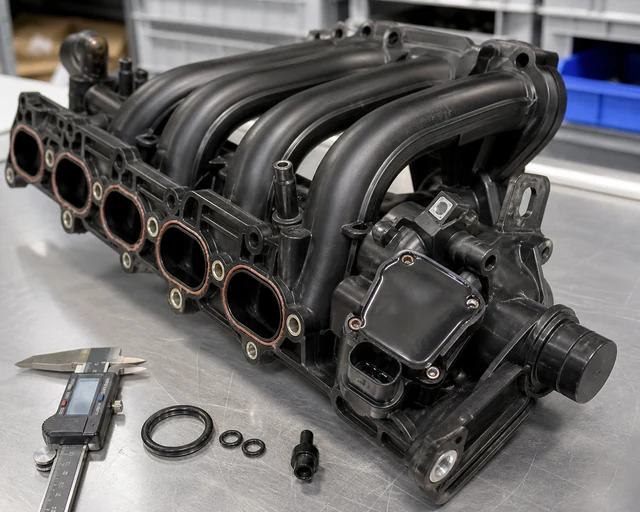
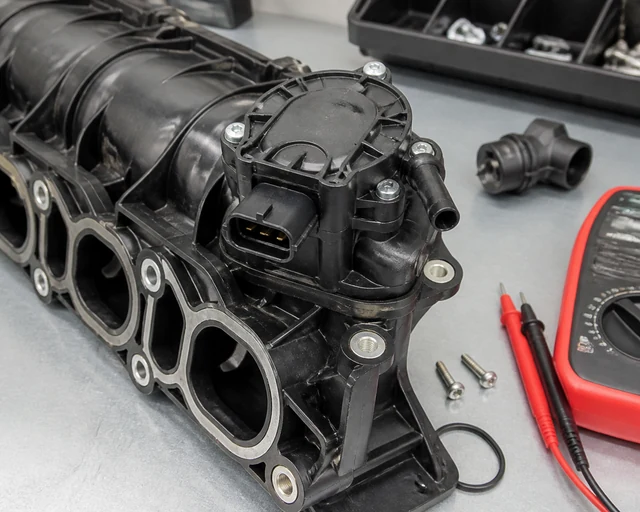
Next, compare the old part and the sample part from several angles. A top view confirms the general shape, but side and underside views catch the problems that stop installation. Look at the throttle body flange, MAP sensor boss, vacuum fittings, brake booster port, EGR connection, coolant neck, and mounting bosses. If the supplier cannot show these areas clearly, ask for better photos before purchasing.
Score Area | High-Confidence Supplier | Warning Sign |
|---|---|---|
Cataloging | OE number, engine code, and build-period detail | Only vehicle model name is provided |
Assembly completeness | Gaskets, actuator status, plugs, and hardware are listed | Photos do not match kit description |
Functional fit | Runner/flap movement and port layout are documented | Supplier avoids underside photos |
Packaging | Ports and flanges are protected | Thin carton with no internal support |
Warranty handling | Clear evidence requirements and failure review | All claims are treated as installer error |
The first mistake is ordering by engine family alone. Two engines in the same family can use different manifold versions. The second mistake is ignoring transferred components. If the old actuator or sensor must be reused, the new housing must accept it perfectly. The third mistake is skipping gasket verification. A manifold can fit the bolt pattern but leak if the gasket profile is wrong or the sealing rail is distorted.
Another common error is treating all intake manifold symptoms as part defects. A vehicle may have a blocked EGR path, failed sensor, boost leak, carbon buildup, or vacuum line problem. If those causes remain, the new manifold may be blamed unfairly. Suppliers and distributors can reduce warranty pressure by giving workshops a checklist: confirm smoke-test result, inspect hoses, check fault codes, verify actuator movement, and compare the old and new ports before installation.
Premium sourcing is justified when labor time is high, the manifold includes moving parts, or the vehicle has a known problem history. German-market workshops often repair vehicles where intake manifold access requires significant disassembly. A low-cost part that fails quickly can damage the distributor's reputation more than it saves on the invoice.
Use the cheapest acceptable supplier only when the application is simple, the sample has been approved, the fitment data is stable, and the buyer has clear warranty evidence. For complex VAG, BMW, Mercedes-Benz, and diesel applications, give more weight to technical documentation and sample consistency. The best supplier is the one that reduces total job risk, not only part cost.
Warranty handling is easier when the distributor collects evidence before the part is fitted. For intake manifolds, ask the workshop to keep the old part label, take photos of the failed area, record the fault codes, and note whether a smoke test or pressure test was performed. If the old manifold failed because of a cracked nipple, broken flap shaft, or leaking gasket rail, those photos help the supplier understand whether the replacement part addresses the actual cause.
It is also worth documenting the surrounding components. A new intake manifold can be damaged or blamed if the engine has a blocked crankcase ventilation system, excessive oil carryover, a stuck EGR valve, or poor turbo hose condition. German B2B buyers should therefore prefer suppliers that accept technical evidence and discuss root cause instead of only approving or rejecting claims from invoice data. That approach protects the distributor from repeated disputes and helps workshops trust the product line.
Gasoline direct-injection engines often create intake complaints through vacuum leaks, carbon deposits, plastic heat fatigue, and sensor-port sealing problems. The buyer should check throttle flange alignment, MAP sensor position, vacuum nipples, and gasket profile. A small air leak can create lean codes, idle fluctuation, and poor cold-start behavior, so sealing quality matters as much as the visible shape of the manifold.
Diesel applications may create a different risk profile. Swirl flaps, EGR contamination, oil mist, and boost-pressure control can make the manifold a more complex assembly. On these applications, buyers should pay close attention to flap movement, shaft sealing, actuator mounting, and whether the manifold is designed to withstand oily soot deposits over time. A supplier that understands these differences will give better technical answers than a seller who treats every manifold as a static plastic shell.
German intake manifold sourcing should combine brand confidence, technical verification, and practical availability. Pierburg, Febi, Vaico, MEYLE, METZGER, online wholesale channels, OE dealer data, direct manufacturers, and Elecdura each play different roles. The strongest purchasing strategy is not to choose one source for every manifold, but to match the supplier type to the application risk.
Before buying, collect OE numbers, engine codes, photos of the old part, actuator details, port layout, gasket requirements, and the failure symptom. This evidence allows a supplier to quote the correct part and helps the buyer separate a true manifold issue from a surrounding diagnostic problem. For distributors that want intake manifolds alongside thermal and A/C parts, Elecdura can help build a cleaner, evidence-based sourcing program for repeat aftermarket demand.