
English
Views: 0 Author: Elecdura Publish Time: 2026-08-13 Origin: Site
Brazil has several strong channels for automotive air-conditioning condensers: OE-focused global brands, Brazilian manufacturers, importers with private-label ranges, national or regional distributors, and specialists serving light vehicles, trucks, buses, agriculture, construction, and off-highway equipment. They are not interchangeable. A workshop that needs one original condenser today has a different buying problem from a distributor building a 300-reference range.
This guide compares ten suppliers with current, first-party evidence of Brazilian operations and condenser or automotive A/C activity as of August 2026. It is an editorial procurement shortlist, not a ranking by revenue or market share. Each company is labeled by its documented role. Importers and distributors may sell products from several factories, so buyers should identify the actual brand and part number in every quote. For repeat-volume or private-label sourcing, local channels can also be compared with Elecdura's wholesale automotive condenser supply using the same fitment, test, packaging, and traceability criteria.
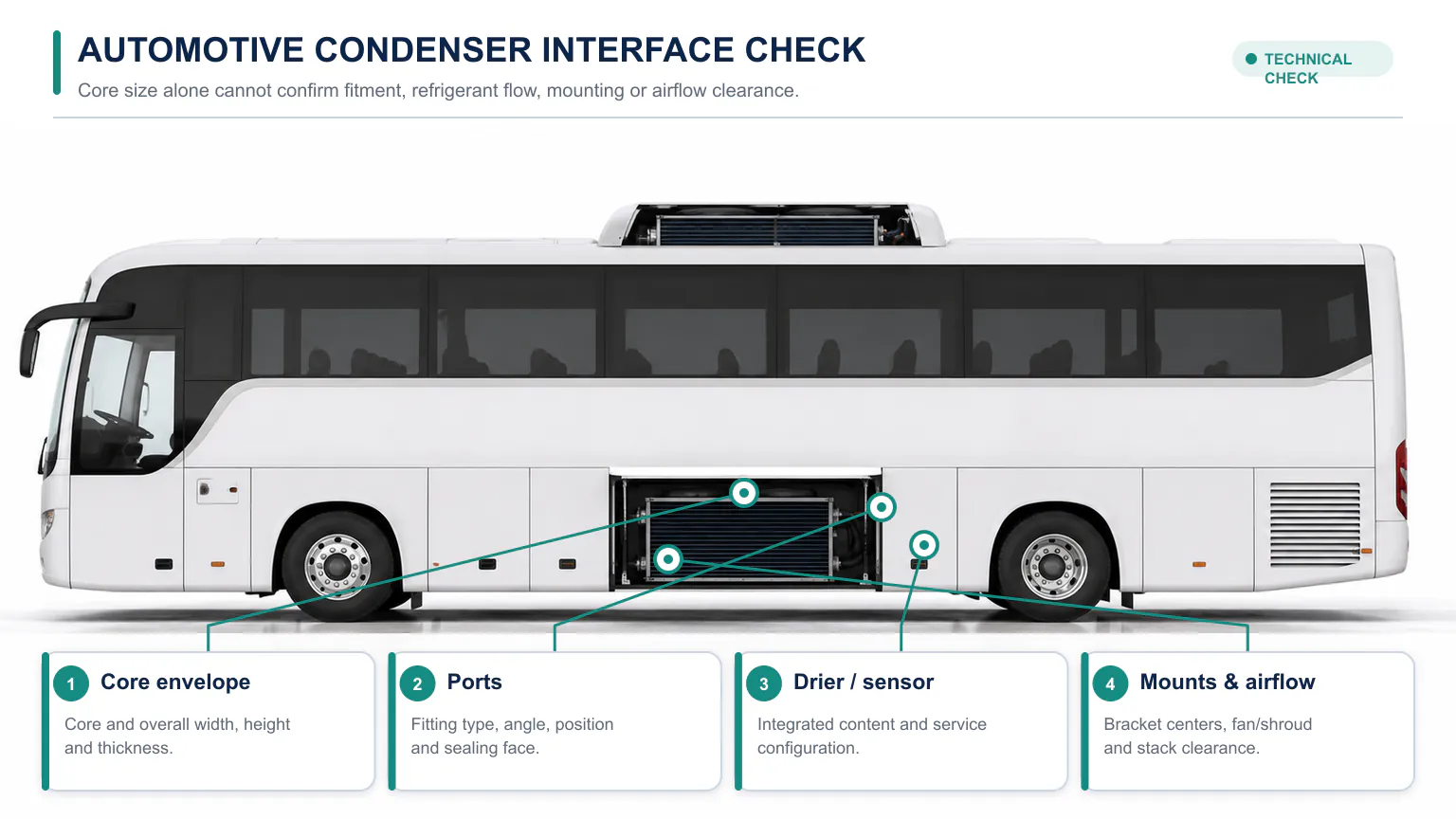
Condenser fitment depends on the complete interface—core dimensions, ports, receiver-drier, brackets, sensors, and airflow clearance.
Supplier |
Verified role |
Documented coverage |
Best-fit buying situation |
|---|---|---|---|
Valeo Service Brazil |
Global OE and aftermarket brand |
Automotive A/C condensers including modern powertrains |
Brand-controlled light-vehicle coverage |
Skafer |
Brazilian manufacturer and distributor |
Condensers for automotive, heavy, agricultural, and construction applications |
Local production, custom work, and off-highway coverage |
HC Automotivo |
Importer, distributor, and private-label supplier |
Light, heavy, agricultural, bus, mining, and construction A/C parts |
Broad catalogue and multi-location service |
Refrijet |
Brazilian automotive A/C specialist |
Visible light and heavy condenser application catalogue |
Application-led truck and equipment sourcing |
Termoklima / AIKOR |
Distributor, importer, and own-brand supplier |
Condensers and automotive A/C parts across the Northeast |
Regional stock and CNPJ technical service |
PV8 |
Automotive A/C parts specialist |
Light, heavy, construction, and agricultural lines |
Multi-segment specialist support and national delivery |
Climer |
Cooling and vehicle A/C distributor |
Light, heavy, agricultural, and stationary lines |
Southern Brazil distribution and mixed thermal parts |
Aspex |
Brazilian aftermarket distributor |
Condensers plus radiators, compressors, evaporators, and heavy line |
Broad aftermarket basket and reseller supply |
Tolear |
Vehicle A/C fabricator, system integrator, and distributor |
Compressors, condensers, and systems for small and large vehicles |
Custom systems and non-standard applications |
GAP Ar Condicionado Automotivo |
Automotive refrigeration-parts specialist |
Light, heavy, agricultural, on/off-road lines |
Specialist trading and mixed-brand quotations |
Several companies overlap, but the comparison must remain like-for-like. A Valeo-branded unit, a locally fabricated copper condenser, and an imported private-label condenser have different design authority, construction, documentation, warranty, and price.
Companies were included when an official company or product page documented Brazilian operations plus automotive A/C condenser activity or a clearly relevant automotive climate-parts range. First-party sources were preferred over directories and marketplaces because the seller identity, application authority, and warranty channel matter to professional buyers.
The order balances manufacturer, brand, importer, distributor, and custom-system routes. It does not claim that every supplier stocks every condenser or ships nationally on the same terms. Buyers should verify stock, legal identity, brand, origin, product condition, application, taxes, delivery, and warranty in the live quotation.
Valeo Service Brazil publishes an official automotive condenser range and describes Valeo as an OE supplier of A/C and HVAC components. Its product information highlights multi-channel tubes, dense fins, receiver-driers on selected designs, and coverage that includes electric and hybrid vehicles.
Valeo is a useful brand-controlled reference for passenger-vehicle applications where OE-style design and application documentation are priorities. Availability still depends on the Brazilian catalogue and distributor network. Confirm that the quoted part is Valeo-branded, new, and correct for the VIN or OE number rather than assuming that any visually similar condenser is equivalent.
Verify in the quote: Valeo part number, OE cross-reference and application, receiver-drier inclusion, sensors or fittings, port caps, production/origin marking, local warranty channel, stock, and packaging condition.
Skafer describes itself as a Brazilian manufacturer and distributor of automotive climate-control components, including heat exchangers and condensers for light, heavy, agricultural, and construction equipment. Its official pages also show special-project capability plus examples for trucks, excavators, loaders, and agricultural aircraft.
This combination makes Skafer relevant when a standard catalogue part is unavailable or when a fleet, agricultural, or construction application needs a locally supported custom solution. A custom build should not proceed from a damaged sample alone. Agree on the drawing, material, tube/fin construction, ports, brackets, pressure test, and thermal/airflow assumptions before release.
Verify in the quote: manufactured or distributed item, drawing authority, aluminum or copper construction, exact dimensions and ports, receiver-drier arrangement, operating/test pressure, coating, application references, lead time, and warranty.
HC Automotivo states that it imports and distributes automotive A/C parts, develops the KALT private label, and serves light, heavy, agricultural, bus, mining, construction, and van applications. Its catalogue includes condensers and identifies more than 30,000 A/C parts with multiple Brazilian locations.
HC's breadth can help distributors consolidate a mixed order and workshops locate unusual applications. Because the catalogue contains original branded and other product lines, the quote should state the exact brand and manufacturer rather than only an HC stock code. A distributor's product page can support application matching, but the buyer must still inspect the delivered unit.
Verify in the quote: HC SKU plus manufacturer part number, original/branded/private-label status, OE cross-reference, stock location, receiver-drier and fittings, warranty, substitution policy, batch identity, and shipping protection.
Refrijet publishes a detailed heavy-line condenser catalogue with visible applications for Volvo, Mercedes-Benz, Scania, Iveco, Ford, Volkswagen trucks and off-highway equipment, along with Refrijet and OE reference codes. This kind of application visibility makes the company useful for truck and equipment buyers.
Catalogue specificity reduces ambiguity but does not eliminate variant risk. A Volvo FH, Mercedes Axor, or Scania family can have year, cab, market, or HVAC differences. Verify the original label and physical interface and check whether a receiver-drier, fan, bracket, or hose is included or transferred.
Verify in the quote: Refrijet code, OE number, model and production range, core and overall dimensions, port type/orientation, mounts, receiver-drier, fan/voltage if integrated, stock, packaging, and warranty.
Termoklima describes itself as an official automotive A/C parts distributor that manufactures own brands including AIKOR, imports directly, and carries condensers, evaporators, compressors, driers, hoses, valves, refrigerants, and tools. Its official site documents multiple branches across Brazil's Northeast and technical service for workshops, fleets, and CNPJ buyers.
The regional branch network can shorten domestic delivery for buyers in Ceará, Rio Grande do Norte, Paraíba, and Pernambuco. Ask whether the specific condenser is AIKOR, another branded product, or an imported line, and compare product evidence rather than treating every item under the same distributor as identical.
Verify in the quote: product brand, manufacturer and origin; application/OE match; stock branch; same-day dispatch conditions; receiver-drier and port caps; return freight; warranty; and volume terms for CNPJ customers.
PV8 presents itself as an automotive A/C parts specialist with light, heavy, construction, and agricultural lines, more than 2,000 stock items, several Brazilian units, national delivery, and technical support for distributors, workshops, and resellers.
PV8 is a practical specialist route for buyers who need application assistance across passenger vehicles and machines. Its homepage documents segment coverage but not every condenser, so request the product-specific page, code, or dimensional evidence behind the quotation.
Verify in the quote: supplied brand and part number, product-specific condenser listing, OE reference, application data, branch stock, delivery coverage, packaging, warranty period, and technical-contact responsibility.
Climer is a distributor specializing in vehicle cooling and A/C systems for light, heavy, agricultural, and stationary applications. It documents operations in Rio Grande do Sul and Santa Catarina and presents mixed cooling/climate categories, technical service, and delivery across Brazil.
Climer can be useful when the condenser purchase sits within a broader thermal-system order containing a radiator, fan, module, fluid, or installation accessory. Confirm the actual condenser brand and stock because distributor breadth is not evidence that every product is produced by the distributor.
Verify in the quote: product manufacturer/brand, part number, light/heavy/agricultural application, exact assembly content, stock unit, national freight terms, warranty, and whether technical support extends to installation diagnosis.
Aspex identifies itself as a Brazilian aftermarket parts distributor and lists condensers, radiators, compressors, evaporators, electrical products, and a heavy line. This makes it another candidate for resellers or workshops consolidating multiple categories.
The public site provides category-level evidence, so buyers should request exact product documentation before approving the source. When an online marketplace is also used, keep the legal seller, invoice, warranty channel, and product identity aligned; marketplace availability alone does not validate fitment.
Verify in the quote: Aspex stock code, product brand and manufacturer, OE/application reference, new condition, photos, receiver-drier configuration, shipment origin, invoice entity, warranty procedure, and return terms.
Tolear documents the design and installation of A/C and heating systems for small and large vehicles and off-highway machines, fabrication of tubes, connections and compressor/condenser supports, plus national commercialization of compressors, condensers, evaporators, filters, valves, tubes, and hoses.
Tolear is particularly relevant when the condenser is part of a retrofit, special vehicle, agricultural machine, old vehicle, or non-standard package. In those cases, condenser selection is a system-engineering task. The supplier needs heat load, compressor, refrigerant, airflow, fan, mounting, hose route, control, and service data—not only the space available.
Verify in the quote: catalogue part versus custom system, design responsibility, refrigerant and capacity conditions, condenser/fan performance, materials, bracket loads, hose/port layout, controls, test and commissioning, documents, and warranty boundary.
GAP Ar Condicionado Automotivo describes a specialist business trading imported and Brazilian automotive refrigeration parts across light, heavy, agricultural, on-road, and off-road segments. Its catalogue examples include condenser-related fan products and heavy-duty A/C components.
GAP can provide another mixed-brand specialist quotation. Because the official homepage emphasizes the overall range more than a dedicated condenser list, ask for the exact current condenser record and brand before adding it to an approved catalogue.
Verify in the quote: condenser-specific stock code, manufacturer and origin, application/OE match, dimensions and ports, heavy/agricultural availability, batch identity, packaging, national shipping, warranty, and technical-support contact.

Supplier role determines application authority, customization, stock, MOQ, documentation, and warranty handling.
Route |
Best when |
Strength |
Main watch-out |
|---|---|---|---|
Global/OE brand |
A known application has supported catalogue coverage |
Brand-controlled design and documentation |
Local stock, price, and channel identity |
Brazilian manufacturer |
Heavy, agricultural, custom, or obsolete units need local production |
Drawing collaboration and repairable supply relationship |
Thermal design authority and sample-based errors |
Specialist distributor/importer |
You need broad range, domestic stock, and technical sales support |
Mixed baskets and faster replenishment |
Different brands/quality levels under one seller |
System integrator |
The condenser belongs to a retrofit or special vehicle HVAC system |
Vehicle-level packaging and commissioning |
Unclear component versus system warranty boundary |
Direct overseas factory |
Stable volume supports samples, MOQ, and planned freight |
Private label and controlled range development |
Qualification, change control, landed cost, and local returns |
Modern passenger vehicles commonly use brazed aluminum parallel-flow condensers with multiport tubes and dense fins. Older vehicles and special equipment may use tube-and-fin, serpentine, copper/brass, or custom constructions. A different construction is not automatically better or worse, but it changes heat transfer, refrigerant charge, pressure drop, corrosion behavior, repairability, and airflow sensitivity.
Match the OE number and vehicle data, then verify the complete physical interface: core width/height/thickness, overall envelope, mounting tabs and hole centers, port block or fitting type, port position and angle, receiver-drier location, pressure sensor or switch port, fan/shroud attachment, splash shields, and clearance to the radiator, bumper, grille, and hood latch. Look for a model-year split or powertrain difference.
The condenser must also support the system's refrigerant and pressure requirements. R-134a and R-1234yf systems may use similar-looking hardware but require correct materials, service practices, labeling, and component approval. Never drill, rework, or adapt a refrigerant fitting casually. Follow vehicle-manufacturer service information and applicable safety/environmental rules.
Brazilian operating conditions vary from coastal salt and humidity to dust, insects, mud, agricultural debris, mining contamination, rough roads, and long highway duty. Dense fins can deliver strong clean-core performance but may plug quickly in off-highway service. Coatings and material choices must suit the actual environment, and the installation needs a cleaning path that does not damage fins.
Packaging is a quality characteristic. Condensers have wide, fragile fin fields and long unsupported brackets. A unit can pass the factory leak test and arrive with bent fittings, crushed fins, distorted rails, or contaminated open ports. Use rigid corner/edge protection, port caps, moisture control where required, and an individual carton that prevents movement without loading the core.
For national distribution, compare stock location, ICMS/tax handling, carrier limits, dimensional freight, remote-area lead time, return routing, and replacement availability. A cheaper unit shipped twice after freight damage is not cheaper. For agricultural and construction applications, Elecdura's off-highway parts sourcing route can be compared with local manufacturers using the same environment and packaging specification.
Vehicle/machine make, model, year/build date, VIN or serial number, engine/powertrain, and operating region.
OE number, supplier cross-reference, original label, and clear front/back/port/mount photographs.
Core width, height and thickness; overall dimensions; bracket centers; ports; drier; sensor/switch ports; fan/shroud interfaces.
Refrigerant, system architecture, operating/test pressure requirements, and any approved coating specification.
Construction type, alloy/material, tube and fin design, fin protection, rail and bracket thickness, and joining process.
Receiver-drier included or separate, desiccant/control requirements, service plugs/caps, O-rings, and other supplied accessories.
Required leak-test method and acceptance limit, dimensional inspection, cleanliness, salt/corrosion evidence where relevant, and batch records.
Brand, legal manufacturer, country of origin, product condition, part and lot coding, and change-control requirement.
Sample quantity, annual volume, MOQ, delivery city, Incoterm, tax/freight basis, warranty, and return process.
Individual packaging, port protection, fin/edge protection, pallet pattern, drop/transport validation, and label/barcode.

Incoming control should catch fitment, integrity, contamination, and shipping problems before the condenser reaches a vehicle.
Inspect the first approved sample in detail, then use a risk-based plan for production lots. Check carton and part identity, brand/lot marking, OE cross-reference, overall dimensions, mount positions, ports, drier and sensor fittings, fin damage, bracket distortion, contamination, caps, accessories, and packaging. Use a fixture or controlled drawing for repeatable critical dimensions.
Do not leak-test by applying uncontrolled shop air to an open condenser. Use the supplier's approved test method, pressure, medium, safety controls, and acceptance limit. If the buyer requires independent testing, define it before purchase so that the method does not damage the product or create a false comparison.
Record damage by carton and lot, not only by total quantity. Photograph recurring crushed corners, bent ports, loose brackets, or missing caps and connect them to packaging changes. For field returns, preserve the condenser, refrigerant-system history, diagnostic data, contamination evidence, installation invoice, and part/lot identity. A leak near an impact or overpressure event has a different corrective action from a brazed-joint process defect.
Use the same application list and acceptance criteria for every candidate. Normalize quotations to the same product content, brand status, currency, tax, Incoterm, freight, packaging, MOQ, lead time, warranty, and expected damage/return rate. A condenser with an integrated receiver-drier cannot be compared directly with a bare core unless the missing parts and labor are added.
For private label, approve a golden sample and controlled drawing, then specify material, critical dimensions, leak-test limit, cleanliness, coating, label, carton, batch traceability, and written approval before change. Trial a pilot lot through normal transport and installation before expanding the range.
Measure business performance after launch: application accuracy, transit damage, out-of-box leakage, installation issues, cooling complaints, warranty rate, response time, fill rate, and corrective-action closure. A supplier with a slightly higher unit cost may create a lower total cost if it reduces wrong-fit returns and emergency freight.
No. The list includes a global OE/aftermarket brand, Brazilian manufacturers, importers, distributors, and a system integrator. Their documented roles are shown so buyers can compare the right type of source.
No. Core dimensions do not confirm mounts, ports, receiver-drier, sensors, fan interfaces, pressure rating, or clearance. Use the OE number/VIN and verify the complete physical interface.
No. It can provide efficient heat transfer, but the system must be designed for its refrigerant flow, pressure drop, capacity, charge, fittings, and airflow. Do not change construction without vehicle- or system-level engineering approval.
Follow vehicle service information. Many modern condensers integrate the receiver-drier, while other systems use a separate component. If the refrigerant circuit was open or contaminated, the specified moisture-control components and procedures are critical.
Possible causes include wrong application, blocked or recirculating airflow, inactive fan, incorrect refrigerant charge, air/moisture in the system, restricted expansion device, compressor/control problems, bent fins, contaminated stack, or incorrect installation.
Decide whether the purchase needs an OE-focused brand, Brazilian manufacturing, domestic specialist distribution, a custom vehicle system, or a qualified overseas factory. Give every candidate the same OE/application data, drawings, quality limits, packaging specification, volume, and commercial terms. Approve the product and process evidence rather than approving a company name alone.
For recurring wholesale or private-label condenser requirements, submit the OE list, vehicle segments, annual demand, sample/drawing data, target quality evidence, packaging, and delivery locations through the Elecdura contact page. Elecdura can then prepare a product-specific quotation that can be evaluated against Brazilian manufacturers and distributors on fitment, integrity, traceability, lead time, and landed cost.


