
English
Views: 0 Author: Elecdura Publish Time: 2026-08-13 Origin: Site
Brazilian radiator buyers can source from local heat-exchanger factories, OE-oriented aftermarket brands, national cooling-parts distributors, specialist copper/brass producers, custom aluminum fabricators, and cross-border private-label programs. These routes are not interchangeable. A national distributor solves stock and delivery; a factory supports process and development audits; a performance fabricator solves unusual geometry; an importer program supports repeat-volume ranges and branding.
This guide compares ten useful supply routes with verifiable Brazil relevance as of August 2026. The order is an editorial procurement framework, not a ranking by revenue, sales or market share. Every company is labeled by role so a distributor catalogue is not mistaken for factory ownership. Importers can benchmark local offers against Elecdura's wholesale automotive radiator program using identical OE references, drawings, pressure-test requirements, packaging standards and warranty evidence.
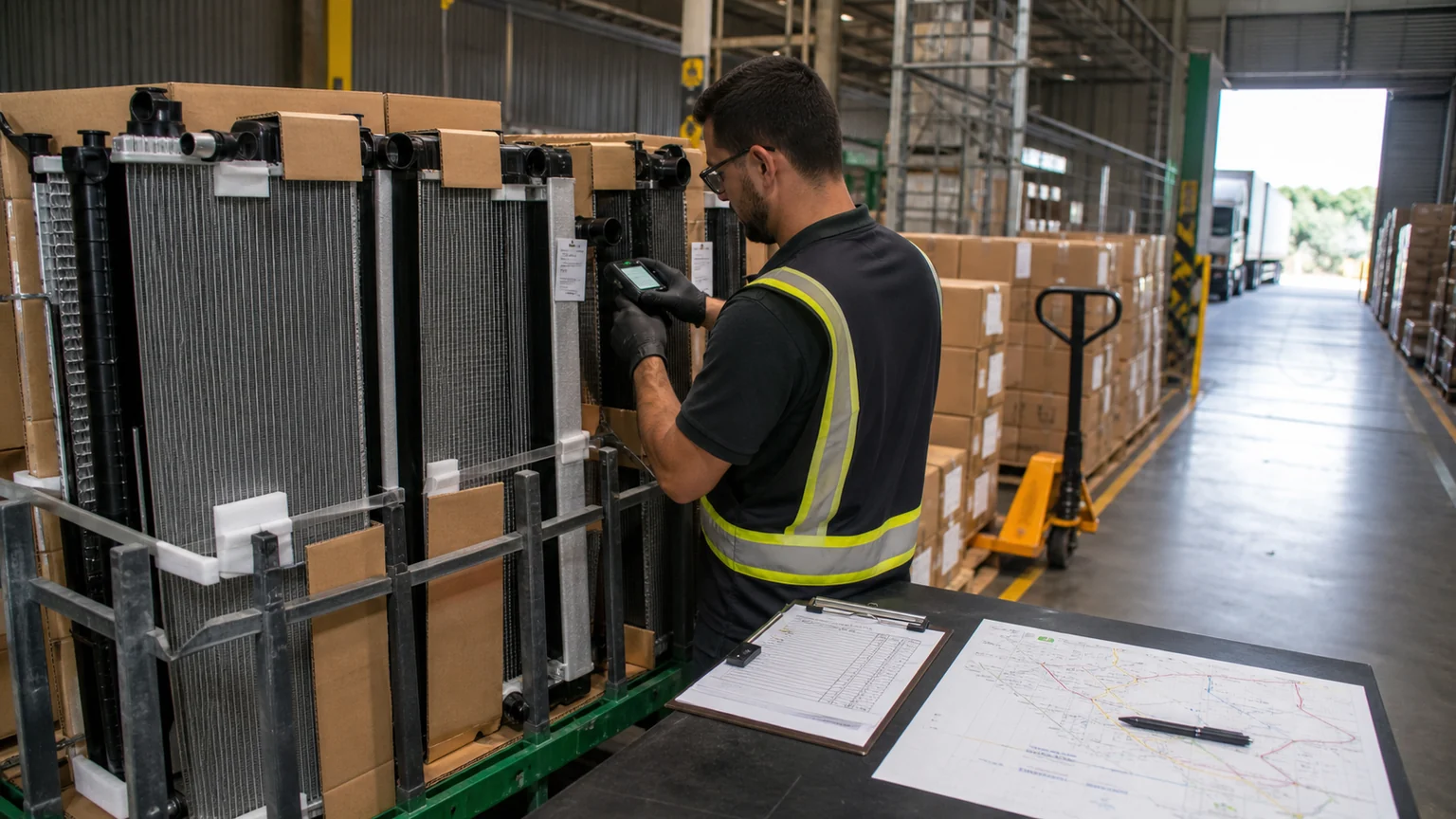
Brazil-market radiator matching starts with vehicle, engine, transmission and build data plus the physical interfaces—not model name alone.
Supplier or route |
Verified role |
Relevant strength |
Best buyer fit |
|---|---|---|---|
Valeo Service Brazil |
OE-oriented aftermarket brand and local channel |
Wide radiator/cooling portfolio, catalogue and technical support |
Premium branded replacement programs |
Radiadores Visconde |
Brazilian heat-exchanger manufacturer |
OEM, aftermarket, export and industrial thermal products |
Factory-qualified local programs |
Notus do Brasil |
Brazilian cooling-system manufacturer/brand |
Broad nationally produced cooling portfolio and distributor support |
Brazil-focused aftermarket ranges |
MAHLE Aftermarket Brazil |
Global OE-oriented aftermarket brand/channel |
Radiators, thermal-system breadth, catalogue and warranty route |
Branded light- and commercial-vehicle sourcing |
DENSO Aftermarket Brazil |
Aftermarket thermal brand and distributor channel |
Brazil radiator references, installation guidance and service bulletins |
Application-specific DENSO replacement route |
Paccini |
National cooling/HVAC distributor |
More than 13,000 products and multi-state distribution units |
Fast replenishment and mixed cooling-parts baskets |
IRB Automotive |
Brazil aftermarket parts brand |
Light-fleet radiator line, electronic catalogue and published limits |
Application-led branded aftermarket coverage |
Nobre Meriti |
Brazilian copper/brass manufacturer |
Repairable radiators, tanks, accessories and project development |
Copper/brass, older-fleet and special niches |
Motocooler Radiadores |
Brazilian specialist aluminum fabricator |
Brazed all-aluminum performance and custom radiators |
Classic, modified, motorcycle and performance applications |
Elecdura |
Cross-border wholesale/private-label route |
Broad OE-number coverage, factory integration and export support |
Importers building repeat-volume ranges |
Public websites identify possible routes, not approved suppliers. The quoted legal entity, manufacturing origin, certificate scope, stock status, part revision, test record and warranty authority must be confirmed for each SKU.
Companies were included when a current first-party source documented radiator manufacturing, a Brazil radiator/thermal catalogue, a national cooling-parts distribution route, specialist radiator fabrication, or a clearly described wholesale program relevant to Brazilian importers. Sources that named products and roles were favored over general business directories.
“Top” means useful for a defined procurement scenario. It does not mean every supplier carries every application or that one route is best for all buyers. Public claims about coverage, capacity, quality systems and warranties must be supported by current SKU- and site-specific documents.
Valeo Service Brazil publishes a dedicated radiator and engine-cooling offer for the Brazilian aftermarket. Its current pages describe broad fleet coverage, aluminum radiators, OE-oriented design, vibration and corrosion durability, protective packaging, traceability labels and connected technical support.
Valeo is useful when buyers want an established brand, catalogue support and an aftermarket warranty route. Its Brazil presence and manufacturing history do not prove that every radiator SKU is produced in Brazil. The manufacturing country and responsible plant should be checked for the exact item.
Verify in the quote: Valeo part number, OE crosses, vehicle/engine/transmission, current Brazil catalogue status, country of origin, cooler configuration, included accessories, authorized seller, lot label, stock, technical bulletins, warranty route and return conditions.
Radiadores Visconde describes a Brazilian heat-exchange manufacturer founded in 1966, operating an industrial site in Guarulhos. It states that it serves OEM, aftermarket, export and industrial segments with radiators for national and imported vehicles and other thermal-system products.
Visconde is a strong factory-audit candidate where the buyer needs local manufacturing evidence, engineering contact or stable volume. Its website references quality-management standards, but buyers should obtain current certificates and map the legal entity, address and scope to the quoted product.
Verify in the quote: current certificate copies, manufacturing site, customer segment, application ownership, drawing/tooling status, core process, tank material, PPAP, thermal and vibration validation, leak/burst test, capacity, change control, packaging and warranty.
Notus do Brasil describes itself as a Brazilian manufacturer of automotive cooling-system items with more than 2,500 products and a large ready-to-ship inventory. Its portfolio includes radiators, intercoolers, fan modules, electric fans, condensers, oil coolers and heater cores, and it supports distributor/specialist partners.
The breadth makes Notus relevant to Brazil-focused distributors that want several cooling categories from one route. Large coverage claims should still be tested against the buyer's actual vehicle population and replenishment needs. Product origin, national content and certification should be verified at SKU and plant level.
Verify in the quote: active application list, production versus sourced SKU, OE cross-reference, plant, certificate scope, core construction, cooler ports, leak test, label and lot code, fill rate, branch/partner stock, packaging, warranty and catalogue-update process.
MAHLE Aftermarket Latin America presents a broad engine-cooling program including conventional plastic-tank radiators, all-aluminum radiators, fans, intercoolers, oil coolers, expansion tanks and thermostats. Brazil-specific catalogue tools, technical assistance and warranty processes provide a local commercial route.
MAHLE is an OE-oriented brand/channel rather than evidence that every aftermarket radiator is locally made. It suits buyers who value technical documentation, brand positioning and portfolio breadth. Always confirm the exact application, origin and current availability in the Brazil catalogue.
Verify in the quote: MAHLE/BEHR part number, OE references, current Brazil application, origin, authorized channel, radiator type, cooler circuit, mounts, included hardware, label traceability, installation instructions, stock, warranty and analysis procedure.
DENSO Aftermarket Brazil publishes engine-cooling products, distributor locations, radiator installation guidance and Brazil-specific service bulletins. Current materials include radiator applications and instructions on correct coolant selection for radiators commercialized as DENSO replacement products in Brazil.
This evidence supports an application-specific aftermarket route. It does not justify claiming that every DENSO radiator is produced locally or that all global applications are stocked in Brazil. The current catalogue and authorized distributor network should control the shortlist.
Verify in the quote: DENSO reference, OE number, vehicle and flex-fuel/engine variant, transmission, production date, country of origin, authorized distributor, stock, coolant requirements, installation bulletin, traceability, warranty evidence and supersession.
Paccini explicitly identifies itself as a Brazilian distributor specializing in automotive cooling and climate-control parts. It describes more than 13,000 products, coverage of cars through buses and machinery, and units in several Brazilian states serving the country.
Paccini is included for distribution and logistics—not as a radiator factory. It can simplify mixed-category orders and local replenishment, but the buyer must identify the manufacturer, origin and warranty owner behind each radiator. Distributor qualification should emphasize application accuracy, stock handling, fill rate and returns.
Verify in the quote: brand and manufacturer, SKU/OE cross, warehouse, available quantity, lot label, stock age, delivery service level, damaged-goods process, return authorization, warranty handoff, credit terms and special-order lead time.
IRB Automotive describes a proprietary aftermarket brand supplying radiators for Brazil's light-vehicle fleet through an electronic catalogue. Its current radiator page publishes a claimed operating temperature range and pressure range plus dimensional, fit and quality-control positioning.
IRB should be treated as a brand and supply channel unless factory ownership and manufacturing origin are established for the exact SKU. Published ranges are useful only when the test method and application specification agree; a generic pressure number does not replace the vehicle's approved cap and system requirements.
Verify in the quote: IRB SKU, catalogue vehicle, origin and plant, actual test method, coolant-circuit design pressure, transmission cooler, dimensions, fitment evidence, batch identity, dealer route, stock, packaging and warranty analysis.
Nobre Meriti describes a fully Brazilian industry specializing in copper/brass radiators and radiator accessories. It also advertises component replacement and project development for mobile or stationary national and imported applications.
This is a distinct niche. Copper/brass construction can be repairable and appropriate for older vehicles, industrial equipment and special projects, but it should not be generalized to the modern aluminum/plastic direct-fit market. Buyers need to compare weight, corrosion system, joint method, performance and lifecycle service for the intended duty.
Verify in the quote: copper/brass specification, core and tank design, solder/braze process, thermal duty, pressure test, material compatibility, mount and port geometry, repair policy, production volume, delivery, packaging, traceability and warranty.
Motocooler Radiadores describes a Brazilian specialist manufacturing brazed all-aluminum radiators and intercoolers with TIG-welded structures. Its public catalogue focuses on performance, classic, motorcycle and made-to-measure applications, with specific dimensions and installation claims on product pages.
Motocooler is a specialist/custom route, not evidence of broad national passenger-car catalogue coverage. It is most relevant when stronger all-aluminum construction, unusual fitment or an older application is required. Performance claims should be validated at stated coolant flow, airflow, ambient and heat-rejection conditions.
Verify in the quote: exact application and year, drawing or sample, core specification, weld inspection, thermal duty, fan/shroud interface, pressure and vibration test, mounting accuracy, cap/expansion arrangement, lead time, warranty and suitability for fleet volume.
Elecdura radiator sourcing is a cross-border wholesale/private-label route rather than a Brazilian manufacturer. Its current wholesale program covers brazed and mechanical radiator construction through audited manufacturing partners, OE-number-based applications, mixed-order support, pressure/leak testing, traceability, packaging and export logistics.
The Brazilian importer remains responsible for customs, taxes, local labeling/commercial requirements, Portuguese documents, stock planning and downstream warranty. The approved factory and sample must remain fixed; purchase documents should prohibit unapproved changes in source, material, construction, tooling or packaging.
Verify in the quote: OE numbers, Brazil applications, factory by SKU, construction, sample/PPAP approval, material, cooler circuit, leak and pressure test, Portuguese/private-label artwork, lot traceability, MOQ, mixed-container rules, Incoterm, landed lead time and warranty evidence.
Supply model |
Best use |
Evidence to request |
Main risk |
|---|---|---|---|
Brazil factory |
Volume, engineering and local industrial qualification |
Site certificate, process audit, PPAP, validation, capacity |
Assuming a factory has every aftermarket application |
OE-oriented brand |
Recognized direct-fit replacement and technical support |
Current catalogue, origin, traceability, authorized warranty |
Assuming all brand SKUs are made locally |
National distributor |
Fast replenishment and mixed-category orders |
Manufacturer, stock, fill rate, handling and returns |
Confusing distribution coverage with process ownership |
Niche/custom manufacturer |
Older, modified, copper/brass or performance applications |
Drawing, duty point, material, test and sample approval |
Buying on appearance without thermal validation |
Cross-border private label |
Importer range, repeat volume and brand building |
Approved factory, batch tests, packaging and landed cost |
Uncontrolled source changes or excess inventory |
Brazil's fleet diversity makes catalogue discipline essential. A vehicle family may have flex-fuel gasoline/ethanol engines, diesel variants, manual and automatic transmissions, regional production changes, different air-conditioning packages and locally specific OE numbers. Use VIN/build data and OE references before accepting a visual match.
Operating duty also varies. Dense urban stop-and-go reduces ram air and increases dependence on fan control. High ambient temperature, an A/C condenser ahead of the radiator and automatic-transmission heat raise the cooling-stack load. Coastal salt, industrial contamination, heavy rain, insects, dust and road debris influence fin condition, coating and service life. None of these factors can be corrected simply by installing the thickest available core; airflow resistance and fan capability must remain compatible.
Vehicle make, model, year, Brazilian market, engine code/fuel, transmission and VIN/build range.
OE radiator number, verified cross-references and photos of the original label.
Core width, height and thickness plus overall envelope and stack clearance.
Hose neck diameter/orientation, filler neck or remote expansion design, drain and bleed points.
Mounting pins, brackets, fan-shroud holes, sensors and A/C condenser relationship.
Transmission/engine-oil cooler presence, fitting type, thread and center distance.
Material/construction, coolant, test pressure, corrosion requirement and expected duty.
Annual demand, pilot lot, labeling language, packaging, traceability, destination, Incoterm and warranty.
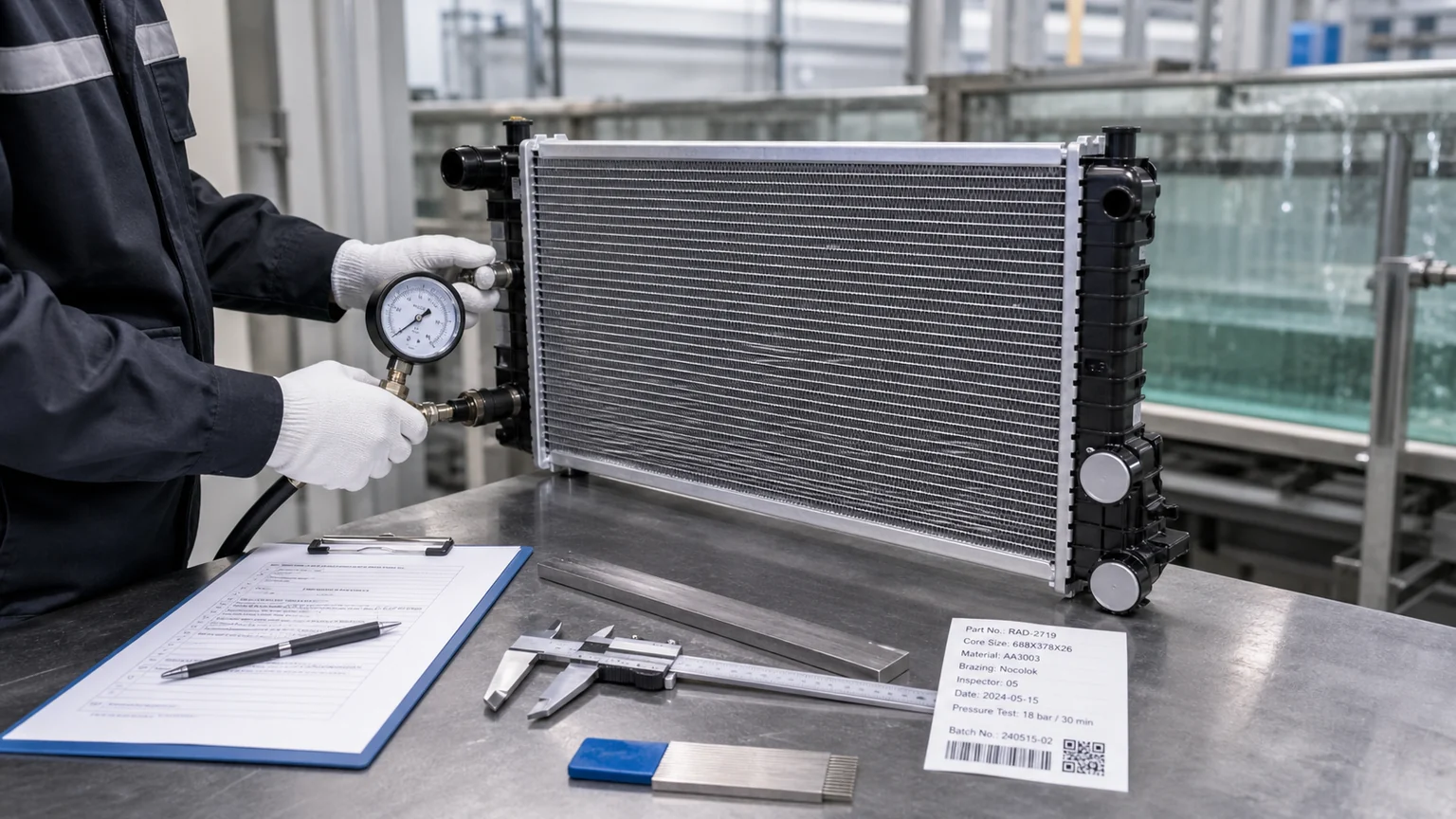
Radiator approval combines material and process evidence with dimensional, leak, fin, cooler-circuit and batch-label checks.
Follow the physical product from material receipt through tube and fin forming, core assembly, brazing or mechanical expansion, tank assembly, cooler installation, leak testing, final inspection and packaging. Identify which characteristics use controlled gauges or statistical monitoring. Confirm calibration and inspection records rather than relying on showroom samples.
Review alloy and resin specifications, furnace profile or expansion controls, header/tank joint consistency, dimensional gauges, leak-test pressure/medium/hold time, cooler-circuit isolation, pressure cycling, vibration, corrosion and thermal validation. Link every certificate to the legal entity, address, standard, current validity and applicable scope.
Change control is essential. A different tube supplier, fin density, tank resin, cooler, bracket, plant, sub-supplier or carton can change fit and failure rate. Written buyer approval should precede any change to the approved part or process.
Match identity. Compare purchase order, carton, part label, OE cross and approved revision.
Record transport damage. Photograph crushed cartons, punctures, moisture, bent fins, cracked tanks and displaced mounts before release.
Measure the interfaces. Check core/envelope, mounts, hose necks, shroud holes and cooler fittings against the drawing.
Inspect workmanship. Review braze joints, crimps, welds, tank/header engagement, threads, drains and debris.
Test separate circuits. Apply the approved method to the coolant circuit and any oil/transmission cooler without exceeding specification.
Retain traceability. Store results by supplier, SKU, purchase order, lot/date code, carton and test-equipment ID.
Quarantine and analyze failures. Do not mix repaired or unverified parts back into released inventory.
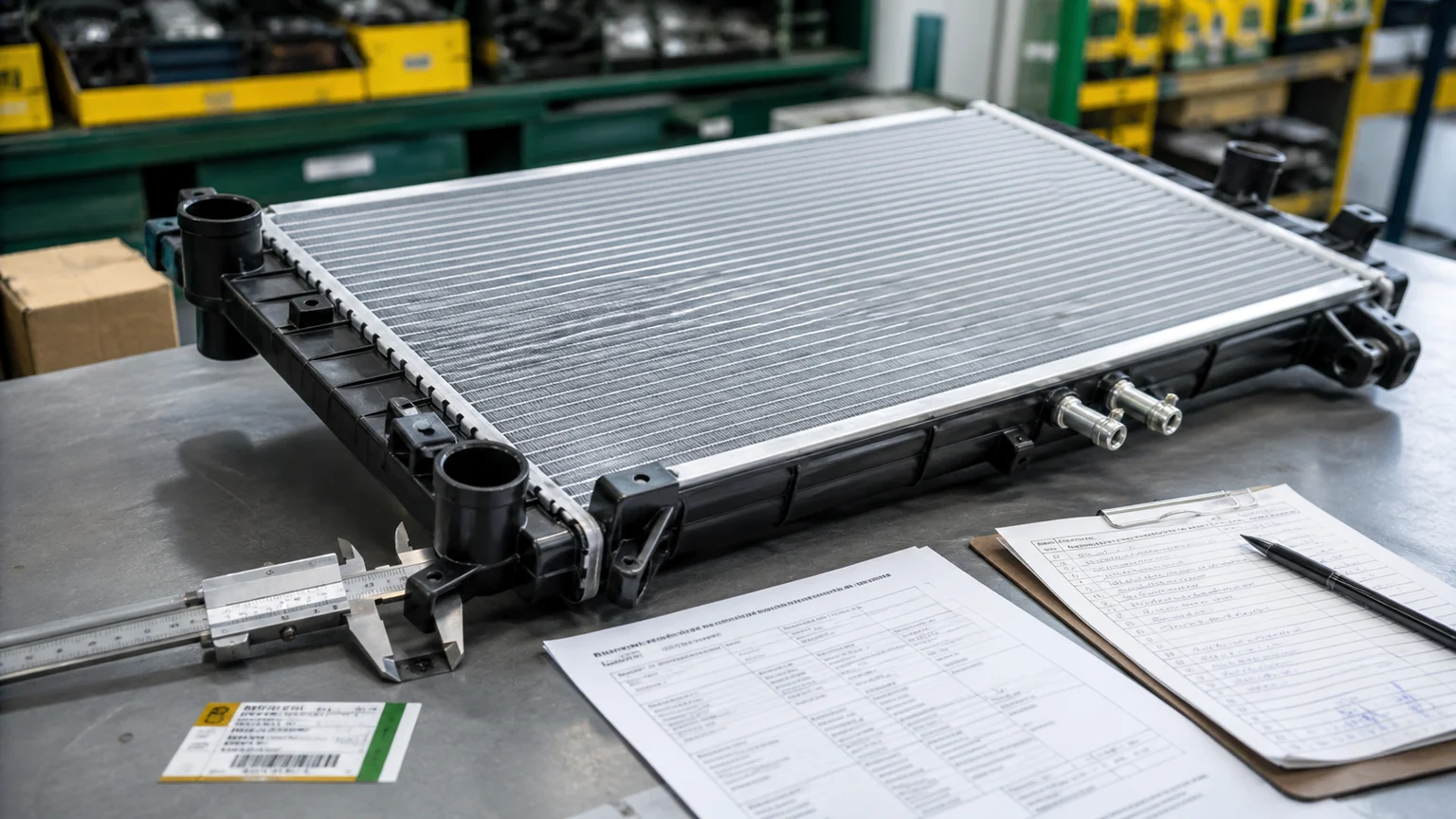
Brazil-wide sourcing must connect physical radiator protection, application-controlled stock and a documented freight route.
Compare the full commercial system: sample and tooling cost, MOQ, tax and customs, domestic or international freight, inventory carrying cost, credit, packaging loss, wrong-part returns, workshop labor, vehicle downtime, warranty transport and replenishment variability. A low unit price loses its advantage when fitment data or packaging is unstable.
For imported programs, model exchange-rate and port-delay exposure and keep safety stock tied to actual lead-time variability. For local distribution, compare fill rate and emergency availability. For custom products, include engineering time and future repairability.
Confirm legal entity, CNPJ or applicable registration, site, seller role and brand ownership.
Classify each SKU as manufactured, sourced, distributed, fabricated, repaired or imported.
Verify current certificates and product/site scope.
Audit application and cross-reference governance for Brazil-specific variants.
Review drawings, material controls, gauges, production tests and validation.
Witness pilot-sample leak tests, including the integrated cooler circuit.
Require lot traceability, nonconformance control and engineering change approval.
Test carton, foam and pallet protection for the intended freight channel.
Define warranty evidence, labor policy, return authorization and analysis time.
Release a pilot lot before scale and track claims by SKU, batch and failure mode.
No. The list deliberately combines Brazilian manufacturers, global aftermarket brands, a national distributor, specialist fabricators and a cross-border wholesale program. Role labels prevent a catalogue or warehouse from being confused with the manufacturing plant.
No. Verify country and plant of origin for the exact SKU. A brand may combine local, imported and partner-produced products, and an address may be a factory, warehouse, office or distributor.
Paccini's own company page identifies it as a distributor of cooling and climate-control parts. Its value is broad inventory, multiple units and national service—not claimed radiator factory ownership.
It can suit older vehicles, industrial or stationary equipment and applications where repairability or a custom metal tank is valuable. It should not be assumed equivalent to every modern lightweight aluminum/plastic direct-fit radiator.
Use the exact engine code, vehicle build range, transmission, OE number and physical interfaces. Flex-fuel model names may cover production changes, and an automatic-transmission cooler or cooling-stack difference can split the radiator application.
A volume program can reasonably require 100% leak testing, but the specification must define medium, pressure, hold time, acceptance criterion, calibration and separate cooler-circuit testing. Independent receiving sampling remains useful.
A defensible shortlist begins with the job to be solved: local engineered production, branded direct-fit replacement, nationwide replenishment, copper/brass or performance fabrication, or a private-label import range. Qualify the exact SKU and source, approve a pilot lot, and monitor application accuracy, leaks, transport damage and warranty cost.
For repeat-volume or private-label sourcing, send Elecdura the Brazil vehicle applications, OE numbers, annual quantities, target construction, Portuguese packaging requirements and destination through the radiator project contact page. Compare the proposal with Brazilian routes on exact fit, approved factory, batch evidence, landed lead time and total warranty cost.


