English
Views: 0 Author: Elecdura Publish Time: 2026-08-13 Origin: Site
Automotive radiator sourcing in Mexico is not one uniform market. Buyers can purchase from Mexican heat-exchanger manufacturers, global OE-oriented brands, nationwide aftermarket distributors, custom radiator fabricators, local service companies, or cross-border wholesale programs. Those channels solve different problems. A vehicle manufacturer developing a thermal module needs engineering and validation; a repair network needs fast direct-fit coverage; an importer building a private-label range needs repeatable batch control, packaging, and landed-cost discipline.
This guide compares ten useful supply routes with verifiable Mexico relevance as of August 2026. The order is an editorial procurement framework, not a market-share or revenue ranking. Every company is labeled by role so buyers can compare like with like. Importers evaluating repeat-volume programs can also benchmark local sources against Elecdura's wholesale automotive radiator program using the same OE references, dimensional approval, pressure-test records, packaging requirements, and warranty evidence.
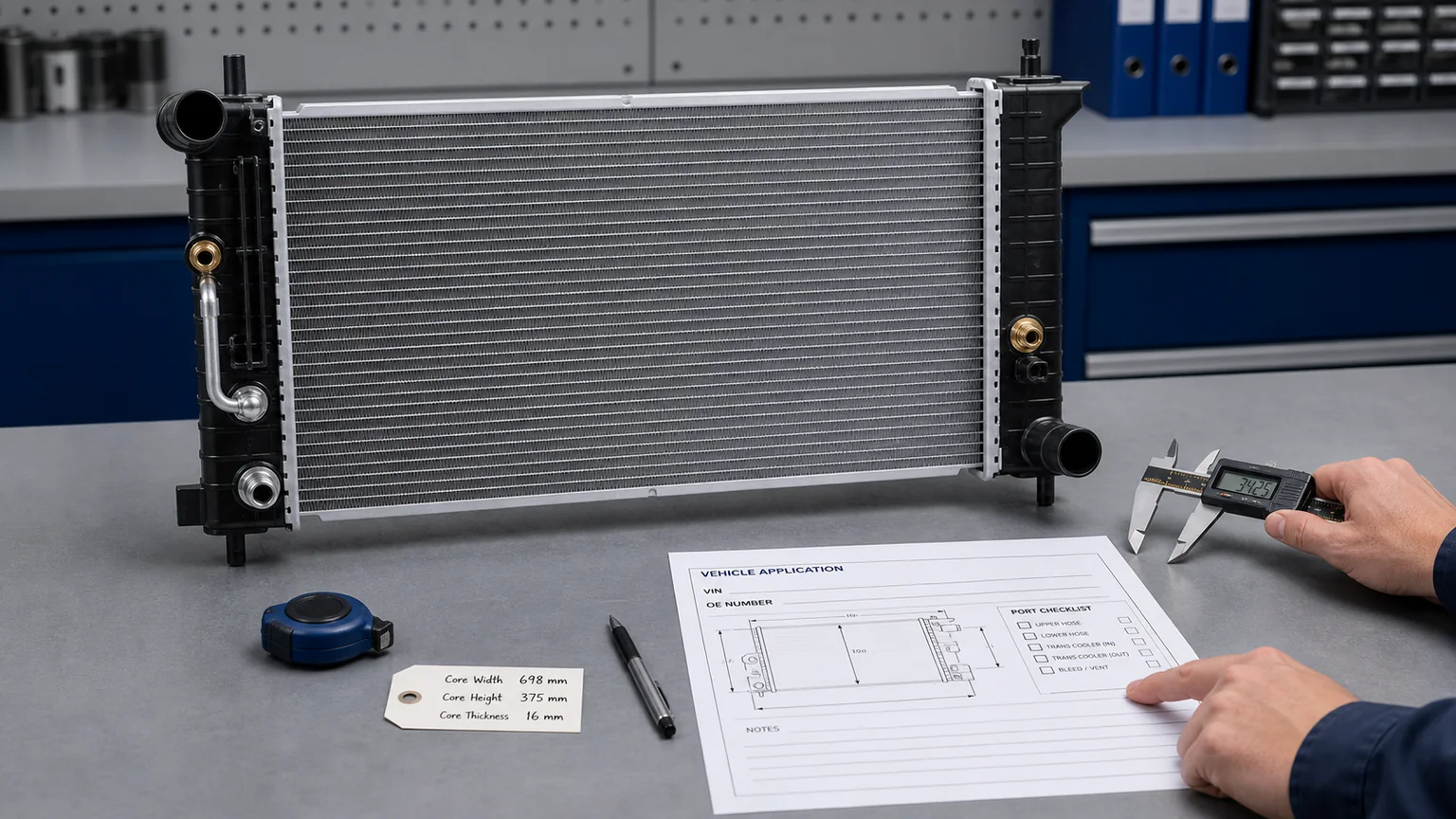
A valid radiator RFQ starts with application data, OE references, core and envelope dimensions, mounting geometry, and cooler-port configuration.
Supplier or route | Verified role | Relevant strength | Best buyer fit |
|---|---|---|---|
DENSO Mexico | Automotive component manufacturer with Mexico plants | Radiators manufactured in Mexico and OE-oriented thermal capability | Vehicle programs and application-specific brand sourcing |
Air Temp de Mexico | Mexican thermal-system manufacturer | Design, validation, brazing, testing, OEM and aftermarket work | Engineered local production and development projects |
Grupo Industrial Armas | Mexican automotive heat-exchange manufacturer | Radiators and thermal products for OEM and aftermarket | Manufacturing programs requiring integrated processes |
DEYAC | Mexican cooling-products brand and distribution program | Broad vehicle coverage, stock, CEDIS and distributor network | Aftermarket catalogue and national availability |
Bufalo Radiadores | Mexican radiator manufacturer/fabricator and catalogue seller | Automotive, truck, heavy-equipment and custom units | Catalogue supply and hard-to-find fabrication after entity verification |
Valeo Service Mexico | OE-oriented aftermarket brand and local channel | Direct-fit light-vehicle radiators, technical content and traceability | Premium branded aftermarket programs |
Radiadores i Mas | Manufacturer, distributor and service channel | Automotive to industrial coverage and nationwide delivery | Local catalogue, service and mixed-application enquiries |
Grupo Automotive | National parts distributor | Valeo radiator listings and established Mexican distribution | Retail, workshop and regional distributor replenishment |
Rinher's | Fabrication, repair and cooling-system service specialist | Custom radiators, industrial work, oil coolers and intercoolers | Project-specific or repairable applications |
Elecdura | Cross-border wholesale/private-label route | Broad OE-number coverage, dual-process sourcing and export support | Importers building repeat-volume ranges |
The table deliberately separates a factory from a distributor and a direct-fit replacement from a fabricated unit. Public claims identify a potential route; they do not prove that a quoted SKU was made at the named company's plant. Buyers should confirm the legal seller, manufacturing origin, certificate scope, test plan, stock status, and warranty authority on every quotation.
A company was included when a current first-party source documented at least one of the following: radiator manufacturing in Mexico, a Mexican automotive heat-exchange factory, a current Mexico radiator catalogue, a national distribution or service route, custom radiator fabrication, or a clearly described cross-border wholesale program relevant to Mexican importers. Preference was given to sources that state the company's role and product scope rather than only displaying a logo or an unsourced directory listing.
DENSO Mexico explicitly lists the radiator among products manufactured in Mexico. Its company information describes four plants in Mexico and a wider local portfolio of thermal, electronic, transmission, and other automotive systems. This makes DENSO a meaningful OE-oriented manufacturing benchmark rather than merely a brand visible in an online catalogue.
The public manufacturing statement does not mean every service radiator is sold directly or produced at the same Mexican facility. DENSO's contact guidance also distinguishes OEM parts from aftermarket enquiries. A distributor should therefore verify the current application, sales channel, manufacturing origin, and commercial availability instead of assuming access to an OE production part.
Verify in the quote: exact part number, vehicle and engine, genuine-service or aftermarket line, factory of origin, current catalogue status, transmission-oil cooler configuration, included fittings, supersession, authorized distribution, order quantity, warranty, and traceability label.
Air Temp de Mexico describes a Mexican company that designs, tests, manufactures, and validates automotive heat exchangers and air-conditioning systems. Its site explicitly includes radiators, condensers and thermal modules for light vehicles, commercial vehicles, OEM programs and the aftermarket. Published capabilities include fin and core production, assembly, brazing, leak testing, thermal and vibration validation, SPC, and material traceability.
Air Temp is relevant to development work and controlled production, but its capability page is not a live replacement catalogue. Confirm whether the request is an existing SKU, customer-owned drawing, new development, or sourced component.
Verify in the quote: design responsibility, drawing and tooling ownership, PPAP level, validation plan, alloy and braze process, tank material, thermal duty, pressure cycle, vibration requirement, corrosion test, annual capacity, change control, service-part horizon, and certificate scope.
Grupo Industrial Armas identifies itself as a Mexican automotive supplier established in 1968 and dedicated to manufacturing air-conditioning and heat-exchange products for OEM and aftermarket segments. Its product pages list radiators, HVAC units, heater cores, plastic parts and stamped components. The company's overview also describes processes such as Nocolok brazing, plastic injection, stamping, metrology and tooling.
The integrated process mix suits OEM or volume aftermarket programs where tanks, joints, brackets and fittings affect fit and warranty. Public information does not establish a universal independent-aftermarket catalogue.
Verify in the quote: application ownership, existing versus new tooling, manufacturing location, design validation, PPAP records, leak and burst criteria, brazing controls, plastic-resin specification, dimensional capability, production volume, replacement tooling plan, warranty responsibility, and aftermarket order terms.
DEYAC presents a broad Mexican cooling-system catalogue covering automotive and heavy-equipment radiators, condensers, fans, intercoolers, coolers and related products. It promotes stock availability, a warranty program, distribution opportunities, multiple CEDIS locations and an authorized-distributor directory. These characteristics make DEYAC particularly relevant to aftermarket resellers and repair networks seeking local availability.
A broad catalogue may use several manufacturing routes. Request origin, certificate scope and quality evidence for the quoted SKU rather than assuming every line shares one plant or process.
Verify in the quote: DEYAC SKU and OE reference, vehicle coverage, manufacturing origin, certificate scope, core size, transmission type, cooler fittings, pressure-test record, packaging, branch stock, back-order policy, distributor pricing, return authorization, and warranty exclusions.
Bufalo Radiadores describes a Monterrey operation that manufactures and sells radiators for passenger vehicles, trucks, heavy equipment and industrial applications. It also advertises made-to-measure production based on specifications or a sample. This route may suit a hard-to-find application, an older fleet, or a buyer who needs fabrication rather than a standard plastic-aluminum replacement.
There is an important due-diligence caveat. DEYAC's public distributor/CEDIS information and Bufalo's public location information include an overlapping Guadalupe, Nuevo Leon address. That overlap may reflect a commercial relationship, shared location, brand connection, historical listing, or another arrangement. It does not by itself prove legal independence or common ownership. Buyers should verify the contracting entity, production site, brand relationship and warranty authority before counting DEYAC and Bufalo as independent qualified sources.
Verify in the quote: legal seller and tax identity, relationship with DEYAC, actual production address, catalogue versus custom construction, sample/drawing approval, tube and fin material, tank method, pressure and thermal test, repairability, delivery time, freight protection, and warranty issuer.
Valeo Service Mexico offers an aftermarket radiator route built around OE-oriented design, direct fit, corrosion resistance, pressure and vibration durability, application coverage, and traceability labels. Valeo's Mexico pages also describe local aftermarket operations and a distributor network serving light and commercial vehicles.
Valeo is a branded aftermarket option, not proof that every Mexico-listed radiator is locally made. Verify the SKU because transmission, engine, production date and market can split apparently identical vehicles.
Verify in the quote: Valeo part number, OE crosses, exact Mexican-market application, authorized seller, country of origin, transmission cooler, sensor or drain details, included accessories, label traceability, technical-bulletin requirements, warranty route, and batch availability.
Radiadores i Mas in Tepic describes itself as a manufacturer, distributor, supplier and service business for automotive, heavy-equipment, agricultural and industrial radiators. Its live catalogue shows identifiable radiator SKUs, and the company advertises nationwide delivery in Mexico as well as repair-related services.
A quote may cover local fabrication, a stocked third-party product, a repair, or a catalogue replacement. Identify brand, origin and change-control responsibility before approval.
Verify in the quote: new, rebuilt or repaired status; manufacturer and origin; OE/SKU mapping; core and overall dimensions; port and mount location; pressure test; packaging; branch or warehouse stock; shipment tracking; return policy; and whether installation or coolant-system service is included.
Grupo Automotive states that it is a Mexican national distributor of automotive parts and has operated since 1980. Its current catalogue lists multiple Valeo radiator references. This is a distribution route, not a radiator factory, and that distinction is useful for buyers who need local replenishment, brand access and consolidated purchasing.
Because a distributor normally does not control design or factory processes, qualify authorization, application accuracy, handling, returns and traceability to the manufacturer.
Verify in the quote: brand authorization, current SKU, warehouse location, available quantity, lot/label traceability, OE cross-reference, order cut-off, fill rate, freight terms, damaged-goods process, warranty handoff, credit terms, and special-order lead time.
Rinher's describes a Mexican specialist in radiator fabrication, repair and reconstruction, with additional work on oil coolers, intercoolers and industrial heat exchangers. Its positioning is project- and service-oriented rather than a documented national direct-fit catalogue. That can be valuable when the original radiator is obsolete, the vehicle has been modified, or the application needs a robust custom core.
Custom fabrication needs a thermal duty, installation envelope and operating environment—not only the old part. A pressure test alone does not prove adequate heat rejection or vehicle durability.
Verify in the quote: legal and contact details, design inputs, material and construction, thermal calculation, sample condition, mounting and hose geometry, cap/expansion arrangement, pressure and vibration test, workmanship criteria, repair policy, delivery time, and warranty.
Elecdura radiator sourcing is a cross-border wholesale and private-label route rather than a Mexican local manufacturer. Elecdura's current wholesale program describes collaboration with multiple manufacturing partners, brazed and mechanical production options, broad passenger and light-commercial coverage, mixed-order support, pressure/leak testing, packaging and export logistics. This model is relevant to importers and distributors building a repeat-volume range rather than buying one urgent radiator.
The importer remains responsible for Mexico customs, local labeling, stock planning, application data and downstream warranty. The purchase order should prevent unapproved factory or construction changes.
Verify in the quote: OE numbers and target vehicles, factory allocated to each SKU, brazed or mechanical construction, sample/PPAP approval, pressure and leak test, dimensions, cooler configuration, private-label artwork, batch traceability, packaging drop protection, MOQ per model, mixed-container rules, Incoterm, landed lead time, and warranty evidence.
Supply model | Best use | Main evidence to request | Common mistake |
|---|---|---|---|
Mexican OEM/thermal manufacturer | New programs, engineered changes, stable volume | Process flow, PPAP, validation, capacity, change control | Assuming it offers a broad service catalogue |
Aftermarket brand/channel | Direct-fit replacement with catalogue and warranty support | OE mapping, current SKU, origin, traceability, warranty | Assuming every SKU is locally manufactured |
National distributor | Fast local stock and consolidated purchasing | Authorization, inventory, lot labels, returns, fill rate | Auditing the distributor as though it controls product design |
Custom fabricator/service specialist | Obsolete, modified, industrial or unusual applications | Drawing, duty point, material, tests, sample approval | Copying an old part without checking thermal duty |
Cross-border private label | Repeat-volume importer range and brand building | Approved factory, sample, batch tests, packaging, landed cost | Selecting on FOB price without warranty and inventory cost |
Part-name-only enquiries produce avoidable mismatches. The same model can use different radiators by engine, transmission, model year, build plant, towing package, air-conditioning package and market. Send the supplier a controlled application sheet containing:
Vehicle make, model, year range, engine code/displacement, transmission and market.
OE radiator number, trustworthy aftermarket references, VIN or chassis range when available.
Core width, height, thickness and construction, plus overall envelope dimensions.
Inlet and outlet diameter, orientation and center position; filler neck or remote expansion arrangement.
Mounting pins, brackets, fan-shroud attachment points, sensors, drain and bleed points.
Transmission or engine-oil cooler presence, fitting type, thread and center distance.
Required pressure/leak test, corrosion protection, coolant compatibility and packaging.
Annual demand, order mix, pilot quantity, labeling, traceability, destination, Incoterm and warranty target.
Where OE data and the physical sample disagree, stop and resolve the variant. Modifying a mount, stretching a hose, blocking airflow with an incorrect core, or leaving an unused cooler fitting can convert a cheap purchase into repeat labor and engine-damage exposure.
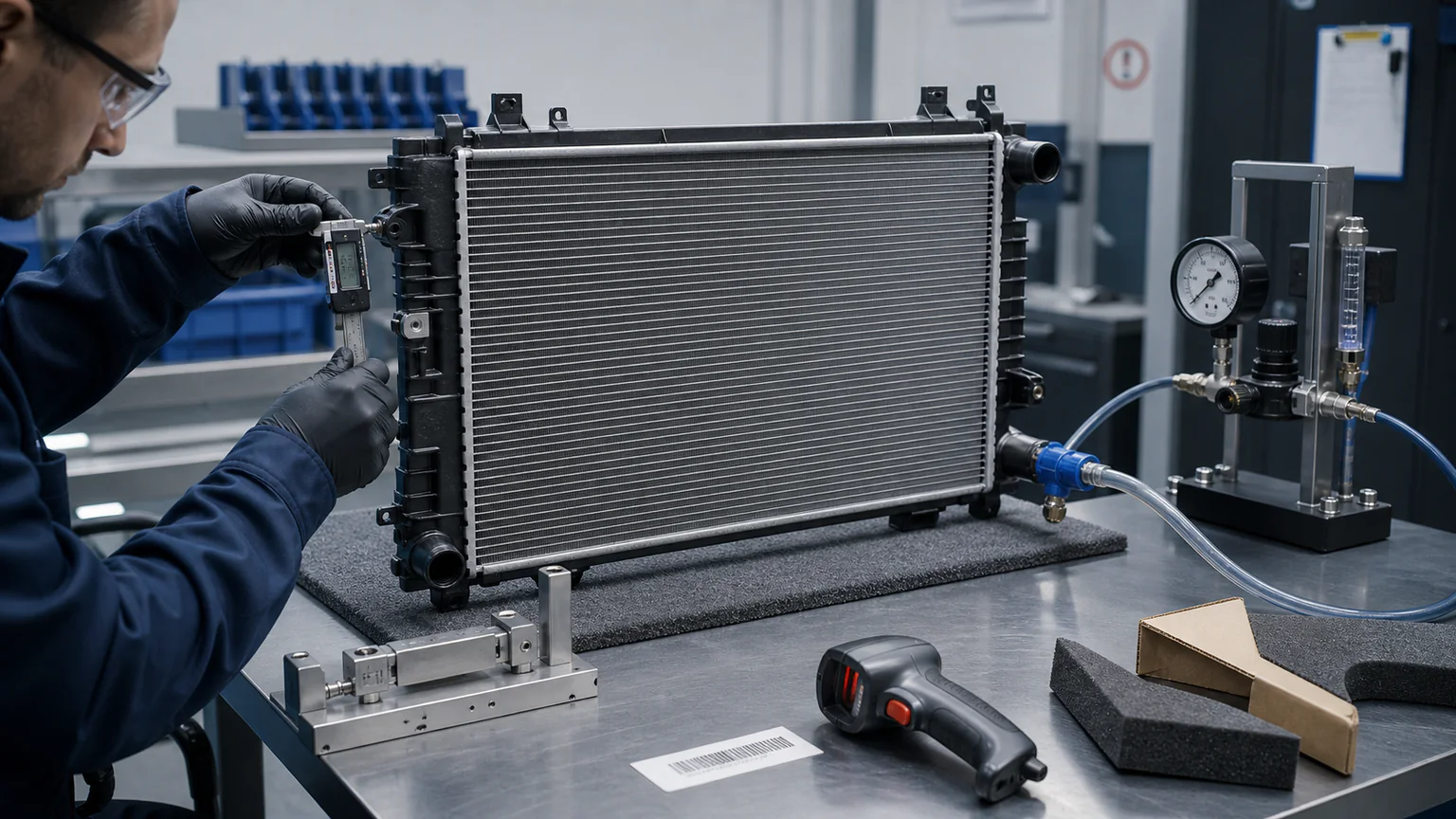
Incoming inspection should confirm geometry, cooler fittings, pressure integrity, fin condition, label identity and packaging damage before stock is released.
A glossy radiator and a clean carton do not demonstrate process control. For a volume program, trace the product from incoming material through tube and fin forming, core assembly, brazing or mechanical expansion, tank assembly, leak testing, final inspection and packaging. Ask which characteristics are controlled statistically and which are checked only at final inspection.
Critical evidence includes alloy and plastic-resin specifications, braze-furnace controls, header and tank joint consistency, dimensional gauges, calibrated leak-test equipment, pressure-cycle or burst validation, thermal-performance method, vibration and corrosion testing, cooler-circuit integrity, process audit records, nonconformance handling, and lot traceability. Certificate logos should be matched to the legal entity, address, standard, scope and expiry date.
The supplier must also control change. A new tube supplier, revised fin density, different tank resin, alternate transmission cooler, moved bracket or thinner carton can affect field performance. Require written approval before material, sub-supplier, process, tooling, plant or packaging changes.
Confirm identity. Match purchase order, carton label, radiator label, OE references and approved sample revision.
Inspect freight condition. Record crushed corners, punctures, wet cartons, bent fins, broken tanks, distorted mounts and loose fittings before unpacking the lot.
Measure critical geometry. Use the approved drawing for core, envelope, mount, hose and cooler-port dimensions. Do not rely on carton text alone.
Check appearance and workmanship. Inspect braze joints, tank/header engagement, seals, threads, brackets, filler neck, drain, fin spacing and debris.
Pressure-test the correct circuits. The coolant circuit and any integrated oil/transmission cooler are separate leak risks. Use the approved medium, pressure, hold time and acceptance criterion.
Retain traceability. Link inspection records and photos to supplier, SKU, purchase order, lot/date code, carton and test equipment.
Quarantine failures. Do not rework mixed product into saleable inventory without documented disposition and renewed testing.
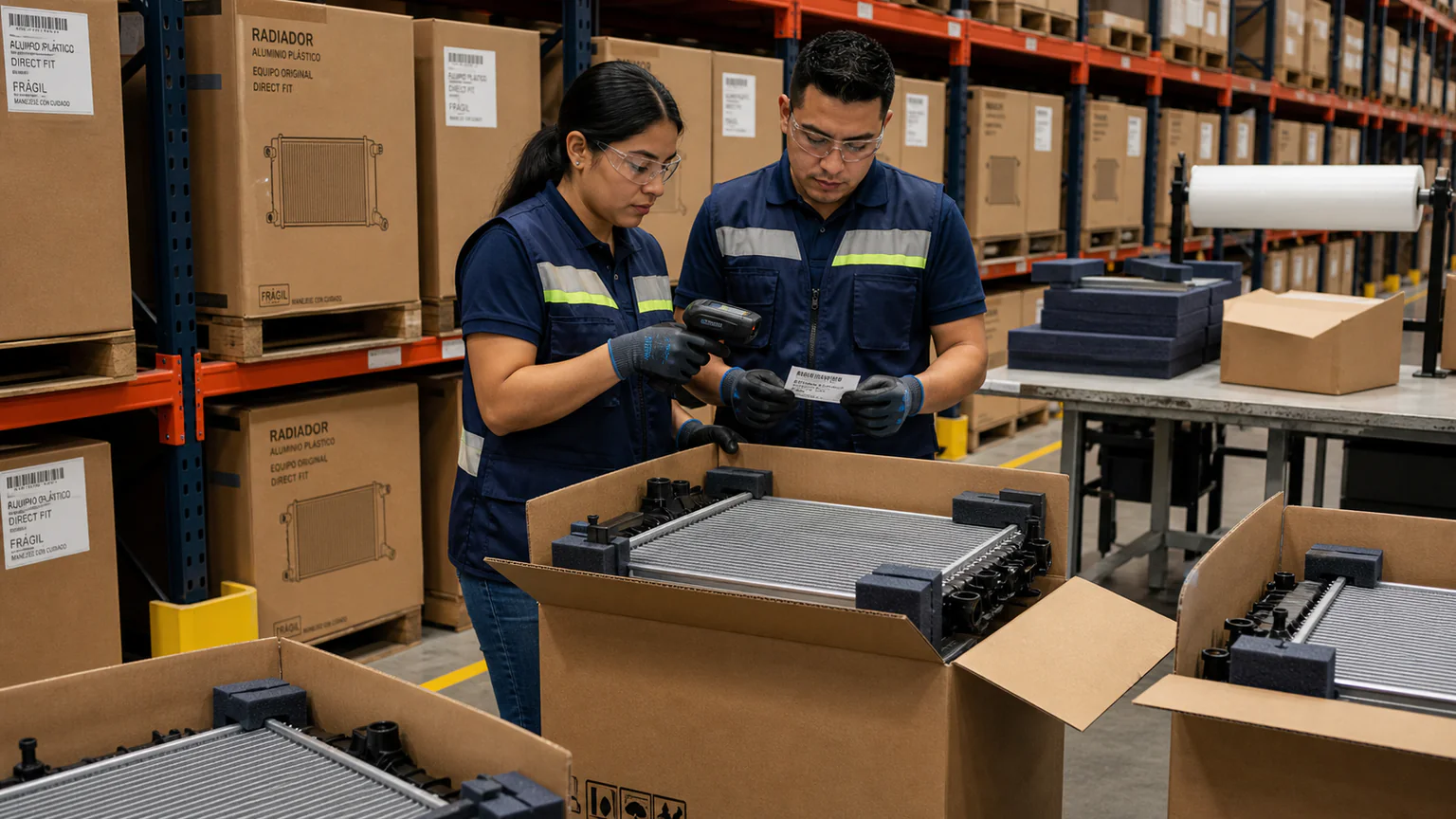
Application-controlled picking and protective handling matter after manufacturing; wrong-SKU and freight damage can create the same field symptoms as a poor radiator.
Match the shortlist to the operating model: confirmed local stock for urgent replacements, a capable fabricator for obsolete or modified applications, an engineering manufacturer for OEM/high-volume programs, or an audited cross-border factory for private label.
Compare total cost, including samples, tooling, MOQ, freight, customs, inventory, packaging loss, wrong-part returns, labor, downtime and warranty transport. A higher unit price can produce a lower landed warranty cost.
Confirm legal entity, tax details, physical site, seller role and any related brands or shared locations.
Classify each quoted SKU as locally manufactured, imported, distributed, fabricated, rebuilt or repaired.
Map certificate scope and address to the actual product and plant.
Verify OE/application data, variant controls and catalogue update responsibility.
Review approved drawings, gauges, material specifications and test standards.
Witness or record coolant- and cooler-circuit leak tests on pilot samples.
Audit traceability, nonconformance control, corrective action and engineering change approval.
Run packaging drop/stack checks appropriate to parcel, pallet or container delivery.
Define warranty evidence, return authority, labor policy and analysis turnaround.
Approve a pilot lot before full rollout and monitor claims by SKU, lot and failure mode.
No. DENSO Mexico, Air Temp and Grupo Industrial Armas publish clear Mexican manufacturing capability. Other entries are brands, distributors, mixed-role businesses, fabricators, service channels or cross-border wholesalers. The role labels prevent a distributor's catalogue from being mistaken for factory ownership.
No. A local address may be a plant, warehouse, commercial office, CEDIS, store or service location. Ask for the country and plant of origin for the exact SKU, then verify traceability and certificate scope.
Not without additional verification. Their public online footprints include an overlapping Guadalupe address. A buyer should confirm legal entities, ownership or commercial relationship, production sites, tooling, warranty authority and whether the supply chains are operationally independent.
Incomplete application data. Transmission type, engine, build date, market, cooler fittings and mounting details often create variants within one vehicle model. OE number plus physical dimensions and port/mount photos is safer than model name alone.
For a defined wholesale program, 100% production leak testing is a reasonable requirement, but the method must be specified. Pressure, medium, hold time, allowable decay or bubble criterion, calibration and separate oil-cooler testing should be documented. Sampling remains useful for independent receiving verification.
It can be appropriate for obsolete, modified, industrial, performance or unusual applications where a direct-fit part is unavailable. The fabricator needs the heat-rejection duty, airflow, coolant flow, pressure, installation envelope and environment—not only an old sample.
The best supplier is the one whose operating model matches the purchase: engineered factory development, branded local replacement, national distribution, custom fabrication, or repeat-volume import. Keep those models separate, qualify the exact SKU and plant, and make application accuracy, pressure integrity, traceability and packaging part of the commercial decision.
For a repeat-volume or private-label radiator range, send Elecdura the OE numbers, vehicle applications, annual quantities, target construction, packaging requirements and destination through the radiator project contact page. The quotation can then be compared with Mexican sources on exact fit, approved factory, test evidence, landed lead time and total warranty cost.