English
Views: 0 Author: Elecdura Publish Time: 2026-08-13 Origin: Site
Brazilian aftermarket buyers can source automotive thermostats from domestic temperature-control manufacturers, international brands with a Brazilian channel, national distributors and cross-border wholesale programs. These routes are not interchangeable. A manufacturer may control product design and validation, a brand may source different product families from several plants, and a distributor may provide valuable local stock without making the part.
This guide compares ten verifiable routes as of August 2026. The order is a procurement framework, not a market-share ranking. Verify the legal seller, actual producer, origin and warranty issuer for each part number. Repeat programs can compare local offers with Elecdura's wholesale automotive thermostat range using the same application, test and change-control requirements.
A thermostat must be matched by engine, OE reference, calibration and every mechanical or electrical interface—not by outside diameter alone.
Supplier or route | Verified role | Best fit | Verify before ordering |
|---|---|---|---|
MTE-THOMSON | Brazilian temperature-control manufacturer | Broad thermostat application and OE lookup | Exact engine, calibration, revision and origin |
Wahler Brazil | Established thermostat brand and Brazil channel | Branded valves, housings and technical route | Current SKU source, local stock and warranty |
Valclei | Brazilian cooling-component manufacturer | Aftermarket valves, housings and modules | Material, test evidence and application revision |
Iguaçu Componentes | Brazilian automotive-component manufacturer | Thermostat valves and combined components | Current certificate scope and exact catalogue item |
Magneti Marelli / Marelli Cofap | Brazilian aftermarket brand/channel | Branded thermostat valves and housings | Actual producer, country of origin and warranty |
MAHLE Aftermarket / BEHR | Global thermal-management brand with Brazil route | Engine-specific branded thermal products | Brazil availability, source and included components |
Paccini | Cooling and HVAC distributor | Local comparison of thermostat brands | Brand, stock, authorization and returns |
RMP Distribuidora | Multi-brand automotive-parts distributor | Regional stock of established thermostat brands | Current inventory, source and warranty owner |
TBrasil Autopeças | Multi-branch parts distributor | Local MTE and general aftermarket access | Branch stock, exact SKU and returns process |
Elecdura | Cross-border wholesale/private-label route | Repeat importer and distributor programs | Approved factory, sample, batch and landed lead time |
MTE-THOMSON is a Brazilian temperature-control specialist with a long operating history, a Brazilian electronic catalogue and technical material covering thermostat valves. Its catalogue supports searches by vehicle, product and original-equipment reference, making it a practical first reference for distributors building coverage across Brazilian passenger and light-commercial applications.
Even a strong catalogue match needs purchase-level confirmation. Specify vehicle year, engine code, fuel, transmission where relevant, OE number, opening temperature and whether the item is a valve, housing assembly or electronically heated module. Ask which plant produced the quoted SKU, which seal is included, whether the supersession is current and which entity handles warranty. A Brazilian brand does not prove that every catalogue item is made in Brazil.
Wahler Brazil presents thermostat products, technical support and a Piracicaba contact route for the Brazilian market. The brand is well established in engine temperature control and can be relevant when buyers value application support, branded packaging and a local route for technical or warranty questions.
Confirm the current commercial route for the exact part number because brand ownership, portfolio responsibility and distribution arrangements can change. The quotation should identify producer, country of origin, calibration, housing or valve content, sensor/heater specification where fitted, seal content, batch code and warranty issuer. Do not assume that a Wahler-marked item offered by any seller came through the authorized Brazilian chain.
Valclei describes itself as a Brazilian manufacturer of automotive cooling components and offers thermostat valves, housings and integrated modules for the aftermarket. This product focus is useful for buyers who need both conventional inserts and more complete plastic or metal assemblies.
Evaluate each family separately. A standalone wax thermostat requires control of frame geometry, wax-element performance, spring force and bypass features. A housing module adds polymer or alloy specification, sealing surfaces, welded or crimped joints, hose necks and sometimes a sensor or electrical heater. Ask for current application data, approved material, dimensional report, thermal cycling, leakage/pressure testing, calibration sampling and batch traceability.
Iguaçu Componentes Automotivos is a Brazilian automotive-component manufacturer whose public catalogue includes thermostat valves and combined temperature-control components. The company also states quality-process controls associated with ISO 9001. This makes it a relevant domestic route for an aftermarket buyer comparing application breadth and controlled production.
Quality-system language is a starting point, not SKU approval. Request the certificate scope, catalogue revision, drawing, calibration limits, sub-suppliers and test plan. Confirm whether housings, wax elements, springs, seals and electrical items are produced on site or sourced.
The Marelli Cofap aftermarket portal lists Magneti Marelli thermostat valves and housing assemblies in its thermal product range for Brazil. This is primarily a recognized brand and distribution route: it can simplify catalogue lookup, packaging recognition and access through established resellers.
Verify the manufacturer and origin of the selected SKU, engine and OE cross-reference, calibration, housing revision, electrical content, seal and warranty channel. Product source can differ across part numbers; do not describe the entire range as Brazilian manufacture without evidence.
MAHLE Aftermarket Latin America provides a regional aftermarket route, while MAHLE's thermal-management portfolio includes thermostat technology associated with BEHR. For buyers, this can be a useful branded option for engine-specific temperature-control products where application data and established distribution matter.
Confirm that the exact thermostat is currently offered for Brazil and identify the selling entity, brand shown on the product, manufacturing origin and included hardware. A global technology brochure demonstrates capability but not local stock or the origin of every service part. Match by engine code and OE reference and validate mapped/electrically heated functions rather than substituting a visually similar mechanical valve.
Paccini is a Brazilian cooling and air-conditioning parts distributor whose thermostat page lists brands including Valclei and Wahler. Its value is distribution: buyers may compare locally available branded products and combine cooling-system purchases through one commercial channel.
Paccini should not be presented as the factory for those thermostats. Ask for the brand and manufacturer on the exact quotation, current stock location, original sealed packaging, batch identification, authorized-source evidence and returns procedure. When two brands cross-reference the same OE number, compare calibration, included seals, housing content and warranty—not only price.
RMP Distribuidora operates as a broad automotive-parts distributor and publicly lists established thermostat-related brands such as MTE, Valclei and Wahler. It can suit retailers and workshops needing multi-brand availability through a regional commercial route.
Distribution coverage is not the same as live inventory or factory authorization for every line. Require an exact part-number quote, brand, source, stock status, manufacturing date or batch where marked, delivery time and warranty owner. Check packaging integrity and traceability at receipt, especially when the market contains visually similar thermostat valves with different calibrations.
TBrasil Autopeças is a multi-branch Brazilian automotive-parts distributor and presents MTE-THOMSON among its supplier routes. This can help workshops or resellers obtain established Brazilian applications through local branches rather than creating a direct factory or import account.
Confirm which branch holds the exact SKU, whether transfer stock is needed, the return conditions for an opened package and who processes a technical claim. The seller should record the engine and OE match rather than accepting a thermostat based only on vehicle model. TBrasil is a distribution route; product design and manufacture belong to the named brand or producer.
Elecdura is a cross-border wholesale and private-label route for importers, distributors and aftermarket program owners. It is not a Brazilian local-stock distributor and is not the best option for a workshop needing one emergency thermostat. It becomes relevant when the buyer has repeat applications, annual volume and the ability to approve samples and manage import lead time.
Send OE references, vehicles and engines, drawings or approved samples, calibration, housing/valve scope, sensor or heater requirements, seals, annual quantity, branding and destination. Require disclosure of the actual factory; sample and pilot-lot validation; approved materials and sub-suppliers; batch traceability; packaging; Incoterm; warranty handling and formal change control.
Route | Main advantage | Main limitation | Evidence to request |
|---|---|---|---|
Domestic manufacturer | Direct product/process discussion and local commercial access | Catalogue breadth and minimums vary | Factory scope, drawing, test plan and batch records |
International or national brand | Application data, recognized program and channel support | Source may vary by SKU | Exact producer/origin, current catalogue and warranty entity |
Brazilian distributor | Local stock, credit, delivery and multi-brand choice | Usually no manufacturing-process control | Authorized source, part/batch identity and returns process |
Cross-border wholesaler | Private label, range building and repeat-volume economics | Longer lead time and importer validation responsibility | Approved factory, samples, audit, batch and change control |
A vehicle model can use different engines across Brazilian production years, fuel systems and regional specifications. Flex-fuel calibration, turbocharging, transmission package and emissions strategy can also change the cooling circuit. Begin with VIN or chassis information, engine code, production date and the OE thermostat or housing number. Record every supersession rather than treating an old number as permanently equivalent.
Then define product architecture. A conventional wax-element valve reacts mechanically to coolant temperature. An electrically heated or map-controlled thermostat adds an ECU-driven heater so the engine-management system can influence opening behavior. A complete module may combine the valve, molded housing, sensor, heater, multiple hose ports and seals. These designs are not interchangeable even when a central valve appears similar.
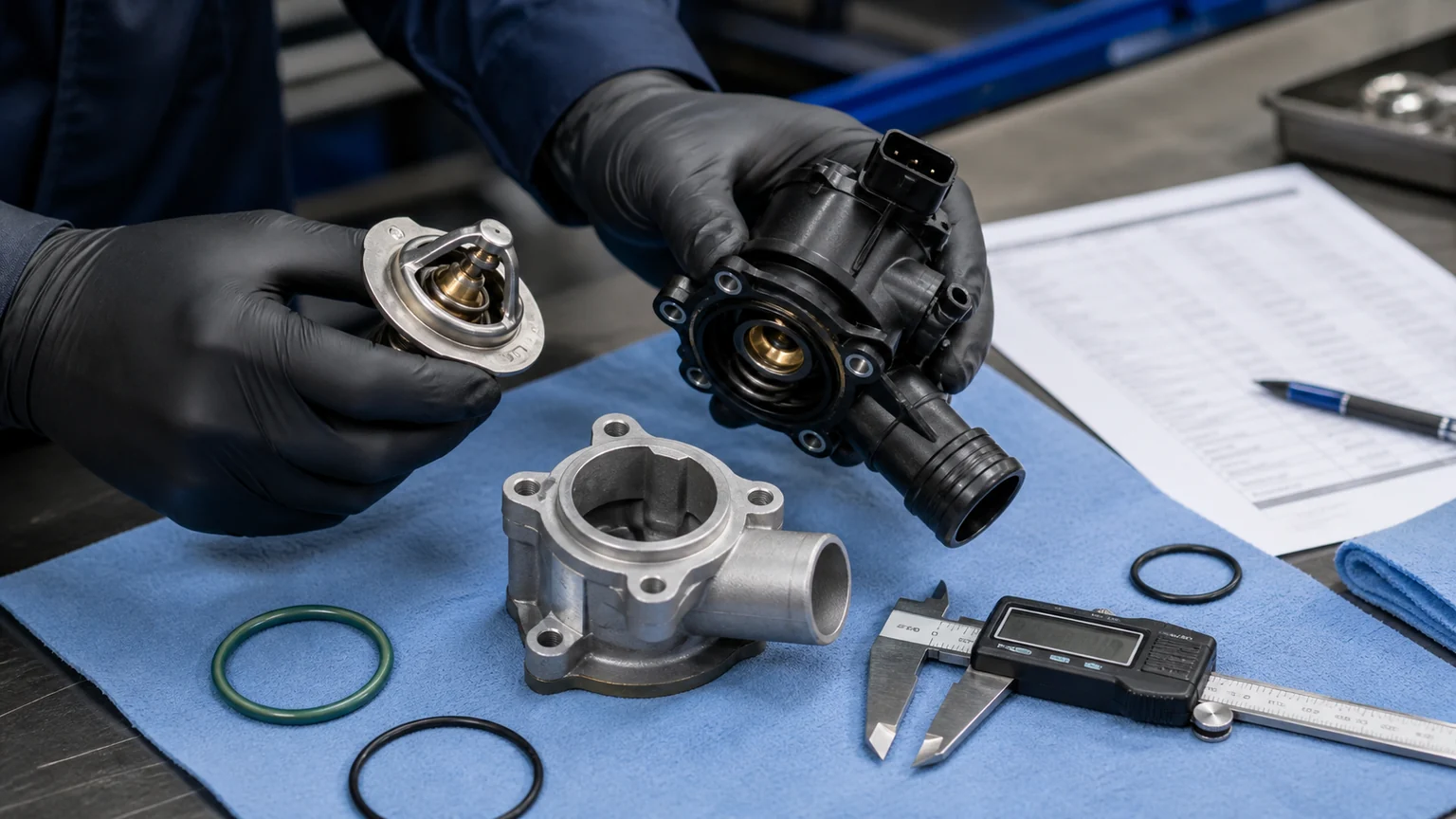
Compare flange and seal geometry, installed height, main valve diameter, bypass valve or disc, spring orientation, jiggle pin, hose-neck angles, mounting holes, connector keying and pin count. Record whether the seal is separate or bonded and whether new bolts, clips or sensors are included. A fitment error can cause an external leak, internal bypass problem, connector fault or incorrect warm-up without an obvious dimensional mismatch.
Thermostat markings often reference a nominal opening temperature, but buyers also need the controlled test definition and tolerance. Initial movement, specified lift at a stated temperature and full-open behavior are different measurements. Heating rate, bath uniformity, reference-sensor accuracy, sample conditioning and the point used to measure lift all affect the result.
Ask for the approved performance curve or the opening threshold, required lift and closing acceptance. For electrically heated products, define heater resistance, connector load and energized test conditions. Fail behavior and ECU diagnostics belong to the exact application.
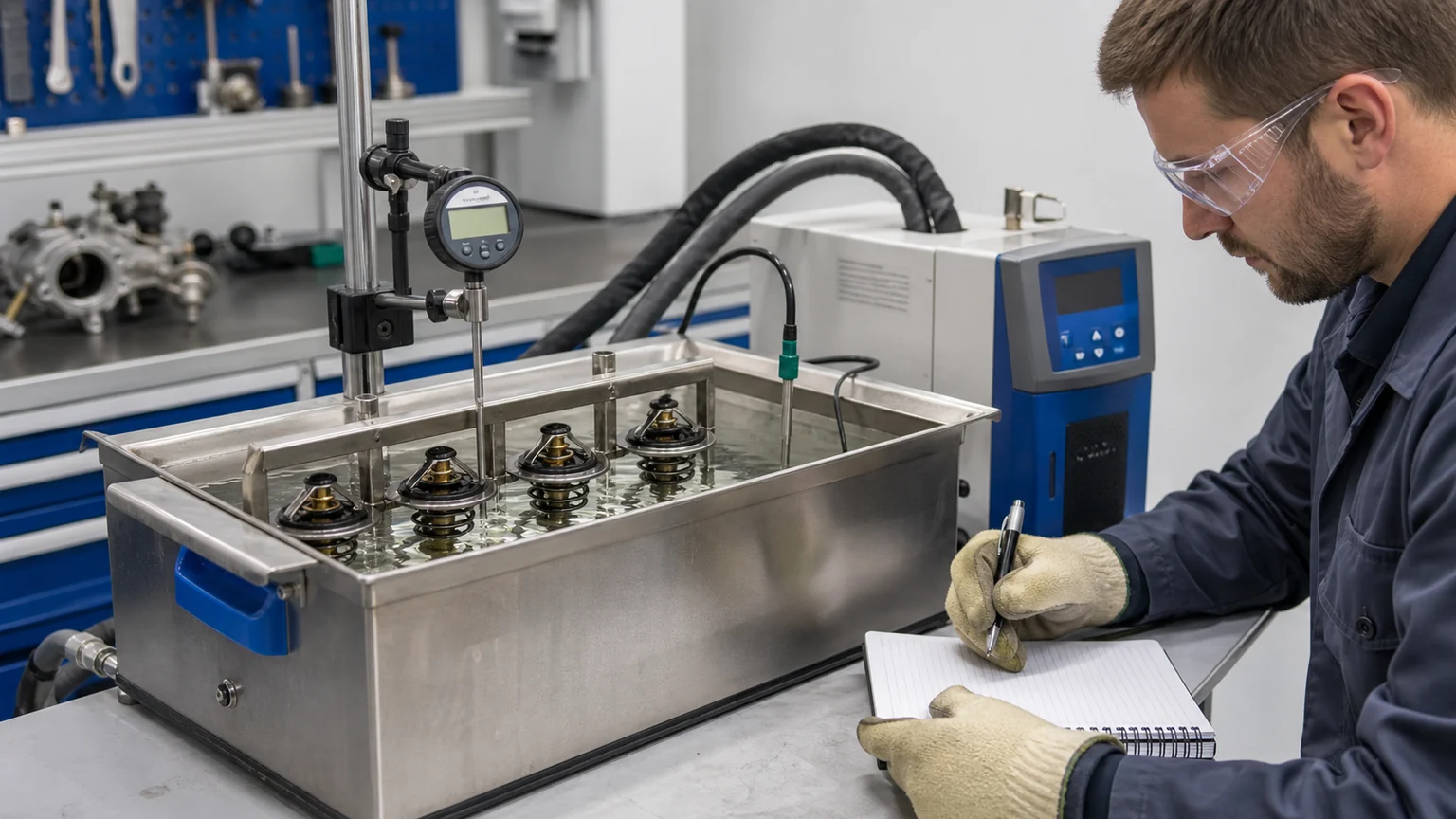
A controlled comparison records bath temperature and valve lift with calibrated instruments; opening, specified lift and full-open behavior are separate results.
Use a purpose-controlled workshop or laboratory bath, calibrated reference temperature instrument, suitable fixture and lift measurement device. Follow the product or equipment maker's procedure, isolate electrical energy where applicable and use PPE for hot liquid and components. Never use food-preparation vessels or an uncontrolled kitchen setup. A destructively evaluated or contaminated sample should not be installed in a customer's engine.
Condition the sample as specified, avoid direct heater contact and keep bath temperature uniform. Record temperature versus lift during the prescribed profile and cooling recovery where required. Test enough samples to understand variation.
The bath test does not validate every function. Pressure containment, housing leakage, thermal cycling, vibration, corrosion, electrical performance and vehicle-level cooling control require separate methods. For a new supplier, compare candidate samples with an approved OE or validated reference under the same controlled method and document any construction or response differences.
Vehicle make/model, Brazilian model year, VIN range, engine code, fuel and production date.
OE thermostat/housing numbers, supersessions, brand references and installed photographs.
Valve, housing assembly or complete module scope, including every seal, sensor, heater, clip and bolt.
Nominal opening temperature, tolerance, required lift at temperature and approved test method.
For electrical products: connector, pinout, heater resistance/power and diagnostic requirements.
Housing, frame, spring, wax element and seal materials; coolant and pressure compatibility.
Dimensions, flange, hose ports, mounts, bypass features, flow direction and packaging orientation.
Factory, country of origin, quality-system scope, production tests, batch code and change control.
Annual quantity, forecast, sample/pilot lot, branding, Incoterm, destination, lead time and warranty.
Trace the product from application data and engineering drawing through incoming materials, stamping or molding, wax-element and spring control, assembly, calibration, leakage testing, electrical checks, marking and packaging. Establish which operations occur at the named plant and which elements or housings come from sub-suppliers. A distributor warehouse audit alone does not establish manufacturing capability.
Review drawing and revision control, gauge calibration, lot traceability, wax-charge and spring controls, polymer conditioning, crimp or welding settings, seal management, test-bath stability, sample frequency and reaction plans. For molded modules, inspect cavity identification, dimensional capability and leak/pressure cycling. For electrically heated units, review resistance and functional checks plus connector and terminal controls.
Require written approval before changes to wax-element source, spring, elastomer, polymer, connector, housing cavity, plant or test limit. Retain approved samples and inspection data for comparison.
Thermostat diagnosis must consider the complete cooling system. Long warm-up, weak cabin heat or low reported temperature may indicate a valve stuck open, but it can also involve an incorrect low-temperature part, missing thermostat, biased sensor or fan-control problem. Overheating may involve a stuck-closed valve, yet low coolant, trapped air, a blocked radiator, failed pump, combustion-gas leakage, hose collapse, cap pressure or fan performance can produce similar symptoms.
Mixed or degraded coolant can attack seals, promote deposits and reduce corrosion protection. Mineral-rich top-up water, incompatible coolant chemistries and stop-leak products may obstruct small passages or interfere with moving surfaces. Brazil's varied ambient temperature, congestion, ethanol/flex-fuel operating strategies and heavy air-conditioning load make correct engine-specific calibration more important—not less.
Do not condemn a thermostat from the dashboard gauge alone. Check fault codes, live data, fan command, coolant condition and pressure using safe workshop procedures. Follow the vehicle maker's filling and bleeding procedure; never open a hot pressurized system.
Confirm identity. Match purchase order, manufacturer, part number, revision, calibration marking, origin and batch.
Inspect packaging. Reject wet, crushed, opened or mixed cartons and record transit damage before repacking.
Compare the approved sample. Check valve orientation, bypass features, flange, mounts, ports, connector and included seals.
Inspect workmanship. Look for distorted frames, rough sealing faces, poor molding, loose terminals, corrosion and contamination.
Measure the agreed characteristics. Use the drawing and sampling plan for critical dimensions and electrical values.
Retain traceability. Do not combine unidentified lots; preserve label, batch and receipt data through sale and claim.
Run scheduled validation. Use controlled calibration, leakage and functional checks at the agreed lot frequency.
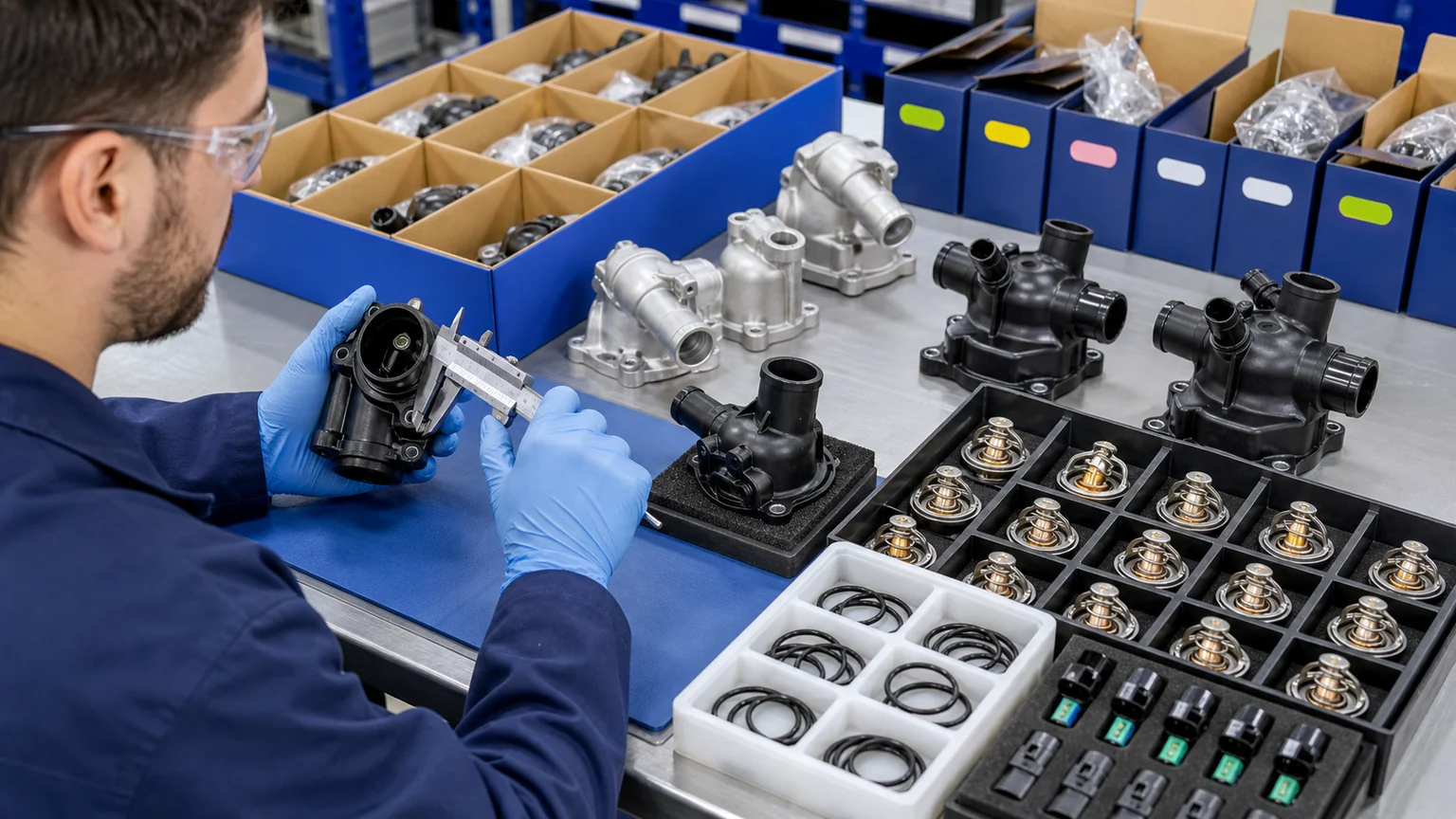
Receiving control keeps the housing, insert, seal, electrical interface, calibration and batch linked to the approved application.
Compare the part price with freight, tax and duty, minimum order, wrong-fit returns, packaging damage, labor, coolant replacement, diagnosis time, engine overheating risk and warranty administration. A local distributor may reduce emergency downtime; a direct manufacturer relationship may improve technical control; a cross-border program may suit predictable repeat demand and private-label range building.
Use identical application and acceptance evidence across quotations. Track returns by part, engine, failure mode, batch, installation date and mileage rather than combining every “temperature problem” into one warranty rate.
Classify the company as actual manufacturer, brand owner, distributor or cross-border wholesaler.
Verify legal seller, actual producer, manufacturing origin and warranty issuer per SKU.
Match VIN/engine, OE reference, revision, calibration and mechanical/electrical interfaces.
Separate mechanical valve, electrically heated thermostat and complete module requirements.
Approve drawing, materials, calibration method, leakage/pressure and thermal-cycle evidence.
Audit sub-supplier, process, test-equipment calibration, batch traceability and reaction plans.
Require sample and pilot-lot approval before repeat supply or private-label launch.
Protect sealing faces, connectors, sensors, valves and O-rings during storage and delivery.
Define change notification and preserve failed parts, data and coolant evidence for claims.
No. The list deliberately includes Brazilian manufacturers, branded aftermarket channels, distributors and a cross-border wholesaler. Confirm who made the exact part number rather than transferring one company-level label to every SKU.
No. Those are only two variables. Verify engine and OE number, installed height, flange, bypass design, seal, housing and ports, flow direction, connector and electronically heated function where fitted.
No. It proves market coverage, not manufacturing origin. Ask for the producer and country of origin on the specific SKU and keep that evidence with the purchase record.
No. Initial opening, specified lift at a stated temperature and full-open behavior describe different points. The test method and tolerance must accompany the temperature claim.
A casual boiling-water check is not adequate for procurement validation and creates burn and contamination risks. Use controlled workshop equipment, a calibrated reference instrument, a defined heating profile, PPE and the manufacturer's method.
No. Diagnose coolant level and condition, air pockets, radiator restriction, pump, fan, cap, sensors, hoses and combustion leakage. A replacement part will not correct another cooling-system fault.
Brazil gives buyers several viable thermostat routes, but company name alone cannot establish fit or quality. Shortlist by purchasing situation, verify the exact engine and OE reference, identify who actually made the part, approve calibration and interfaces, and retain batch-level evidence through receiving and warranty.
For repeat-volume sourcing, send Elecdura the vehicle and engine list, OE references, approved samples or drawings, calibration and test requirements, annual quantities, packaging and Brazilian destination through the thermostat project contact page. Compare the result with domestic manufacturers, brands and distributors on application control, verified source, lead time, change control and total claim risk.