English
Views: 0 Author: Elecdura Publish Time: 2026-08-13 Origin: Site
South African excavator owners can buy oil coolers through OEM parts networks, independent earthmoving-parts specialists, local heat-exchanger manufacturers, repair/retube workshops, exchange programs and cross-border wholesale channels. These routes solve different problems. An OEM channel prioritizes serial-number accuracy; an independent supplier may solve obsolete or price-sensitive demand; a heat-exchanger workshop can inspect and rebuild a serviceable unit; an importer program suits repeat applications.
This guide compares ten verifiable routes as of August 2026. The order is an editorial procurement framework, not a ranking by revenue, capacity or market share. Every company is labeled by role so a dealer catalogue is not mistaken for factory ownership. Buyers can compare local offers with Elecdura's wholesale oil-cooler range using the same machine serial, OE reference, drawing, cleanliness, test and warranty requirements.
An excavator cooler is matched by machine identity, circuit and complete interface geometry—not by core dimensions alone.
Supplier or route | Verified role | Best fit | Verify before ordering |
|---|---|---|---|
Komatsu South Africa | OEM parts and REMAN channel | Komatsu serial-controlled genuine support | Part supersession, new/reman status and stock |
Hitachi Construction Machinery Africa | OEM/selected/reman parts network | Hitachi excavator parts accuracy and support | Exact model, serial, circuit and part program |
Barloworld Equipment / Cat | Independent Cat dealer channel | Caterpillar application and dealer support | Genuine/reman/other status and warranty entity |
HPE Africa | Hyundai construction-equipment distributor | Hyundai genuine parts and branch support | Machine serial, cooler position and current part |
Komanco | Independent Komatsu parts/rebuild specialist | Komatsu new, used or exchange alternatives | Condition, origin, test and return-core terms |
P&R Earthmoving | Independent component sourcing specialist | Cat, Hitachi, Komatsu and Liebherr alternatives | Manufacturer, condition, source and traceability |
Thermo Radiators | Local manufacturer and repair/retube route | Mining oil coolers, rebuilds and exchange work | New/repair/retube/exchange scope and test |
NCN Core Manufacturers | Core manufacturer and oil-cooler workshop | Cleaning, repair, tube-stack or exchange projects | Reused parts, cleanliness and pressure record |
Cape Heat Exchange | Local heat-exchanger manufacturer/workshop | Hydraulic oil cooler manufacture and repair | Excavator geometry, duty and warranty category |
Elecdura | Cross-border wholesale/private-label route | Repeat aftermarket applications and importer ranges | Approved factory, sample, batch and landed lead time |
Komatsu South Africa operates a parts distribution centre at its Germiston campus and describes a REMAN facility for overhaul, rebuild and exchange of components. For a Komatsu excavator, this is the reference route when serial-controlled fit, supersession management and OEM support outweigh purchase-price differences.
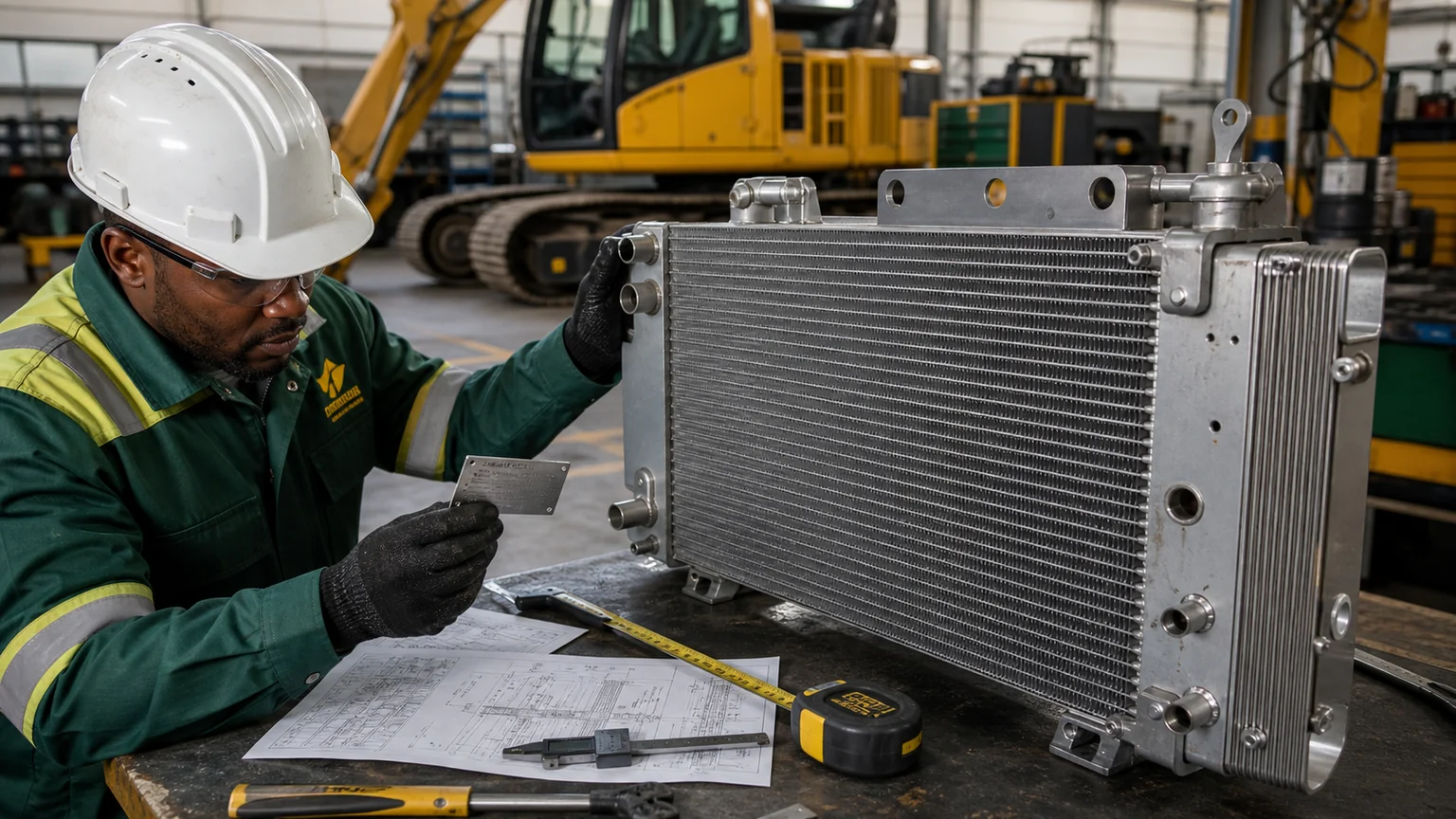
Provide the machine model, product identification number, serial range, current cooler part number and photographs of the complete cooling stack. Confirm whether the quoted cooler is new genuine, remanufactured or part of another approved program. A general Komatsu model name is insufficient because engine, hydraulic configuration, regional specification and production changes can alter the cooler.
Hitachi Construction Machinery Africa supports genuine parts, selected parts and remanufacturing programs through a regional network. This route suits Hitachi excavators where the buyer needs application validation and access to the manufacturer-backed parts chain.
Ask which parts program applies to the exact oil cooler and whether local stock, regional depot supply or a special order is involved. Identify hydraulic, engine-oil or transmission circuit; verify serial break, hose/pipe fittings, mounts and stack position; and record warranty coverage. Do not infer that every listed part is manufactured in South Africa.
Caterpillar identifies Barloworld Equipment as its independent dealer in Southern Africa, supported by the Johannesburg distribution centre. This is the primary branded channel for Cat excavator cooler identification, genuine parts, service information and dealer warranty handling.
Barloworld is the dealer route, not automatically the oil-cooler factory. State the Cat product identification number, arrangement and cooler part number. Confirm new, reman or alternate status, origin, lead time and return-core requirements. For a cooling package, verify whether the quotation is for one core or the complete radiator, charge-air, hydraulic and fuel-cooler stack.
HPE Africa distributes Hyundai construction equipment and parts across Southern Africa and operates parts/service branches in several South African regions. It is the appropriate reference channel for Hyundai excavator buyers who prioritize genuine fit and local dealer support.
Use the Hyundai machine model and full serial number, not only an R-series designation. Submit the current label, ports, brackets and stack photos. Ask the branch to confirm supersessions, included fittings, stock location, warranty and whether the item is the hydraulic oil cooler or another heat exchanger. HPE Africa is a distributor/service route, not a claimed South African oil-cooler manufacturer.
Komanco is an independent earthmoving parts and rebuild specialist focused on Komatsu excavators. Its site explicitly lists radiators and oil coolers among new parts and also describes used/exchange units, hydraulics, rebuilds and field service.
The commercial advantage can be availability and machine-specific experience, but the quotation must identify new, used, reconditioned or exchange condition; manufacturer/brand; source; hours where known; inspection; pressure test; cleanliness and warranty. Photograph a used unit before dispatch and define return-core ownership. Do not treat independent supply as OEM manufacture.
P&R Earthmoving sources new, used and reconditioned components for Caterpillar, Hitachi, Komatsu and Liebherr equipment. It can be useful for obsolete machines, non-stock components and customers evaluating alternatives to the OEM channel.
Require the exact cooler manufacturer and condition, source machine/serial when used, part number, repair history, leak/pressure test, internal cleanliness, dimensional confirmation and warranty. A sourced cooler may arrive through an international partner, so confirm lead time, duties and who handles a claim. Do not accept “fits model” without serial and circuit validation.
Thermo Radiators says it manufactures radiators, oil coolers and heat exchangers and supplies, cleans, repairs and retubes oil coolers for mining and industrial customers. It also describes service-exchange stock. This route is relevant when a cooler is repairable or a new/exchange unit needs local workshop support.
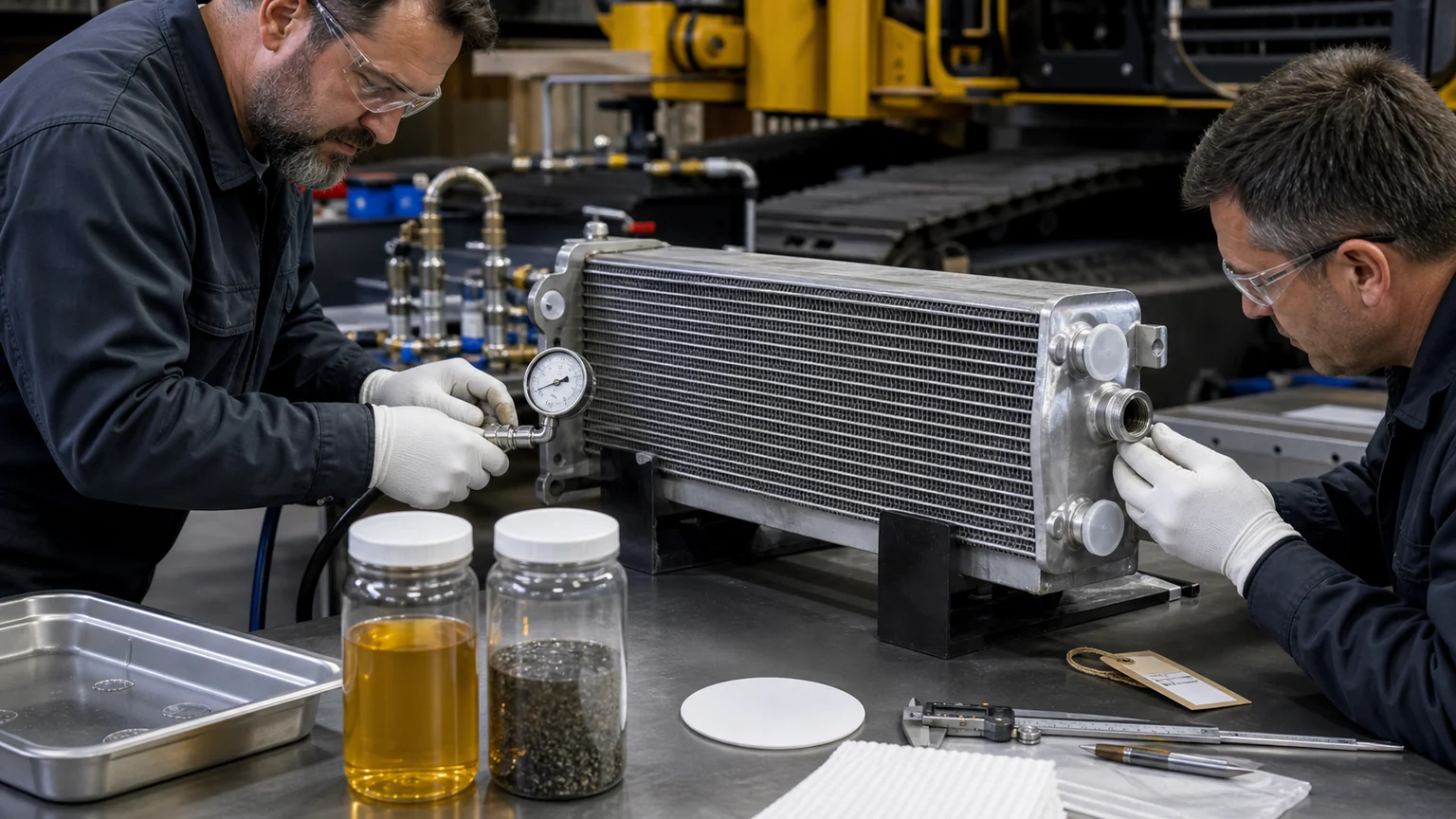
Separate new manufacture, cleaning, repair, retube and service exchange on the order. A strip report should identify the failure and every reused or replaced component. Define tube/fin material, pressure and flow duty, allowable pressure drop, test medium/pressure/hold time, cleanliness level and final dimensions. For hydraulic service, residual debris can damage pumps and valves even when the cooler does not leak.
NCN Core Manufacturers describes oil-cooler cleaning, repair, manufacture of new tube stacks and exchange units, with earthmoving and mining applications. This is a useful rebuild/manufacturing route where the shell, tanks or frames remain serviceable but the heat-transfer core needs controlled replacement.
Request the incoming inspection, cleaning method, contamination findings, tube-stack specification, reused-part list, repairs, dimensional report and pressure test. If a hydraulic component failed upstream, agree a cleanliness verification method rather than assuming flushing has removed hard particles. Label the completed cooler with a traceable job or build number.
Cape Heat Exchange develops and manufactures heat exchangers and lists hydraulic, automotive and other oil coolers alongside cleaning, testing and repair services. Its South African manufacturing and warehouse footprint can suit custom or repeat projects that need local engineering.
Confirm that the proposed construction matches the excavator's specific air-side and oil-side duty. Supply oil type/viscosity and temperatures, flow, pressure, allowable pressure drop, ambient/altitude, airflow, fan/shroud data, dimensions and vibration environment. Approve a drawing and first-off thermal/pressure evidence before replacing a validated OEM design.
Elecdura offers cross-border sourcing for repeat aftermarket excavator oil-cooler applications. It is not a South African field-service provider and is not the right route for a machine that needs an emergency local repair. It is relevant to importers and distributors building controlled ranges from verified OE references and samples.
Send the machine model, serial range, engine, OE cooler number, photos, full dimensions, port threads/orientation, mount geometry and annual volume. Confirm the actual factory, approved drawing, materials, cleanliness and leak-test requirements, pilot lot, packaging, Incoterm, lead time, batch traceability and change control.
Cooler type | Typical fluid | Critical checks | Mismatch risk |
|---|---|---|---|
Hydraulic oil cooler | Hydraulic fluid returning from work circuits | Flow, working/transient pressure, cleanliness and pressure drop | Pump/valve damage, high oil temperature or rupture |
Engine-oil cooler | Lubricating oil, sometimes oil-to-coolant | Engine family, oil/coolant sides, seals and bypass | Oil/coolant mixing or lubrication failure |
Transmission oil cooler | Transmission or torque-converter oil | Transmission model, fittings, heat load and contamination | Overheating or cross-contamination |
Charge-air cooler | Compressed intake air | Air pressure, boost leak, tanks and hose interfaces | Boost loss; not an oil cooler despite oily residue |
Complete cooling pack | Several separated circuits | Stack order, seals, frames, fan/shroud and every circuit | Buying one correct core in the wrong assembly revision |
Excavator hydraulic heat load changes with cycle time, attachment, relief-valve operation, swing and travel duty, pump efficiency, oil viscosity and operator technique. High ambient temperature and altitude reduce cooling margin. Mine dust, coal fines and oily deposits block the air side, while bent fins, missing foam seals, damaged shrouds or a slow fan allow hot discharge air to recirculate. A cooler selected for an unloaded yard test may not control temperature during continuous hammer, quarry or bulk-earthworks duty.
Record oil temperature at repeatable points, ambient temperature, engine speed, fan command/speed, hydraulic pressure and the actual work cycle before blaming the core. Inspect the complete cooling stack in the correct airflow direction: debris between stacked cores may be invisible from the outside. Check thermostatic bypass valves, fan drive/control, hydraulic pump condition, relief settings, oil specification and tank level. A new cooler will not correct heat generated by a worn pump or a valve held across relief.
Cleaning also needs control. High-pressure water applied too close or across delicate fins can fold the air passages, and aggressive chemicals can attack aluminum or coatings. Isolate electrical and hydraulic hazards, allow the machine to cool, follow the equipment maker's access procedure and clean in the direction that removes—not drives in—debris. Record before/after temperatures and pressure restriction so maintenance has evidence rather than appearance alone.
A credible claim identifies the machine and hours, cooler part/build/repair number, installation date, oil and filter service, failure time, operating temperatures and symptoms. Photograph the installed stack, mounts, hoses, ports, impact area and contamination before cleaning or disassembly. Retain oil and debris samples when a hydraulic failure is suspected.
Separate manufacturing defects from external causes such as impact, unsupported pipes, vibration, blocked fins, overpressure, electrolysis, incompatible chemicals, pump debris or incorrect installation. Do not cut open or flush away evidence before the supplier agrees the inspection plan. The warranty process should state who authorizes removal, freight and analysis; how the failed unit is preserved; response time; labor/core coverage; and how corrective action is traced to other units from the same batch.
Machine make/model, PIN or serial range, engine and hydraulic/transmission configuration.
OE cooler and cooling-pack numbers, supersessions, labels and installed photos.
Exact fluid circuit, oil grade, temperatures, flow, pressure and allowable pressure drop.
Core and envelope dimensions, stack position, airflow direction and neighboring cores.
Port thread/type/orientation, hose or pipe interfaces, mount centers and protective frames.
Fan, shroud, seals, bypass, thermostat and control relationships.
Material/coating, vibration, corrosion, dust/debris and ambient/altitude duty.
New/used/reconditioned/retubed/exchange status, quantity, packaging, lead time and warranty.
Leak-free is not enough: hydraulic cooler approval also requires separate-circuit identity, internal cleanliness and controlled pressure-drop evidence.
Trace the job from incoming identity and contamination assessment through cleaning, disassembly, material inspection, tube/fin/header manufacture or repair, brazing/welding/retubing, pressure testing, flushing, drying, capping and packaging. Confirm which steps occur on site and which are subcontracted.
Review drawing control, alloy and tube specifications, brazing or welding procedure, calibrated gauges, test medium/pressure/hold time, pressure-drop method, internal particle/cleanliness control, nonconformance records and job traceability. A repaired cooler should identify all reused parts. A production supplier should obtain buyer approval before changing material, core source, fin, ports, mounts, plant or sub-supplier.
Verify identity and condition. Match PO, part/revision, machine serial, new/rebuilt status and any exchange-core record.
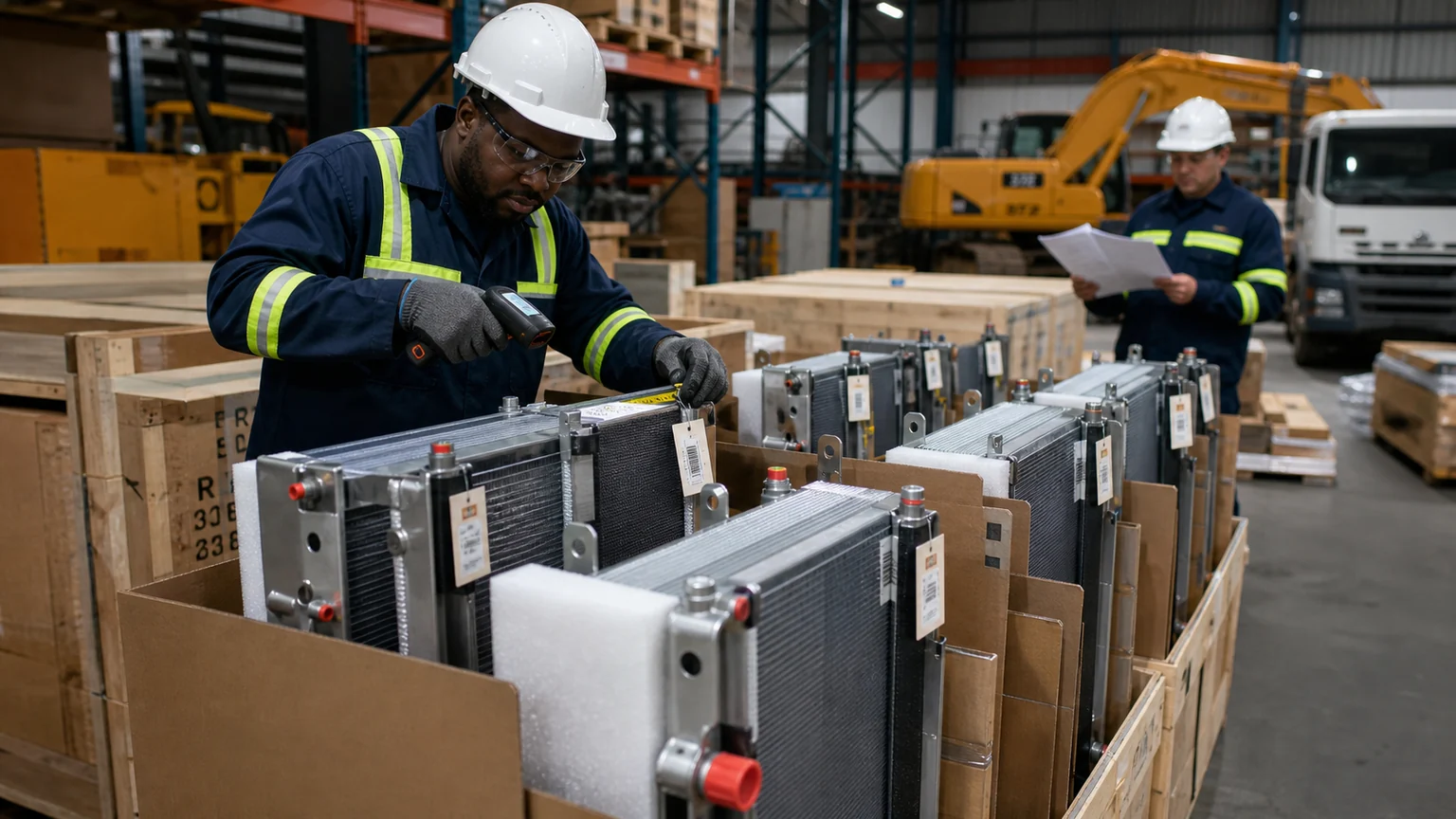
Inspect packaging. Record crushed cartons, exposed fins, bent frames, uncapped ports and moisture before release.
Measure interfaces. Confirm envelope, ports, mounts, stack alignment, seals and fan/shroud clearance.
Check cleanliness. Use the agreed method; do not install a visibly contaminated or uncapped hydraulic cooler.
Correct root cause. Investigate pump/motor failure, hose debris, bypass, fan, dust blockage and oil condition.
Flush or replace affected components. Follow the machine maker's repair procedure and never circulate debris into a new cooler.
Commission and trend. Check leaks, oil level, fan operation, temperatures and restrictions under controlled load.
Oil-cooler logistics must protect fins and ports while preserving part, circuit, batch and cleanliness traceability.
Compare invoice price with freight, import duty, core deposit, cleaning, removal/installation labor, oil replacement, flushing, wrong-fit returns, machine downtime and warranty analysis. An OEM unit may reduce application uncertainty; a controlled repair may shorten lead time; an independent or import route may improve availability for older fleets.
Use the same condition definitions and acceptance evidence across bids. A cheap cooler becomes expensive if it carries debris into the hydraulic system, restricts return flow or arrives without capped ports. Track cost per operating hour, temperature performance, leaks and repeat contamination by machine and build/repair batch.
Confirm legal seller, role, actual manufacturer/workshop and warranty issuer.
Identify hydraulic, engine-oil, transmission or other circuit explicitly.
Verify machine serial, OE part, cooling-pack revision and physical geometry.
State new, used, reconditioned, repaired, retubed or exchange condition.
Define fluid, temperature, flow, pressure, pressure drop and cleanliness.
Audit material, processes, calibrated tests, drying/capping and traceability.
Approve first-off or pilot evidence before repeat supply or design conversion.
Protect fins, ports and frames for the actual road/site freight route.
Define claim evidence, labor/core policy, response time and root-cause analysis.
No. The list includes OEM/dealer parts channels, independent parts specialists, local manufacturers/repairers and a cross-border wholesaler. Verify who actually made or rebuilt the exact cooler.
No. Confirm machine serial, circuit, OE number, ports, mounts, stack interfaces, flow, pressure, pressure drop and duty. Similar dimensions can hide a different internal circuit or capacity.
Only after the machine maker's repair procedure and a defensible contamination assessment. Fine hard debris can remain trapped in passages and damage replacement pumps and valves. Replacement may be safer when cleanliness cannot be verified.
No. It establishes containment under the defined test but does not prove cleanliness, pressure drop, thermal performance, correct circuit identity or fit.
When retained tanks, frames, plates and connections are structurally sound and the workshop can document the replacement specification, workmanship, cleanliness and final tests. Compare downtime and warranty with a new or exchange unit.
Capping prevents moisture and abrasive contamination from entering clean circuits during storage and freight. Caps should be removed only during controlled installation.
The right route depends on the machine, urgency, condition and fleet plan: OEM serial-controlled supply, independent alternative, local rebuild, exchange stock or importer range. Compare proposals on identical circuit and duty data, approve the first unit and monitor oil temperature, pressure restriction, leaks, blockage and contamination-related claims.
For repeat-volume sourcing, send Elecdura the machine serial ranges, OE numbers, cooler drawings/photos, annual quantities, test and cleanliness requirements, packaging and South African destination through the oil-cooler project contact page. Compare the result with local routes on fit, approved source, cleanliness evidence, lead time, service support and total downtime risk.