English
Views: 0 Author: Elecdura Publish Time: 2026-08-13 Origin: Site
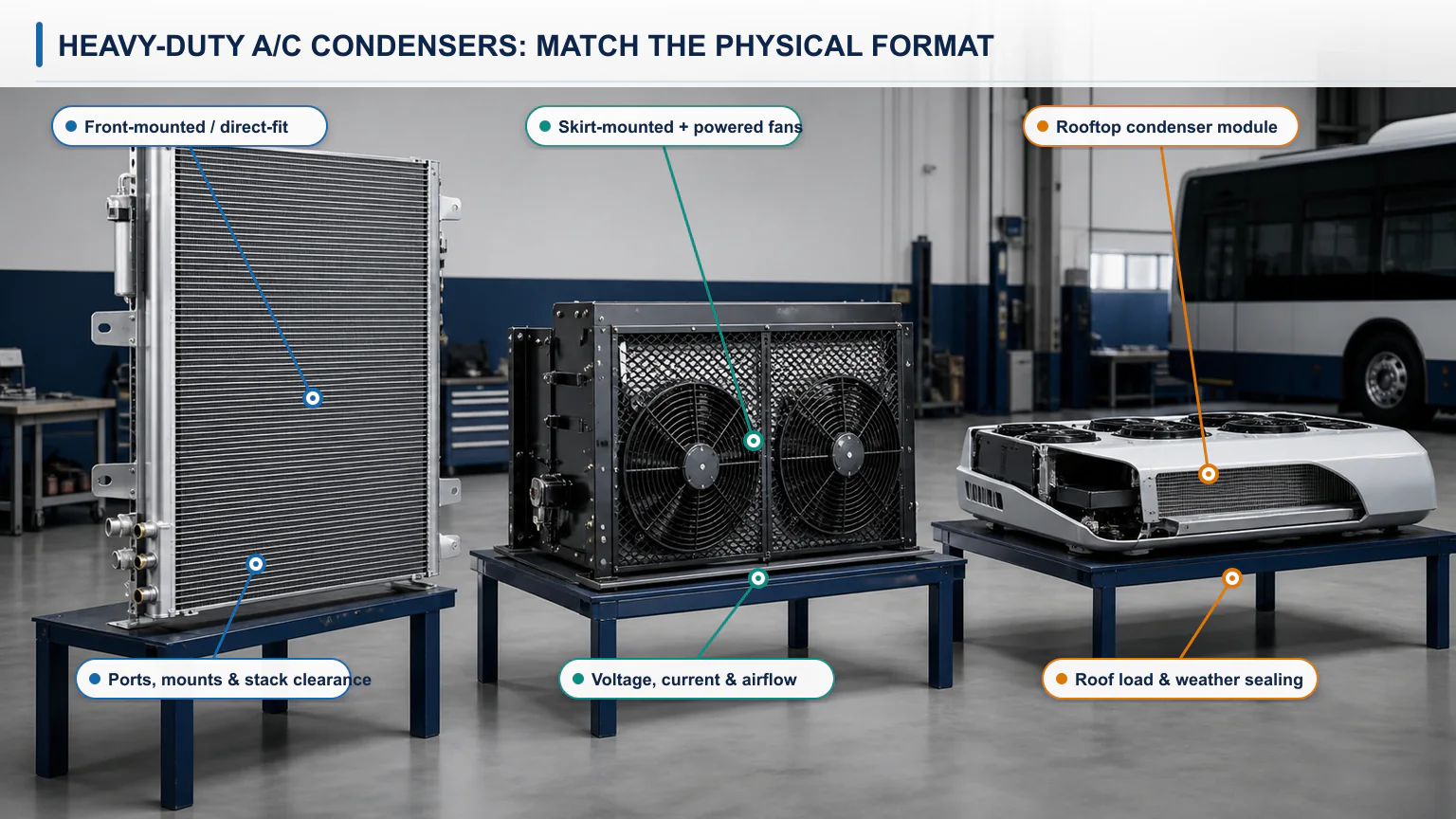
Heavy-duty AC condenser sourcing in Mexico includes several different channels: Mexican heat-exchanger manufacturers, bus-HVAC system specialists, service and parts networks, global thermal brands with local application support, and cross-border wholesale suppliers. These channels do not sell the same thing. A direct-fit condenser mounted ahead of a truck radiator is different from a powered skirt condenser, a rooftop bus condenser, and the condenser section inside an integrated electric-bus HVAC unit.
This guide compares ten useful supply routes with verifiable Mexico relevance as of August 2026. The order is an editorial procurement framework, not a ranking by revenue or market share. Each company's role is labeled so buyers can compare like with like. Importers building a repeat-volume replacement range can also benchmark local options against Elecdura's automotive AC condenser supply, using the same OE references, drawings, pressure-test requirements, packaging controls, and warranty evidence.
Condenser format, mounting position, fan package and system architecture must be defined before suppliers are compared.
Supplier or route | Verified role | Relevant format or application | Best buyer fit |
|---|---|---|---|
Air Temp de México | Mexican thermal-system manufacturer | Automotive condensers, commercial vehicles, OEM and aftermarket | Engineered local manufacturing and validation |
FRIJET / Cooltemp | Mexican designer, manufacturer, distributor and installer | Truck, bus, special-vehicle AC equipment and condensers | Local system integration, parts and service |
Hispacold México | Bus and coach HVAC manufacturer/channel | Conventional, hybrid and electric bus climate systems | Fleet or vehicle-builder bus projects |
Spheros | Commercial-vehicle thermal-system specialist | Bus AC systems, components and application support | Integrated commercial-vehicle projects and service |
Bergstrom | Heavy-duty HVAC manufacturer with Mexico presence | Powered skirt and rooftop bus condensers | Published-capacity condenser modules |
Thermo King | Integrated bus-HVAC manufacturer and dealer route | Conventional and electric bus HVAC systems | Complete-system and authorized-support requirements |
DENSO México | Mexico automotive thermal manufacturer | Local HVAC manufacturing plus global condenser capability | OE-oriented thermal-system benchmark after application verification |
Radiadores i Más | Mexican manufacturer, distributor and service channel | Automotive and heavy-equipment condensers | Local catalogue, service and nationwide delivery |
SIIASA | Bus/van AC parts and service provider | Bus AC service parts, including condenser motors | Local diagnosis, repair and component sourcing |
Elecdura | Cross-border wholesale and private-label route | OE-number-based truck and commercial condensers | Importers and distributors building repeat-volume ranges |
The category boundary matters. A transport-refrigeration condenser protects cargo temperature, while a cabin or bus-HVAC condenser rejects heat from passenger air conditioning. Some companies work in both markets, but an RFQ must name the actual system. A refrigeration unit for a box truck should not be shortlisted merely because it is described as “truck AC.”
Companies were included when a current first-party source documented at least one of four things: Mexico-based thermal manufacturing, heavy-duty or bus-HVAC condenser products, a Mexican application/service location, or a clearly described cross-border supply route for Mexico-relevant truck condensers. Manufacturers were prioritized, but service and authorized system routes were retained because fleets often need diagnostics, installation, controls, and warranty support—not only a heat exchanger.
Public website evidence is a starting point, not supplier approval. Product scope, legal entity, stock, manufacturing location, certification scope, refrigerant compatibility, test pressure, fan performance, and warranty responsibility must be confirmed in the quote. Where a company's public pages describe complete HVAC systems rather than loose condensers, that limitation is stated.
Air Temp de México describes a Mexican operation that designs, tests, manufactures, and validates automotive heat exchangers and air-conditioning systems. Its current site explicitly lists radiators, condensers, thermal modules, commercial-vehicle solutions, and both OEM and aftermarket markets. The company has operated since 1982 and identifies its facility in Umán, Yucatán.
Air Temp is one of the strongest local-manufacturing candidates when a buyer needs more than a catalogue cross-reference. Its public positioning supports development and validation, which can be relevant for custom mounting, regional duty, or a vehicle programme. It does not prove that every heavy-truck or bus application is available as an aftermarket SKU.
Verify in the quote: exact application or drawing ownership, locally manufactured versus sourced content, core construction, alloy and corrosion protection, design and test pressure, thermal test conditions, vibration test, dimensional report, process certification, production capacity, traceability, and service-part availability.
FRIJET, operated by Sultana Empresarial in Monterrey, says it designs, manufactures, and commercializes automotive AC equipment and components. Its site shows condensers as a product category and describes work for cars, pickups, trucks, ambulances, forklifts, armored vehicles, special applications, and buses. The related Cooltemp division focuses on bus and transport climate equipment.
This combination makes FRIJET useful for buyers who need installation and system integration as well as parts. A powered condenser is an electrical and airflow assembly, so local engineering and service can be as important as coil supply. The buyer should still establish whether the quoted item is made by FRIJET, sourced under another brand, or configured from several suppliers.
Verify in the quote: manufacturer and brand of the offered condenser, refrigerant, cooling duty, ambient rating, mounting position, fan voltage and current, airflow, controller/pressure-switch logic, hose and fitting standard, service parts, installation responsibility, and warranty route.
Hispacold México presents a Mexico entity for the design, manufacture, and marketing of climate equipment and components for conventional, hybrid, and electric buses and coaches. Its Mexico page identifies an address in Tlalnepantla, Estado de México and positions the business around passenger-transport HVAC rather than general automotive replacement parts.
Hispacold belongs on a shortlist for bus fleets, body builders, and electrified-vehicle projects where the condenser is part of a matched thermal system. It may be less appropriate for a distributor seeking a generic front-of-radiator truck condenser. Ask whether the need can be met as a component, a condenser module, or only as part of a complete system.
Verify in the quote: vehicle and body data, system model, component-only availability, condenser location, cooling capacity at stated ambient, refrigerant, compressor compatibility, voltage, current, controls, CAN integration where applicable, spare-parts horizon, Mexico service coverage, and commissioning responsibility.
Spheros develops and supplies thermal systems and components for commercial vehicles, with a focus on bus air conditioning, heating, electronics, and transport thermal management. A current first-party service publication identifies Ramos Arizpe, Mexico as an application and service location. Spheros products include integrated roof systems and microchannel condenser technology for passenger transport.
Spheros is most relevant when a buyer needs an engineered commercial-vehicle solution, approved service support, or an exact system component. It should not be treated as evidence that a universal loose coil is stocked locally. The system number, vehicle application, and service channel are essential.
Verify in the quote: Mexico legal and service entity, stock location, system serial number, condenser or coil part number, supersession, refrigerant, fan/blower electrical data, controller compatibility, field retrofit requirements, warranty authorization, technical training, and lead time for critical spares.
Bergstrom publishes unusually clear data for heavy-duty bus condenser modules. Its bus range includes two- and three-fan skirt condensers plus RTC2 and RTC3 rooftop condensers, with voltage, rated capacity, current, airflow, dimensions, weight, and mounting position. The company's Mexico page and corporate information document a Mexico presence.
Published ratings make Bergstrom useful for an early technical comparison, but ratings are not interchangeable without their test conditions. A 12-volt module cannot be placed into a 24-volt fleet without an approved configuration, and nominal BTU/h alone does not confirm performance at a specific condensing temperature or Mexican summer ambient.
Verify in the quote: Mexico sales/service route, 12- or 24-volt version, rating conditions, refrigerant, allowable pressure, fan current and inrush, airflow restriction, mounting orientation, stone guard, corrosion protection, hose connections, replacement fan/coil availability, and complete-system compatibility.
Thermo King offers conventional and electric bus HVAC systems, including integrated rooftop and split-system architectures. Its current bus pages cover transit, coach, and battery-electric applications, and its regional dealer locator provides the route for Mexico support.
Thermo King is included as a complete-system and authorized-support option, not as proof of a broad loose-condenser catalogue. For an existing Thermo King bus system, the authorized route may provide the correct condenser section, controller compatibility, technical literature, and warranty. For a generic truck condenser, another candidate may be more direct.
Verify in the quote: bus and HVAC unit serial numbers, exact condenser assembly scope, new versus remanufactured status, refrigerant, firmware/control requirements, installation and commissioning, dealer territory, stock and emergency lead time, core return if any, warranty, and lifecycle support.
DENSO México documents local manufacture of automotive radiators and HVAC products. Its Mexico company page lists four plants and current quality certificates, while DENSO's global mobility portfolio includes condensers and air conditioners for buses and construction vehicles. Together, these sources establish meaningful thermal-system capability and a Mexican industrial footprint.
They do not establish that every heavy-duty condenser is available through the Mexican aftermarket. DENSO is best treated as an OE-oriented benchmark and a potential application-specific channel. Buyers should use the current country catalogue and authorized contact rather than assuming a global product photo is locally stocked.
Verify in the quote: Mexico aftermarket channel, exact part number and application, manufacturing origin, genuine-service or aftermarket line, refrigerant, port and bracket configuration, test evidence, supersession, authorized distribution, warranty, and minimum order if the enquiry is a programme rather than one replacement.
Radiadores i Más in Tepic describes itself as a manufacturer, distributor, supplier, and service provider for automotive, heavy-equipment, agricultural, and industrial cooling products. Its live catalogue includes condensers, and the company states that it ships nationwide in Mexico.
This route can suit buyers looking for local catalogue availability, a repair conversation, or a hard-to-source application. Because the company performs several roles, the RFQ should identify the actual origin and warranty authority for the quoted part. A stocked imported condenser, a locally fabricated unit, and a repaired original require different qualification evidence.
Verify in the quote: manufacturer and country of origin, OE cross-reference, core/envelope dimensions, fittings, receiver-drier inclusion, leak-test record, coating, mounting kit, availability by branch, shipping protection, warranty process, and whether installation or system flushing is included.
SIIASA describes a Mexican business that commercializes and services air-conditioning equipment for vans, intercity buses, city buses, and minibuses. Its public parts content includes condenser motors. This makes it a useful local diagnostic and service route, especially when a condenser problem is actually a failed fan motor, relay, wiring circuit, or restricted coil.
SIIASA is not presented here as a condenser manufacturer. Before asking for a complete assembly, confirm whether it supplies the required coil/module or supports only service parts for the installed system. A good service provider can prevent the unnecessary replacement of a sound condenser.
Verify in the quote: system brand and model supported, complete condenser availability, motor and fan specifications, diagnostic scope, installation, hose repair, leak testing, electrical test results, part warranty, and geographical service coverage.
Elecdura truck AC condenser supply is a cross-border wholesale route rather than a local Mexican manufacturer. Its published Kenworth K122125 condenser page documents an OE-reference application for T600, T800, and W900 trucks plus bulk-order information, customization options, lead-time range, warranty, and an MOQ. This kind of route is relevant to Mexican importers and distributors building repeat-volume coverage.
The procurement model is different from buying one urgent local replacement. It works best when the buyer controls application data, approves a sample, defines labeling and packaging, and monitors production lots. The Mexican importer remains responsible for customs, local commercial requirements, inventory planning, and downstream warranty service.
Verify in the quote: OE number and vehicle coverage, sample approval, material and construction, pressure/leak test, critical dimensions, receiver-drier and fittings, coating, labeling, batch traceability, packaging drop protection, MOQ per model, Incoterm, landed cost, production lead time, and warranty evidence.
Architecture | Typical application | Critical checks |
|---|---|---|
Direct-fit front-mounted condenser | Truck cab, van or light commercial vehicle | OE reference, core/envelope, ports, mounts, drier, stack clearance |
Powered skirt condenser | Shuttle bus, school bus, coach auxiliary system | Capacity, 12/24 V, current, airflow, stone protection, service access |
Rooftop condenser module | Bus and special vehicle | Roof load, airflow, weather sealing, height, electrical load, hose routing |
Integrated HVAC condenser section | Transit, coach, hybrid or electric bus | System model, refrigerant, controls, compressor/inverter match, commissioning |
A buyer should not size a powered condenser from face area alone. Heat-rejection duty, refrigerant mass flow, condensing temperature, ambient, recirculation, fan curve, external static pressure, and fouling margin affect performance. Likewise, a direct-fit condenser that occupies the correct space can still fail if port clocking, bracket position, drier configuration, or the gap to the radiator is wrong.
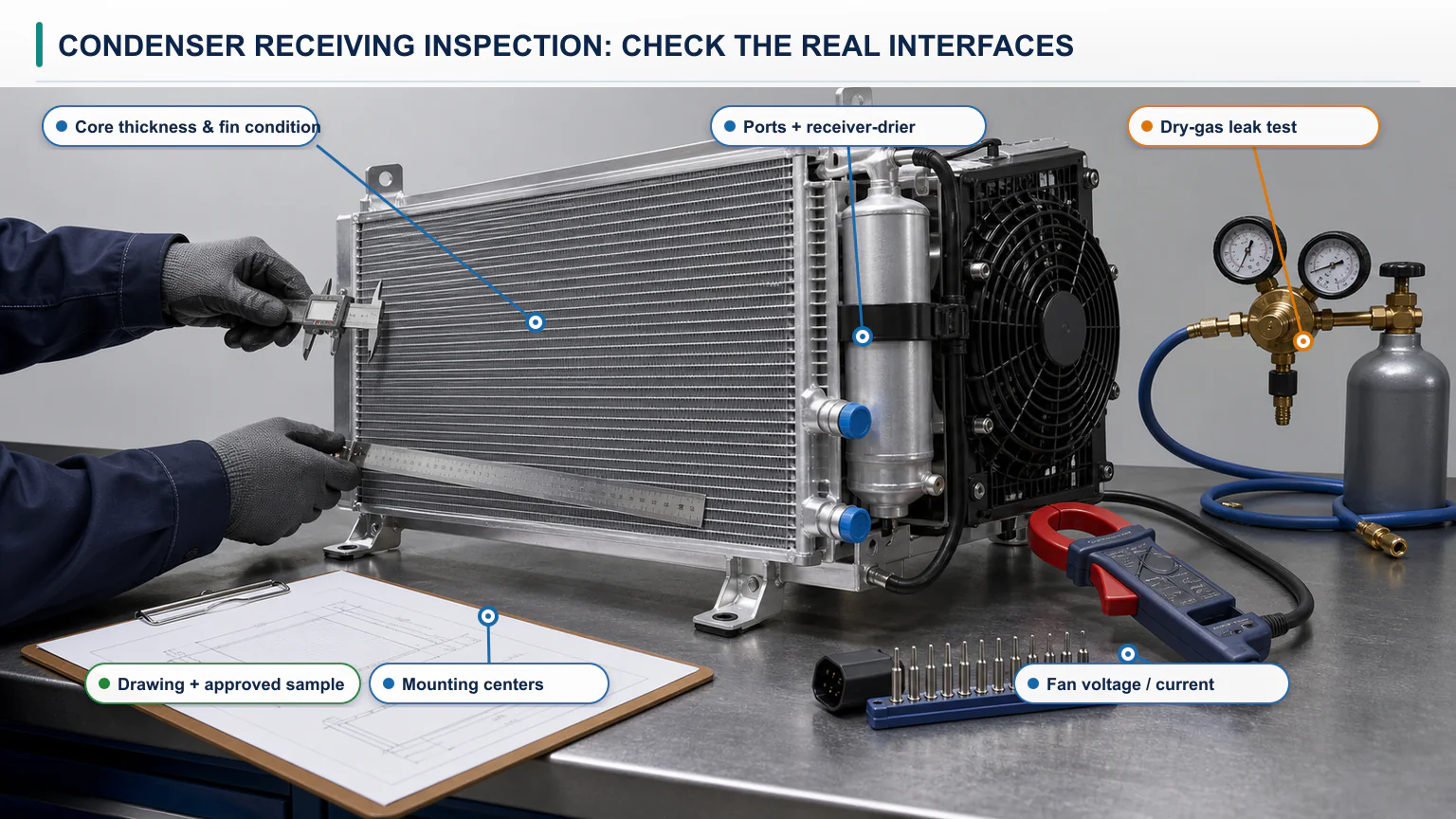
Approve a condenser from measured interfaces and test evidence, not from a catalogue thumbnail.
Confirm the label, part number, batch, manufacturing date, refrigerant statement, and country of origin against the purchase order.
Measure the complete envelope, core face and thickness, mounting-hole centers, bracket offsets, port location and orientation, and adjacent-stack clearances.
Inspect fins, tubes, headers, brazed joints, drier, caps, fittings, fan guards, wiring, connectors, and shipping protection.
Use an approved dry-gas leak or pressure-test method. Never introduce shop air containing moisture or oil into a clean refrigerant circuit.
For powered units, record voltage, running current, inrush where relevant, fan direction, vibration, abnormal noise, and airflow direction.
Retain photographs, dimensions, test record, and label data as the approved-sample baseline.
Mexican fleets operate across hot lowland cities, high-altitude routes, dusty construction environments, coastal salt exposure, and severe stop-and-go service. High ambient reduces the available temperature difference for heat rejection. Altitude reduces air density, so the same fan may move less cooling mass. Road debris damages low skirt units, while rooftop recirculation can reduce performance if discharge air is drawn back into the coil.
Describe the duty rather than writing “heavy duty.” State maximum ambient, altitude, vehicle speed profile, idle time, passenger or cab heat load, refrigerant and charge, compressor displacement/speed, target pressures, condenser mounting, allowed electrical current, fan-control method, dust/debris exposure, corrosion class, cleaning method, and available service access.
Also inspect the whole system. A high head-pressure complaint may come from a non-operating fan, reversed fan direction, blocked coil, overcharge, non-condensable gas, restricted receiver-drier, incorrect expansion device, or radiator/condenser air recirculation. Replacing the condenser without diagnosing these causes can create a repeat warranty claim.
Vehicle make, model, year, VIN/chassis, engine, body builder, fleet number, and installed HVAC system model.
OE and supplier part numbers, photographs of label and installation, and any known supersession.
Direct-fit, skirt, roof, or integrated format; complete envelope; core size; mounts; guard; service clearance.
Port thread/type, tube size, position and clocking; drier, pressure switch, sensor, hose, and fitting scope.
Refrigerant, oil compatibility, design/operating/test pressure, required leak rate and test documentation.
Cooling or heat-rejection duty with rating conditions—not a capacity number without ambient and refrigerant conditions.
Fan quantity, diameter, voltage, running/inrush current, airflow, direction, connector, IP protection, controller and fuse requirements.
Material, fin density, microchannel or tube-and-fin construction, coating, stone protection, vibration and salt exposure.
Annual demand, order mix, pilot quantity, packaging, label language, traceability, warranty, Incoterm, destination, and required delivery.
Begin with a document review: legal entity, manufacturing or distribution role, facility, quality-system scope, product drawing, material specification, process flow, test plan, control plan, gauge calibration, nonconformance process, warranty data, and change-control procedure. A certification logo on a page is not sufficient; request the certificate, issuer, validity, address, and scope.
For a manufactured condenser, audit tube/fin or microchannel material, forming, cleaning, flux control, brazing profile, header and fitting assembly, corrosion protection, leak testing, dimensional inspection, labeling, and packing. For a distributor or service route, audit application lookup, approved suppliers, incoming inspection, stock conditions, warranty authorization, technician competence, and parts traceability.
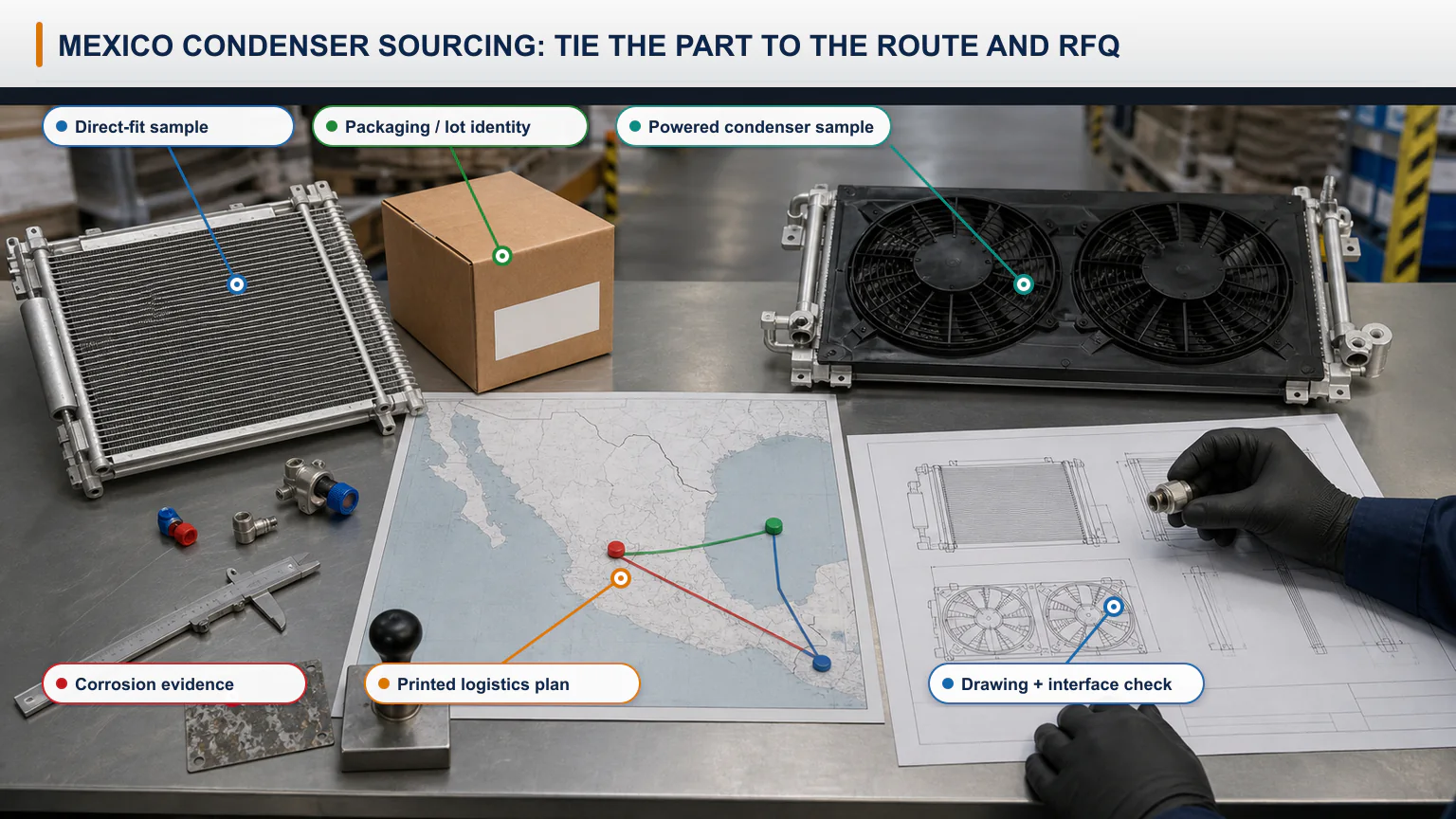
Approve a physical sample in the intended vehicle before a large order. Check installation without forcing brackets or hoses, evacuate to the specified vacuum and hold criteria, charge by the approved procedure, and record ambient, idle/road conditions, pressures, vent temperature, fan current, and abnormal vibration. Preserve the sample and signed record. Then use a small pilot lot to detect variation and transit damage before scaling.
A repeatable sourcing decision ties each physical condenser to its drawing, test record, application and supply route.
No. The list deliberately includes Mexican manufacturers, global bus-HVAC manufacturers with Mexico relevance, integrated-system routes, local service/distribution channels, and one cross-border wholesale route. Their roles are shown in the comparison table.
No. Capacity must be tied to refrigerant and rating conditions. Voltage, current, airflow, mounting position, ambient, recirculation, pressure limits, noise, roof or skirt packaging, and service access also matter.
Not automatically. Cargo refrigeration and passenger HVAC may use different refrigerants, controls, temperature targets, compressors, duty cycles, and regulatory requirements. Use the condenser only when the complete system engineering supports it.
Possible causes include insufficient airflow, wrong fan direction, fan-control faults, recirculation, overcharge, non-condensables, a restriction, incorrect refrigerant, or excessive engine/radiator heat entering the condenser. Diagnose pressures, temperatures, airflow, and charge procedure before replacing more parts.
Send every candidate the same application record, drawing, operating duty, test specification, sample requirements, packaging standard, annual demand, and warranty expectations. Compare landed cost and evidence—not the quoted unit price alone.
Start with architecture and role. Choose a local manufacturer for development and validation, a bus-HVAC specialist for integrated systems, a service channel for diagnosis and supported repairs, or a wholesale route for a controlled multi-SKU programme. Request evidence at the product and batch level, install an approved sample, and scale only after a pilot lot passes.
For a repeat-volume truck or commercial-vehicle condenser range, send Elecdura the OE numbers, vehicle data, drawings or samples, annual quantity, required packaging, and destination through the contact page. The proposal can then be compared with Mexican supply routes on exact fit, thermal duty, leak-test evidence, fan/electrical specification, traceability, landed lead time, and total warranty cost.