English
Views: 0 Author: Elecdura Publish Time: 2026-08-13 Origin: Site
South African buyers can source heavy-duty radiators through local manufacturers, mining-focused rebuilders, national service networks, branded modular-radiator distributors, application integrators and cross-border wholesale programs. The best route depends on whether the requirement is a new repeatable part, an urgent recore, a repairable modular system, a complete cooling pack or a private-label import range.
This guide compares ten useful supply routes with verifiable South African relevance as of August 2026. The order is an editorial procurement framework, not a ranking by turnover, output or market share. Each company is labeled by role because a workshop, dealer network and authorized distributor do not provide the same process control as the actual manufacturing plant. Importers can benchmark local proposals against Elecdura's wholesale radiator program using the same OE references, drawings, duty conditions, validation evidence and warranty terms.
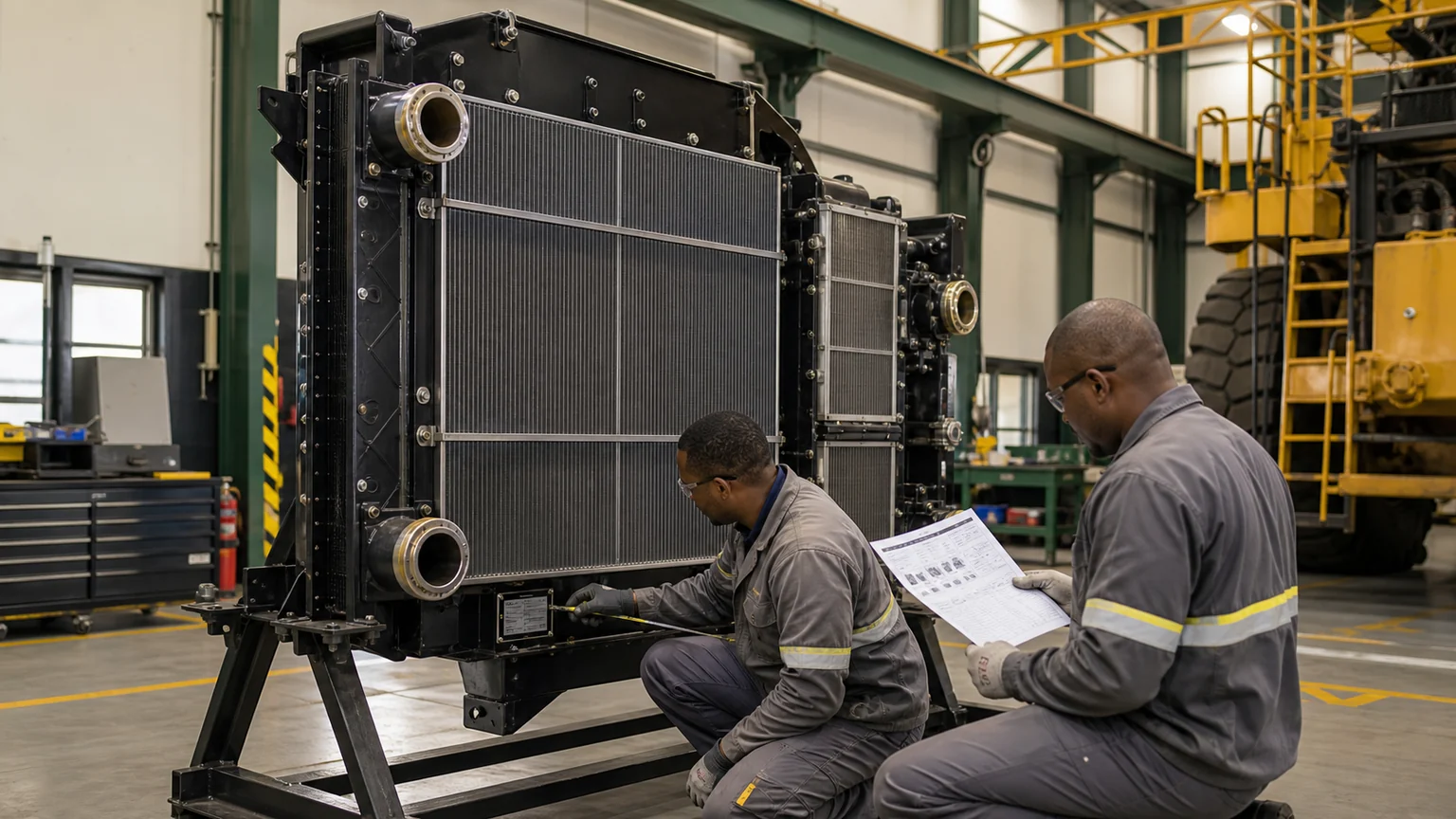
Heavy-duty matching begins with machine identity and the complete cooling-pack interfaces, not a visual estimate of core size.
Supplier or route | Verified role | Best-fit requirement | Verify before ordering |
|---|---|---|---|
Silverton Engineering | South African manufacturer | Controlled production and OEM-oriented programs | Exact heavy-duty scope, plant, drawing and validation |
Cape Heat Exchange | Manufacturer plus warehouse and workshop services | Truck, industrial and application-specific heat exchangers | Construction, test standard and warranty category |
Green's Radiator Service | Heavy-duty designer/manufacturer and repairer | Mining, earthmoving, locomotive and generator duty | Duty calculation, material, drawing and test record |
Thermo Radiators | Mining/industrial manufacturer and service-exchange specialist | Large off-road radiators and planned exchange stock | New, rebuilt or exchange status and certificate scope |
BSSC Radiators | Heavy cooling-pack manufacturer/rebuilder and field-service route | Mining uptime, rebuilds and emergency exchange | Repair scope, core architecture, exchange condition and warranty |
Brakecore / MESABI | South African distributor and agent | Genuine MESABI modular radiators and field-repairable systems | Manufacturer part number, genuine status, tubes, seals and support |
Talrad Engineering | Local manufacturer plus distribution/service agent | Mobile and stationary heavy-industry cooling | Whether the quoted unit is Talrad-made or distributed |
Silverton Radiators / MAHLE | Southern African service and product network | Geographic service access and conventional cooling products | Part origin, branch capability and warranty entity |
Universal Coolers | Importer/distributor and application integrator | Small-to-medium custom or integrated cooling projects | Design responsibility, actual producer and project capacity |
Elecdura | Cross-border wholesale/private-label program | Repeat applications, importer ranges and branded supply | Approved factory, pilot sample, landed lead time and batch control |
Silverton Engineering presents itself as a South African manufacturer of automotive radiators and oil coolers with an OEM-oriented manufacturing facility in Pretoria. Its strongest fit is a controlled production program where buyers need engineering review, manufacturing-system evidence and repeatability rather than an emergency workshop repair.
The similar Silverton name also appears across a broad service network, so identify the legal seller, producing plant and warranty issuer on the quotation. For a heavy truck, bus or off-highway project, request the exact product scope, approved drawing, material specification, process flow, validation plan, capacity and change-control procedure. Do not assume every product available through a Silverton branch is produced by Silverton Engineering.
Cape Heat Exchange says it develops and manufactures heat exchangers for OEM, automotive and industrial aftermarket applications in Paarl. It also describes a South African warehouse network and workshop capability for repair, cleaning and testing. That combination can suit buyers who want a new heat exchanger plus local technical support.
Its published warranty document separates complete aluminum automotive/truck radiators, recored aluminum products, copper/brass/steel products and industrial heat exchangers. This is useful evidence that warranty depends on construction and work scope. The purchase order should identify whether the item is new, recored or repaired; define the coolant and oil circuits; and state test pressure, hold time, dimensional inspection, finish and traceability.
Green's Radiator Service states that it designs and manufactures radiators, oil coolers and charge-air coolers for mining, earthmoving, locomotive, automotive, generator and other applications. It also performs service and repair. This is a relevant project route when the old unit is obsolete, the duty has changed or a heavy machine needs a drawing-based replacement.
For custom work, provide the rejected unit, cooling-pack layout, engine heat rejection, coolant flow and temperature data, fan and shroud information, ambient/altitude duty, allowable pressure drop, mounting loads and contamination conditions. Require a controlled drawing and acceptance test before releasing repeat units. Copying external dimensions alone does not prove the new core will reject sufficient heat.
Thermo Radiators describes on-site manufacture of radiators, oil coolers and heat exchangers and a focus on mining and industrial customers. It also lists service-exchange units and stock ranging from forklift radiators to large Caterpillar and Komatsu applications. This makes it relevant where mine uptime and exchange availability matter as much as the component itself.
Ask whether the proposal is for a new unit, a recore, a rebuilt exchange component or a repair to the customer's core. Record core ownership, deposit, acceptable return condition and the exact warranty start point. Verify the current certification and site scope rather than relying on a logo alone. For a complete cooling pack, define which radiator, charge-air, hydraulic-oil and transmission circuits are included.
BSSC Radiators markets heat-transfer products and services for mining, earthmoving, transport and industrial sectors. Its service-exchange material describes complete cooling packs, nosecone units, radiators, intercoolers, oil coolers and emergency field support. This model can reduce downtime when the fleet uses controlled exchange stock.
The RFQ must separate manufacture, repair, recore, rebuild and service exchange. Specify conventional, modular/removable-tube or folded/segmented architecture, because repair method and warranty can differ. Inspect an exchange unit for clean internal circuits, verified leak-test results, straight mounts, fan clearance, correct shrouding and a unique build/repair record. An immediately available unit is only valuable when its configuration matches the machine.
Brakecore Supply Company identifies itself as the South African distributor and agent for L&M Radiator's MESABI radiators and oil coolers. MESABI uses individual cooling tubes and flexible seals so damaged tubes can be isolated or replaced. That field-repairable architecture can be attractive for large mining equipment where a conventional soldered or brazed core would cause long downtime.
Brakecore is the local supply and support route, not the MESABI manufacturer. Verify the genuine MESABI part number, cooling-pack revision, tube and seal material, approved tools, spares availability, technician training and warranty workflow. A modular conversion should be treated as an engineered change: compare heat rejection, pressure drop, fan demand, mass, mounts and service access against the original system.
Talrad Engineering says it manufactures its own radiators, intercoolers and hydraulic/engine-oil coolers for mobile and stationary heavy industry. It also describes a service and distribution relationship with Silverton products. The mixed model gives buyers local custom capability and access to a wider conventional product range.
Make the quoted role explicit: a Talrad-manufactured heat exchanger, a distributed Silverton product, a repair or a service job. For a new custom unit, request a signed drawing, bill of material, core construction, design duty, pressure test and serialized record. For a distributed part, require the actual brand, origin, manufacturer part number and warranty issuer.
Silverton Radiators / MAHLE Aftermarket South Africa reports a network of more than 110 dealers across Southern Africa and long experience in engine cooling. A network can be valuable to transport fleets operating across provinces because inspection, removal, repair and warranty communication may be available closer to the vehicle.
Network reach is not the same as single-plant manufacturing control. Confirm each branch's capability for heavy cores, aluminum welding, cleaning, pressure testing and field collection. Identify whether the quotation covers a new branded part, locally manufactured core, imported assembly, recore or repair. Require the product origin and warranty entity in writing.
Universal Coolers says it concentrates mainly on import and distribution while offering heat-exchanger application support, integrated cooling units, 3D CAD integration, custom aluminum fabrication, testing and recoring. Its published scope includes military, mining, transport and earthmoving markets. This makes it a useful integration route for small-to-medium bespoke systems or imported components that need local engineering.
Do not assume the company manufactures every catalogued item or can process every large mine cooling pack. Ask who designs, manufactures, tests and warrants the exact unit. For an integrated package, define radiator, charge-air and oil-cooler duties, fan curve, voltage, controls, guard, vibration mounts and environmental protection. Approve a prototype under representative load before volume release.
Elecdura is a cross-border aftermarket radiator sourcing route for distributors and importers building repeat-volume or private-label ranges. It is not a South African field-repair workshop and should not replace a local emergency service supplier. Its relevant use case is a controlled catalogue of repeat truck, bus or equipment applications supported by OE matching, samples, batch inspection and branded packaging.
Send the OE number, machine or chassis identity, core and envelope dimensions, tank/port/mount details, annual demand, destination and target warranty. Confirm the producing factory, approved drawing, material and test requirements, pilot quantity, packaging, Incoterm, lead time and change control. Compare landed cost and safety-stock exposure with local manufacture, rebuild and distribution alternatives.
Supply model | Best used when | Required evidence | Main risk |
|---|---|---|---|
New controlled manufacture | Repeat demand or obsolete application needs a stable specification | Drawing, process audit, validation, capacity and change control | A dimensionally correct unit with inadequate thermal performance |
Repair or recore | Original tanks/frames are sound and local turnaround matters | Incoming report, repair scope, core specification and final test | Reusing fatigued structures or changing the thermal design silently |
Service exchange | Mine or fleet downtime exceeds the value of keeping a spare pool | Unit identity, rebuild standard, deposit, history and availability | Configuration mixing and weak repair traceability |
Modular radiator | Field tube replacement and remote-site serviceability justify the design | OEM part, conversion engineering, tools, tubes, seals and training | Unapproved conversion or unavailable proprietary service parts |
Cross-border wholesale | Importer has repeat applications and can hold planned inventory | Factory approval, pilot sample, batch tests, packaging and landed lead time | Wrong application, source change or excess inventory |
Heavy-duty cooling demand is a system problem. High ambient temperature, altitude, long grades, slow haul cycles, high payload, repeated retarder or transmission heat and an A/C condenser ahead of the radiator can raise heat load while reducing useful airflow. Mine dust, coal fines, insects, chaff and oily contamination can block fins. Vibration, frame twist, stone impact and poor lifting practices add mechanical failure modes.
Record the actual duty: engine rating and calibration, machine payload, coolant temperatures, fan speed/control, ambient and altitude, hydraulic/transmission circuits, cooling-pack cleanliness and pressure drop. A thicker core is not automatically better because added fin depth or density can restrict dirty-side airflow. Review fan curve, shroud sealing and recirculation before changing the radiator.
Machine, truck, bus or generator make/model; VIN, PIN or serial range; engine and transmission identity.
OE radiator and cooling-pack numbers, supersessions, original labels and clear photos.
Core width, height and depth; overall envelope; mount centers; frame and lifting points.
Hose neck size/orientation, filler or expansion arrangement, drain, bleed and sensor ports.
Integrated oil-cooler circuits, thread types, fittings, center distances and isolation requirements.
Fan, shroud, guard, charge-air cooler, condenser and hydraulic-cooler stack relationships.
Coolant, pressure cap, flow, inlet/outlet temperature, heat rejection, pressure drop and ambient duty.
Construction, material, coating, vibration/corrosion requirement, test method and cleanliness limit.
New/recore/rebuild/exchange status, quantity, lead time, packaging, destination and warranty.
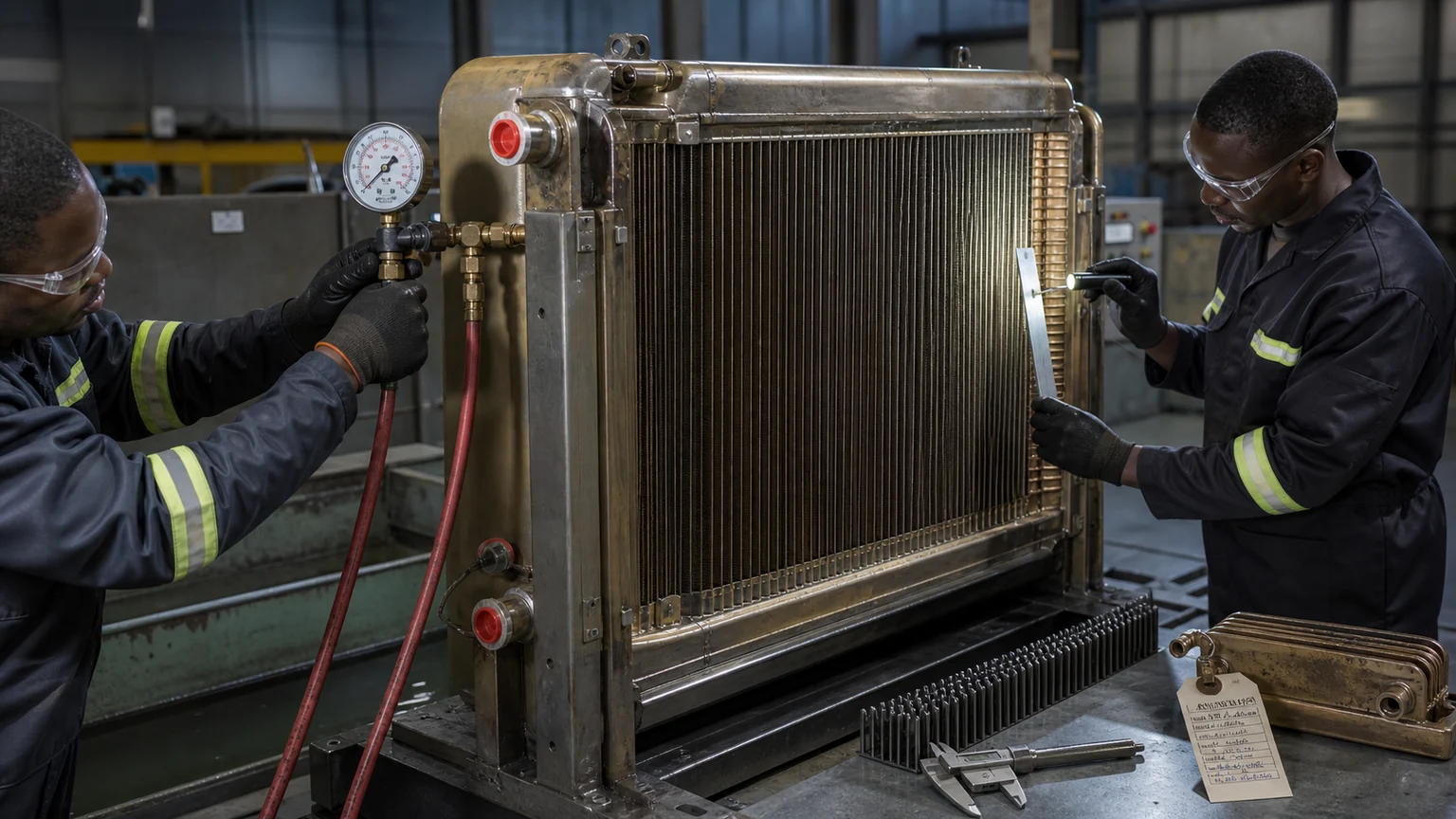
A defensible rebuild record identifies the reused structure, replacement core, workmanship checks, separate-circuit test and final acceptance.
Follow the physical job from identification and strip report through cleaning, non-destructive inspection where applicable, drawing control, material receipt, tube/fin/header production, brazing/soldering/welding or modular assembly, pressure testing, dimensional inspection, coating and packaging. Confirm which steps are performed on site and which are subcontracted.
Review gauge calibration, welder/brazer competence, furnace or solder-process control, leak-test medium/pressure/hold time, separate oil-circuit testing, internal cleanliness, traceability and nonconformance control. For a rebuild, the report should identify every reused and replaced part. For new manufacture, the buyer should approve changes to alloy, tube, fin, core supplier, tanks, seals, mounts or factory.
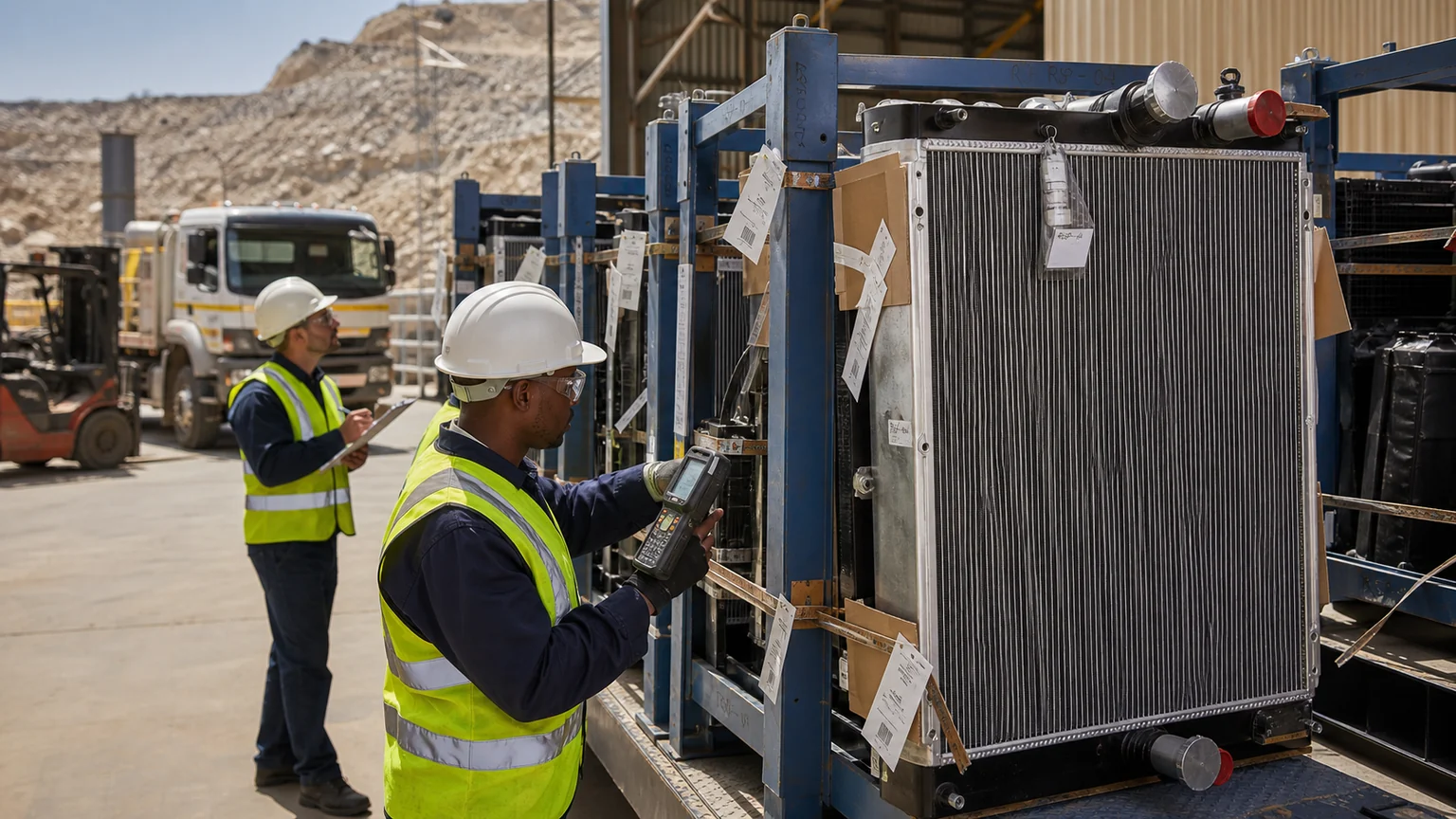
Verify identity. Match purchase order, part/revision, serial or rebuild tag, machine application and exchange-core ownership.
Inspect freight condition. Record crushed packaging, fin damage, distorted frames, cracked tanks, wet internals and uncapped ports.
Measure interfaces. Check envelope, mounts, hose necks, cooler fittings, fan/shroud clearance and lifting points.
Review evidence. Confirm material, build/repair report, pressure-test result, cleanliness and warranty documentation.
Prepare the system. Correct contamination, fan, shroud, thermostat, pump, cap, hose, electrolysis and coolant problems before installation.
Commission under control. Fill and bleed correctly; check leaks, fan operation, temperatures and pressure without exposing personnel to hot coolant.
Retain traceability. Link operating data and any claim to machine, part, build/repair batch, hours and failure mode.
Remote-site availability depends on configuration-controlled exchange stock, protective handling and a traceable dispatch/return process.
Compare part price with removal/installation labor, freight, travel, machine downtime, cleaning, coolant, wrong-fit risk, emergency hire, service-stock capital and warranty recovery. A service-exchange unit may cost more than a repair but return equipment to duty faster. A cross-border program may reduce repeat unit price but requires forecast discipline and safety stock.
Model cost per operating hour and expected downtime rather than invoice value alone. Require comparable definitions: new, recored, rebuilt, repaired, converted or exchange. Record which seller owns thermal performance, field support, labor and consequential costs. Low price is not a saving when application data, cleanliness or change control is weak.
Confirm the legal seller, site, role, brands represented and manufacturing location.
Separate new manufacture, distributed product, repair, recore, rebuild and exchange.
Verify application by VIN/PIN/serial, OE number, drawing and physical interfaces.
Define heat rejection, coolant flow, pressure drop, ambient/altitude and contamination duty.
Audit materials, process controls, calibrated tests, cleanliness and traceability.
Approve a pilot or first-off unit before repeat production or conversion.
Test packaging and handling for the radiator's mass, fin exposure and freight route.
Define warranty evidence, response time, labor policy, exchange core and root-cause process.
Track temperature, blockage, leaks, vibration and claims by machine and build/rebuild batch.
No. The list deliberately includes manufacturers, rebuilders, a service network, a modular-radiator distributor/agent, an importer/integrator and a cross-border wholesale program. Confirm the actual manufacturing and warranty entity for the quoted part.
No. A recore normally retains serviceable tanks, frames or other structures and replaces the core. The supplier should document reused parts, new-core specification, repairs, tests and warranty. Inspect retained structures for fatigue and corrosion.
It is useful when downtime is expensive, the fleet has repeat configurations and the supplier can maintain traceable ready stock. Define ownership, deposit, acceptable return condition, rebuild standard and availability before the first changeout.
No. Heat rejection depends on coolant flow, air mass flow, fin/tube design, pressure drop, fan/shroud performance and cleanliness. A deeper or denser core may restrict dirty-side airflow and perform worse in the actual duty cycle.
No. MESABI is a specific modular architecture. Use the correct manufacturer part or an engineered conversion and verify heat rejection, pressure drop, mounts, fan relationship, tools, replacement tubes, seals and technician training.
Exact configuration control, pressure/leak and cleanliness records, robust packaging, safe lifting points, exchange/spares availability, field-response time and a clear return/warranty workflow often matter more than a generic catalogue claim.
A defensible shortlist starts with the work to be done: repeat new manufacture, urgent recore, controlled service exchange, modular mine cooling, network repair access or importer inventory. Identify the machine and duty, compare suppliers on the same specification, approve the first unit and monitor operating temperature, blockage, leakage, freight damage and warranty cost.
For repeat-volume or private-label sourcing, send Elecdura the OE references, machine applications, drawings, annual quantities, material/construction target, test requirements, packaging and South African destination through the radiator project contact page. Compare the proposal with local routes on exact fit, approved source, batch evidence, landed lead time, field support and total downtime risk.