English
Views: 0 Author: Site Editor Publish Time: 2026-08-25 Origin: Site
Cooling-parts traceability should answer four questions quickly: what exactly is the part, which production or supplier group did it come from, where did that group go, and is the returned unit the same one that was sold or installed? An OE reference or aftermarket SKU answers only the first question. Lot control narrows a quality event to a defined group. Serialisation identifies one physical unit. A QR code can carry or link those identifiers, but it is not a traceability system by itself.
For a distributor, the practical design is to connect the physical label with receiving, inspection, inventory, customer shipment, installation and warranty records. The level of identification should match the risk. A simple hose or bracket may need part-and-lot control; an electric compressor, integrated fan module or high-value heat exchanger may justify serial-level capture when the supplier provides stable identifiers.
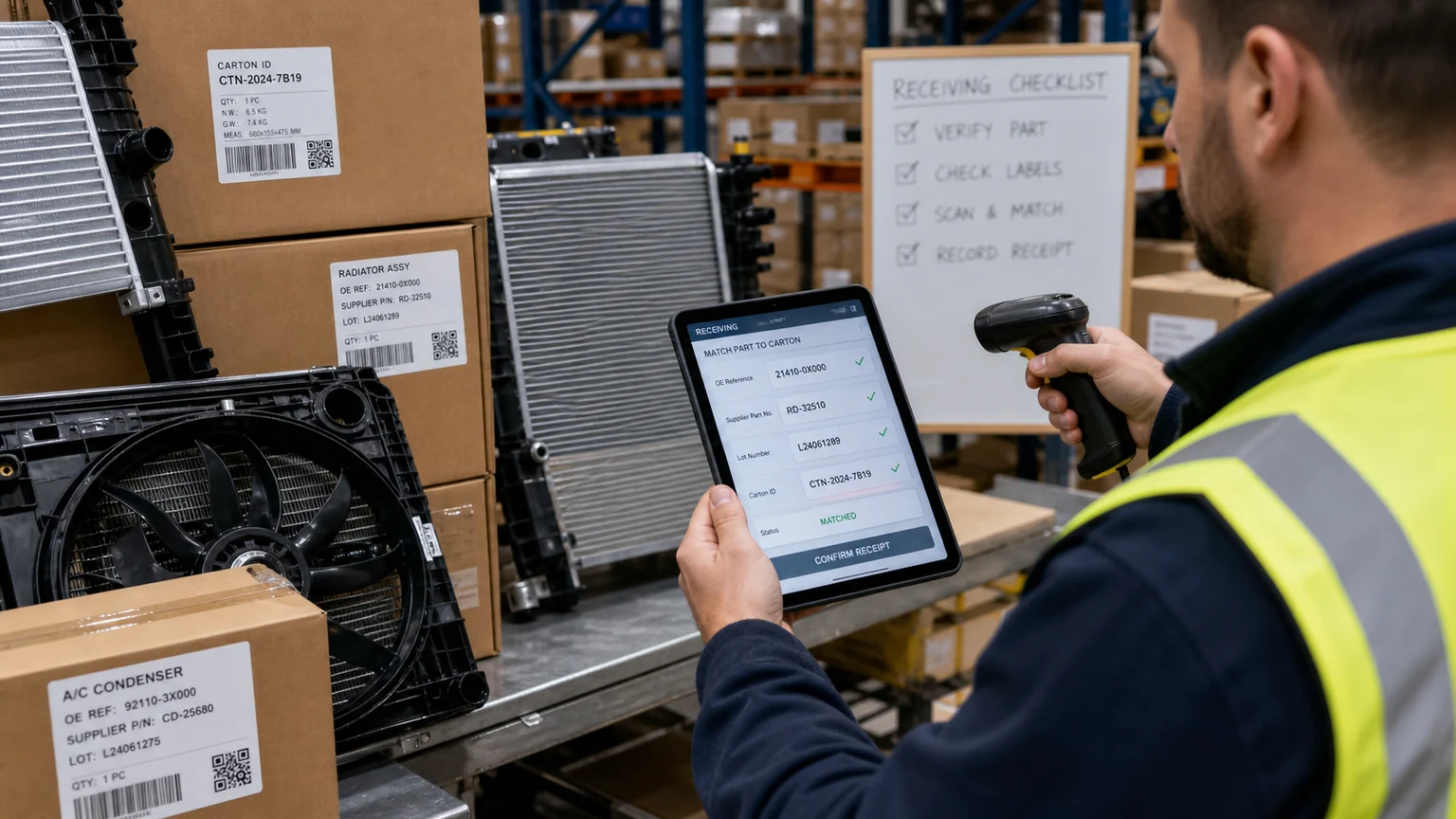
Traceability starts by matching the physical part, its carton and the receiving transaction.
Level | Identifies | Cooling-parts example | Warranty capability |
|---|---|---|---|
Class or part level | The product type | Supplier SKU plus OE cross-reference for a radiator variant | Confirms the intended type but cannot distinguish one batch or unit from another. |
Batch/lot level | A defined production, receipt or supplier group | Condenser lot produced on one line/date or fan batch received under one PO | Finds customers and stock exposed to the same group-level risk. |
Instance/serial level | One physical unit | Unique electric-compressor serial linked to a customer shipment | Confirms the exact unit’s receipt, inspection, sale, installation and return history. |
More granularity creates more scanning, data-storage and label-control work. Full serialisation is not automatically better. Use it where component value, safety relevance, counterfeit risk, supplier identification, warranty exposure or recall precision justifies the cost. A traceability programme fails when staff capture identifiers that are unstable, unreadable, duplicated or never used in a decision.
The master record should separate the supplier part number, Elecdura or distributor SKU, OE cross-references, application, revision and physical variant. One commercial SKU should not hide different ports, voltage, connector, control type, core construction or mounting. If a design changes without a new number, create an internal revision or approved-change field that preserves the difference.
OE references require control. A reference can be superseded, regional, option-specific or visually similar to a non-interchangeable version. Store the source and date of each cross-reference plus the evidence used: supplier catalogue, original label, application record, dimensions, connectors, ports or validated sample. Do not present a broad cross-reference list as guaranteed interchangeability.
For an A/C compressor, the master record may include refrigerant, oil context, pulley/clutch or electric-drive design, voltage, connector, control method, ports and mounts. For a cooling fan, include voltage, motor/control architecture, connector, blade diameter, rotation, shroud and mounting. For a condenser or radiator, include media, port/manifold layout, core dimensions, tanks/drier/sensor features and stack position.
A supplier’s manufacturing lot is strongest when it has a documented rule: line, date range, material batch, shift, process batch or another controlled boundary. Ask what the lot code means, where it appears, whether it is unique across years and factories, and how long the supplier retains related process and test records. A printed date that repeats annually may be insufficient.
If the supplier has no reliable lot code, the distributor can assign a receiving lot linked to supplier, PO, shipment, production markings and inspection. This is weaker than manufacturing traceability but still isolates receipts and customers. A receiving lot proves a logistics boundary, not a shared factory process history. Never replace or obscure the supplier code; store both. If several supplier lots are mixed in one carton or pallet, capture that relationship instead of pretending the logistics unit is one manufacturing batch.
Distributor SKU, supplier part number and controlled OE-reference version.
Supplier name, purchase order, shipment and receiving date.
Supplier lot/batch and serial number where present.
Distributor receiving lot when needed.
Quantity received, rejected, quarantined and released.
Factory/line/date markings that explain the lot.
Carton and part-label photographs.
Inspection sample plan and results.
Deviation, rework or relabelling approval.
Warehouse location and stock status.
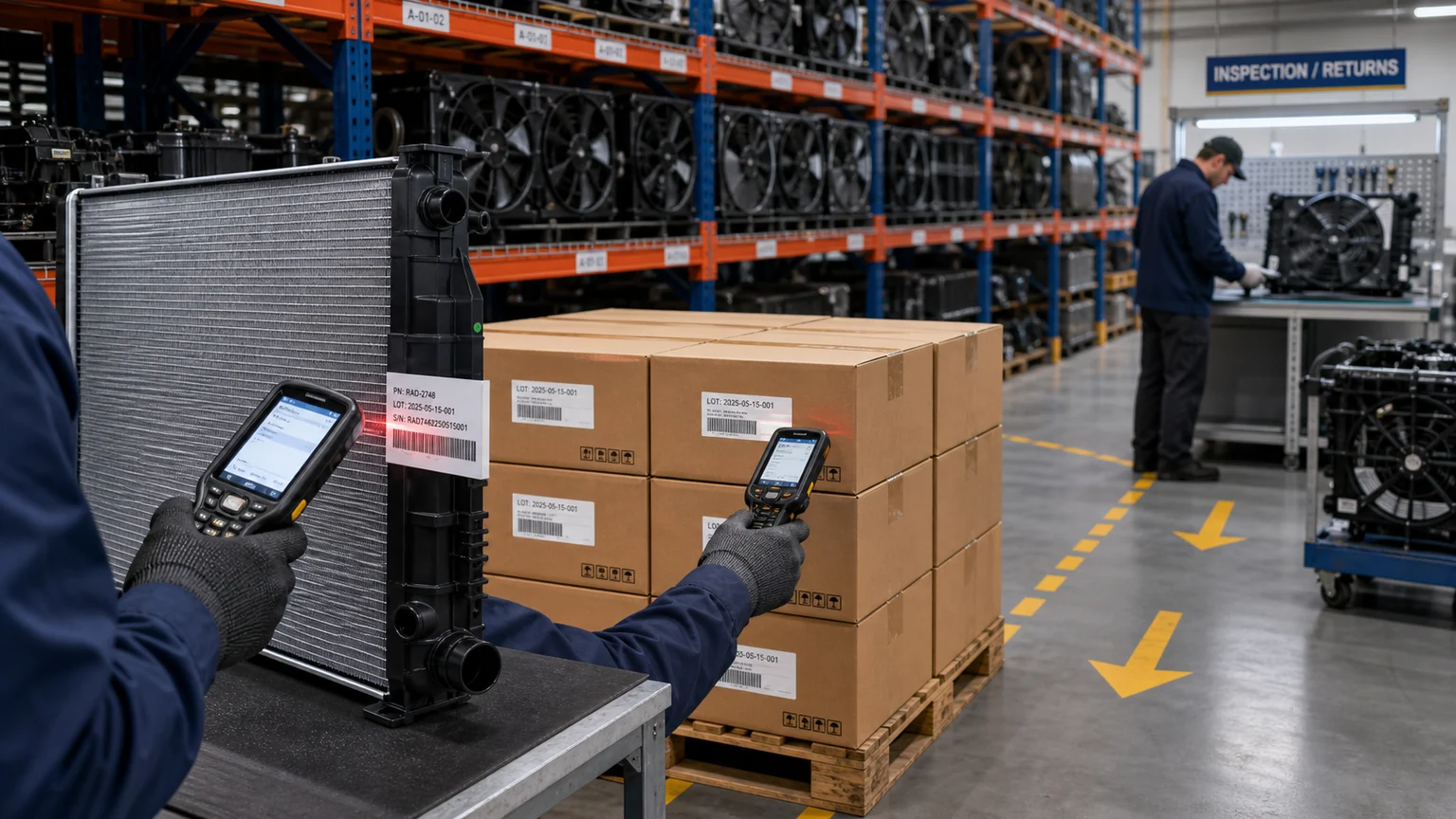
Receiving staff should scan or enter the identifier and confirm the human-readable text. A scan that opens a webpage is not proof that the lot in the database matches the part. Compare the carton and component labels, especially when units can be removed from outer packaging. Record label damage, over-labels, duplicate codes or differences between the sample and master data.
A 2D carrier can encode a part identifier, lot, serial, production date or a web link to a controlled record. Keep the payload stable and documented. Dynamic data such as lot and serial should be generated at production or packing, not printed permanently in generic artwork. The code should be sized and placed so it survives normal handling without covering ports, fins, safety labels or installation surfaces.
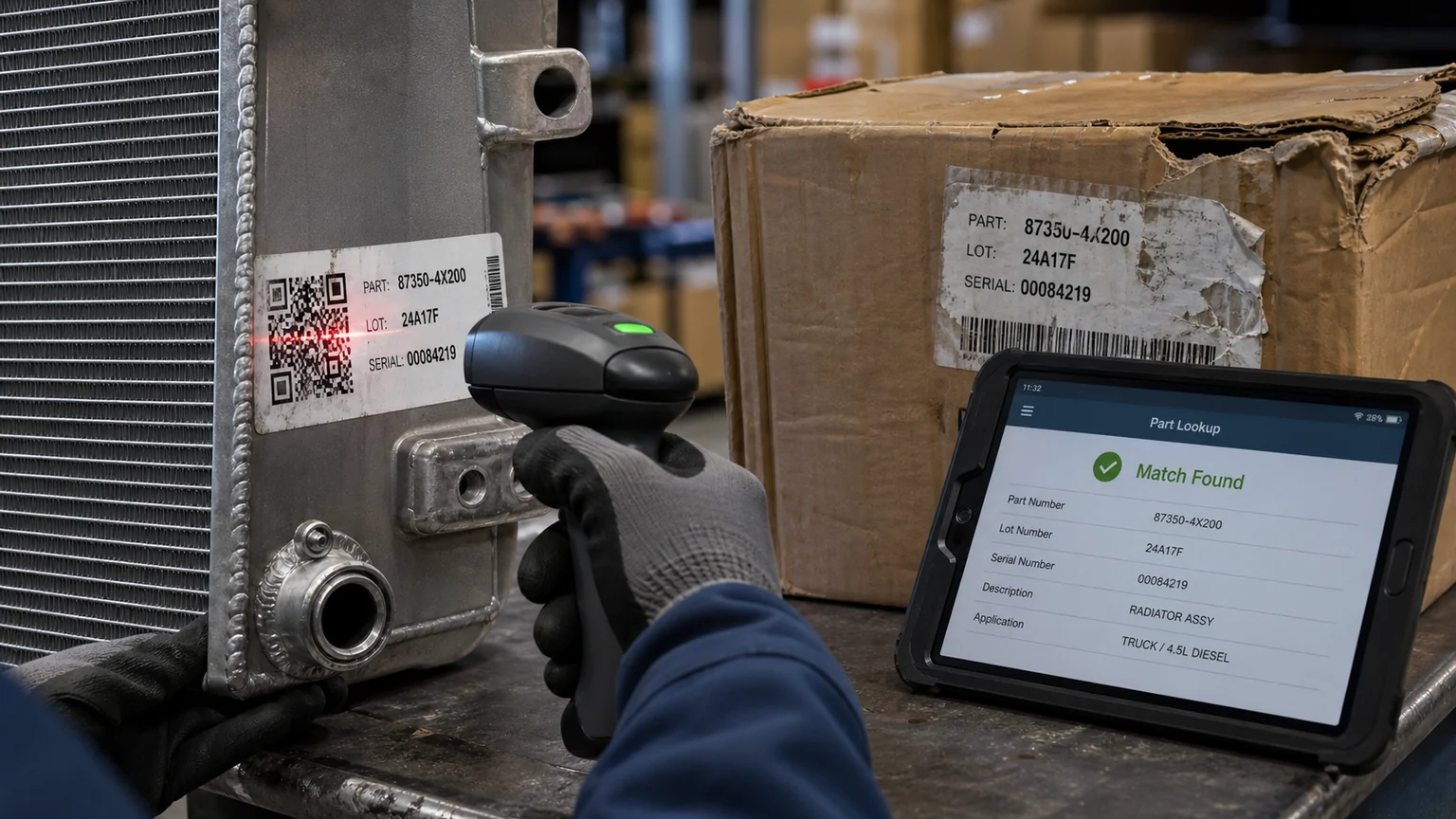
Always print essential identifiers in human-readable form. Workshops, warehouses and customers may have different scanners, offline conditions or damaged labels. A person must still be able to read the part number and lot or serial. If a QR code only links to a public marketing page, it adds little warranty evidence. The underlying link should resolve to a controlled product or instance record with appropriate access and retention.
Validate uniqueness at the level promised. The distributor's traceability key must be unique within its own system; when supplier serial namespaces can overlap, combine supplier ID, factory or another controlled namespace with the serial. Flag repeated scans in different shipments or locations. A copied QR image can reproduce the same text perfectly, so authentication claims require more than a visible code. Do not call a normal QR label anti-counterfeit protection unless the system verifies authenticity.
Every movement should preserve the link between serialized identity, lot and custody.
At put-away, preserve the lot or serial relationship with the bin and quantity. At picking, use first-in/first-out or another approved rule without losing lot identity. If units are repacked, link new carton identifiers to the original part and lot. If a carton is split, record the quantities and destinations. Returns to stock should preserve the original identity and pass an inspection before release.
Do not merge physically similar lots when a quality investigation is open. Quarantine should block allocation, transfer and shipment while retaining count and location. A trace request must answer both directions: which supplier records created this stock, and which customers received it?
For lot-controlled parts, the invoice or delivery record should retain the shipped lot and quantity. For serialised high-value parts, capture each serial against the customer and order. When practical, capture installation linkage: vehicle VIN/equipment serial, mileage/hours, installation date, workshop and removed-part OE reference. Do not make installation data mandatory for every low-value wholesale transaction if the channel cannot provide it; define the gap honestly.
Selected service processes can scan both the asset identifier and replacement-part code, creating a direct installed-unit record. For distributors, a lighter version may use a warranty-registration page or installer upload. Validate input formats and prevent one serial from being registered to incompatible applications without review.
Before diagnosing the return, compare the returned label and physical interfaces with the sales record. Confirm distributor SKU, supplier number, OE reference, lot/serial, customer, invoice and installation date. If the label is missing, use photos, markings, dimensions and packaging cautiously; mark identity as uncertain instead of assigning a convenient lot.
Then add failure evidence: complaint, DTC/freeze frame, voltage/current/pressure/temperature data, leak location, contamination, wiring/airflow/flow checks, installation photos, service records and post-repair result. Traceability tells who made and handled the part; it does not prove the part caused the failure. Warranty decisions need both identity and technical evidence.
Review claims by part revision, supplier, factory, lot, production date, customer, installer, route, application and failure mode. A higher count in one lot may indicate a production issue, but also compare exposure: ten claims from a lot of 100 is different from ten claims from a lot of 10,000. Separate repeated symptom descriptions from verified failure modes.
For example, several condensers may be returned for leaks. Traceability shows most came from one shipping event but two manufacturing lots. Photos locate damage at the same carton corner and bent mounting tab. The pattern points first to packaging or handling, not a manufacturing leak across both lots. If leaks instead cluster at the same manifold braze within one manufacturing lot and receiving cartons were intact, supplier process investigation becomes stronger. A distributor receiving lot alone would establish common receipt, but not common production conditions.
Define the affected part, revision, supplier and suspected lot/serial range.
Block identified warehouse stock and open orders without blocking unrelated variants.
Trace backward to supplier PO, shipment, test and production records.
Trace forward to customers, quantities, invoices and installed units where captured.
Inspect samples using the specific suspected failure mode.
Communicate clear hold, inspection, return or release instructions.
Record quantities found, inspected, failed, reworked, returned and released.
Close only after disposition and preventive action are documented.
Test the trace process before a crisis. Select a lot and measure how quickly the team can identify remaining stock, customers, quantities and supplier evidence. Reconcile the total: received equals stock plus shipped plus scrapped, reworked, returned and adjusted quantities. Unexplained differences are a traceability failure even if the QR scans correctly.
Set retention according to product life, warranty period, legal/customer requirements and the time a part may remain in distribution. Cooling components can sit in warehouses before installation, so invoice date alone may understate exposure. Keep identifiers, transactions, evidence and change history available for the defined period.
Control who can create, edit, merge and retire identifiers. Corrections should preserve the original value, reason, approver and date. When a supplier changes label format, factory, lot syntax, QR payload, part revision or packaging, validate the change before release. A scanner rule that silently stops reading a new code can break forward trace without immediately affecting sales.
Retain voltage, connector family, pin count, motor/control architecture, blade and shroud variant, rotation, supplier software or revision where applicable, and the lot or serial. Link end-of-line current, speed, balance or functional-test records when the supplier can provide them. A fan claim should add vehicle command, supply/ground evidence, current, actual speed, blade damage, shroud clearance and airflow condition. This distinguishes a motor batch issue from connector damage, blocked cores or application mismatch.
Retain, where applicable, refrigerant and oil/factory-fill information, electric or belt-driven architecture, voltage or clutch/control type, ports, connector, pulley, supplier factory, lot/serial and test status. For warranty, link recovery/charge records, contamination and cleaning-decision evidence, leak point, pressure/temperature response and the returned-unit identity. If a compressor serial is printed only on a removable carton, add the relationship to the component marking at receiving.
Retain medium, core construction/revision, manifold or tank variant, ports, integrated drier or sensor provisions, mounts, factory, lot and packaging revision. A heat-exchanger lot may be associated with brazing, crimping, material, tube, plate or leak-test records. Warranty evidence should identify the exact leak or damage location and separate manufacturing, transport, impact, mounting stress, corrosion, contamination and wrong-application causes.
Retain temperature rating, electrical heater/sensor connector, housing material, gasket/seal kit, casting/mould cavity where supplied, date/lot and dimensional revision. Heat aging, warpage, fastener stress and sealing-surface damage can be application or installation dependent. A traceable mould cavity or process lot can be valuable when cracks cluster at one physical feature.
Test label materials against abrasion, oil, coolant, refrigerant oil residue, humidity, temperature, UV exposure and cleaning practices appropriate to the component. The code must remain readable after warehouse handling and normal installation exposure for the intended period. Do not place it on a removable protective cap if instance identity must remain with the part.
Use contrast and quiet zones appropriate to the selected carrier, and verify with more than one device used in the supply chain. Print quality at the factory may pass while a small reprint label in the warehouse fails. Establish a rejection and reprint process that links the replacement label to the original record, requires approval and prevents two active labels for one serial.
Human-readable identifiers keep the record recoverable when a machine-readable code is damaged.
If a code will not scan, enter the human-readable value and photograph the label. If the value is unreadable, quarantine the item unless another controlled marking can establish identity. If carton and part identifiers conflict, do not choose one silently; preserve both, stop release and resolve the supplier or repacking error. If the same serial appears twice, quarantine both units and investigate duplication, relabelling or data-entry error.
Returned parts often arrive dirty or without packaging. Train warranty staff to photograph the label before cleaning and to compare permanent physical features with the sales record. Never manufacture a lot assignment merely to complete a claim. An “identity not confirmed” outcome is better than contaminating lot analytics with a guessed record.
Percentage of receipts with valid supplier and lot capture.
Percentage of high-risk serialised units linked to customer shipment.
Scan failure, duplicate and carton-to-part mismatch rates.
Time required for forward and backward trace exercises.
Quantity reconciliation accuracy during containment.
Warranty returns with confirmed sold-part identity.
Claims linked to complete technical evidence and disposition.
Supplier corrective actions supported by verified lot clustering.
A high scan rate is not enough if shipments are not linked or quantities do not reconcile. Use outcome measures: faster containment, fewer unrelated units blocked, more returned identities confirmed, clearer supplier investigations and lower time spent reconstructing records. Review the metrics by warehouse and supplier so process gaps are visible.
A public QR link should not expose customer identity, pricing, internal quality records or unrestricted warranty files. Separate the public product view from authenticated partner and internal evidence. Define roles for warehouse, supplier, customer, technician and warranty staff. Log material changes and downloads where appropriate. If an external platform is used, define ownership, export, retention and availability so trace records remain accessible if the service changes.
Stage | Capability | Next improvement |
|---|---|---|
1. Part control | Controlled SKU, supplier part and OE-reference evidence | Add supplier/receiving lot to every receipt. |
2. Lot trace | Lot linked to stock, shipment and warranty | Test forward/backward reconciliation and quarantine. |
3. Risk-based serialisation | Serial linked to selected high-value customer/installation records | Add duplicate detection and return identity validation. |
4. Evidence integration | Inspection, photos, tests and claim data linked to identifier | Use exposure-adjusted lot analytics and supplier corrective action. |
A useful cooling-parts trace system begins with controlled part identity, adds lot or serial detail according to risk, and links that identity through receipt, stock, shipment, installation and return. QR and DataMatrix labels can accelerate capture, but human-readable identifiers, database relationships, reconciliation and disciplined scanning make the evidence trustworthy.
For an Elecdura cooling-parts enquiry, provide the OE reference, application, label and interface photos, quantity and required traceability level. For a warranty case, include the lot or serial plus measured failure evidence so the physical part, supply-chain history and technical decision remain connected.