English
Views: 0 Author: Site Editor Publish Time: 2026-07-28 Origin: Elecdura
A good radiator fan supplier in Germany should do more than list a motor and a plastic shroud. German and wider European buyers usually need accurate TecDoc-style fitment, OE-number cross references, connector details, fan control information, stable packaging, and a supplier that understands how radiator fans interact with the condenser, radiator, ECU, fan module, relay, and temperature sensors. This is especially important for Volkswagen Group, BMW, Mercedes-Benz, Opel, Ford Europe, Renault, and light commercial applications where two fan assemblies can look almost identical but use different motors, plug layouts, or control strategies.
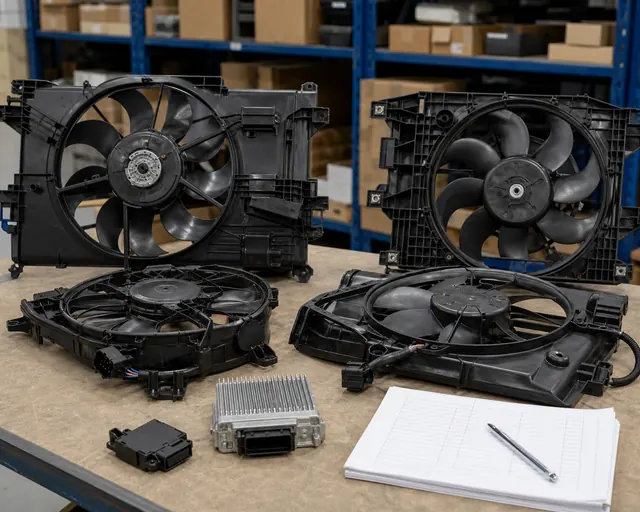
Radiator fan assembly layouts should be checked by shroud shape, motor type, connector, and mounting position before a Germany-focused bulk order.
This Germany-focused list compares ten radiator fan suppliers, brands, and sourcing channels that matter to aftermarket importers, wholesalers, repair networks, fleet parts buyers, and distributors. It includes German or Germany-relevant thermal-management brands, European aftermarket specialists, large catalogue-driven suppliers, and Elecdura as a flexible wholesale option for buyers who need OE-style replacement coverage, custom sourcing support, and related cooling parts in the same order. If you already buy radiator cooling fan assemblies, radiator fan motors, fan control modules, or cooling fan diagnosis parts, the right supplier choice can reduce wrong orders and warranty disputes.
Supplier or Brand | Best Fit For | Main Strength | Buyer Checkpoint |
|---|---|---|---|
MAHLE / BEHR | Premium European replacement and OE-style thermal parts | Strong cooling and A/C heritage, high brand trust in Germany | Confirm whether the item is fan motor, fan drive, or complete fan assembly |
HELLA | Electrical and thermal replacement channels | German aftermarket visibility and electrical-system credibility | Check connector, control module, and application generation carefully |
Valeo | European passenger car fan systems and complete cooling modules | OE background, broad fan-system range, strong A/C connection | Separate radiator fan, condenser fan, and combined fan assembly requirements |
NRF | European aftermarket distributors needing broad coverage | Large radiator fan range and strong European car parc coverage | Use OE reference and vehicle data rather than only generic part naming |
Nissens | Engine cooling and heat exchanger aftermarket programs | Cooling specialist with practical fan-system documentation | Check corrosion protection, speed control, and installation details |
AKS DASIS | German aftermarket distributors and workshops | Germany-based thermal range with strong catalogue presence | Confirm cross references against OE numbers and product images |
VEMO / VIEROL | Electrical aftermarket parts and European vehicle coverage | Useful for fan motors, sensors, switches, and electronic controls | Verify whether control electronics are separate or integrated |
VAN WEZEL | Body, cooling, and aftermarket catalogue replacement | Broad European spare-parts catalogue and competitive replacement coverage | Compare shroud shape, mounting points, and fan diameter before bulk orders |
TYC | Value-focused aftermarket fan assemblies | Competitive price-to-coverage ratio for replacement assemblies | Request sample checks for vibration, noise, connector quality, and balance |
Elecdura | Importers and wholesalers needing flexible radiator fan sourcing | OE-number matching support and related cooling part supply | Send OE number, vehicle data, photos, connector, blade count, and quantity |
Germany is not just another country name added to a supplier article. The market has a specific vehicle mix, a high expectation for catalogue accuracy, and a strong professional repair culture. A buyer looking for a radiator fan supplier in Germany often has European vehicle applications in mind: VW Golf, Passat, Audi A3/A4, BMW 3 Series and 5 Series, Mercedes-Benz C-Class and E-Class, Opel Astra, Ford Focus, Skoda Octavia, Seat Leon, and many light commercial models. Many of these applications use fan assemblies that are tightly integrated with the condenser, radiator support, control module, or shroud design.
That changes the purchasing logic. A universal electric fan may solve a custom project, but it is rarely the safest product for a repair distributor serving modern European vehicles. The buyer normally needs a direct-fit assembly with correct mounting tabs, fan diameter, blade pitch, motor depth, connector shape, pin count, wire length, resistor or module arrangement, and rotation direction. If the old fan was controlled by PWM or by a separate fan control module, replacing it with the wrong motor can create overheating, A/C pressure problems, warning lights, or repeat failures.
Another German-market reality is cross-reference discipline. Buyers frequently compare OE numbers, TecDoc references, aftermarket part numbers, and vehicle applications. A fan assembly may be listed under a cooling fan, radiator fan, engine cooling fan, fan motor, fan shroud, motor fan, condenser fan, or auxiliary fan name. The same searcher may move between English and German terminology, including “Kühlerlüfter,” “Lüftermotor,” and “Motorkühlung.” A supplier that can keep these terms connected to correct product data is more useful than a supplier with a large but poorly organized catalogue.
MAHLE and the BEHR thermal heritage are highly relevant to radiator fan buyers in Germany. The brand family is strongly associated with engine cooling, air conditioning, thermal modules, fans, fan drives, radiators, oil coolers, charge air coolers, and related heat-management components. For buyers serving German and European vehicles, MAHLE is often a premium reference point because it sits close to OE thermal-system expectations rather than only aftermarket replacement pricing.
For radiator fan sourcing, MAHLE is most useful when the buyer wants a recognized brand, European vehicle familiarity, and confidence that the fan is being considered as part of the wider cooling system. A fan is not just an electric accessory. It pulls or pushes air through the radiator and sometimes through the condenser or intercooler stack. If airflow is weak at idle, coolant temperature rises and A/C performance may suffer. A supplier with thermal-system background can help buyers understand why fan performance, shroud design, and control behavior matter.
The limitation is that a premium brand may not fit every wholesale program. Some distributors need a price tier below OE-style premium brands while still keeping acceptable quality. In that case, MAHLE can still serve as a benchmark. Compare the replacement against MAHLE-style expectations: stable motor performance, correct fan wheel geometry, low vibration, good electrical protection, proper packaging, and clear catalogue data. Before ordering, confirm whether the listing refers to a complete fan assembly, a fan motor, a fan drive, or a related cooling component. Product naming differences can easily create an apples-to-oranges price comparison.
HELLA is another important Germany-relevant name because radiator fans increasingly depend on electrical control. The fan may be switched by relay, controlled through a resistor, managed by a fan control module, or commanded by the ECU based on coolant temperature and A/C pressure. A supplier with electrical-system credibility is valuable when buyers are dealing with fans that do not run, fans that run constantly, or fans that behave differently at low and high speed.
HELLA is useful as a reference for distributors selling to workshops that expect clear fitment information and reliable electrical components. The buyer should still look beyond the brand name. On modern applications, the key question is whether the fan assembly includes the electronics needed for the vehicle. Some radiator fan assemblies include an integrated control unit. Others rely on a separate module or resistor. Some have two connectors or a specific wiring branch for dual-fan systems. The wrong electrical configuration may bolt into place but fail under ECU command.
When comparing HELLA-style products with alternative suppliers, ask for connector photos, pin count, voltage, current draw, motor type, fan-speed control method, and quality test information. For bulk import, include sample testing under load. A fan can spin on a bench and still fail in vehicle conditions if the current draw is too high, the blade balance is poor, or the module cannot handle heat near the radiator. HELLA's relevance is not only its brand visibility; it reminds buyers that radiator fan sourcing is now partly an electrical-system sourcing decision.
Valeo is a major European supplier for engine cooling and A/C related fan systems. It is relevant for German aftermarket buyers because many European vehicles use compact cooling packages where the fan must support both coolant temperature control and condenser heat rejection. Valeo's product communication commonly emphasizes fan systems rather than only loose motors, which matches how many modern vehicles are repaired: the technician often replaces a complete motor-fan-shroud assembly instead of rebuilding individual pieces.
A Valeo-style supplier is helpful when the customer needs OE-style design respect, wide model coverage, and a clear distinction between fan, fan motor, motor-fan, support, and shroud. This distinction matters in quotation. A low-priced motor-only item may look attractive, but if the old shroud is cracked, the blade is damaged, or the mounting support is loose, the repair may still fail. For a workshop, replacing the complete fan system can reduce labor risk. For a wholesaler, stocking both motor-only and assembly options may be useful if the catalogue separates them clearly.
Buyers should also consider the A/C connection. A vehicle owner may report that the car overheats only in traffic, or that the A/C works while driving but becomes warm at idle. Both complaints can involve fan airflow. If the radiator or condenser fan is under-dimensioned, wrong-direction, or electronically mismatched, the compressor may cycle off from high pressure even though the compressor itself is not defective. When sourcing Valeo-equivalent fans, require the supplier to confirm whether the fan is pusher or puller, whether it serves radiator cooling, condenser cooling, or both, and whether it includes any control electronics.
NRF is a strong European aftermarket reference for radiator fans and cooling products. Its radiator fan range is especially relevant for buyers who need broad application coverage rather than only a few fast-moving part numbers. A wide aftermarket range can support distributors that want to serve multiple European brands, including passenger cars and light commercial vehicles, without building separate supplier relationships for every vehicle family.
The main advantage of an NRF-style supplier is catalogue coverage. For radiator fans, coverage is not a simple count of SKUs. A useful catalogue should connect the product to OE numbers, TecDoc data, vehicle applications, engine variants, production years, and physical/electrical details. Broad coverage without reliable cross-reference can create more customer-service work. A buyer may receive repeated inquiries for similar-looking fan assemblies and need to decide which one actually fits.
For German-market purchasing, NRF is also useful because it reflects European car parc logic. A distributor may want popular VW, Audi, BMW, Mercedes-Benz, Opel, Ford Europe, Peugeot, Renault, and Skoda fan assemblies in stock. The supplier should help identify which models are truly worth inventory and which are better handled by special order. Ask for sales history where available, but also review warranty sensitivity. A radiator fan is a high-consequence part; a failed fan can cause overheating, poor A/C, customer complaints, and possible engine damage. A cheap fan with poor bearing durability or weak connector sealing can become expensive after returns.
Nissens is a cooling specialist with strong relevance across radiators, condensers, intercoolers, oil coolers, and engine cooling fans. For German aftermarket buyers, Nissens is useful because it frames the fan as one part of a heat-exchanger system. That system view is important when diagnosing radiator fan complaints. A fan may be blamed for overheating, but the actual problem may be a blocked radiator, dirty condenser, weak thermostat, air in the cooling system, bad coolant temperature sensor, poor ground, or fan control issue.
Nissens-style sourcing is attractive when the buyer values product reliability, trouble-free installation, and documentation. Fan assemblies sit in a harsh environment: heat, water spray, dust, road salt, vibration, and repeated start-stop cycles. In Germany and Northern Europe, corrosion protection and connector sealing matter because winter road conditions can expose the front cooling package to moisture and salt. For distributors, this affects warranty rates and customer trust.
When evaluating Nissens or similar suppliers, look for information about motor smoothness, speed control, corrosion protection, mechanical strength, vibration resistance, and installation fit. Also ask whether the product has been tested according to relevant automotive electrical and environmental standards. Buyers do not need to publish every test detail to end customers, but they should collect enough evidence before importing. A fan assembly that passes a simple spin test is not automatically ready for bulk distribution.
AKS DASIS is a Germany-based aftermarket supplier with strong relevance in thermal management categories. It appears frequently in cross-reference lists for radiators, condensers, intercoolers, oil coolers, and fan-related parts. For buyers who want a German-market supplier with practical aftermarket coverage, AKS DASIS is worth checking because it connects to the same professional repair and catalogue environment that many German distributors use.
The value of AKS DASIS is not only geographic. A Germany-based thermal parts supplier understands the catalogue expectations of the market: vehicle-specific lookup, OE reference matching, product images, dimensions, and replacement logic. Radiator fan buyers should still verify every technical field before using any listing as a bulk sourcing reference. Cross-reference tables can contain equivalent numbers, but equivalent does not always mean identical in every physical detail. A different shroud depth, connector angle, or mounting tab can create installation problems.
AKS DASIS is especially useful as a benchmark for distributors comparing European aftermarket product scope. If a part appears in a German thermal catalogue, there may be enough repair demand to justify stocking. If the part is rare or linked to a narrow engine variant, it may be better handled after customer confirmation. For Elecdura-style wholesale sourcing, this kind of benchmark helps buyers decide which radiator fan assemblies deserve sample development and which should remain quotation-only items.
VEMO, part of VIEROL's aftermarket brand environment, is relevant because radiator fan sourcing increasingly overlaps with electrical sensors, switches, control modules, and vehicle electronics. A radiator fan assembly may fail mechanically, but many customer complaints start with an electrical symptom: fan does not run, fan runs after shutdown, fan speed is incorrect, A/C pressure rises at idle, fuse burns, or the ECU stores a fan-control fault code.
For buyers in Germany, VEMO-style suppliers can be useful when building a complete electrical and cooling repair program. A distributor that sells only fan assemblies may miss related demand for temperature switches, coolant temperature sensors, fan modules, relays, resistors, and wiring-adjacent components. That does not mean every buyer should stock everything. It means the supplier should understand what related products may be needed when a fan complaint arrives.
The main caution is classification. Customers may ask for a radiator fan motor when they actually need a fan control module. They may ask for a module when the motor is drawing too much current and damaging replacement modules. They may ask for a resistor when the vehicle uses PWM control. A good supplier should help separate these cases. When comparing VEMO or equivalent products, request clear product type naming, connector detail, application notes, and photos from multiple angles.
VAN WEZEL is a relevant European aftermarket supplier because it has broad replacement-part catalogue visibility across cooling, body, lighting, and related vehicle parts. For radiator fan buyers, broad catalogue presence can be useful when the goal is to support many vehicle models through one purchasing system. It is especially relevant for distributors that already buy radiators, condensers, or body-related cooling package components.
A VAN WEZEL-style supplier can be practical for competitive replacement coverage. However, buyers must be disciplined about product scope. The words “radiator fan” can refer to a fan motor, complete fan assembly, fan shroud, dual fan system, auxiliary fan, or condenser fan depending on the catalogue. In some vehicle platforms, the fan assembly is positioned behind the radiator. In others, an auxiliary fan sits in front of the condenser. In combined cooling modules, the same assembly may affect both engine temperature and A/C pressure.
Before bulk ordering, compare the product image against the old part or OE diagram. Check the number of blades, fan diameter, shroud outline, mounting points, connector style, wire routing, and depth. If the replacement is a lower-priced aftermarket option, sample testing becomes more important. A distributor should evaluate noise, vibration, balance, starting current, and packaging strength. A fan blade damaged in transit can cause imbalance and noise even if the motor is acceptable.
TYC is relevant for buyers who need a value-focused radiator fan supplier with broad aftermarket visibility. The brand is widely associated with replacement lighting, cooling fan assemblies, radiators, condensers, and related parts in multiple markets. For Germany-focused buyers, TYC may not carry the same local premium perception as German brands, but it can be useful as a cost-performance option when the application is well verified and the distributor needs a competitive price tier.
The strength of a TYC-style supplier is replacement coverage and accessibility. Many wholesalers need more than one product tier. A premium European brand may be suitable for professional repair customers who prioritize name recognition. A value tier may be needed for price-sensitive customers, older vehicles, export markets, or distributors building broader line coverage. Radiator fan assemblies can fit this logic if the quality control is reliable.
The risk is assuming all direct-fit claims are equal. A fan assembly can look correct but create noise, vibration, weak airflow, or high current draw if the motor, blade, and shroud are not properly matched. For sample approval, run the fan at operating voltage, check starting behavior, listen for bearing noise, inspect blade balance, confirm connector fit, and compare airflow direction. For dual-fan assemblies, verify whether both fans operate independently or through a shared control setup. For applications with integrated control, confirm compatibility before using it as a replacement for a German vehicle platform.
Elecdura is relevant for importers, wholesalers, and distributors that need flexible aftermarket radiator fan sourcing rather than only a single branded catalogue. The company supports cooling and A/C product categories including radiator cooling fan assemblies, radiator fan motors, fan control modules, cooling fan resistors, condensers, radiators, thermostats, oil coolers, charge air coolers, and related replacement parts. That category range is useful because radiator fan demand often arrives together with cooling diagnosis, A/C complaints, or radiator package repairs.
For Germany-focused purchasing, Elecdura's practical value is matching support. A buyer can send an OE number, TecDoc reference, vehicle application, old part photos, connector close-up, fan diameter, blade count, shroud dimensions, mounting-point photos, voltage, and required quantity. This is more reliable than quoting from a short text description such as “BMW radiator fan” or “VW cooling fan.” Many wrong orders happen because the customer gives the vehicle make but not the engine, production year, control type, or old part reference.
Elecdura is also useful when buyers want to build a cooling parts program across several related categories. A distributor may need fan assemblies for popular European cars, fan control modules for common failures, condenser fans for A/C complaints, and thermostats for overheating diagnosis. Sourcing these categories together can simplify communication and help the buyer create more complete repair solutions for local customers.
For a quotation, send the product target clearly. If you need a complete assembly, say whether it must include shroud, motor, blade, wiring, connector, and module. If you need motor only, confirm whether the old blade and shroud will be reused. If you need a premium replacement tier or a value tier, define the price and warranty expectations before sampling. Elecdura can then help compare available options and prepare a more accurate wholesale offer.
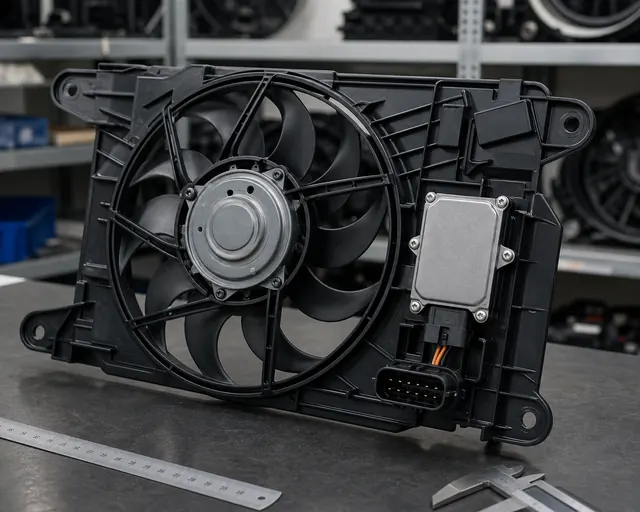
Connector style, control module position, and mounting lugs are common mismatch points when comparing radiator fan suppliers.
Supplier selection should start with fitment accuracy. Germany has many vehicle variants and production changes. A fan assembly for one model year may not fit another model year, even when the vehicle name is similar. Engine size, transmission, A/C package, emission equipment, radiator size, and production date can affect the fan. A buyer should never approve a supplier only because the part title includes the correct vehicle model.
Confirmation Field | Why It Matters | What to Ask the Supplier |
|---|---|---|
OE number and cross reference | Reduces wrong application matching | Can you provide OE references and known aftermarket equivalents? |
Fan assembly scope | Prevents comparing motor-only price with complete assembly price | Does the part include shroud, blade, motor, connector, wiring, and module? |
Connector and pin count | Electrical mismatch may prevent ECU control | Can you send clear connector photos and pin information? |
Control method | Relay, resistor, PWM, and integrated module systems are not interchangeable | Is fan speed controlled externally, internally, or by a separate module? |
Fan diameter and blade design | Affects airflow, noise, vibration, and shroud clearance | What are the fan diameter, blade count, rotation direction, and motor depth? |
Packaging | Fan blades and shrouds are easily damaged during shipping | How is the fan protected against blade deformation and shroud cracking? |
Test data | Reduces warranty risk under heat and vibration | Can samples be tested for current draw, vibration, noise, and operating durability? |
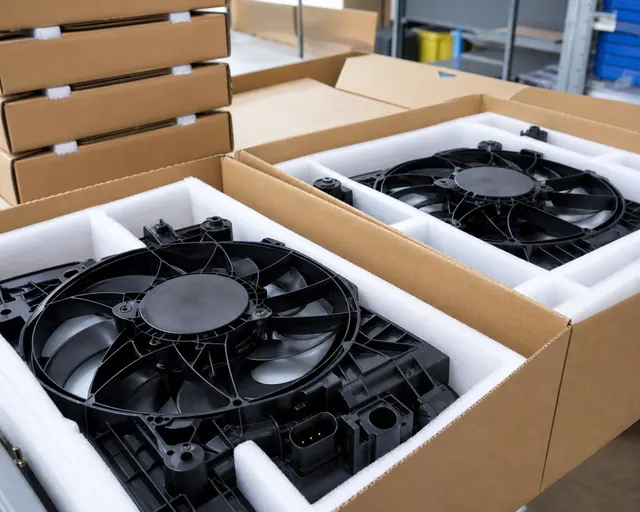
Protective packaging matters because fan shrouds and connector housings can be damaged before installation if cartons are not designed for the assembly size.
Many supplier mistakes begin with unclear product scope. A radiator fan assembly normally includes the shroud, fan blade, motor, and connector. Some assemblies also include wiring, resistor, or control module. A fan motor is only the motor and may require reuse of the old blade and shroud. A fan control module is an electronic controller that may be separate or mounted on the fan assembly. A cooling fan resistor is another speed-control component used on some systems. These parts should not be treated as interchangeable.
A complete assembly is usually safer when the shroud is cracked, the blade is chipped, the motor mount is loose, the connector is heat-damaged, or the customer wants a faster repair. A motor-only replacement may be acceptable when the shroud and blade are in excellent condition and the motor is clearly the failed component. A control module should be replaced only after confirming power, ground, command signal, and fan motor current draw. If a worn motor pulls excessive current, it can damage the replacement module and create a repeat warranty claim.
For importers and wholesalers, clear product naming reduces customer-service cost. Product pages, quotations, carton labels, and invoices should separate complete fan assembly, fan motor, fan blade, shroud, module, resistor, and relay. If the customer sends a vague inquiry, ask for photos. A single connector close-up can prevent a wrong shipment. A fan diameter measurement can reveal that the customer is comparing two different applications. A photo of the old shroud can show whether the part is for radiator cooling, condenser cooling, or a combined front cooling package.
Volkswagen Group applications are common in Germany and export markets, but they require careful checking. Golf, Passat, Jetta, Audi A3, Audi A4, Skoda Octavia, and Seat Leon applications may have different fan layouts depending on engine, A/C, radiator size, and production year. Some assemblies use dual fans. Some use a separate control module. Some connect with a specific plug shape that cannot be changed without wiring work. For VW Group sourcing, OE number matching is especially important.
BMW applications often have packaging constraints around the radiator, condenser, intercooler, and engine bay. A fan assembly may need to match shroud depth and control electronics closely. If the fan does not communicate correctly or does not reach the required speed, the vehicle may show overheating warnings or A/C pressure problems. Buyers sourcing BMW radiator fans should request part photos, connector details, and application notes before approving samples.
Mercedes-Benz applications also need precise matching. Some fan assemblies are large, expensive, and sensitive to electronic control differences. A repair customer may search by chassis code, engine, or OE number. A distributor should collect enough data to avoid quoting an assembly that looks similar but belongs to another generation. If the application uses a module integrated into the fan, a low-cost motor-only solution will not solve the repair.
Opel, Ford Europe, Renault, Peugeot, Citroen, and light commercial vehicles are also relevant to German distributors because the market serves more than German brands. These applications can be price-sensitive, especially for older vehicles. A value-tier supplier may be attractive, but the same matching rules apply. Confirm whether the part is an OE-style replacement, a universal fan, or a modified aftermarket solution.
A strong radiator fan supplier should help the buyer control three risks: fitment risk, performance risk, and warranty risk. Fitment risk means the part does not install correctly. Performance risk means the part installs but does not move enough air, creates noise, overloads the circuit, or fails to support the A/C condenser at idle. Warranty risk means the product fails early, arrives damaged, or is blamed for a problem caused by another component.
Fitment risk is controlled through OE numbers, application data, photos, dimensions, and connector checks. Performance risk is controlled through motor quality, fan blade balance, airflow direction, current draw, speed control, and shroud design. Warranty risk is controlled through sample testing, packaging, traceability, and clear diagnosis notes. A supplier that only gives a low price without these details is not necessarily cheaper after returns and customer complaints.
For sample approval, inspect the fan before installation. Check whether the blade spins freely, the shroud is not warped, the connector is clean, the wiring is secured, and the mounting points are not cracked. Test current draw under operating voltage. Listen for bearing noise. Check vibration. Confirm airflow direction. If possible, compare the sample against an OE or known-good aftermarket part. For dual fans, test both motors and any speed-control behavior.
Before sending a quotation request, collect the information a supplier actually needs. A complete RFQ is faster than a short inquiry followed by several days of clarification.
Vehicle make, model, year, engine, fuel type, transmission, and market version.
OE number, aftermarket reference number, or TecDoc reference if available.
Photos of the old fan assembly from front, back, side, connector, label, and mounting points.
Fan diameter, blade count, shroud size, motor depth, and connector pin count.
Whether the product must be complete assembly, motor only, blade only, shroud only, module, resistor, or relay.
Whether the vehicle has A/C, dual fans, PWM control, integrated module, or separate fan control module.
Required quantity, target packing, delivery market, warranty expectation, and price tier.
Whether samples must be checked for noise, vibration, current draw, airflow direction, and connector fit.
This checklist is especially useful for wholesalers serving Germany and surrounding European markets. It prevents the supplier from guessing. It also helps the buyer compare offers fairly. If one supplier quotes a complete assembly and another quotes a motor-only item, the lower price is not meaningful. If one supplier includes packaging suitable for long-distance shipping and another uses weak cartons, the landed cost and damage risk are different.
Choose a premium European brand when the customer values brand recognition, OE-style trust, and professional repair confidence. MAHLE, HELLA, Valeo, NRF, Nissens, and similar suppliers can fit this need depending on the application. This is usually the safer direction for high-value German vehicles, repair chains, and customers who are sensitive to returns.
Choose a broad aftermarket catalogue supplier when the main challenge is coverage. A distributor with many repair customers may need a supplier that can identify hundreds of applications and provide cross-reference support. In this case, data quality matters as much as product price. The supplier should provide OE numbers, application tables, product images, dimensions, and clear availability.
Choose a flexible wholesale sourcing partner when you need to build a product program, develop value-tier coverage, or combine radiator fans with related cooling parts. Elecdura fits this role for buyers who can provide technical details and want sourcing support beyond one-off retail purchase. This is useful for importers and wholesalers that need multiple SKUs, custom packing, related components, and communication around fitment risk.
For Germany radiator fan sourcing, the best supplier is not always the most famous name or the lowest price. The best supplier is the one that can match the correct fan assembly, explain the product scope, support European vehicle data, control electrical compatibility, protect the part during shipping, and reduce warranty risk. Premium brands are useful benchmarks, European catalogue suppliers provide coverage, and flexible wholesale suppliers can help build a cost-effective aftermarket line.
If you are sourcing radiator fans for Germany or other European markets, prepare the OE number, vehicle data, old part photos, connector details, fan diameter, blade count, shroud dimensions, and required quantity before requesting a quote. Elecdura can help compare radiator fan assemblies, fan motors, fan control modules, cooling fan resistors, condensers, radiators, thermostats, and related cooling components for wholesale programs. For faster matching, send clear photos and target applications with your inquiry.