English
Views: 0 Author: Site Editor Publish Time: 2026-07-07 Origin: Site
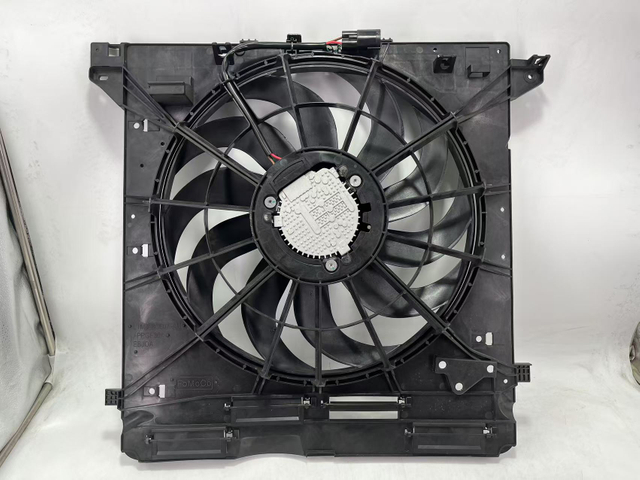
If a cooling fan is not working, do not replace the fan motor first. Start by checking the fuse, relay command, power and ground at the fan connector, fan motor response under load, low-speed resistor path, fan control module, coolant temperature signal, A/C pressure signal, and wiring. The correct failed part depends on where power or control stops.
This guide explains how to separate a bad radiator fan motor from a failed relay, open resistor, faulty fan control module, sensor signal issue, or wiring problem.
What You See | Most Likely Area | First Test | Possible Part |
|---|---|---|---|
Fan never runs, even with A/C on | Fuse, relay, motor, module, wiring | Check fuse and power/ground at fan connector. | Cooling fan motor, relay, fan control module |
Fan runs on high speed but not low speed | Low-speed circuit | Check fan resistor and low-speed relay output. | Cooling fan resistor, relay, wiring |
Fan runs when jumped to battery | Control or supply circuit | Check relay command, sensor input, and module output. | Relay, control module, sensor, harness |
Fan has 12V/14V but does not spin | Motor or ground under load | Load-test power and ground while connected. | Fan motor, connector, ground wire |
Fan runs all the time | Relay stuck, module command, sensor signal | Check relay contacts and scan coolant temperature data. | Relay, fan control module, coolant temperature sensor |
Fan works intermittently | Connector, module heat failure, relay socket, wiring | Wiggle-test harness and inspect melted terminals. | Fan control module, connector, relay box |
A non-working cooling fan can be caused by the motor, relay, resistor, module, sensor command, or wiring.
Electric cooling fans can start unexpectedly. Keep fingers, tools, and loose clothing away from the fan blades. Do not open a hot radiator cap. Use a fused jumper wire if you power a fan directly from the battery.
A blown fuse is not only a failed part; it is a clue. If the replacement fuse blows again, suspect a shorted motor, damaged harness, stuck relay, or connector problem.
Confirm the correct fuse rating.
Check both sides of the fuse for power.
Inspect relay box terminals for heat damage or corrosion.
Check whether the fan shares power with A/C or engine-control circuits.
If the connector has battery voltage and a strong ground while the fan is commanded on, but the fan does not spin, the motor is likely failed. If there is no voltage, do not blame the motor yet.
Test Result | Meaning | Next Step |
|---|---|---|
Voltage present, fan does not run | Motor may be failed, or ground cannot carry load | Load-test ground and inspect connector terminals. |
No voltage at fan connector | Fault is upstream | Check relay, resistor, module, sensor command, and wiring. |
Fan runs with fused battery jumper | Motor can spin | Focus on control circuit, relay, module, or resistor. |
Fan spins slowly or noisily | Motor bearing or brush wear, high current draw | Replace fan motor or assembly after checking connectors. |
Elecdura supplies replacement radiator fan motor and radiator cooling fan assembly products for aftermarket sourcing.
The cooling fan relay switches high current to the fan. Some vehicles use separate low-speed and high-speed relays. Others use electronic modules or PWM control instead of simple relay logic.
Relay checks include:
Swap with an identical known-good relay if allowed by the fuse box layout.
Listen or feel for relay click when the fan is commanded on.
Check relay coil power and ground.
Check high-current input and output terminals.
Inspect relay socket for loose, burnt, or spread terminals.
Many two-speed fan systems use a resistor for low speed. If the fan works on high speed but not low speed, the resistor, low-speed relay, or low-speed wiring path becomes a prime suspect.
Symptom | Likely Direction | Why |
|---|---|---|
High speed works, low speed does not | Resistor or low-speed relay path | The motor and main ground are probably capable of running. |
Low speed works, high speed does not | High-speed relay, fuse, or wiring | Low-speed resistor path is not the main problem. |
No speed works | Main power, ground, motor, module, or command | Do not replace the resistor before checking supply and motor. |
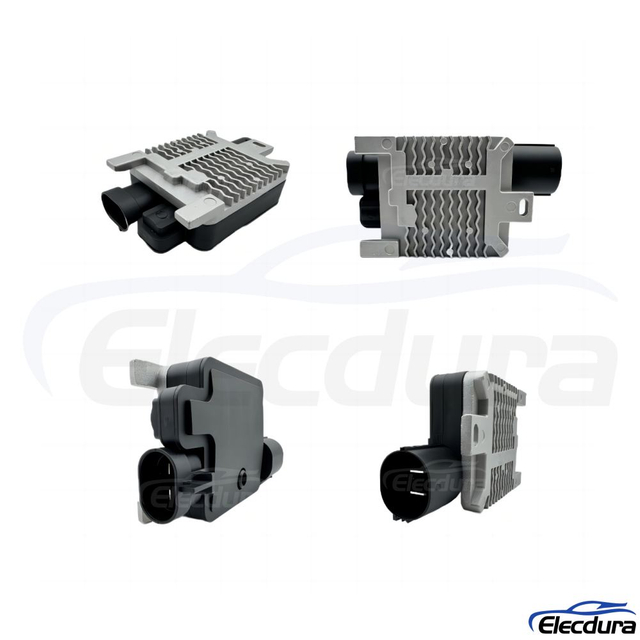
Modern vehicles often use a fan control module that receives ECU command and controls fan speed. Module faults can cause no fan, intermittent fan, full-speed fan, or fan run-on after shutdown.
Fan control modules can fail electrically or through heat-damaged connectors, especially in high-current cooling fan circuits.
Before replacing the module, check:
Module power supply and ground
ECU command signal or PWM signal if available
Connector corrosion, heat damage, loose pins, and water entry
Fan motor current draw, because a failing motor can damage the module
Coolant temperature sensor and A/C pressure signal data
For replacement sourcing, see Elecdura's fan control module category.
The fan may be healthy but never commanded on. The ECU usually turns the fan on based on coolant temperature, A/C pressure, vehicle speed, and sometimes battery or engine load. If scan data shows a cold coolant reading while the engine is hot, the fan may not receive the correct command.
For wholesalers and distributors, cooling fan parts create return risk because electrical versions can look similar. Before ordering, confirm:
OE number and application model
Single fan, dual fan, shroud assembly, or motor-only design
Brushless or brushed motor
Voltage and wattage
Connector shape and pin count
Fan diameter and blade count
With or without resistor or control module
Left/right side for dual fan assemblies
Photos of the old fan, connector, label, and shroud
Elecdura supports sourcing across wholesale cooling fan, fan control module, radiator fan motor, and related cooling system parts.
A cooling fan that does not work is not automatically a bad fan motor. Follow the path: fuse, relay, power and ground, motor under load, resistor path, fan control module, sensor command, and wiring. The point where power or command disappears usually tells you which part has failed.
If you are sourcing cooling fan assemblies, fan motors, resistors, or control modules for multiple applications, send Elecdura the OE numbers, application list, connector photos, voltage, wattage, and target quantity. We can help check compatibility before bulk ordering.