English
Views: 0 Author: Site Editor Publish Time: 2026-07-29 Origin: Site
AC compressor black death means the air-conditioning system is contaminated by dark sludge, degraded oil, metal wear particles, acid, or rubber debris after compressor or hose deterioration. It is not just a failed compressor. It is a system problem. If the contaminated oil and debris remain in the condenser, lines, receiver drier, accumulator, expansion valve, or orifice tube, the new compressor can fail quickly even if the replacement part is good.
The correct repair depends on contamination severity. At minimum, a black-death repair usually requires a new compressor, new receiver drier or accumulator, new expansion valve or orifice tube, new O-rings, correct oil, evacuation, recharge, and system cleaning where flushing is allowed. In severe cases, the condenser must be replaced, especially if it is a parallel-flow or micro-channel design that can trap debris. Some cases also require hose or evaporator replacement if sludge cannot be removed reliably.
Black death is a system contamination problem, so the replacement decision must include the compressor and the parts that protect it.
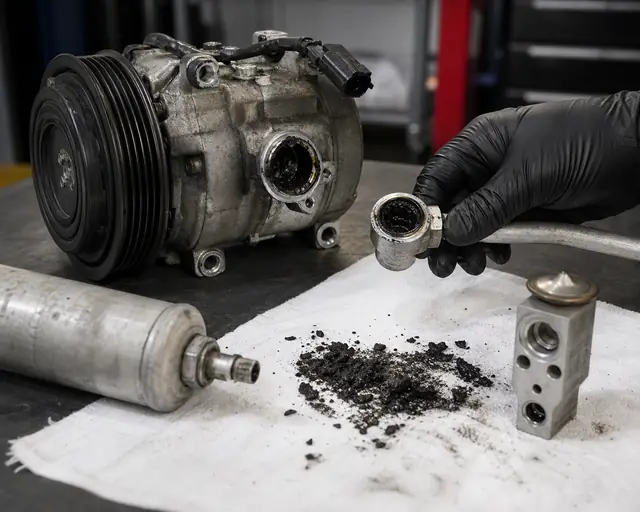
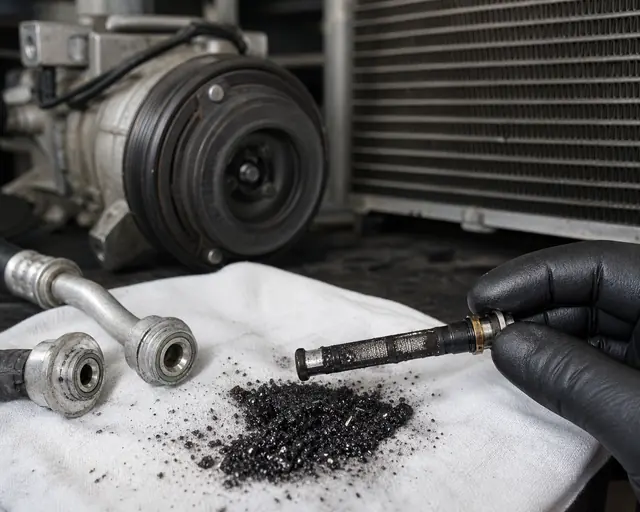
Black death is often discovered when a compressor is removed, an orifice tube is pulled, oil is drained, or a line is opened. The oil may look black, gray, gritty, burnt, or thick. The orifice tube screen may be coated with black sludge or shiny metal particles. The receiver drier or accumulator may be clogged. The compressor may have seized, made grinding noise, or sent debris through the high side of the system. Sometimes the system still cools weakly before failure, but pressure readings are abnormal and compressor noise is already present.
Dark oil, metal debris, and residue at the compressor ports are stronger evidence than a warm vent complaint alone.
Debris on a screen or metering device shows that contamination has moved beyond the compressor.
Do not rely only on color. Some used compressor oil can darken with age without catastrophic contamination, while small metallic particles can create serious risk even if oil is not fully black. The technician should inspect oil condition, debris on screens, compressor port contamination, hose interior condition, condenser restriction, and whether the old compressor failed mechanically. A clean leak repair and a seized compressor are different situations.
For distributors, photos matter. Ask customers for photos of drained oil, compressor ports, orifice tube or expansion device, and any debris found during disassembly. A warranty claim that says "compressor failed again" is incomplete without contamination evidence. A new compressor installed into a dirty system may be damaged by the vehicle condition, not by a manufacturing defect.
Black death is usually the result of heat, lubrication failure, moisture, chemical breakdown, or mechanical wear. A compressor needs clean refrigerant and correct oil to lubricate moving parts. If the system has low refrigerant, wrong oil, insufficient oil, excessive oil, air, moisture, or restricted flow, the compressor can overheat and wear internally. As metal surfaces wear, particles circulate with refrigerant oil. Moisture can react with refrigerant and oil to form acids. Rubber hoses can deteriorate internally and shed material. The result is dark contamination that circulates through the loop.
Once contamination starts, it can accelerate. Debris can clog the expansion valve or orifice tube. Restriction can starve the evaporator and alter pressure. Poor oil return can damage the compressor further. A restricted condenser can raise high-side pressure and increase compressor workload. A drier saturated with moisture can no longer protect the system. The compressor then becomes both the victim and the source of contamination.
This is why simply bolting in a new AC compressor is often not enough. The new unit enters a hostile system. If the same dirty oil, debris, moisture, or restriction remains, the new compressor inherits the old failure conditions.
Symptom or finding | What it may mean | Repair implication |
|---|---|---|
Black or gray compressor oil | Oil breakdown, sludge, wear particles, acid contamination | Do not replace compressor alone; inspect and clean system |
Metal particles in ports or orifice screen | Internal compressor wear or seizure | Replace protective parts; evaluate condenser replacement |
Compressor locked or clutch slips | Severe mechanical failure or overload | High contamination risk; kit repair is safer |
High side and low side pressure abnormal | Restriction, weak compression, or blocked expansion device | Check condenser, drier, orifice tube, and expansion valve |
New compressor fails shortly after installation | Old contamination remained or oil/charge procedure was wrong | Review repair scope before approving warranty |
These symptoms do not all need to appear together. One strong finding, such as metallic debris in the orifice tube after compressor seizure, is enough to change the repair plan. The repair should be designed around contamination control, not only compressor replacement.
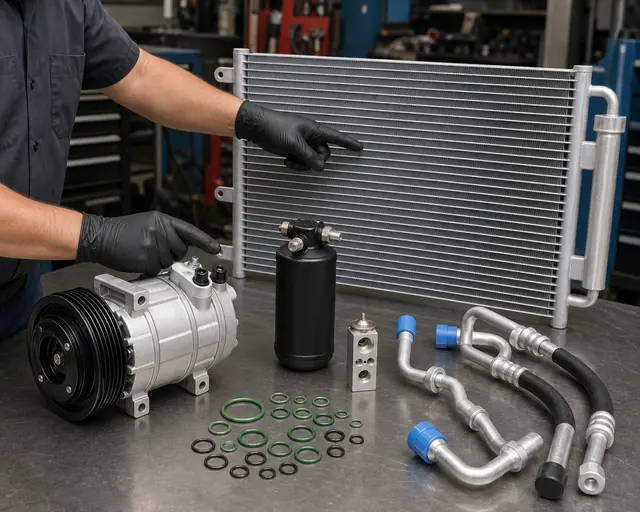
The compressor must be replaced if it seized, shed debris, has internal damage, or cannot build pressure correctly. The receiver drier or accumulator should normally be replaced when the system is opened and especially after contamination because it filters particles and absorbs moisture. The expansion valve or orifice tube should be replaced or inspected because debris often collects at the restriction point. O-rings and seals should be replaced at opened joints.
A contamination repair often needs the compressor, condenser, drier or accumulator, expansion device, seals, and documented flushing decision.
The condenser decision is more complicated. Older tube-and-fin condensers may sometimes be flushed successfully, depending on design and contamination. Modern parallel-flow and micro-channel condensers can trap debris in small passages. If black death contamination is severe, replacing the condenser is often safer than attempting to flush it. This connects directly to AC condenser sourcing. A compressor supplier that can also support condenser matching helps repair networks build a more complete solution.
Hoses and evaporator are case-specific. Some hoses deteriorate internally and continue shedding material. Some evaporators can be flushed; others are difficult to clean thoroughly. If sludge remains after flushing or if the system has repeated compressor failures, deeper replacement may be required. The correct repair is not always the same for every vehicle.
Part | Replace in mild case? | Replace in severe black death? | Reason |
|---|---|---|---|
Compressor | Yes if failed | Yes | Source of mechanical failure and main damaged component |
Receiver drier / accumulator | Usually yes | Yes | Moisture and debris control |
Expansion valve / orifice tube | Inspect or replace | Yes | Restriction point where debris collects |
Condenser | Inspect and flush only if design allows | Often yes | Micro-channels can retain metal and sludge |
Lines and hoses | Flush if allowed | Replace if shedding or impossible to clean | Internal rubber debris can restart contamination |
O-rings and seals | Yes at opened joints | Yes | Leak prevention after disassembly |
Flushing removes old oil, debris, and contamination from parts that can be flushed safely. It is a critical step after many compressor failures, but it does not make every contaminated part reusable. The compressor itself should not be flushed and reused after internal failure. The receiver drier or accumulator should be replaced, not flushed. Expansion devices are usually replaced or cleaned only according to design. Many modern condensers are poor flushing candidates because small passages trap debris.
A proper flush uses approved A/C flush solvent and dry compressed air or nitrogen according to service practice. The goal is to move contamination out, then remove solvent and moisture before assembly. Lines should be flushed in the correct direction and dried thoroughly. The system must be evacuated long enough to remove moisture before charging. Shortcuts create repeat failures.
For B2B customers, flushing requirements should be part of compressor warranty communication. If the claim history shows repeat compressor failures after severe contamination, the distributor may need to offer kits that include drier, expansion device, O-rings, and condenser, or at least specify those parts as required during installation. See Elecdura's AC compressor kit vs bare compressor guide for a broader replacement-scope decision.
Black death is not only solid debris. Oil chemistry matters. Moisture can enter when the system is open, when seals leak, when service is performed poorly, or when the drier is saturated. Moisture reacts with refrigerant and oil, forming acids and sludge that attack metal surfaces and reduce lubrication. Wrong oil type or wrong oil amount can make the compressor run hotter or starve internal parts.
Before installing the replacement compressor, confirm the oil type and amount. Do not assume the compressor contains the full system charge. Some compressors are shipped with oil, some with assembly oil, and some dry. Drain and measure old compressor oil only if the service procedure supports that method, and adjust based on replaced components. Add oil to the correct locations according to repair practice. Over-oiling can hurt cooling performance; under-oiling can destroy the compressor.
For electric or hybrid compressors, oil choice is even more sensitive because insulation properties can matter. Do not treat high-voltage electric compressors like conventional belt-driven units. Confirm the compressor label, refrigerant, oil type, voltage, and service procedure.
After replacing parts and recharging the system, pressure readings and vent temperature should be checked. Abnormal high-side pressure can mean condenser airflow problems, condenser restriction, overcharge, air in the system, or a fan problem. Low-side pressure that does not respond normally can point to expansion device or compressor performance issues. Equalized or nearly equal pressures while running can indicate compressor failure or severe restriction depending on condition.
The repair is not complete when the compressor clutch engages or the new compressor turns. It is complete when the system holds vacuum, charges correctly, runs within expected pressure ranges, cools properly, and shows no signs of debris-related restriction. For distributors, requesting pressure readings can help evaluate warranty claims and identify installation problems.
Not every dirty A/C system should be treated the same way. A useful practical method is to classify contamination into mild, moderate, or severe before choosing the replacement package. This keeps the repair realistic. It also helps wholesalers create different product offers without turning every compressor sale into the most expensive possible kit.
A mild case may involve an old compressor with a shaft seal leak, slightly dark oil, no metal particles, and no pressure evidence of restriction. The system still needs careful service, but the risk is lower. A moderate case may involve noisy compressor operation, dirty oil, suspected internal wear, pressure behavior that suggests restriction, or an orifice tube with visible debris. A severe case includes seizure, metal flakes, black sludge, burned smell, repeated compressor failure, clogged expansion device, or a condenser that cannot be trusted.
Contamination level | Typical evidence | Replacement scope | Buyer risk |
|---|---|---|---|
Mild | Clean leak, no metal, oil only slightly aged | Compressor, seals, drier if system is opened, oil correction | Lower, if installation is professional |
Moderate | Noise, dirty oil, small debris, uncertain maintenance history | Compressor kit, drier, expansion device, flushable lines cleaned | Medium; warranty terms should be documented |
Severe | Seized compressor, black sludge, metal particles, repeated failure | Compressor, drier, expansion device, condenser often replaced, deeper cleaning | High; compressor-only sale is unsafe |
This classification is not a laboratory standard. It is a commercial and repair decision tool. A distributor can use it when training sales teams: do not sell a bare compressor into a severe black-death case unless the customer explicitly accepts the risk and has a separate repair plan. A repair chain can use it to define warranty documentation. A fleet buyer can use it to decide whether a vehicle should receive a quick repair or a full A/C system recovery.
One of the most expensive mistakes in black-death repair is believing that flushing makes every part new again. Some parts should be replaced because their job is to trap moisture or debris. Others are difficult to flush because their internal passages are too small. If those parts are reused after severe contamination, they may release debris later or restrict flow immediately.
The receiver drier and accumulator are not normal tubes. They contain desiccant and filter material. Once contaminated or exposed to moisture, they should be replaced. The expansion valve or orifice tube is also a restriction and metering point; debris there can distort pressure readings and starve the evaporator. The compressor should never be treated as a flushable reusable part after internal failure. A condenser with very fine passages may retain particles even after solvent flow appears clear.
For suppliers, this distinction should appear in installation notes. If a customer installs a new compressor while reusing a saturated drier and debris-filled condenser, the compressor failure may look like a product problem but is actually a system-cleanliness problem. Clear instructions reduce this conflict before it happens.
Consider a distributor who sells a bare compressor to a repair shop. The old compressor had seized, but the shop did not replace the condenser or expansion device. The system cools for two weeks and then the new compressor becomes noisy. When the claim arrives, the failed unit contains gray oil and metal. In this scenario, the important question is whether the original contamination was removed. The new compressor may have been damaged by debris left in the system.
Now consider a clean leak case. The old compressor leaked at the body seal, but oil was clean, the system was recovered properly, the drier was replaced, the correct oil amount was added, and pressure readings were normal after repair. If the new compressor then leaks from the same area quickly, the claim deserves a different evaluation. The installation evidence supports a product-related review.
A third case involves wrong compressor matching. The replacement compressor fits the bracket but has a different control valve or pulley specification. The system shows poor cooling and abnormal pressures. The buyer may describe it as black death or compressor failure, but the root issue may be application mismatch. This is why OE number, compressor label, connector, pulley, and control details matter in every claim, not only contamination cases.
Old compressor failure mode: leak, noise, seizure, clutch failure, internal debris, or unknown.
Oil condition: clean, dark, gray, gritty, burnt, acidic smell, or metallic particles.
Expansion device condition: screen debris, restriction, or replacement required.
Drier or accumulator replacement included.
Condenser type and replacement decision.
Flush procedure and parts that can or cannot be flushed.
Correct oil type and oil amount.
Correct refrigerant type and charge amount.
Vacuum and leak test record.
Pressure readings after repair.
OE number, connector, pulley, control valve, and application matching for the new compressor.
This checklist is useful for importers, wholesalers, and repair supply companies because black-death repairs are high-risk. They often involve more labor and more expensive parts than a clean compressor leak. A buyer who sells only the compressor without discussing contamination may face unnecessary returns. A buyer who always sells every component may become too expensive for clean repairs. The right answer depends on evidence.
Elecdura supports aftermarket compressor sourcing for passenger vehicles, trucks, agricultural machinery, construction equipment, and related A/C systems. For severe compressor failure cases, buyers may need more than a compressor. They may need condenser matching, kit planning, oil notes, packaging support, and claim documentation. When sending an inquiry, provide the OE number, old compressor photos, connector photos, application details, target quantity, and any failure information available.
For a standard clean replacement, a bare compressor may be enough. For black death, a kit or wider repair package is often safer. That may include compressor, drier or accumulator, expansion valve or orifice tube, O-rings, and possibly condenser. If you are comparing AC compressor replacement cost, include the cost of a second failure. A cheaper first repair can become more expensive if contamination destroys the new compressor.
Do not treat AC compressor black death as a single-part failure. It is contamination in the refrigerant loop. The new compressor must be protected from the same debris, sludge, moisture, and restrictions that damaged the old one. Replace the compressor, replace moisture and debris-control components, clean only the parts that can be cleaned, and replace parts that cannot be flushed reliably.
The repair should be based on contamination evidence. Mild cases may need a compressor, drier, seals, oil correction, and careful inspection. Severe cases may need condenser, expansion device, hoses, and deeper cleaning. For distributors and importers, the safest supply strategy is to define the repair scope clearly before quoting. That protects the installer, the buyer, the supplier, and the vehicle's A/C system.