English
Views: 0 Author: Site Editor Publish Time: 2026-08-10 Origin: Site
BMW 11538596107 is commonly searched as a thermostat-related replacement reference for BMW diesel cooling-system repairs, especially where buyers are checking B57-family applications and aftermarket availability. Before ordering, the important questions are not only "does this number cross over?" but also whether the thermostat assembly matches the engine code, housing shape, hose connection, sensor or electrical connector where fitted, sealing package, opening-temperature specification, and surrounding cooling-system layout. A wrong thermostat can create slow warm-up, overheating, fault codes, coolant leaks, or repeat labor.
This article explains how buyers and repair networks should evaluate a BMW 11538596107 thermostat replacement: likely symptoms, fitment checks, old-part photo requirements, diagnostic steps, and wholesale procurement controls. Elecdura supports thermostat sourcing alongside automotive thermostats, radiators, cooling fans, and fan control modules for buyers building a broader BMW and European cooling parts program.
Start with the OE reference, but do not stop there. BMW cooling systems can vary by engine family, model year, emission specification, auxiliary cooler layout, and market version. A thermostat assembly may look similar from one angle while using a different hose outlet, mounting flange, seal, or sensor connector. If the vehicle has a B57 diesel engine, confirm the exact engine code and vehicle model before approving any aftermarket substitution.
Fitment Field | Why It Matters | Evidence to Request |
|---|---|---|
OE number | Defines the main replacement reference | Old part label or catalog cross-reference |
Engine code | BMW diesel variants can use different cooling layouts | VIN, engine code, model and year |
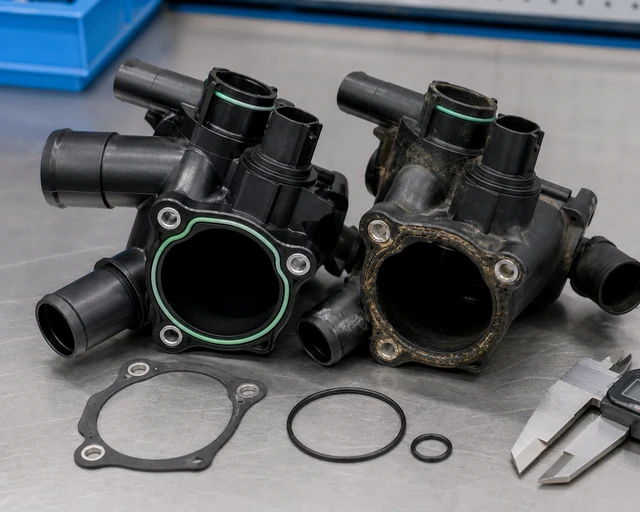
Housing shape | Mounting angle and hose routing must match | Top and side photos |
Seal and O-ring kit | Missing seals cause coolant leaks | Kit-content photo |
Connector or sensor provision | Some assemblies include electrical control or sensor interfaces | Connector close-up and pin count |
A thermostat that sticks open can cause slow warm-up, low operating temperature, poor heater performance, increased fuel consumption, and emissions-related complaints. On a modern diesel, operating temperature affects combustion efficiency and aftertreatment strategy, so a thermostat that does not close correctly can create more than a comfort issue. A scan tool may show coolant temperature staying below expected range during normal driving.
A thermostat that sticks closed or restricts flow can cause overheating, pressure rise, coolant overflow, or temperature spikes under load. A leaking thermostat housing can cause coolant smell, visible residue, low coolant warnings, and repeated top-ups. A fault in an electrically controlled thermostat or related sensor circuit may create codes even when the mechanical valve is not fully stuck.
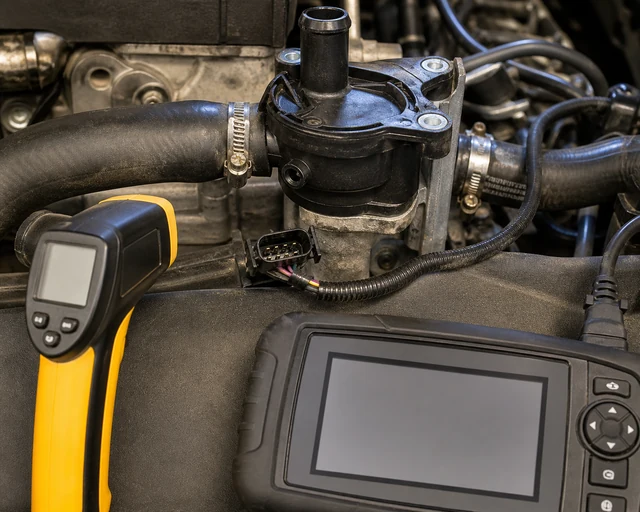
Check actual coolant temperature with scan data or an accurate temperature tool. A dashboard gauge may be damped and may not show the full behavior. If the engine warms too slowly, confirm ambient temperature, driving condition, heater use, and whether the radiator fan is running when it should not. If the engine overheats, check coolant level, air bleeding, radiator condition, water pump operation, fan control, and cap pressure before blaming the thermostat alone.
Look for leaks around the housing and hose connections. Dried coolant residue can show where seepage occurs. If coolant is low, the thermostat may behave incorrectly because the system contains air. Bleeding procedure matters on BMW cooling systems, and an improperly bled system can create temperature complaints after a new part is installed. A replacement thermostat should not be used to cover an unresolved leak or air-pocket problem.
The B57 diesel platform uses a cooling system designed for emissions control, engine efficiency, cabin heat, and durability under load. Depending on model and specification, the cooling system may interact with EGR cooling, charge-air cooling, auxiliary pumps, and electronically managed fan behavior. This is why a thermostat complaint should be diagnosed as part of the thermal-management system rather than as an isolated mechanical valve.
For repair networks, this context affects parts ordering. If a vehicle has a thermostat-related fault but also has an EGR cooler, auxiliary pump, radiator fan, or coolant-temperature sensor issue, replacing only the thermostat may not solve the complaint. For distributors, selling related cooling parts with clear fitment data helps workshops complete the diagnosis instead of creating repeat visits.
Request photos from the top, side, hose outlet, mounting flange, seal area, and connector area. If the old thermostat assembly has a visible part number, photograph it before cleaning. If the part number is not visible, use the vehicle VIN and engine code, then compare physical photos with the proposed replacement. A photo of only the carton label is not enough because suppliers may use different cross-reference systems.
For wholesale buyers, build an approval file for every BMW thermostat number stocked. Include photos of the approved sample, packaging, seal kit, and connector. If a later shipment changes housing texture, outlet angle, seal color, or connector shape, compare it before releasing stock. This protects the buyer from silent product changes that create installation complaints.
Thermostat opening temperature must match the vehicle design. A thermostat that opens too early can keep the engine too cool. A thermostat that opens too late can create overheating risk. Some modern assemblies may be mapped or electronically assisted, meaning the control module can influence opening behavior under certain conditions. A purely visual match does not guarantee correct thermal behavior.
Buyers should ask suppliers for the temperature specification and whether the replacement is mechanical, electronically assisted, or includes a sensor or heater element. The connector and pin count should match the original. If the old part has an electrical connector and the replacement does not, it is not a direct replacement even if the housing looks similar.
Thermostat replacement can fail if sealing surfaces are not cleaned, O-rings are reused, bolts are over-tightened, hoses are not seated, or the cooling system is not bled. BMW cooling systems can be sensitive to trapped air. After installation, the technician should follow the correct bleed procedure, verify coolant level after cool-down, and confirm operating temperature during a road test.
For distributors, warranty claims should include installation photos, coolant type, bleed confirmation, scan-tool temperature data, and leak evidence. If the complaint is overheating after installation, ask whether the radiator fan, water pump, radiator, cap, and air bleeding were checked. A thermostat may be defective, but a repeat overheating complaint often has more than one possible cause.
A good aftermarket thermostat supplier should provide OE cross-reference, engine-code coverage, photos, temperature specification, seal kit contents, and packaging quality. The part should arrive with protected sealing surfaces and clean ports. If the assembly includes a connector, terminal alignment and lock-tab fit should be checked on samples. If the housing is plastic, inspect molding quality, flange flatness, and hose outlet strength.
For importers, sample testing is especially important. Compare the sample against an OE part or known-good replacement. Check fit on the mating surface, hose angles, connector reach, and seal compression. A thermostat is not expensive compared with labor and coolant, but a poor part can create a high-friction warranty case because the repair must often be repeated.
Confirm OE number and accepted cross-references.
Confirm BMW model, year, engine code, and market specification.
Compare housing shape, hose outlet direction, mounting flange, and seal groove.
Check whether O-rings, gasket, bolts, or clips are included.
Confirm opening-temperature specification and electrical connector details where applicable.
Inspect packaging for protection of seals and plastic outlets.
Record scan-tool temperature behavior before approving warranty claims.
Check related radiator, fan, cap, water pump, and bleeding procedure when symptoms persist.
The first mistake is ordering by partial number or vehicle model alone. The second is ignoring the physical housing and connector. The third is assuming a thermostat fault when the engine has low coolant, trapped air, fan failure, or water-pump issues. The fourth is accepting a replacement without seal kit confirmation. The fifth is failing to record temperature data before and after repair.
These mistakes are avoidable. A parts seller can ask for the old part photo and engine code before quoting. A workshop can verify scan data and cooling-system condition before removal. A distributor can keep approved sample photos and supplier test data. Together, these steps reduce returns and make aftermarket thermostat sourcing more predictable.
Complaint | Thermostat Direction | Other Checks |
|---|---|---|
Engine takes too long to warm up | Thermostat may be stuck open or opening too early | Ambient temperature, scan data, fan command, coolant level |
Overheating under load | Thermostat may restrict flow or not open | Radiator restriction, water pump, fan, trapped air |
Coolant leaking near housing | Housing, seal, O-ring, or hose connection may leak | Pressure test and inspect mating surface |
Temperature fault code | Thermal behavior may be outside expected range | Sensor data, connector, wiring, control strategy |
Repeat failure after replacement | Wrong part, poor bleed, missing seal, or installation issue | Compare old/new part and review procedure |
This table helps buyers and workshops avoid a single-track diagnosis. Thermostat symptoms overlap with fan, radiator, pump, sensor, and coolant-level problems. The best repair path begins with evidence: temperature data, leak location, and physical part comparison. If a customer orders BMW 11538596107 only because the vehicle is slow to warm up, the seller should still ask for engine code and old-part photos before shipping.
A quotation for BMW 11538596107 should include the supplier part number, OE cross-reference, compatible engine codes, temperature specification, housing material, included seals, connector details, minimum order quantity, lead time, packaging method, and warranty terms. If the supplier cannot state whether the O-ring or gasket is included, the buyer should treat the offer as incomplete.
For importers and distributors, quote comparison must be done at assembly level. One supplier may quote only the housing and thermostat. Another may include the seal kit. Another may include a sensor or electrical element. A lower headline price may become more expensive if installation hardware is missing or if the part creates returns. Use a standard quote sheet so every supplier is compared on the same basis.
Before approving a bulk shipment, inspect a sample against the old part or OE reference. Check flange flatness, seal groove quality, outlet angle, connector lock, terminal alignment, plastic finish, casting or molding marks, and included seals. If the thermostat is electronically assisted, confirm connector style and ask whether the supplier has performed functional testing. If the housing includes multiple hose outlets, measure each one.
Packaging should protect the thermostat from deformation and contamination. Plastic hose necks can crack if cartons are crushed. Seals can deform if pressed against hard edges. For export shipments, request inner supports or bagging that keeps the sealing surfaces clean. A thermostat may be small, but a damaged outlet or missing O-ring can stop an installation immediately.
BMW part references may be superseded or cross-listed by aftermarket catalogs. A supersession can be valid, but it should be verified by application and physical features. Do not assume that every cross-reference listed online is safe for every market. The same model name may appear in different regions with different cooling packages or emission configurations.
When a supplier offers an alternate number, ask what changed: housing, connector, temperature rating, seal kit, or packaging. If nothing changed and the number is only a catalog replacement, record that. If the physical part changed, request photos and fitment notes. Supersession control is a quiet but important part of wholesale accuracy because one wrong cross-reference can spread through many orders.
Example one: a BMW diesel warms slowly in cold weather and scan data shows coolant temperature staying low during steady driving. The radiator fan is not running unnecessarily, coolant level is correct, and no leaks are found. A thermostat stuck open becomes a strong suspect. Replacement should still match the OE number, housing, seal kit, and engine code.
Example two: a vehicle overheats after a thermostat replacement. The new part is blamed, but the cooling system was not bled correctly and air remains trapped. After proper bleeding, temperature stabilizes. This is not a product defect. It is an installation-process issue that should be recorded separately in warranty data.
Example three: a thermostat housing leaks after installation. The O-ring supplied in the box is incorrect or was twisted during assembly. The part may be physically correct, but the seal package failed. For bulk buyers, this type of claim points toward kit-content control and installation notes, not only housing quality.
BMW thermostat demand is attractive because European cooling-system repairs often carry higher order value and repeat demand. But the category also creates high sensitivity to wrong fitment. A workshop may spend significant time reaching the thermostat area, draining coolant, and bleeding the system. If the part is wrong, the distributor absorbs phone calls, return freight, and lost trust.
A disciplined distributor can turn this risk into an advantage. Staff should ask for OE number, engine code, and photos before confirming stock. The warehouse should keep similar thermostat assemblies separated. The purchasing team should choose suppliers that can provide stable part quality and clear data. This makes the line easier to sell and reduces returns.
Related cooling parts should be inspected, not automatically replaced. Check upper and lower hoses, radiator condition, expansion tank, cap, cooling fan behavior, water pump operation, and coolant-temperature sensor data. If the vehicle had overheating, check for radiator restriction and fan control issues. If it had slow warm-up, confirm that the fan is not being commanded on unexpectedly and that temperature data is plausible.
For parts programs, this means BMW thermostat stock should be connected with other thermal-management parts. A buyer may need thermostat, radiator, fan module, hose, or coolant flange options depending on the diagnosis. Offering those parts with correct application data helps workshops complete the repair more efficiently.
For a BMW 11538596107 thermostat quotation, send the OE number, engine code, vehicle model, year, old-part photos, connector photos, hose outlet views, seal requirements, and target market. If the buyer has a known sample, send photos with measurements. If the application is for multiple BMW models, list them separately rather than grouping them under one general description.
This information lets the supplier confirm the replacement before price discussion becomes the only focus. In aftermarket cooling parts, a quote based on evidence is more valuable than a fast quote based on a vague title. The goal is to supply a thermostat that fits, seals, opens correctly, and supports a stable repair.
BMW 11538596107 thermostat sourcing should be handled with OE number confirmation, engine-code verification, physical photo comparison, seal-kit checks, and temperature-specification review. Symptoms such as slow warm-up, overheating, coolant leaks, low heater output, and temperature codes can point toward thermostat trouble, but related cooling-system faults must be ruled out before replacement.
When requesting a quotation, send the OE number, VIN or engine code, vehicle model and year, old-part photos, connector details, seal requirements, and target order quantity. Elecdura can help buyers verify BMW thermostat replacements and related cooling parts so the selected part fits the application and solves the real thermal-management complaint.