English
Views: 0 Author: Site Editor Publish Time: 2026-08-03 Origin: Site
Bar-and-plate and tube-and-fin charge air coolers can both reduce intake-air temperature, protect engine performance, and support turbocharged truck operation. The difficult question is not which design is always better. The practical question is which design fits the truck, duty cycle, installation space, repair environment, and procurement target. A highway tractor, vocational dump truck, performance diesel pickup, and export fleet may all value different trade-offs.
This article compares the two charge air cooler designs from a fleet and distributor perspective. It covers construction, heat transfer, pressure drop, durability, weight, packaging, failure signs, and buying checks. For any charge air cooler order, buyers should confirm dimensions, tank style, core design, boost-pipe layout, and application evidence before choosing a replacement or upgrade.
Charge air cooler selection should balance thermal performance, pressure drop, vibration durability, weight, and installation fit.
A charge air cooler cools compressed air after it leaves the turbocharger and before it enters the engine. Cooler intake air is denser, which helps combustion efficiency and can reduce exhaust temperature. In truck service, the cooler must handle boost pressure, heat cycles, road vibration, debris, pressure pulsation, and mounting stress. A leak or restriction can reduce power, increase fuel consumption, trigger fault codes, raise exhaust temperature, or make the engine feel weak under load.
Because the charge air cooler is part of the engine air path, fit and internal condition matter. A replacement that physically mounts in the truck but creates excessive pressure drop can reduce performance. A cooler with poor durability may crack at the tank, tube joint, or mounting area. A cooler that ships with bent fins or twisted brackets can become a warranty issue before the truck leaves the shop.
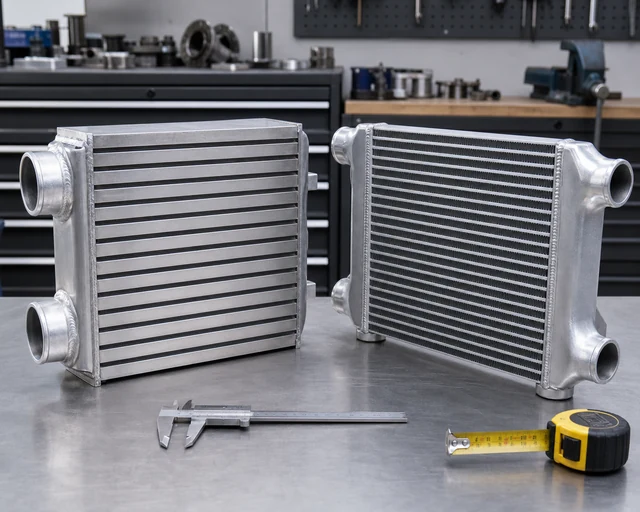
Bar-and-plate charge air coolers use stacked plates, bars, and fins to create a robust core. This design is often associated with strength, high heat capacity, and resistance to pressure. The dense construction can handle demanding boost and thermal conditions, which is why many performance and heavy-duty discussions favor bar-and-plate designs. The structure can also tolerate road vibration and pressure cycling well when manufactured and mounted correctly.
The trade-off is weight and airflow resistance. A bar-and-plate cooler can be heavier than a tube-and-fin cooler of similar size. Depending on internal fin design and flow path, it may also create more pressure drop. That does not make it bad; it means the buyer should not assume a thicker or heavier core automatically improves the fleet result. A truck that needs fast airflow through the front stack may not benefit from a dense cooler if radiator and condenser airflow suffer.
Tube-and-fin charge air coolers use tubes and external fins to transfer heat from compressed air to outside airflow. This design is generally lighter and can allow good airflow across the front cooling stack. It is common in OE-style applications because vehicle manufacturers balance cooling, weight, cost, pressure drop, packaging, and airflow for the whole truck. A tube-and-fin cooler can be a strong choice when the fleet wants OE-like fit, moderate weight, and predictable installation.
The trade-off is durability under high stress. Thin tubes and fin structures may be more vulnerable to impact, vibration, and fatigue if the truck works in harsh conditions or if mounting is poor. However, a well-designed OE replacement tube-and-fin cooler can still perform very well. The buyer should compare application evidence rather than rely on internet shortcuts that label one design as universally superior.
Factor | Bar-and-Plate | Tube-and-Fin |
|---|---|---|
Typical strength | Often stronger under pressure and heat cycling | Good when OE design and mounting are correct |
Weight | Usually heavier | Usually lighter |
Pressure drop | Can be higher depending on internal design | Often lower in OE-style applications |
Cooling stack airflow | Dense core may affect airflow | Often easier on front-stack airflow |
Best fit | High-stress, performance, demanding duty cycles | OE replacement, weight-sensitive fleets, broad stock |
Charge air cooler buyers often focus on outlet temperature, but pressure drop is just as important. A cooler that removes more heat but creates too much restriction can force the turbocharger to work harder to maintain boost. That can affect response, efficiency, and thermal stress. A cooler with very low pressure drop but weak heat rejection can leave intake air too hot under load. The right selection balances both.
For fleet replacement, it is useful to compare the old cooler with the replacement by core dimensions, tank shape, tube count, inlet and outlet diameter, mounting position, and duty cycle. For a performance or severe-duty application, ask for pressure-test information and any available flow or temperature data. For standard fleet repair, OE-style dimensions and proven application fit may be more important than chasing the largest possible core.
Durability is not only the core design. Mounting stress, road vibration, bracket alignment, engine movement, boost pressure, thermal cycling, and installation quality all matter. A strong bar-and-plate cooler can fail if the brackets force it into a twisted position. A tube-and-fin cooler can last well when the mounting system supports it properly and the cooling stack is clean.
Truck fleets should inspect the reason for failure before replacing the cooler. Look for rubbed areas, cracked tanks, oily residue around seams, loose clamps, damaged boots, missing mounting isolators, and collision damage. If the old cooler failed from external impact, the replacement decision may be straightforward. If it cracked at the same place twice, the problem may be mounting stress, chassis vibration, or line/boot alignment.
Repeated charge air cooler failure should trigger checks for mounting stress, boot alignment, vibration, and cooling stack damage.
Weight matters for installation, shipping, and long-term support. Heavier coolers may require stronger packaging and careful handling. If the mounting points were designed for a lighter OE cooler, a heavier replacement should not be installed without checking bracket strength and vibration isolation. Extra weight may not be a problem in a specific truck, but it should be considered rather than ignored.
For distributors, weight also affects freight cost and damage risk. A strong core can still arrive with damaged tanks or brackets if packaging is weak. A replacement charge air cooler should be protected at corners, ports, mounting tabs, and core faces. The larger the cooler, the more important carton strength and internal blocking become.
A leaking charge air cooler may cause hissing noise, oily residue, reduced boost, black smoke, high exhaust temperature, poor fuel economy, and engine derate. A restricted cooler may show poor power at high load, slow boost recovery, or temperature issues. If the fleet operates in dusty construction sites, quarry roads, or long grades, durability and cleaning access become more important. If the trucks spend most time on highways with predictable loads, OE-style efficiency and low pressure drop may matter more.
Design choice should follow the failure pattern. If the fleet repeatedly cracks lightweight coolers under vibration, a stronger design may be justified. If the fleet has overheating in the full front stack, adding a dense cooler without evaluating radiator and condenser airflow can create another problem. If the trucks have mixed applications, the best stock strategy may include OE-style replacements for normal units and upgraded options for severe-duty trucks.
Before selecting bar-and-plate or tube-and-fin, collect the truck model, engine, year, OE number, core measurements, inlet and outlet diameter, tank shape, bracket photos, and failure symptoms. Ask whether the truck is standard, tuned, overloaded, or used in severe-duty work. For commercial fleets, request pressure-test information, packaging photos, and sample approval if ordering in bulk. For distributors, maintain clear product photos so sales teams can distinguish similar coolers quickly.
Do not quote a cooler only from length and width. Include thickness, port position, tank depth, bracket pitch, boot diameter, sensor ports if any, and cooling stack clearance. If the replacement will be shipped internationally, ask for pallet packaging or corner protection. If the customer reports repeated cooler failure, ask for photos of mounting points and boots before sending the next part.
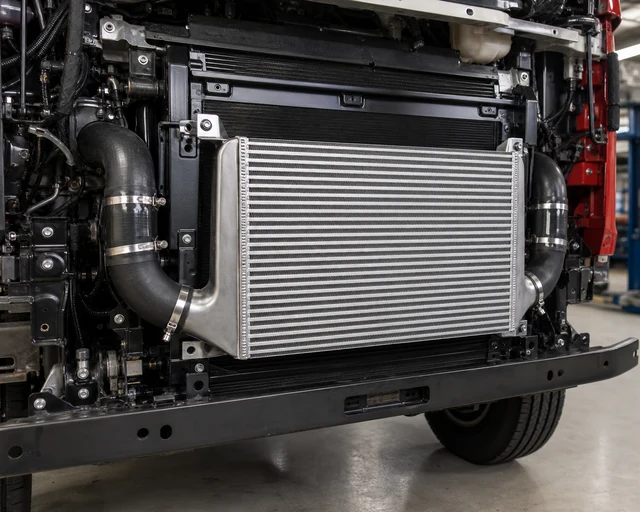
The charge air cooler is usually installed near the radiator, AC condenser, fan shroud, and sometimes oil cooler. A change in one component can affect airflow across another. A dense charge air cooler may protect boost temperature but reduce airflow to the radiator or condenser if the stack is already dirty or restricted. A damaged AC condenser can also block airflow and make engine cooling issues appear worse.
For this reason, front-stack inspection should be part of replacement. Check bent fins, debris, missing seals, fan operation, shroud alignment, and radiator condition. Related truck radiators and AC condensers should also be inspected when airflow through the full cooling package is part of the complaint.
Charge air cooler performance depends on airflow through the whole front cooling stack, not only on core design.
Bar-and-plate designs often make sense for severe-duty trucks, performance applications, higher boost pressure, repeated tube failure, or environments where strength is a priority. They can be useful when the buyer accepts additional weight and confirms that pressure drop and cooling stack airflow remain acceptable. This design can also appeal to customers who associate heavier construction with durability, but the supplier should still explain fitment and airflow trade-offs honestly.
A fleet should not upgrade blindly. If the original issue was a loose boot, clogged exterior fins, damaged mounting bracket, or front-end collision, a stronger cooler may not solve the root cause. Use failure evidence to decide whether bar-and-plate construction is truly needed.
Tube-and-fin designs often make sense for OE-style replacement, weight-sensitive applications, standard fleets, and situations where low restriction and front-stack airflow are important. They are also practical for distributors who need broad coverage and predictable fit. A well-made tube-and-fin replacement can be the right answer when the truck is not running extreme boost or severe vibration conditions.
The main caution is damage control. Thin fins and tubes need careful packaging, inspection, and installation. If the customer works in rough conditions, check whether the mounting system and grille protection are adequate. The cooler should be selected for the truck's real life, not only for the catalog photo.
A fleet may replace several OE-style tube-and-fin charge air coolers with heavier bar-and-plate units after repeated leaks. The new coolers feel stronger and survive pressure testing, but some trucks begin to run warmer on long grades. Inspection shows that the front cooling stack is dirty, the radiator fins are partly blocked, and the denser charge air cooler has reduced airflow through the radiator under high load. The original leak problem was real, but the new design created a different system trade-off.
The lesson is not that bar-and-plate was wrong. The lesson is that charge air cooler selection should be connected to the whole front module. If the fleet wants a stronger core, the repair plan should also include stack cleaning, fan and shroud inspection, mounting checks, and temperature monitoring. A product that performs well in one truck may not be the best answer for every duty cycle unless the surrounding airflow path is healthy.
After installing a charge air cooler, technicians should inspect boots, clamps, brackets, and clearance before road testing. Boots should sit squarely on the inlet and outlet without folding or stretching. Clamps should be tightened to specification and positioned away from bead damage. The cooler should not be forced into twisted brackets. There should be enough clearance from the radiator, condenser, hood structure, and fan shroud.
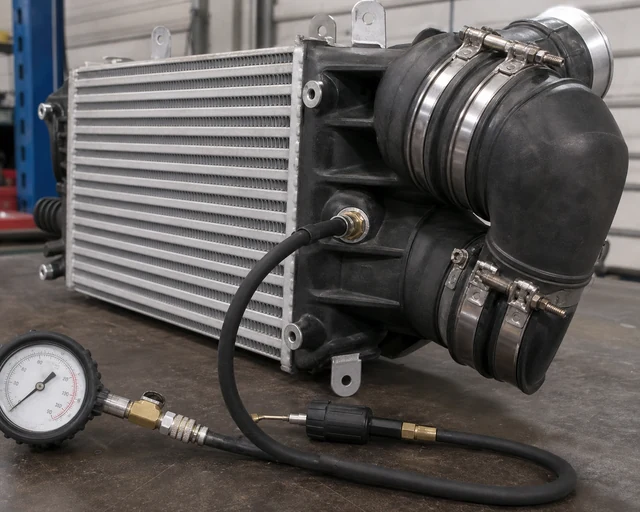
Road testing should confirm boost response, smoke level, fault codes, and intake temperature if data is available. A pressure test can find leaks before the vehicle returns to work. For fleets, recording the reason for the old failure helps future stocking. If most failures are impact-related, protection and packaging may matter most. If most failures are seam cracks, design and mounting stress deserve more attention.
Performance buyers often focus on maximum cooling, boost pressure, and upgrade potential. Fleet buyers usually care about uptime, repeatable fit, fuel economy, warranty stability, and fast installation. A product description that appeals to a performance audience may not answer a fleet's main questions. Fleet buyers need to know whether the cooler fits existing boots, whether it changes pressure drop, whether it affects radiator airflow, and whether it can be stocked consistently across similar trucks.
Distributors should separate these audiences in product notes and sales conversations. If the customer is a fleet, avoid selling only by the word upgraded. Explain the trade-off. If the customer is a tuned or high-load truck, ask about boost pressure, engine modifications, and temperature goals. Both customers may buy charge air coolers, but they need different evidence to feel confident.
Charge air coolers are vulnerable during freight. Inspect the carton before signing where possible. Look for crushed corners, port impact, bent brackets, and distorted tanks. After opening, check core flatness, fin damage, weld areas, mounting tabs, and inlet/outlet roundness. A cooler with a slightly oval port can create boot sealing problems. A bent bracket can force the cooler into a stressed installation.
For wholesale shipments, ask the supplier how the cooler is protected inside the carton. Corner blocks, port caps, inner foam, and pallet rules can reduce damage. Large cooling parts should not float in oversized boxes. Packaging is part of product quality because a well-built cooler that arrives damaged still becomes a failed customer experience.
Charge air cooler marketing often uses broad claims such as improved cooling, upgraded core, or heavy-duty design. Buyers should translate those claims into evidence. Ask for core measurements, pressure-test standard, tank material, weld quality, inlet and outlet diameter, mounting style, and packaging photos. If a supplier claims lower temperature, ask under what airflow, boost pressure, and ambient condition the comparison was made.
For fleet procurement, the strongest supplier is not always the one with the most aggressive performance wording. It is the supplier that can help identify the correct application, explain design trade-offs, ship the cooler safely, and respond with useful evidence if there is a return. That kind of support matters more than a generic upgrade label.
Buyers should also ask whether the supplier can keep dimensions stable across batches. A small change in bracket position, port diameter, or tank depth can create installation problems even if the SKU number remains the same. Batch consistency is especially important when the same cooler is stocked for multiple fleet locations.
Bar-and-plate is not automatically better, and tube-and-fin is not automatically weaker in every useful sense. The correct charge air cooler is the one that matches the truck, handles the duty cycle, controls intake temperature, keeps pressure drop acceptable, fits without stress, and arrives without damage. Fleet buyers should make the decision from failure evidence, application data, and installation checks.
Elecdura can support charge air cooler sourcing when buyers provide OE number, photos, dimensions, port details, mounting style, and operating conditions. For distributors, the best product page and sales process should help customers compare designs without oversimplifying the trade-off. That creates fewer returns and better confidence from repair networks.