English
Views: 0 Author: Site Editor Publish Time: 2026-07-08 Origin: Site
An electric AC compressor is not a belt-driven compressor with a different plug. For hybrid, plug-in hybrid, and electric vehicles, the compressor may be powered by the high-voltage system, controlled by an inverter, filled with vehicle-specific non-conductive oil, and protected by safety logic that can shut the vehicle or A/C system down when insulation, current, or communication conditions are wrong. For importers, distributors, and repair networks, the buying risk is clear: a compressor can look correct in a photo but still fail because the voltage range, connector, oil type, refrigerant specification, mounting design, or OE reference does not match the vehicle.
This guide explains what buyers should confirm before ordering aftermarket electric AC compressors. It focuses on the details that reduce wrong shipments, warranty disputes, compressor lockout, high-voltage isolation faults, and repeat repairs. If you only need category support, Elecdura's electric compressor range is available at /electric-ac-compressor.html. If you are comparing electric compressors with conventional belt-driven units, start by treating the electric compressor as a different product family with different matching and service rules.
Buying checkpoint | Why it matters | What to request before ordering |
|---|---|---|
Voltage and power type | Hybrid and EV compressors may use high-voltage DC supply and internal or external inverter control. | Compressor label, OE number, vehicle platform, powertrain type, and voltage range. |
Connector and pin layout | Similar compressor bodies can use different HV connectors, signal plugs, pin counts, or lock tabs. | Clear photos of every connector, pin view, harness side, and lock design. |
Oil type | Wrong oil can reduce electrical insulation and damage high-voltage compressor systems. | Vehicle maker oil specification, compressor label, and supplier confirmation of pre-filled oil. |
Refrigerant | R134a and R1234yf systems may require different service practice, oil compatibility, and fittings. | Under-hood label, market version, and refrigerant specification. |
Mechanical fit | Mounting ears, port angle, bracket position, and hose routing must match the vehicle. | Old part photos from front, rear, side, ports, bracket, and label. |
Control compatibility | The compressor must communicate and respond correctly to the vehicle's A/C control strategy. | OE number, supersession, vehicle year, market, and exact model variant. |
Electric compressor matching should include voltage, connector, oil, refrigerant, mounting points, and OE number, not only the vehicle model.
A conventional automotive AC compressor is usually driven by the engine through a belt and clutch or variable displacement control. Its speed is tied to engine operation, even when control valves adjust output. An electric AC compressor is powered by an electric motor, so it can run when the engine is off, during stop-start operation, while the vehicle is driving in electric mode, or in a full battery electric vehicle with no belt drive at all. This is why electric compressors are common on HEV, PHEV, and EV platforms.
The difference changes the entire buying process. With a belt-driven unit, buyers usually focus on pulley grooves, clutch diameter, mounting ears, port position, displacement, and OE number. With an electric unit, those mechanical checks still matter, but they are not enough. Buyers also need to confirm high-voltage connection, control connector, inverter design, oil type, insulation requirements, and refrigerant compatibility. A wrong plug or wrong oil can stop the system even if the compressor bolts onto the vehicle.
Delphi's hybrid compressor service guidance explains that many newer hybrids use inverter compressors powered by high-voltage electrical supply, so compressor operation is no longer dependent on engine belt drive. DENSO's eCompressor guidance also emphasizes that oil selection is different from many mechanical compressors and that vehicle maker specifications must be checked. For buyers, these points mean an electric compressor should never be sourced from a body-shape match alone.
One of the first questions is whether the compressor is a low-voltage auxiliary unit or a high-voltage hybrid/EV unit. Some aftermarket and retrofit applications use 12V or 24V electric compressors, especially for auxiliary cooling, custom vehicles, cabins, small systems, or specialty equipment. Many modern hybrid and EV passenger vehicles, however, use high-voltage electric compressors powered from the traction battery system through inverter electronics. Elecdura's electric compressor category notes that many high-voltage vehicle applications are commonly in the 200V to 350V range, though the exact specification depends on the vehicle.
Do not replace voltage research with a simple "electric compressor" label. A 12V compressor, 24V compressor, 48V compressor, 200V-class compressor, and 350V-class compressor may all be electric, but they do not belong to the same sourcing decision. Voltage range affects connectors, insulation, control method, safety requirements, service equipment, and the customer's installation capability. If your buyer is a repair chain working on Toyota, Lexus, Tesla, Nissan, Honda, Hyundai, Kia, BYD, or other hybrid/EV platforms, the exact OE reference and vehicle powertrain are much safer than a generic voltage assumption.
Type | Typical use case | Main sourcing risk | Best confirmation method |
|---|---|---|---|
12V or 24V auxiliary electric compressor | Retrofit, auxiliary cabin cooling, small equipment, custom systems. | Undersized cooling capacity, wrong controller, wrong hose/fitting package. | System design data, power supply, controller, refrigerant, and mounting plan. |
48V compressor | Mild hybrid or specialty vehicle systems. | Confusing it with 12V or high-voltage HEV/EV compressors. | Vehicle platform and compressor label. |
High-voltage HEV/PHEV/EV compressor | Factory hybrid, plug-in hybrid, and battery electric vehicles. | Wrong voltage range, connector, oil, inverter/control logic, or OE application. | OE number, VIN/application, label photos, connector photos, and vehicle maker oil specification. |
Buyers often ask for "a 300V electric compressor" as if voltage alone defines the part. It does not. Voltage range is only one layer. Two compressors may operate in a similar voltage class but use different internal inverter electronics, signal connectors, communication protocols, mounting brackets, port orientation, and oil charge. A compressor may fit one model year and fail on another if the vehicle's A/C controller does not recognize it or if the electrical connector is different.
For procurement, voltage should be recorded together with OE reference, compressor manufacturer, vehicle model, production year, market, refrigerant, and connector details. If the compressor label is readable, keep a photo in the order file. If the label is missing, use the original vehicle data and old part photos. Elecdura also has a practical identification guide for compressors without a part number at /identify-ac-compressor-without-part-number.html, which is useful when a workshop sends only photos or a damaged unit.
High-voltage systems also introduce safety requirements. Service technicians should follow vehicle maker procedures for disabling high voltage, waiting for discharge, checking for voltage absence, and using insulated tools where required. Sanden's electric compressor service concepts warn that high-voltage handling can cause serious injury when done without proper training or when the compressor is connected to current. For distributors, this safety point affects customer support: do not present a high-voltage electric compressor as a simple plug-and-play DIY part.
Connector mismatch is one of the most common reasons an electric compressor cannot be installed. The high-voltage connector may have a different shape, locking tab, keyway, seal, or cable angle. The low-voltage control connector may have a different pin count or pin arrangement. Some compressors also have sensor or communication connections that are easy to miss in a single front-view photo. Because connector housings can be small and partially hidden, a buyer should never approve a replacement from a single catalog image.
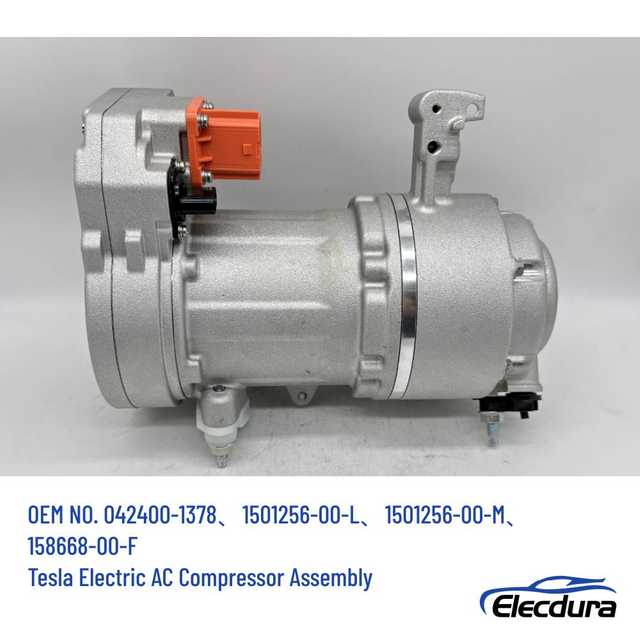
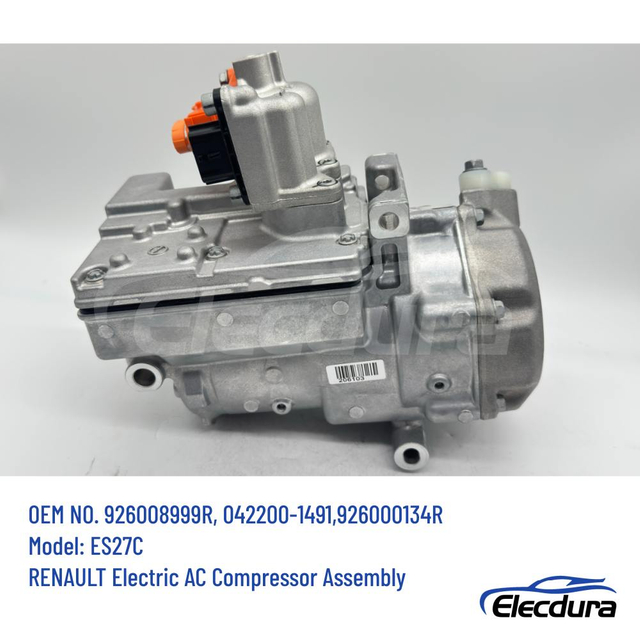
Request connector photos from multiple angles. A good photo set includes the high-voltage socket straight-on, side view of the lock tab, control plug pin view, port side, mounting side, and label. If the old compressor is still in the vehicle, ask the workshop to photograph the harness connector after safe disconnection. For distributors, adding connector-view photos to the product page reduces wrong orders because customers can compare the actual plug before purchase.
Connector matching also helps detect market differences. A vehicle sold in one region may use a different supplier or updated compressor after a production change. The same model name can hide multiple compressor variants. If your customer only sends "Prius compressor" or "EV compressor" without year, engine or powertrain generation, OE number, and connector photo, the order is not ready. Ask for more data before shipping. That extra step is less expensive than a return across borders.
Oil selection is a major difference between many electric compressors and conventional mechanical compressors. High-voltage electric compressors often require non-conductive oil specified by the vehicle manufacturer. DENSO states that ND-Oil 11 is a highly insulating POE oil used in many eCompressor applications, but it also warns that the vehicle manufacturer's specified formulation must be checked. UnderhoodService and NHTSA-linked service material make the same practical point: high-voltage compressors require unique non-conductive oil, and all non-conductive oils are not automatically the same.
The risk is not only lubrication. In many electric compressors, the motor is inside the refrigerant and oil environment. The oil must help maintain electrical insulation. If standard PAG oil contaminates a high-voltage system that requires POE or another specified non-conductive oil, insulation resistance can drop and the vehicle may set isolation faults, shut down the compressor, or damage expensive electrical components. NHTSA-linked service material warns that even a very small percentage of standard PAG contamination can reduce dielectric properties of approved POE oils and damage the system.
This is why repair networks should use dedicated equipment and sealed oil containers for hybrid/EV A/C service. A machine, hose, injector, or oil container previously used for standard PAG service can contaminate the system. Moisture is another concern because some oils are hygroscopic and can absorb moisture after opening. For a parts distributor, the product listing should not simply say "with oil." It should state whether the compressor is pre-filled, what oil type is used, whether the buyer must adjust oil quantity, and that the vehicle maker specification remains the final reference.
Oil question | Why it matters | Buyer action |
|---|---|---|
Is the compressor pre-filled? | Too much or too little oil can reduce performance or damage the compressor. | Ask supplier for oil amount and whether shipping oil must be drained or adjusted. |
What exact oil type is required? | POE, PVE, PAG, and special OEM oils are not interchangeable by name alone. | Follow vehicle maker specification and confirm compressor label or catalog note. |
Was the system contaminated? | Wrong oil, debris, or moisture can damage the replacement compressor. | Check service history, flush/replace required parts, and use dedicated hybrid/EV tools. |
Is refrigerant R134a or R1234yf? | Refrigerant can affect service fittings, oil compatibility, and service equipment. | Read under-hood label and vehicle data before ordering. |
Electric compressor replacement is not isolated from the rest of the A/C system. If the original compressor failed internally, debris can move through the refrigerant circuit. The condenser, drier, expansion valve, and lines may need inspection or replacement depending on the failure pattern. If debris remains in the system, the new compressor can fail quickly and the supplier may receive a warranty claim that is actually caused by system contamination.
Buyers should ask why the old compressor is being replaced. Was it noisy, locked, leaking, electrically failed, or simply not cooling? Was there an isolation fault? Was the system opened for collision repair? Did a previous shop add the wrong oil or refrigerant? Was the condenser replaced after a compressor failure? These questions help decide whether the order should include related A/C parts. Elecdura's guide to the A/C system layout at /radiator-vs-condenser-vs-intercooler.html is useful when customers confuse condenser, radiator, and intercooler functions during diagnosis.
The cost side also matters. Electric compressor replacement can be more expensive than a simple belt-driven compressor job because diagnosis, high-voltage safety steps, refrigerant recovery, oil control, related parts, and programming or fault clearing may be involved. For a broader repair-cost discussion, see Elecdura's AC compressor replacement guide at /ac-compressor-replacement-cost.html. The point for wholesale buyers is not to make the part sound complicated; it is to set the right expectations so shops do not blame the replacement compressor for an incomplete system repair.
Even when voltage, oil, and connector are correct, the compressor still has to fit the vehicle. Mounting ears, bracket thickness, bolt spacing, port direction, hose flange, O-ring seat, and compressor body clearance can all change between applications. On some vehicles, the compressor sits in a tight area near high-voltage cables, frame members, cooling hoses, or underbody panels. A small difference in port angle can make the hose impossible to connect without stress.
For this reason, product photos should show more than the front face. A strong electric compressor listing includes front, rear, side, top, connector, port, bracket, and label views. If the supplier can provide dimensions, include mounting hole spacing, port spacing, and connector orientation. For a customer ordering by photo, ask for the old compressor in the same angles. A buyer who can compare bracket ears and connector position before shipment is much less likely to face an installation refusal.
This is also where OE numbers remain important. A compressor family may share a body casting while using different internal electronics or port blocks. The OE number narrows the application better than appearance alone. When multiple OE numbers supersede to one service part, record that relationship in the SKU notes. When one visual style covers several non-interchangeable variants, separate the SKUs clearly and avoid using one generic product photo for all of them.
A consistent matching workflow prevents most electric compressor purchasing mistakes. The workflow should be simple enough for sales teams to use, but detailed enough to catch the expensive differences.
Step 1: Identify the vehicle and powertrain. Record brand, model, year, market, HEV/PHEV/EV type, engine or motor version, and VIN if available. Market matters because the same model name can use different A/C parts in different countries. Production year also matters because compressor suppliers can change during a facelift or technical update.
Step 2: Capture the OE number and label. The old compressor label is usually the strongest starting point. Ask for a clear label photo before removal if possible. If the label is damaged, use the vehicle catalog, VIN inquiry, or multiple old-part photos. Do not guess from one product image.
Step 3: Confirm voltage and connector details. Store the voltage class, high-voltage connector photo, low-voltage connector photo, pin count, lock tab shape, and cable direction. If the supplier sends a sample photo, compare connector keyways carefully.
Step 4: Confirm oil and refrigerant requirements. Record the vehicle maker oil specification, refrigerant type, oil quantity instructions, and whether the compressor is shipped pre-filled. If the repair shop does not have hybrid/EV A/C service equipment, warn them before sale.
Step 5: Check mechanical fit. Compare mounting ears, port orientation, body length, flange shape, and bracket clearance. If the customer is ordering for a fleet or repair network, keep the approved photo set in the account file for repeat orders.
Step 6: Confirm failure context. If the original compressor failed mechanically, ask whether the condenser, drier, expansion valve, or lines need service. If the failure was electrical or isolation-related, ask about oil contamination, water intrusion, wiring damage, and diagnostic trouble codes.
For repeat supply, keep approved compressor photos and label data with the customer's OE reference and vehicle application.
Before placing a bulk order, ask questions that reveal whether the supplier understands electric compressor risk. A low quote is not useful if the product data is too thin for correct application matching.
Which OE numbers does this compressor replace, and are there supersession notes?
Which vehicle models, years, markets, and powertrain versions are confirmed?
What is the voltage range or vehicle system class?
Are the high-voltage connector and signal connector shown in clear photos?
Is the compressor pre-filled with oil? If yes, what exact oil type and quantity?
Which refrigerant systems are supported?
Are installation notes available for oil adjustment, debris contamination, or related part replacement?
Can the supplier provide label photos, packaging photos, and sample inspection photos before shipment?
What warranty conditions apply if the system was contaminated, incorrectly oiled, or installed without proper high-voltage procedure?
Can the supplier support neutral packaging, private label, or repeat-order labeling for distributors?
For Elecdura inquiries, the best request includes the OE number, compressor label, vehicle model and year, powertrain type, connector photos, old compressor photos, refrigerant type, required oil specification, and target monthly quantity. If your team is building a catalog rather than solving one repair, send the full application list so the compressor range can be organized by OE number and platform rather than by visual similarity.
Ordering by model name only. A request such as "electric compressor for Prius" or "EV compressor for Hyundai" is not enough. Vehicle generation, market, OE number, and connector can change the part. Model-name ordering is useful for starting the search, but it should not approve shipment.
Ignoring oil specification. The wrong oil may not create an immediate mechanical noise, but it can reduce electrical insulation and lead to isolation faults or compressor damage. Shops that service both conventional and hybrid systems need dedicated procedures to avoid cross-contamination.
Assuming all high-voltage compressors are interchangeable within a voltage class. Similar voltage does not mean compatible control electronics. The vehicle controller must be able to command the compressor correctly, and the connector must match the harness.
Replacing the compressor without fixing system contamination. If the old compressor failed internally, debris and oil contamination can remain in the condenser, drier, expansion valve, and lines. A new compressor installed into a dirty system can fail quickly.
Using unclear photos in catalog listings. If the product page does not show connectors, ports, brackets, and label, customers may make their own assumptions. Better photos reduce pre-sale questions and post-sale disputes.
Presenting high-voltage compressor work as ordinary DIY service. Hybrid and EV A/C work can involve high-voltage safety procedures. The part can be sold wholesale, but the installation message should respect the safety requirements.
A distributor listing for an electric AC compressor should help the buyer verify fitment before contacting sales. Include a clear title with the part type, primary OE number, vehicle application, and powertrain. Add photos that show every connector and mounting area. List voltage class if confirmed, refrigerant, oil note, package contents, and application years. If the compressor replaces multiple OE numbers, group them carefully and state whether they are true equivalents or catalog references that need confirmation.
The description should also explain what the buyer must verify. For example, "Confirm OE number and connector before ordering" is more useful than a long generic marketing paragraph. If the compressor requires vehicle-specific non-conductive oil, state that the installer must follow the vehicle maker specification. If the compressor is shipped with protective plugs or shipping oil, explain the service requirement clearly. This type of listing may look more technical, but it reduces wrong orders and builds trust with repair customers.
Elecdura's broader AC compressor category can support conventional compressor sourcing, while the electric compressor category should stay separate for hybrid and EV products. Keeping the categories distinct helps sales teams avoid mixing clutch/pulley questions with high-voltage connector and oil questions.
Before approving an electric AC compressor order, confirm the OE number, vehicle platform, voltage class, high-voltage connector, signal connector, oil specification, refrigerant, mounting design, port angle, and old-part photos. Ask why the old compressor failed, because a mechanical failure, electrical fault, leak, collision repair, or oil contamination case may require different related parts and installation notes. If any of these fields are missing, the safest answer is not "ship the closest compressor." The safest answer is to collect better information.
For importers, wholesalers, and repair supply chains, the goal is repeatable matching. Build your electric compressor database around OE numbers, connector photos, oil notes, voltage class, and application markets. Keep approved sample photos with each customer account. When you request a quote from Elecdura, send the OE reference, label photos, vehicle data, connector photos, refrigerant and oil requirement, and expected quantity. That gives the sourcing team enough information to match the correct aftermarket electric AC compressor and reduce the risk of returns.