English
Views: 0 Author: Elecdura Publish Time: 2026-08-05 Origin: Elecdura
Electric A/C compressor oil must be selected by the exact vehicle and compressor specification, not by the words "hybrid oil," "POE," or "PAG" alone. In a high-voltage electric compressor, refrigerant and lubricant circulate through a housing that also contains the motor. The oil therefore affects lubrication, sealing, heat transfer, chemical compatibility, and electrical insulation. A conventional compressor oil that lubricates well can still be unacceptable if it reduces insulation resistance in the electric system.
The practical rule is simple: confirm the compressor label, OE reference, refrigerant, required oil specification, prefilled quantity, and service procedure before opening an oil container or connecting equipment. Elecdura's electric A/C compressor range covers different hybrid and EV applications, but no single oil rule can be transferred across all of them.
No general interchange should be assumed. Some electric compressor systems specify a particular electrically suitable oil, often from a POE family or another application-defined formulation. Conventional belt-driven systems often use PAG-family oils, but PAG is not one universal product and POE is not one universal product. The correct answer comes from the vehicle or compressor specification, not from the base-oil acronym by itself.
Question | Correct decision principle | Unsafe shortcut |
|---|---|---|
Which oil belongs in this compressor? | Use the exact application specification and compressor label/service data | Assume every electric compressor uses the same POE oil |
Can equipment used with conventional PAG systems be connected? | Use dedicated or validated contamination-controlled equipment | Rely on a quick hose purge without a contamination standard |
How much oil should be added? | Account for factory prefill and oil retained or replaced in each component | Add a generic bottle quantity to every new compressor |
Does correct refrigerant prove correct oil? | No; refrigerant, oil, material, and electrical requirements must all match | Choose oil only because it is marketed for that refrigerant |
Can low insulation be fixed by replacing the compressor? | Only after checking oil contamination, moisture, wiring, connectors, and the full high-voltage circuit | Condemn the compressor from one fault code |
Existing Elecdura articles on the Innova Hycross hybrid versus petrol compressor and the Toyota Zenix hybrid versus gasoline compressor explain why drive method changes fitment. This page goes deeper into one separate risk: how lubricant and service contamination can affect the electrical integrity of an otherwise correct electric compressor.
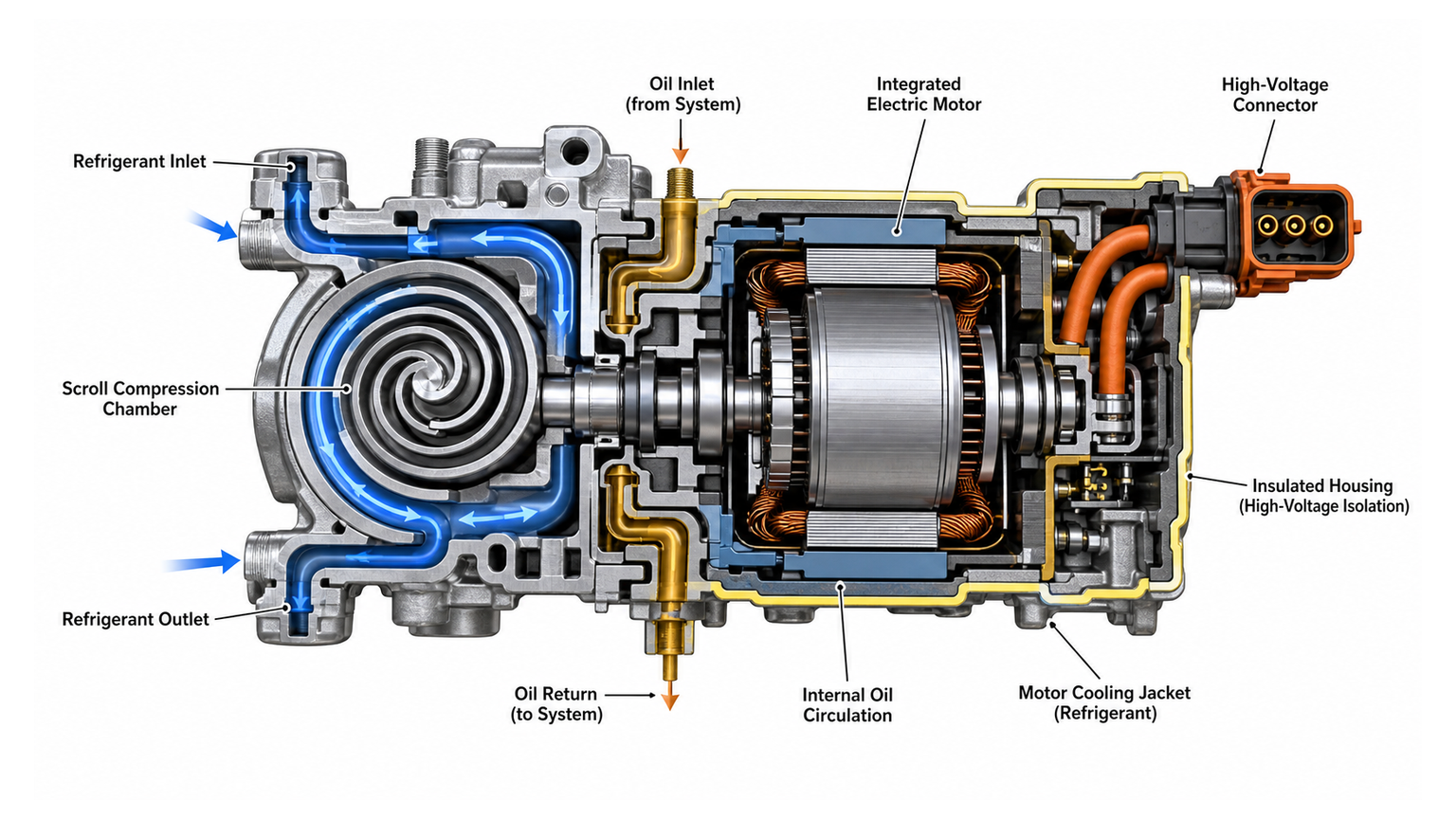
A belt-driven compressor keeps the electric drive motor outside the refrigerant circuit because the engine supplies mechanical power through a pulley or shaft. A high-voltage electric compressor integrates its drive motor into the compressor housing. Refrigerant and oil can contact internal motor-related surfaces, so the circulating mixture becomes part of the electrical insulation environment.
The oil must lubricate bearings, scroll or compression surfaces, and other moving interfaces. It also assists sealing between compression chambers and transports heat. Too little oil can increase wear and temperature. Too much oil can occupy heat-exchanger volume, reduce heat-transfer effectiveness, and change compressor operation. Electrical suitability does not remove these mechanical requirements.
The high-voltage system monitors electrical isolation from the vehicle chassis. Conductive contamination, moisture, damaged motor insulation, contaminated refrigerant/oil, or a compromised connector can lower measured resistance. The vehicle may store isolation faults, disable the compressor, or protect the high-voltage system even when the compressor can still rotate mechanically.
Do not interpret oil as the only insulator. Winding insulation, terminals, connector seals, refrigerant, oil, moisture content, hoses, service equipment, and other electrified components contribute to the measured result. Replacing one component without controlling the rest of the circuit may reproduce the fault.
Many compressor lubricants absorb moisture from air. Water can alter electrical and chemical behavior and contribute to corrosion or acid formation under unfavorable conditions. Keep containers sealed, minimize open exposure, cap system ports, and replace the receiver-drier or desiccant component when the application procedure requires it.
POE means polyol ester and PAG means polyalkylene glycol, but those names do not identify viscosity, additive package, moisture condition, electrical performance, refrigerant compatibility, or compressor approval. Two containers with the same broad acronym may not be interchangeable.
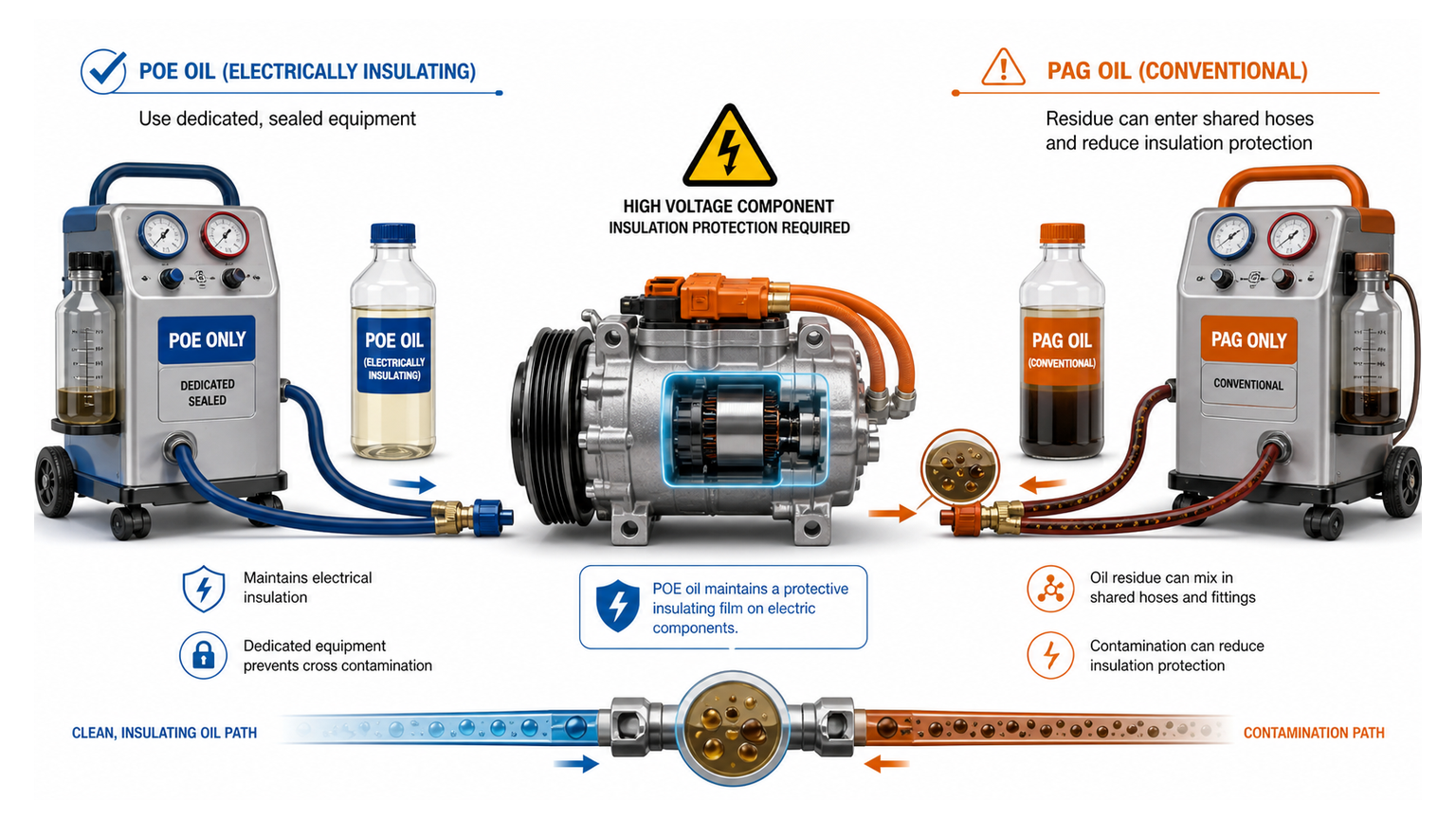
Some conventional PAG oils or residues from service equipment may reduce the electrical insulation performance required by a high-voltage compressor system. The risk is not limited to pouring the wrong bottle into the vehicle. Residue can enter through recovery machines, charging hoses, oil injectors, manifolds, refrigerant cylinders, adapters, or reused flush equipment.
A generic POE label does not prove approval for the exact compressor. Viscosity and formulation affect lubrication and system behavior. A supplier or workshop must reference the vehicle or compressor requirement and use sealed, traceable product. Do not replace an application specification with a color, package style, or marketplace description.
An oil can be described as compatible with a refrigerant without being approved for the compressor's electrical and mechanical requirements. Confirm all four: refrigerant, compressor design, oil specification, and vehicle service information. Elecdura's broader A/C compressor category includes conventional and electric designs that must remain separated during cataloging and service.
Internal tanks, oil separators, hoses, and valves can retain material from previous vehicles. Merely selecting a different oil bottle does not remove residue already inside the equipment. A workshop serving conventional and high-voltage systems needs equipment segregation or a validated process that meets the vehicle maker's contamination requirement.
Small injectors and manifold hoses can hold enough residual oil to matter. Label and store dedicated tools separately. Use protective caps, keep them clean, and prevent a technician from connecting a conventional-oil tool by habit.
Recovered refrigerant can carry oil and contamination. Do not introduce unknown recovered refrigerant into a controlled electric-compressor service stream. Follow legal, environmental, and equipment procedures for identification, recovery, recycling, and charging.
Unsealed containers can absorb moisture or receive the wrong liquid. Decanted oil loses traceability. Record product identity and batch where required, date the opening according to shop policy, and discard material that no longer meets the procedure.
Clear oil can still contain an incompatible lubricant, dissolved moisture, or chemical residue. Dark color may indicate heat or wear but does not identify the contaminant. Use documentation, controlled equipment, and specified electrical or laboratory tests rather than visual judgment alone.
A new compressor may arrive dry, partially filled, or prefilled. The seller should state the oil identity and quantity. If that information is missing, do not assume the unit is ready to install. Verify the label and written documentation before adjusting the system oil balance.
The total system oil charge is distributed through the compressor, condenser, evaporator, hoses, and other components. Replacing one part does not necessarily remove all oil, and flushing can remove an uncertain amount. The service procedure may specify how much to drain from the old component, how to account for a new component, and whether the replacement compressor is prefilled.
For each SKU, record whether the compressor is shipped with oil, the documented oil specification, declared quantity, port-sealing condition, and handling requirement. A distributor that sells two visually similar compressors with different prefill status can create over-oiling or under-oiling even when fitment is correct.
Rotating, draining, or filling an electric compressor incorrectly can leave oil in internal cavities, expose the unit to moisture, or damage it. Use the orientation and procedure for the exact compressor. Do not energize a compressor outside the vehicle or test it with improvised high-voltage power.
Replacing a condenser, hose, evaporator, receiver-drier, or compressor changes how much oil leaves the system. A contaminated system may require a larger service scope than a sealed compressor swap. The A/C condenser category is mechanically adjacent, but its replacement oil adjustment must follow the vehicle-specific procedure.
High-voltage testing requires trained personnel, appropriate personal protective equipment, vehicle isolation, verified absence of voltage, and the vehicle maker's procedure. This article does not provide a universal test voltage or resistance threshold because those values and connection points vary.
Confirm whether the fault relates to isolation, inverter control, supply voltage, communication, temperature, speed, pressure, or another system input. An electric compressor can be disabled by conditions outside the compressor. Record codes before clearing them.
Look for coolant or oil entry, moisture, corrosion, pushed pins, damaged locks, chafing, impact, and incorrect repair work. A connector fault can lower insulation or interrupt control while the internal compressor remains sound.
The approved procedure may isolate branches to locate the low-resistance section. Disconnecting components in an arbitrary order can create misleading results or unsafe conditions. Observe specified waiting times because high-voltage capacitors may retain energy.
If incompatible oil was injected or a shared machine contaminated the circuit, replacing only the compressor may leave the same mixture in the condenser, evaporator, and lines. Determine whether components can be flushed, must be replaced, or need specialized cleaning. The repair plan should state how future contamination is prevented.
Temperature, moisture distribution, and component connection state can affect a measurement. If a known wrong-oil event occurred, document it even if a single reading appears acceptable. Follow the manufacturer's remedy rather than using one result to approve an uncertain system.
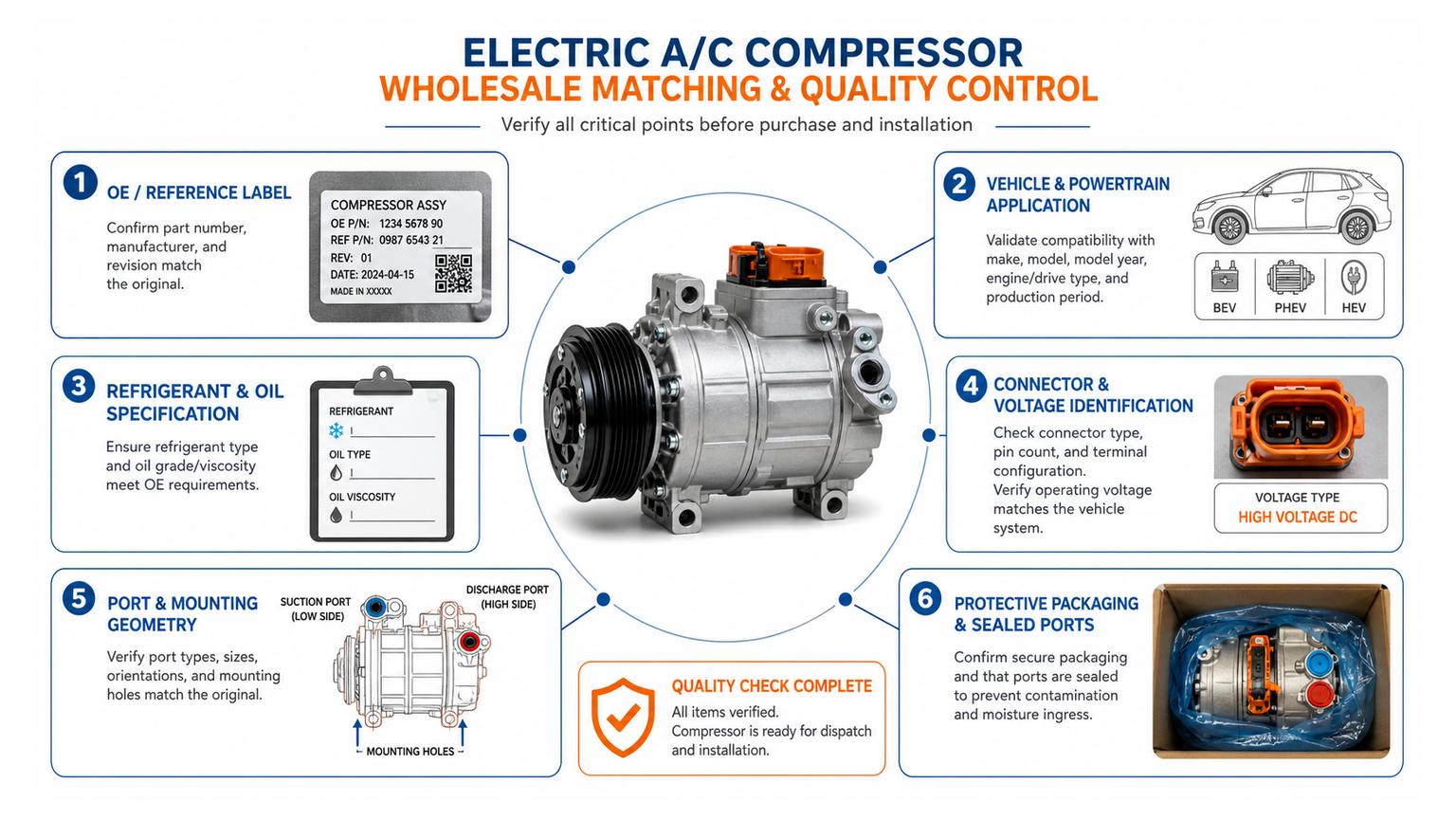
Check | Why it matters | Evidence |
|---|---|---|
OE and compressor reference | Separates similar housings with different electrical/control specifications | Original and replacement label photographs |
Vehicle, model year, powertrain, and market | Prevents hybrid, EV, and conventional application mix-ups | Application record or VIN-derived data where allowed |
Voltage and connector configuration | Prevents high-voltage and communication mismatch | Connector face, pin count, keying, and label data |
Refrigerant and oil specification | Controls lubrication, material, and insulation compatibility | Written technical documentation |
Prefilled oil quantity/status | Prevents incorrect total system charge | Sealed product declaration and batch record |
Port caps and moisture protection | Prevents humidity and particulate entry | Incoming packaging inspection |
Mounting and port geometry | Prevents pipe stress and installation interference | Dimensioned sample and multi-angle photos |
Packaging support | Protects connectors, ports, and housing from impact | Approved carton and internal support standard |
Oil compatibility cannot rescue an incorrectly matched compressor. Confirm the drive type, compressor code, voltage class shown in validated data, connector, communication requirements, mounts, port layout, and refrigerant. The Innova Hycross electric compressor buying guide demonstrates the application evidence required for a model-specific request.
Warehouse labels, product titles, cartons, and sales records should clearly distinguish electric from belt-driven units. Do not let a broad vehicle name hide the powertrain version. For procurement programs, the wholesale A/C compressor page and electric compressor supplier guide provide supply context, while the exact technical file remains SKU-specific.
Inspect port caps on arrival and do not remove them for display photography unless the unit can be resealed under the approved process. Store compressors dry, protected from impact, and oriented according to supplier requirements. Reject broken connectors, damaged pins, open ports, or evidence of oil leakage.
The connector and molded terminal housing should not bear carton load. Internal supports should restrain the compressor by robust housing or mounting areas, and accessories should not strike the connector during transit. Reference documents can be distributed through Elecdura's catalog download center.
Separate recovery/charging equipment, hoses, injectors, adapters, and oil containers where the service standard requires it. Use clear durable identification and storage locations. A written segregation plan is stronger than relying on technician memory.
Receive sealed oil with traceable identity. Check container condition, specification, and shelf or opening rules. Dispense only with clean dedicated tools. Record what was used, how much, and on which vehicle when the workshop quality system requires traceability. The same receiving record should link the lubricant batch to the exact electric compressor SKU rather than to a general vehicle family.
If a wrong or unknown oil may have entered the system, stop charging and quarantine affected equipment. Identify every connected hose, machine, adapter, and vehicle. Do not continue using the equipment on other electric systems until the contamination response is completed.
A warranty review needs installation and contamination evidence: original codes, compressor label, oil specification and quantity, equipment identity, refrigerant charge record, insulation results, replaced components, and photographs. Generic statements such as "installed professionally" do not locate the cause.
Elecdura's aftermarket supply framework, on-highway application coverage, and cooling and A/C product center can support program planning. Oil approval and contamination control, however, remain tied to the exact compressor and service procedure.
Do not assume so. Many applications specify an electrically suitable oil, and POE products are common in some electric-compressor systems, but the exact approved formulation must come from the vehicle or compressor data. "POE" alone is not a complete specification.
The acceptable contamination limit is application-specific. Because conventional oil residue may reduce insulation performance, do not estimate safety from a visible amount. Use dedicated or validated equipment and follow the manufacturer's contamination remedy if mixing is suspected.
Only if the equipment and process are explicitly suitable for the required contamination control. Internal tanks, separators, hoses, and injectors can retain oil. Many workshops use dedicated equipment to reduce cross-contamination risk.
No. Determine whether the replacement is dry, partially filled, or prefilled, and account for oil remaining in or removed with other components. Use the exact system oil-balancing procedure rather than adding a standard bottle quantity.
No. The fault can involve oil or moisture contamination, wiring, connectors, other high-voltage components, or internal compressor insulation. Trained personnel should isolate the fault using the vehicle procedure before ordering a compressor.
Send the OE number, compressor label, vehicle model, model year, powertrain and market, voltage and connector details shown in validated sources, refrigerant, required oil specification, port and mounting photographs, quantity, destination, and packaging requirements. Submit the file through the Elecdura contact page; do not describe the request only as "hybrid compressor."
The correct electric A/C compressor oil is not selected by habit, color, or a broad POE-versus-PAG rule. It is selected from the exact compressor and vehicle specification, then protected through sealed storage, dedicated or validated service equipment, controlled oil quantity, moisture prevention, and documented insulation testing. If contamination occurs, treat it as a system event rather than a compressor-only defect.
For replacement matching, send Elecdura the compressor and OE references, label and connector photographs, powertrain and market, refrigerant and oil requirements, prefill information, quantity, and packaging needs through the technical RFQ channel. Those details allow the electric compressor, its lubricant documentation, and the wholesale acceptance plan to be reviewed together.