English
Views: 0 Author: Site Editor Publish Time: 2026-08-25 Origin: Site
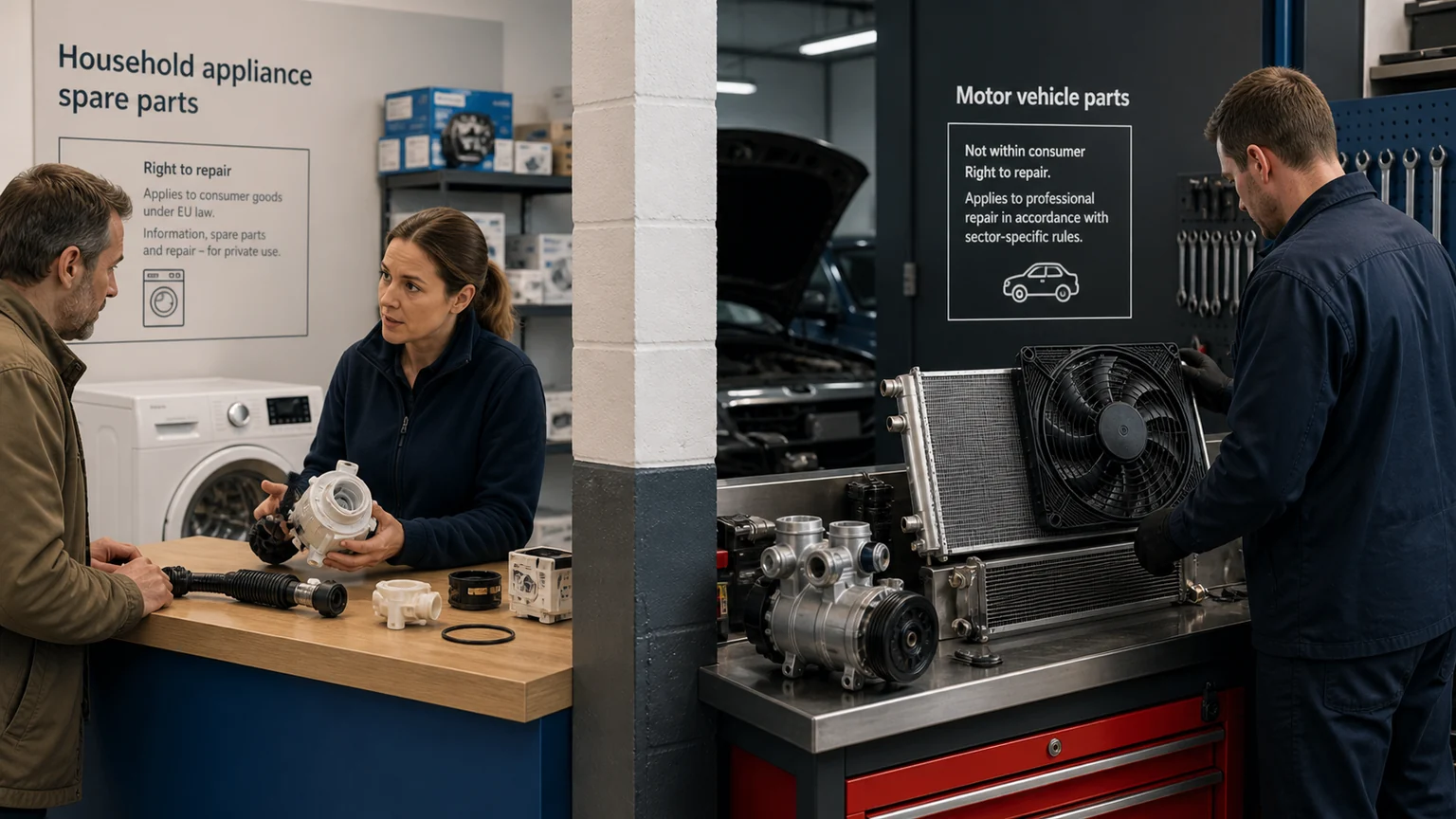
The European Union’s consumer repair directive now strengthens repair options for goods that fall within its defined framework, but it does not by itself place every automotive radiator, condenser, fan or compressor under a universal manufacturer repair obligation. Directive (EU) 2024/1799 links the Article 5 manufacturer repair obligation to goods covered by Union legal acts listed in Annex II. The list is tied to product-specific repairability requirements and can be updated by delegated acts.
Automotive businesses must also distinguish that directive from Regulation (EU) 2026/1738 on vehicle circularity and end-of-life vehicles. The newer regulation contains phased provisions for vehicle design, recovered parts, reuse, remanufacturing, refurbishment, labelling and national incentives. The instruments can point markets toward longer product life, but their scope, dates, actors and evidence are not interchangeable.
This article provides a commercial and operational reading for parts distributors, not legal advice. Confirm obligations against the official text, national implementing measures, product category, vehicle category, transaction and destination.
Consumer-goods repair rules and automotive parts obligations must be evaluated in their own legal contexts.
Question | Directive (EU) 2024/1799 | Regulation (EU) 2026/1738 |
|---|---|---|
Main subject | Common rules promoting repair of goods for consumers | Vehicle-design circularity and management of end-of-life vehicles |
Core coverage logic | Repair obligation for goods listed in Annex II because product-specific EU law sets repairability requirements | Defined vehicle categories, manufacturers, treatment facilities and economic operators under phased articles |
Important current date | Article 22 required Member States to adopt and publish transposing measures by 31 July 2026 and apply them from that date | Published on 24 July 2026; individual obligations use staged dates, including 1 September 2029 provisions |
Cooling-parts implication | Not a blanket Annex II listing of all automotive cooling parts | Direct automotive direction for suitable used, remanufactured and refurbished parts, assessment, information, labelling and incentives |
Business response | Check product listing and national consumer rules before asserting a duty | Map role, vehicle/product scope, article, date, treatment source, evidence and destination |
Directive (EU) 2024/1799 aims to make repair more attractive within and beyond the legal guarantee. Article 22 required Member States to adopt and publish transposing measures by 31 July 2026 and apply those measures from that date. For goods within the relevant scope, it addresses access to manufacturer repair at a reasonable price and within a reasonable time, repair information, and restrictions on unjustified techniques that impede repair.
It also changes the remedy environment under the EU sale-of-goods framework. When a consumer chooses repair instead of replacement within the applicable liability period, the legal guarantee can be extended by at least twelve months under the amended rules. It provides for a European Repair Information Form that repairers may use and an online European repair platform on a later implementation timetable.
The critical boundary is Annex II. Under Article 5, the manufacturer repair obligation applies to goods covered by the Union legal acts listed there, to the extent that those acts establish repairability requirements. Article 5(9) allows the Commission to update Annex II through delegated acts when new Union repairability requirements are adopted. The list must therefore be checked in its current consolidated form; a headline saying “EU right to repair applies” is incomplete unless it names the product category and applicable legislation.
The directive does not turn every radiator, A/C condenser, vehicle cooling fan or A/C compressor into an Annex II product. It does not promise that every component is technically repairable, safe to reuse or economical to restore. It does not abolish application matching, intellectual-property rules, safety requirements, refrigerant controls, vehicle approval relationships or valid objective reasons that affect repair.
It also does not create one identical business-to-business warranty for distributors in every Member State. The directive focuses on consumer relationships and is implemented through national law. A wholesaler selling to a professional installer should assess separately which contract, product, competition, waste, chemicals, safety or sector-specific rules apply to that transaction; this article does not imply that every one of those legal categories governs every sale.
Finally, “reasonable price” does not mean free repair outside a legal guarantee, and repair information does not mean every drawing, calibration file or protected technical asset must be disclosed without conditions. The exact product-specific and national requirements decide. Businesses should avoid marketing statements that promise rights broader than the law or their service network can deliver.
A consumer asking the original seller to remedy non-conforming goods, a consumer buying a spare part from an online shop, a professional workshop requesting technical information, and a distributor purchasing one thousand compressors are not the same legal relationship. Different EU and national rules can apply to sale, guarantee, repair service, product safety, competition, waste and sector access. The words “right to repair” should not collapse them into one obligation.
Map the chain for each offer. Identify manufacturer, importer, authorised representative where relevant, seller, repairer, treatment facility, distributor and end user. Record which actor controls the part design, which actor provides the guarantee, who has the technical capability to repair, and who holds the used core. A distributor should not promise a manufacturer service it cannot authorise, while a manufacturer should not assume an independent seller controls the installation.
Digital sales need the same precision. Before purchase, the page should state product condition, included items, compatible application evidence, seller identity, warranty and core terms. If a part is used, remanufactured or refurbished, do not bury that status in a downloadable document. The physical label, online description, invoice and returned-part process should remain consistent.
Regulation (EU) 2026/1738 addresses circularity requirements for vehicle design and the management of end-of-life vehicles. It replaces earlier directives on end-of-life vehicles and reusability/recyclability within a staged framework. Its scope starts with defined vehicle categories and expands for certain categories on specified dates; readers should check Article 2 and transitional provisions rather than assume every vehicle is included immediately.
The regulation clarifies a route for parts removed from end-of-life vehicles or repair and maintenance operations. Suitable parts assessed for immediate reuse, remanufacturing or refurbishment by professional operators can remain outside the waste classification under the stated conditions. Unsuitable parts follow treatment and waste rules. This distinction matters for a cooling component moving from dismantling to a remanufacturer or distributor.
Article 30 requires parts removed under Article 29(1) to be assessed for reuse, remanufacturing or refurbishment, recycling, or other treatment, taking technical feasibility and vehicle safety into account. Parts assessed as fit for reuse, remanufacturing or refurbishment must carry the Annex VIII label and be protected against transport, loading and unloading damage. The regulation sets the legal assessment and labelling framework; any component-specific leak, flow, electrical or thermal test described below is an engineering qualification recommendation unless a separate applicable rule specifies it. Batteries follow a separate EU battery regime rather than these particular part provisions.
From 1 September 2029, the regulation sets obligations for economic operators selling used, remanufactured or refurbished parts to ensure required labelling from authorised treatment facilities. For consumer sales, the parts must be able to maintain required functions and performance through normal use and comply with other applicable sale-of-goods requirements. The rule applies regardless of the trading technique, including online sales.
From the same date, Member States must incentivise reuse, remanufacturing, retrofitting and refurbishment of parts and components. Possible incentives include requiring repair operators to offer used, remanufactured or refurbished options alongside new parts, subject to conditions designed not to create excessive burdens for micro and small enterprises. A possible national measure is not the same as an identical immediate EU-wide workshop script; monitor each Member State’s implementation.
For distributors, 2029 is not a reason to wait. Supplier qualification, part identity, test methods, treatment-facility relationships, label data, e-commerce fields, transport protection and warranty processes take time to build. Early preparation should be evidence-led, while customer-facing compliance claims should begin only when the applicable rule and date are clear.
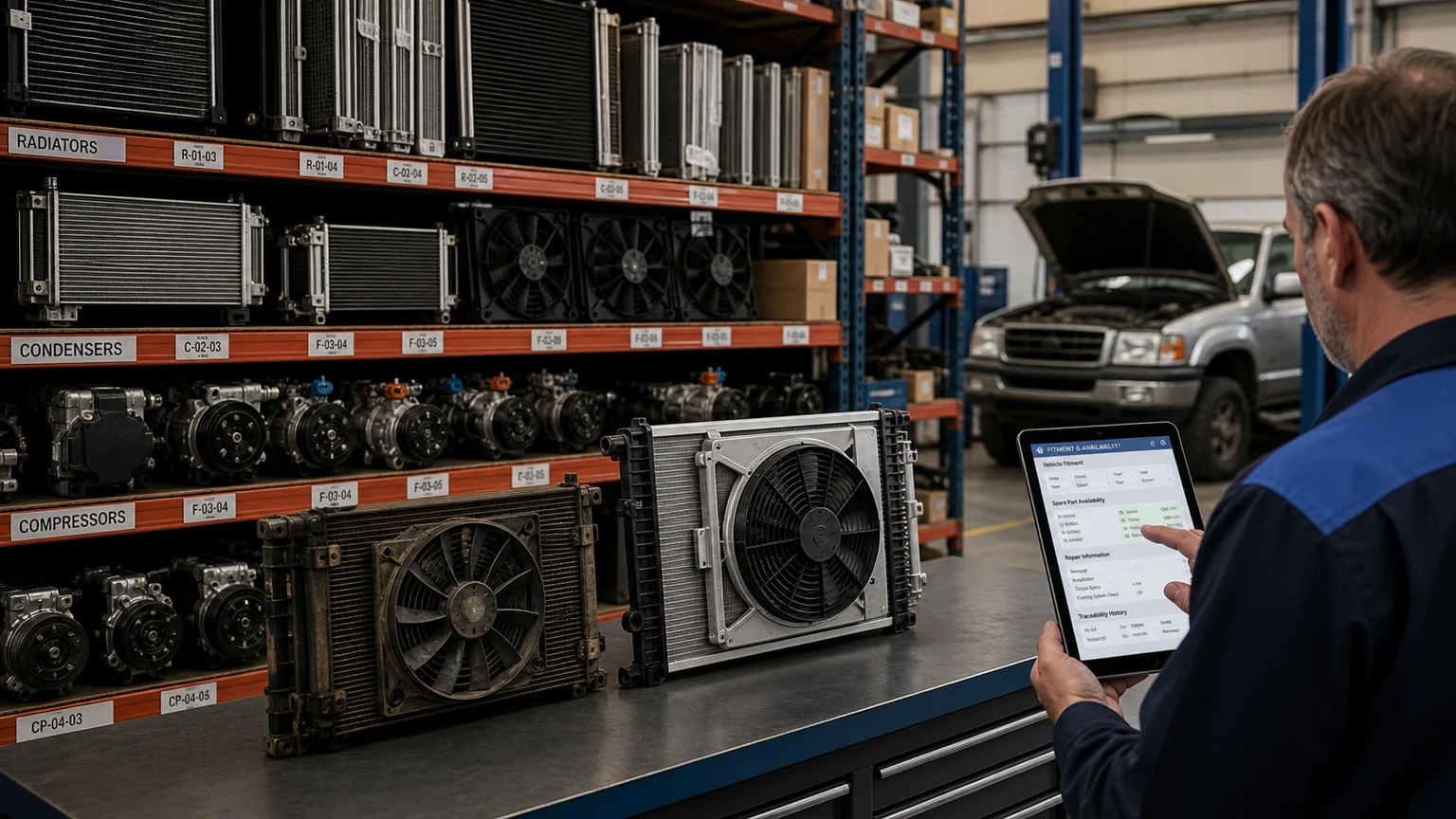
Distributors can prepare through stable fitment records, parts availability and traceable service information.
Keep the legal timeline separate from the operational project. Directive (EU) 2024/1799 was adopted in 2024; Article 22 required Member States to adopt and publish transposing measures by 31 July 2026 and apply those provisions from that date. The national law is the practical source for local procedure, enforcement and any choices allowed by the directive. Review each country where consumer offers are made rather than assuming one implementation summary covers all.
Regulation (EU) 2026/1738 is directly applicable as an EU regulation, but its articles use staged application dates, scope expansion and supporting measures. For every project, add columns for entry into force, the article’s application date, any transition, delegated or implementing act, and evidence readiness. “The regulation exists” and “this exact obligation applies to this sale today” are different statements.
Link business milestones to the legal timeline with margin. Supplier data fields can be agreed first; label designs, treatment-facility relationships and test records can be piloted next; inventory and web data migration can follow; then compliance wording can be approved close to the applicable date. This reduces last-minute relabelling and prevents premature claims.
A condenser removed from an end-of-life vehicle may have an identifiable OE reference and straight fins but still contain refrigerant oil, moisture, corrosion or debris. An external photograph cannot establish leak integrity, internal cleanliness, pressure drop or heat-transfer performance. The evaluation should identify source, construction, ports, damage, contamination and intended route.
As an engineering and procurement decision, direct reuse may be unsuitable when history and internal condition cannot be established. Remanufacturing or refurbishment requires a process capable of restoring and demonstrating the specified functions. Material recovery may be the defensible route when small passages retain contamination or repair would create unreliable joints. These suggested checks are not presented as a universal EU test protocol. Calling every intact condenser “reusable” would undermine both customer safety and the market for qualified recovered parts.
A radiator faces different media and failure patterns: coolant residue, corrosion, mixed-metal condition, tank or seal ageing, blocked passages and impact. The evaluator needs a product-specific method, not a generic used-parts stamp. Pressure integrity alone does not prove adequate coolant flow or heat rejection.
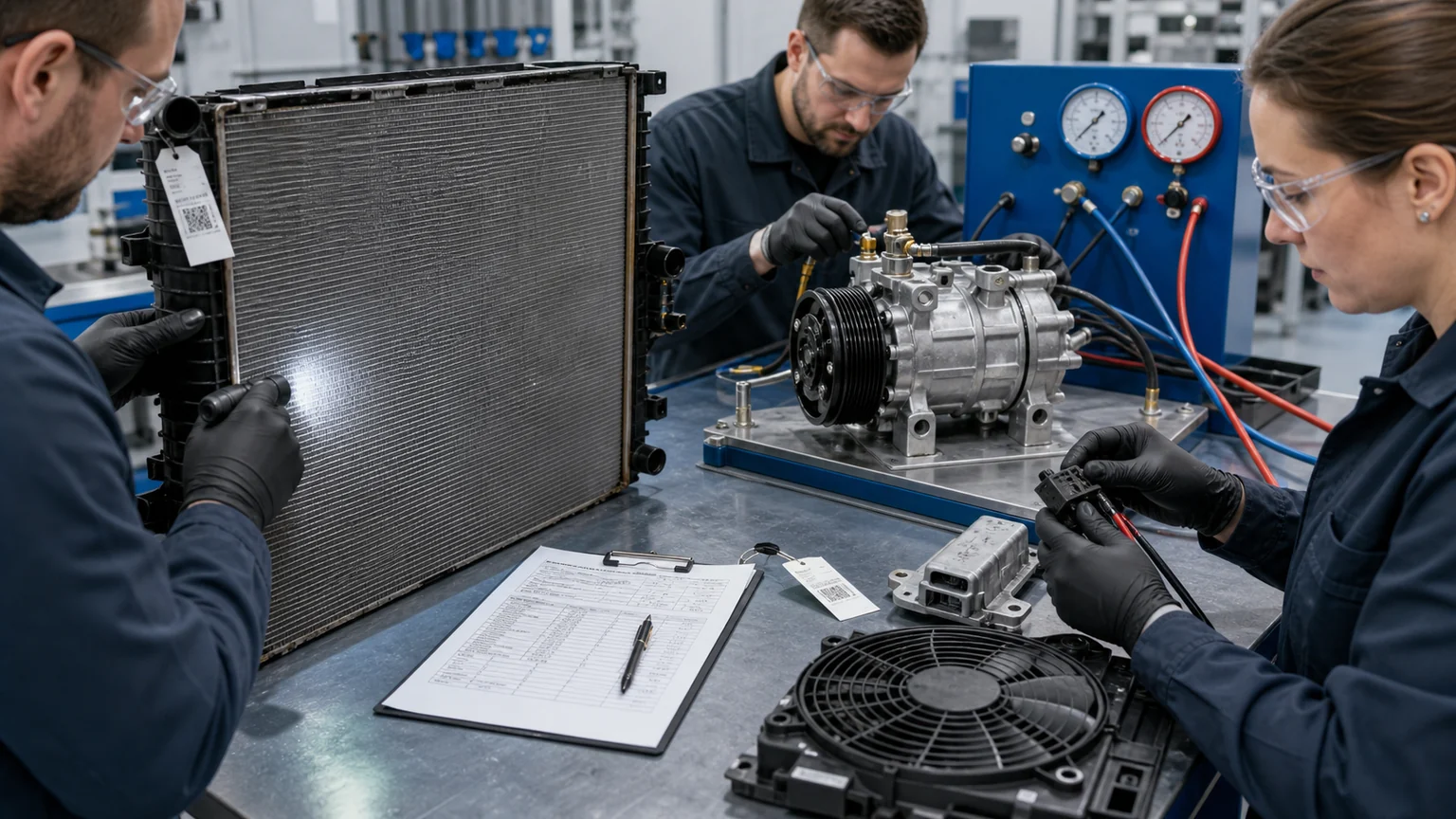
Used and remanufactured parts require component-specific tests rather than a general circularity claim.
A used compressor can be a feedstock for controlled remanufacturing even when it failed, provided the core meets recovery criteria. The remanufacturer should verify identity, disassemble and clean it, reject unusable structures, restore or replace components under documented limits, control oil and cleanliness, and perform architecture-appropriate final tests. A cleaned, repainted housing with unknown internal scope should not be marketed as equivalent.
Refrigerant handling remains governed by applicable environmental and technician rules. A circularity label does not permit venting, cross-contamination or uncontrolled oil disposal. R-134a, R-1234yf and other systems require correct identification, equipment and service procedures for the destination.
A fan module may combine blade, shroud, brushless motor, controller, sensors and vehicle communication. Reuse or refurbishment needs physical, electrical and performance evidence: mounts and blades, connector, current at known voltage/command, rotation, vibration, control response and airflow or a correlated test. A free-spinning motor is not a complete functional assessment.
Create one record for every regulatory claim. Identify the legal instrument, article or annex, current consolidated version, product and vehicle category, obligated actor, transaction type, Member State, application date and required evidence. Name the owner who reviewed it and the date of the next check. Do not store only a web headline or consultant slide.
Separate four statuses: enacted and applicable now; enacted with a future application date; dependent on a national measure or implementing act; and market expectation without a direct legal duty. This prevents a future 2029 label requirement from appearing as a current certificate, and prevents a general sustainability trend from being presented as law.
When a supplier states “EU right-to-repair compliant,” ask which instrument and product rule supports the claim. Compliance normally belongs to an identified product and economic-operator role, not a generic company badge. Retain official-language legal references and obtain qualified legal advice for definitive interpretation.
Each cooling-part record should separate supplier number, distributor SKU, OE references, revision, vehicle/application, media, voltage/control, connectors, ports, dimensions, materials where available, repair or recovery category, test status, lot/serial, treatment source, label data and warranty. Similar-looking variants must not share an identity that hides functional differences.
Add product-status terms that customers can understand: new, used, repaired, refurbished and remanufactured. Define each term and require consistency on web pages, invoices, cartons and returns. Show whether an accessory, control valve, drier, cap, sensor or installation kit is included. If a core exchange applies, publish eligibility, return period, grading and credit rules.
Availability data should be honest. Record normal lead time, minimum order, market restrictions, service elements and the period the supplier commits to support them. Do not promise indefinite supply. For an obsolete OE reference, preserve the supersession chain and technical differences rather than making an unsupported cross-reference.
A proportionate claim process requests identity, installation and failure evidence relevant to the component. For a compressor, that can include refrigerant/oil context, recovered material, contamination scope, pressure/temperature/current observations and corrected external causes. For a heat exchanger, it can include leak location, damage, media, mounting and packaging. For a fan, include supply, ground, command, current and obstruction.
Do not demand unrelated documents or requirements that were unavailable at sale. Publish the evidence schedule in advance and allow practical digital submission. Distinguish product defect, wrong application, installation cause, transport damage and no-fault-found. The goal is a faster correct decision and corrective action, not merely claim rejection.
When repair is feasible within the applicable remedy framework, the service route, parts, time and resulting guarantee need clear documentation. When replacement is necessary, preserve failure data so the supplier can improve design or process. Both outcomes can contribute to longer product and vehicle life.
A stronger repair market can create opportunities for independent workshops, remanufacturers and distributors, but access should not be confused with automatic technical acceptance. Use the same published application, performance, test and traceability criteria for comparable products. Do not reject an independent or remanufactured part merely because of category, and do not approve it merely because it supports circularity.
Supplier qualification should allow evidence through appropriate routes: accredited or capable laboratories, controlled factory testing, sample validation, field data and audited processes. The level should reflect product risk and volume. A small supplier may not have an elaborate portal, but it still needs stable part identity, honest process definitions and defensible release evidence.
When vehicle software or component coding affects a fan, valve or electric compressor, document the dependency early. Availability of the physical unit does not guarantee commissioning. Identify whether calibration, authentication, teach-in, firmware or vehicle-specific communication is required and which authorised route provides it. This is an engineering and service constraint, not a reason to make a blanket statement that repair is impossible.
Workstream | Action now | Avoid |
|---|---|---|
Legal scope | Map instrument, product, actor, country and application date | “All automotive parts are covered” headlines |
Supplier terms | Define new/used/repaired/refurbished/remanufactured and included content | Uncontrolled product-class substitutions |
Recovered parts | Qualify source, assessment, test, label and transport protection | Visual-condition-only release |
Data | Connect part/revision, OE reference, lot/serial, source, test and sale | A QR code without governed data |
Service | Publish realistic availability, core, repair and evidence processes | Indefinite or unsupported promises |
Claims | Use proportionate evidence and cause-coded returns | Vague exclusions added after failure |
Ask suppliers whether an offered product is new, used, repaired, refurbished or remanufactured; who performed the assessment or process; which tests support release; how it is labelled and traced; which vehicle and application requirements it meets; how long service parts and information will be available; and how warranty or repair requests are handled.
Ask legal and compliance teams which national transposition of Directive (EU) 2024/1799 applies to the consumer offer, whether the product is actually in Annex II through product-specific law, and which Regulation (EU) 2026/1738 dates and actor obligations affect the automotive supply chain. Recheck when delegated acts, guidance or national incentives change.
Elecdura can help organise the technical side of this readiness: controlled application data, OE cross-references, labels, product status, test evidence, packaging and warranty fields for cooling and A/C parts. That preparation supports repair and circularity without pretending that one broad “right-to-repair” statement resolves every automotive product and jurisdiction.