English
Views: 0 Author: Site Editor Publish Time: 2026-08-25 Origin: Site
A properly remanufactured A/C compressor can be a defensible replacement when its returned core is recoverable, the remanufacturing process is controlled, and the vehicle system is restored to the required cleanliness. A new compressor reduces dependence on the condition and identity of a returned core, but it is not protected from contaminated oil, the wrong refrigerant, poor condenser airflow, an electrical fault or an installation error.
Therefore, “new versus remanufactured” is not a price-only choice. Distributors should compare the definition of the product, the supplier’s process, application coverage, end-of-line tests, core-return terms and warranty evidence. Installers must also identify why the first compressor failed and define which surrounding components can be cleaned, which must be replaced and which measurements prove that the system is ready.
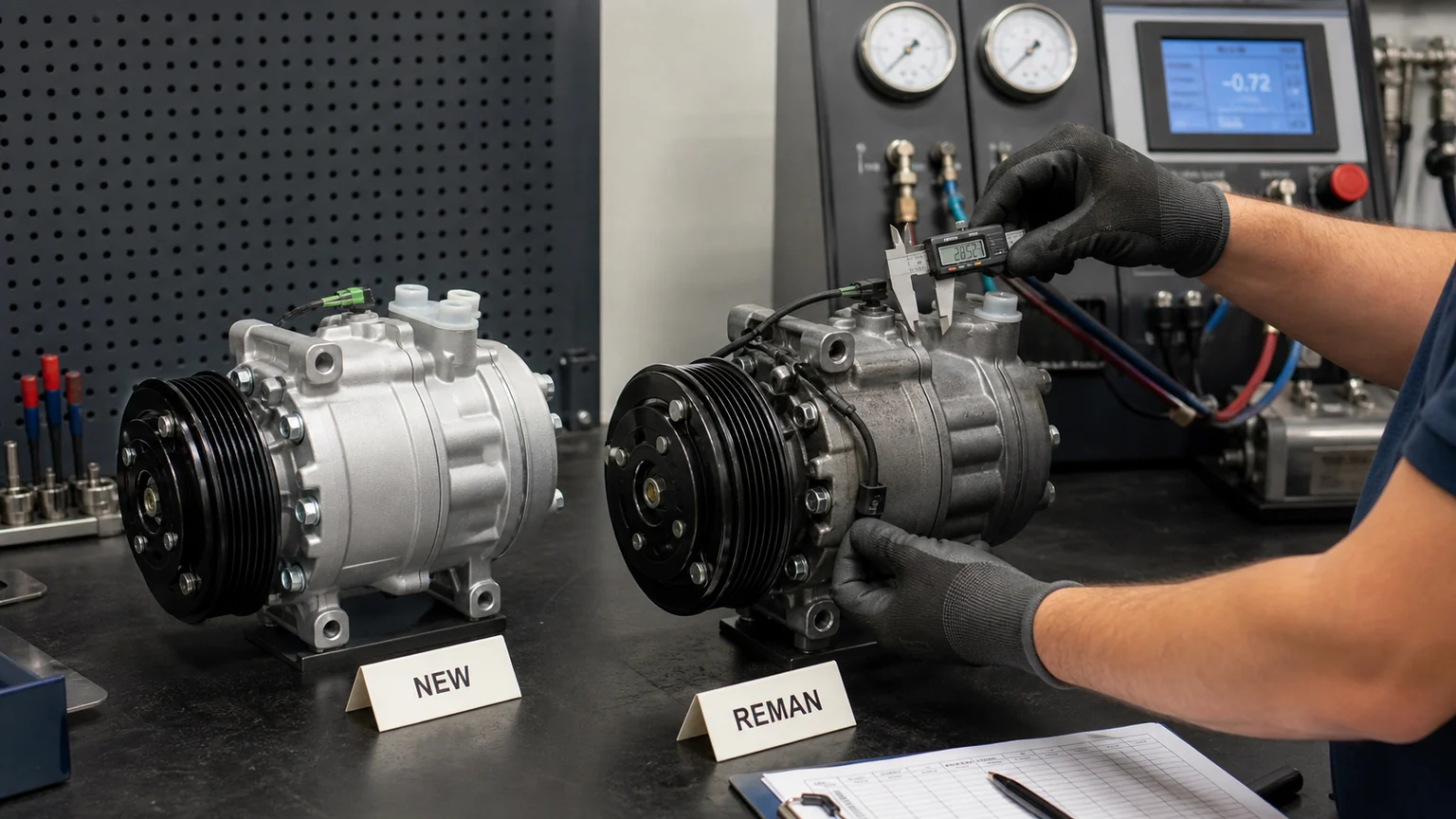
New and remanufactured compressors should be compared by controlled specifications and evidence.
A new compressor is sold as a new product manufactured under a defined production and test process rather than rebuilt from a previously used compressor core. Ask whether the complete unit is new, whether the clutch or control valve is included, and whether its oil, sealing caps and test status match the supplied specification.
A remanufactured compressor starts with a used core and should pass a documented industrial process. That process normally includes identification, disassembly, cleaning, dimensional inspection, rejection of unusable components, replacement or restoration of defined wear items, reassembly, oil control and performance or leak testing. The exact operation varies by compressor type and supplier. “Remanufactured” should describe a repeatable process, not merely a cleaned exterior.
A rebuilt, repaired or used compressor may have a different scope. It might receive only the part required to correct an observed fault, or it may be removed from another vehicle without full disassembly. These products can occupy legitimate market positions when honestly identified, but they should not be treated as equivalent to a controlled remanufactured unit. The quotation, label and warranty should use unambiguous terms.
Decision factor | New compressor | Controlled remanufactured compressor |
|---|---|---|
Dependency on a returned core | Low for production, although a seller may still operate a commercial exchange programme | High; correct, recoverable cores sustain availability and cost |
Identity risk | Centres on application mapping and production revision | Adds core casting, variant and previous-history verification |
Process evidence | Production controls, component specification and final tests | Core grading, disassembly, cleaning, component limits, replacement rules and final tests |
Environmental and material case | May use efficient current production but consumes a new compressor assembly | Can retain usable material and reduce waste when the core and process are suitable |
Vehicle-system preparation | Equally important: diagnose the root cause, control contamination, use the correct oil and refrigerant, and verify the circuit | |
Before ordering any replacement A/C compressor, separate internal mechanical failure from external causes. Seizure, bearing damage, internal wear or a fractured drive element may release particles into oil and refrigerant paths. A clutch, pulley, coil, control-valve, connector or command fault can stop operation without the same internal debris pattern. A leak may come from the compressor body or shaft seal, but it may also be at a hose, service port, condenser or joint.
External causes matter because the replacement product type does not correct them. Low charge can reduce oil return. Excessive or incorrect oil can impair heat transfer and compressor operation. The wrong refrigerant or mixed refrigerants change service and safety requirements. A restricted metering device, blocked heat exchanger, weak fan, high resistance in a power circuit or inaccurate sensor can create abnormal pressure, temperature or current. A belt-drive alignment problem can damage the front end of a conventional compressor.
Record what happened before recovery and disassembly when it is safe to do so: customer symptom, diagnostic codes and status, ambient condition, vent temperature, static and operating pressure, compressor command, voltage/current or clutch state, fan operation, visible leakage and unusual noise. A compressor that has already seized or created unsafe pressure should not be run simply to complete a form.
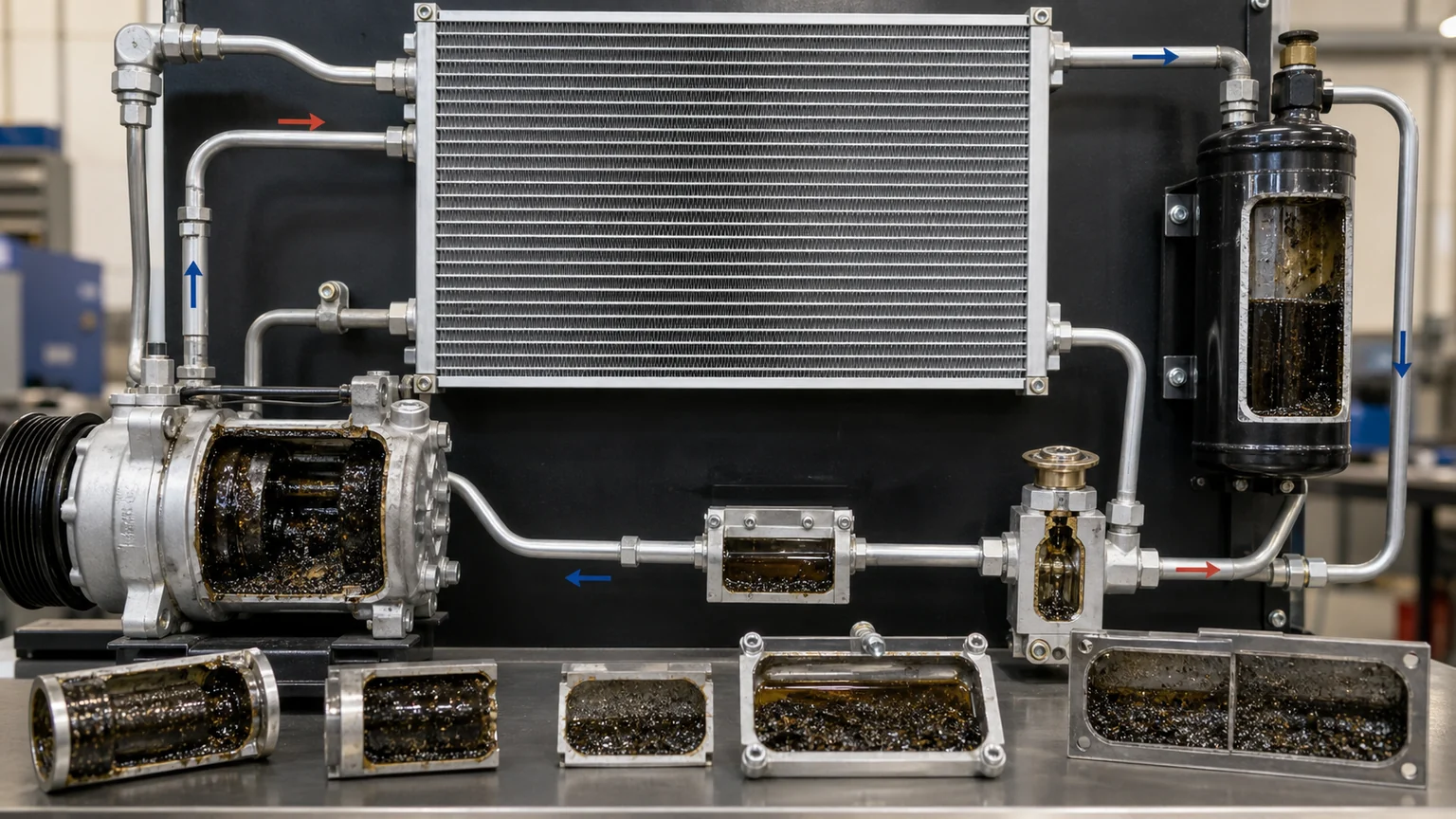
Debris and degraded oil can spread beyond the failed compressor into the entire refrigerant circuit.
Research on failed mobile A/C systems shows why debris control cannot be reduced to the word “flush.” A mechanical failure can move contaminants into the condenser and other passages. Oil carries evidence: colour, odour, metal particles, desiccant material, moisture signs and the recovered quantity can help define the damage boundary. Preserve a representative sample and photograph the drain or filter evidence when a claim may follow.
Whether a component can be cleaned depends on its construction, contamination type, approved method and application instructions. Long accessible lines may be treated differently from mufflers, accumulators, receiver-driers, parallel-flow heat exchangers, integrated manifolds or electrically controlled assemblies. A process that removes circulating oil is not automatically proven to remove embedded hard debris from every microchannel. Never promise that one machine cycle makes all components reusable.
The correct scope comes from the vehicle and replacement-compressor instructions plus inspection evidence. It may include replacing the receiver-drier or accumulator, metering device, contaminated condenser or other non-cleanable component. It may require cleaning approved lines, inspecting hoses, correcting airflow, replacing seals and measuring the recovered oil. Because condenser construction influences debris retention and pressure drop, the installed A/C condenser must be identified rather than treated as a generic coil.
In the United States, MVAC service performed for consideration is subject to Section 609 technician-certification and approved-equipment requirements. EPA guidance states that recovered refrigerant must be recycled with approved equipment or reclaimed before it is charged back into an MVAC, even when it returns to the same vehicle. Other markets apply their own technician, equipment, safety and environmental rules. A distributor should not convert one jurisdiction’s service rule into a global installation claim, but it can require a service record that names the refrigerant and the recovery/recharge process.
Confirm the refrigerant from reliable vehicle identification, service information and fittings. Do not infer it from model year alone. If contamination or an unknown blend is suspected, isolate the situation according to applicable procedures and equipment capability. Cross-contamination can affect service machines, cylinders and subsequent vehicles, while flammable or otherwise non-approved blends can introduce an additional hazard.
Oil decisions also need application evidence. Record the oil type, supplier specification, amount supplied in the compressor, amount drained from replaced components and the adjustment method. “Pre-filled” does not mean the same charge suits every circuit condition. New and remanufactured compressors can both be damaged by a wrong oil family, uncontrolled additives or a total system charge that ignores oil retained elsewhere.
The distributor does not need to dictate proprietary factory methods, but it should audit the outcome and critical controls. Begin with core identity. The casting family, displacement, head and port arrangement, pulley or clutch, control valve, sensor, connector and mounting must correspond to the offered variant. Similar exterior shapes can conceal different control strategies or internal capacities.
Core cleaning should permit meaningful inspection rather than hide damage under paint. The process needs rejection limits for cracked or distorted housings, damaged threads, severe corrosion, unusable shaft or bore surfaces, broken mounts and contamination that cannot be controlled. Dimensional or functional criteria should decide whether a critical component is reused, restored or replaced. A list of “new seals and bearings” is useful only when the remaining parts also meet defined limits.
Assembly needs controlled cleanliness, torque, sealing, oil and traceability. Final testing should reflect the compressor architecture. Possible checks include leak integrity, displacement or flow, pressure capability, torque or power, noise and vibration, clutch coil and gap, control-valve response, connector integrity and rotation; no single list applies unchanged to every compressor design. High-voltage electric compressors add insulation, electrical safety, communication and application requirements that cannot be covered by a belt-driven test bench.
Ask for a test description rather than accepting “100% tested” as sufficient proof. What is measured? At what condition? What is the acceptance range? Is each unit tested or only a sample? Does the lot or serial number connect to the result? The supplier may keep detailed parameters confidential, but the distributor still needs enough evidence to distinguish a real acceptance process from a marketing phrase.
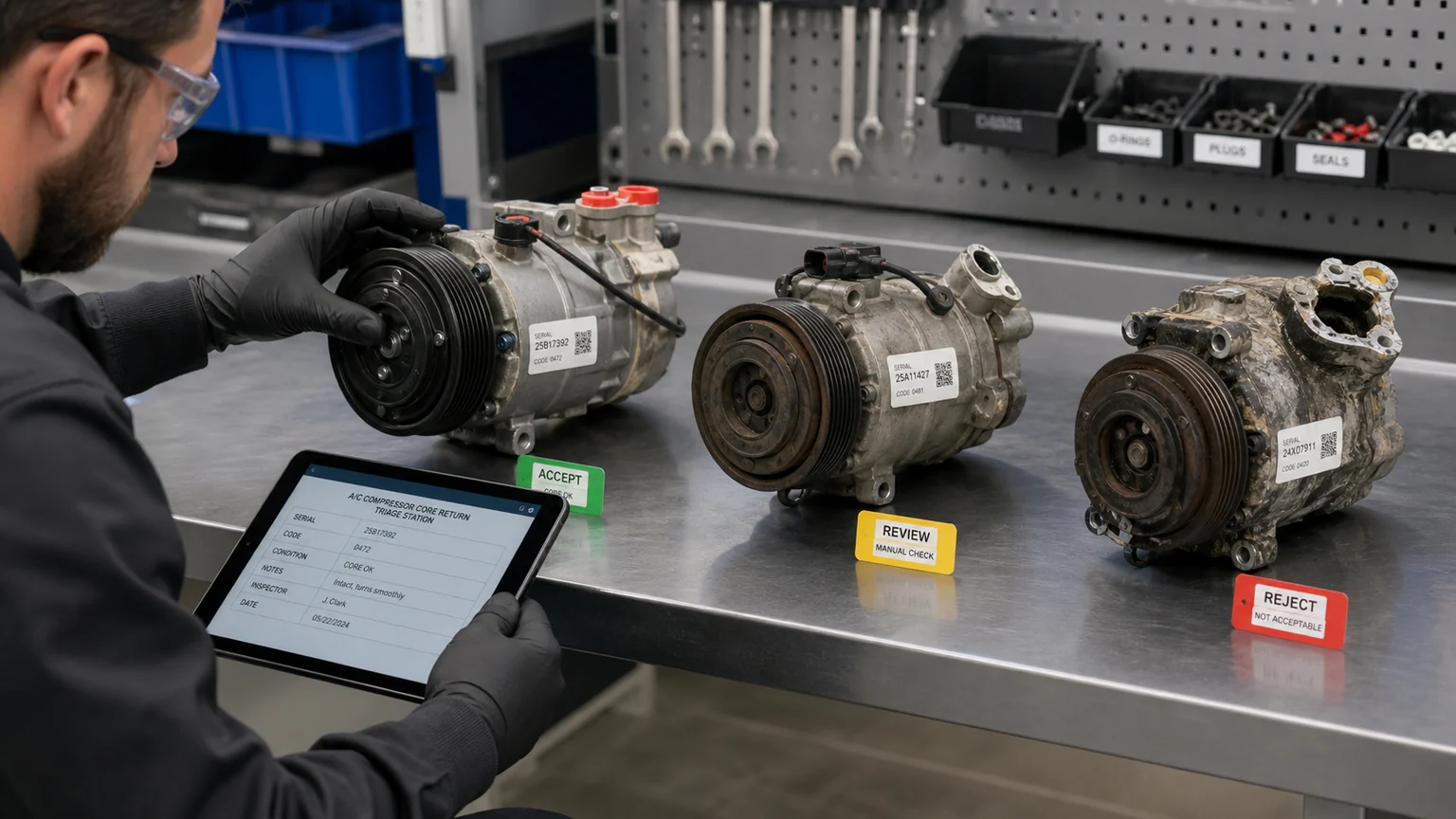
Core grading separates reusable foundations from uncertain or physically unacceptable returns.
A common core-exchange structure combines sale of the replacement with a refundable core charge, credit or other obligation tied to the returned unit; programmes may use different commercial arrangements. Define the eligible core by part family and variant, not just “same type.” State the return window, packaging, fluid-draining and port-capping requirements, freight responsibility, inspection timing and credit rules. Photograph the outgoing replacement and incoming core labels so identity disputes do not depend on memory.
Use three grading outcomes. “Accepted” means the core matches and remains within published recoverability limits. “Review” covers uncertain identity, missing caps, moderate corrosion, incomplete accessories or damage whose effect needs inspection. “Rejected” should be reserved for stated conditions such as a wrong family, missing major casting, broken mount or housing, fire damage, severe corrosion or an unrecoverable internal condition. The supplier should explain the result with photographs or measurements.
A failed core is not automatically a rejected core; failures are the feedstock of remanufacturing. Conversely, an externally clean unit is not automatically recoverable. Avoid incentives that encourage workshops to drain or clean away evidence unsafely. Specify lawful refrigerant recovery, controlled oil drainage, capped ports, a sealed protective bag and packaging that prevents oil leakage or impact during transport.
Warranty duration is only one field. Compare what starts the period, whether coverage is part-only or includes approved labour, which markets and applications are eligible, how commercial or severe-duty use is treated, whether consequential costs are excluded, and what evidence is required. Check whether the core credit and the product warranty are administered separately.
Some warranty conditions—correct refrigerant and oil, system cleanliness, replacement of specified components, corrected electrical faults and documented charge—address genuine repeat-failure risks. They become problematic when they are vague, unavailable before purchase or impossible to prove. Convert them into a checklist that the installer can actually complete and the distributor can apply consistently.
Neither category deserves an automatic warranty advantage. A strong remanufacturer may offer unit-level traceability and meaningful test records, while an undocumented “new” compressor can have weak application control. Equally, a low-cost remanufactured unit with unknown core rules and no test detail creates avoidable uncertainty. Evaluate the actual supplier and programme.
Stage | Evidence to retain | Decision supported |
|---|---|---|
Before removal | VIN/application, OE and compressor labels, codes, symptoms, pressure/temperature/current observations, charge or leak context | Confirms identity and separates compressor failure from an external cause |
System opening | Recovered refrigerant record, oil quantity and condition, debris photos, filter or component inspection | Defines contamination and service scope |
Preparation | Components replaced, approved cleaning method and sections treated, seals, oil calculation, corrected airflow/electrical faults | Shows that the cause and circuit were addressed |
Commissioning | Vacuum/holding method where applicable, charge amount, leak check, vent and ambient temperature, operating pressure, command and current or clutch operation | Confirms the replacement entered service under recorded conditions |
Return | Replacement and returned-unit labels, serial/lot, sealed ports, package condition, claim chronology and requested remedy | Preserves identity and transport condition |
Measurements must be interpreted using the vehicle’s procedure and operating state. Pressure without ambient temperature, fan state and engine/compressor speed can mislead. Current without voltage and command can mislead. A vacuum reading alone does not prove the system is leak-free under every operating pressure. Record tools and units, but do not invent universal pass/fail thresholds.
A new compressor may be preferable when no recoverable core programme exists, the application is new or low volume, previous cores have severe damage, the vehicle requires a revised design, or the buyer needs simpler logistics. It may also suit a programme where the value of uptime outweighs the potential material or acquisition-cost benefit of remanufacturing. These are commercial decisions, not proof that the system can skip diagnosis.
A remanufactured compressor may be attractive when the supplier controls a stable core family, publishes recoverability rules, validates critical components, performs relevant final tests and supports traceable warranty decisions. Mature fleets with predictable core returns can benefit from an exchange loop, especially when they standardise removal evidence and packaging.
Pause the order when identity is uncertain, refrigerant is unknown, debris is found without a cleaning/replacement plan, an electrical or airflow cause remains active, or the seller cannot define the product. Ordering the cheapest unit while the vehicle is still contaminated merely transfers the same failure to another compressor.
Case 1: belt-driven fleet compressor with clutch damage. Inspection finds a failed clutch coil but clean oil, no internal noise before the electrical loss, stable pulley alignment and no debris evidence. The RFQ identifies the exact clutch and control configuration. Both a new complete compressor and a controlled remanufactured exchange unit may be viable, but the buyer compares downtime, accessory inclusion, core window, end-of-line tests and warranty evidence. The electrical cause and air gap or drive conditions remain part of commissioning.
Case 2: seized compressor with metallic debris. Oil and inlet evidence show hard particles, and the condenser construction has small multi-pass passages. The workshop stops treating the job as a compressor-only exchange. It identifies every affected component, follows the application-specific replacement and cleaning scope, documents recovered material and prepares the circuit. Choosing a new compressor would not eliminate this work; choosing a remanufactured compressor would not automatically make the contamination acceptable.
Do not allow a purchase order for one product class to be filled with another without written approval. A remanufactured quotation should not arrive as a repaired used unit, and a new-product order should not silently become a core exchange. The sales record, carton label, invoice and warranty terms should agree. If the supplier changes the included clutch, control valve, connector adapter, oil fill or installation kit, record the revision before stock is mixed.
Sample incoming units against the approved reference. Check the part and production or remanufacturing label, sealed ports, mounts, connector, rotation where marked, pulley or clutch geometry, supplied accessories and package protection. Inspection is not permission to open a clean, sealed refrigerant circuit unnecessarily. Define non-destructive checks and escalation rules with the supplier.
Monitor returns by failure mode, application, supplier lot or serial and installer evidence—not just by total percentage. A cluster of noise complaints, control faults or shipping damage requires a different response from repeat seizures linked to contaminated systems. Separate “no fault found,” wrong application, transport damage, installation cause and confirmed product defect. The resulting data improves both sourcing and warranty fairness.
Provide vehicle or equipment application, model year and market, VIN where appropriate, engine or drive architecture, OE and supplier references, photos of the label, ports, mount, pulley/clutch or electrical connector, refrigerant, voltage/control type and requested included accessories. State whether the request is for new, remanufactured or both and whether a matching core is available.
Add the failure mode, contamination evidence, surrounding components to be replaced or cleaned, expected quantity, delivery destination, warranty expectation and core-return logistics. For electric compressors, include system voltage, connector and communication evidence plus applicable high-voltage service capability. A complete RFQ allows Elecdura to compare application and process evidence instead of guessing from an exterior image.
Send the OE reference, compressor label and port photos, refrigerant and oil context, failure evidence, system-preparation scope and core-return requirements. We can then help define a controlled quotation for a new or remanufactured A/C compressor without treating price, appearance or the word “reman” as a substitute for technical evidence.