English
Views: 0 Author: Site Editor Publish Time: 2026-08-25 Origin: Site
R-1234yf remains a current automotive refrigerant in systems and markets where it is approved and the vehicle is designed for it. The European Union’s F-gas rules and the proposed broad PFAS restriction are separate legal tracks. Neither supports a blanket claim that R-1234yf has already been banned. For distributors, importers, fleet buyers and sourcing teams, the practical job is regulatory monitoring, supplier-evidence control and SKU/application risk management through a dated register for refrigerant, product, country, application and supplier evidence.
The practical sourcing response is to preserve exact refrigerant identity, dedicated service interfaces, compatible A/C compressor and circuit components, leak and recovery controls, material declarations and change monitoring. Alternatives such as R-744 are engineered system architectures—not drop-in cans or automatic component substitutions. This article is a commercial watchlist, not legal advice.
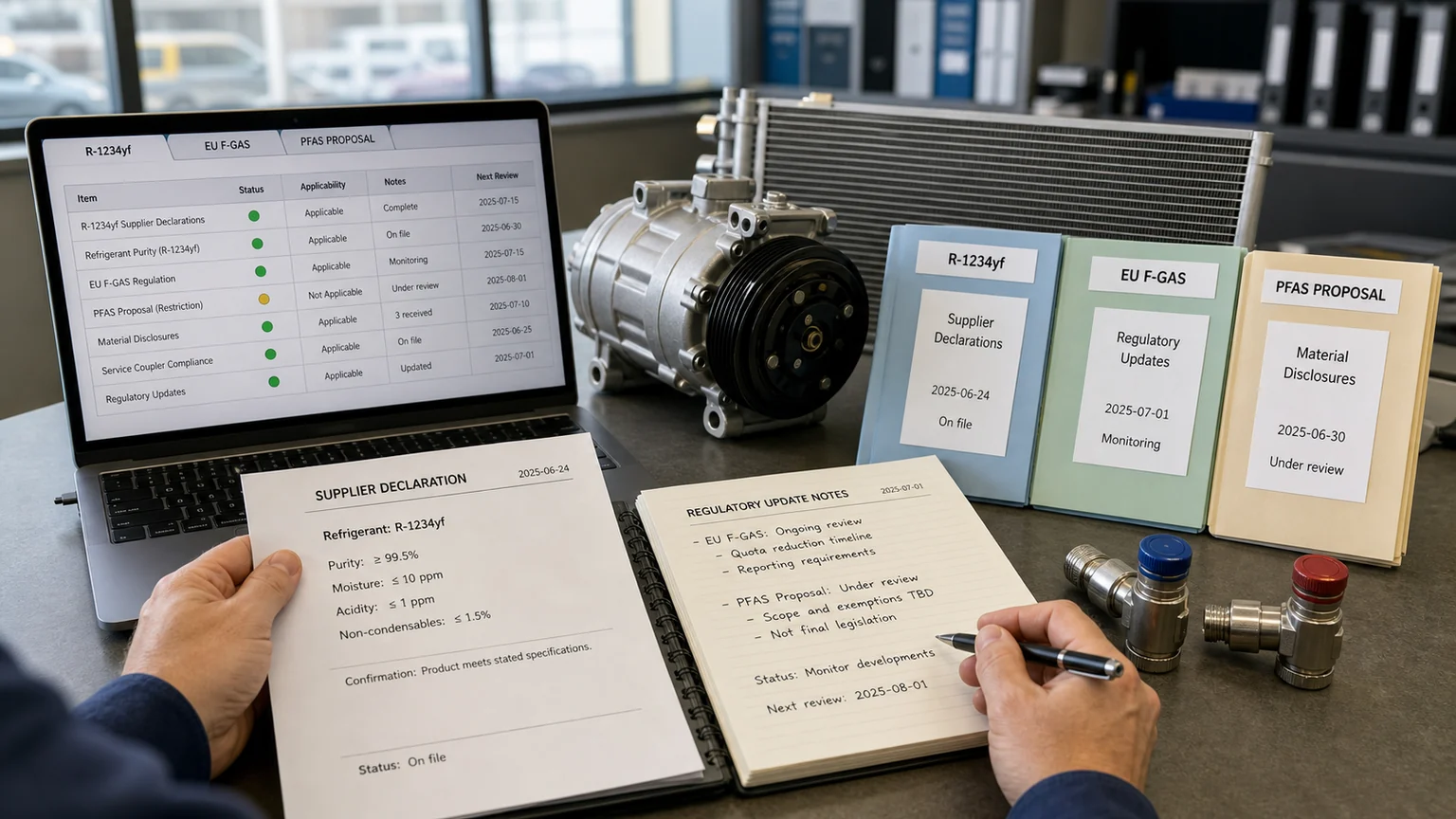
A dated watchlist separates current requirements, proposals, reviews and supplier evidence.
Status | Meaning | Procurement action |
|---|---|---|
Applicable now | An enacted requirement applies to the identified product, actor, market and date | Hold evidence and block non-conforming supply |
Enacted, future date | The legal text exists but the specific obligation starts later | Plan data, product and supplier transition without claiming present compliance |
Proposal/evaluation | Authorities or scientific committees are still developing an outcome | Monitor official milestones, map exposure and avoid predicting final scope |
Voluntary risk action | The company acts before or beyond a direct legal duty | Define the business basis and do not market it as mandatory law |
Every register entry should name the official instrument or authority, article/annex or decision, substance/product, use, country, obligated actor, effective date, evidence owner and last review. A news headline or supplier statement is not enough. Store the current official link and version.
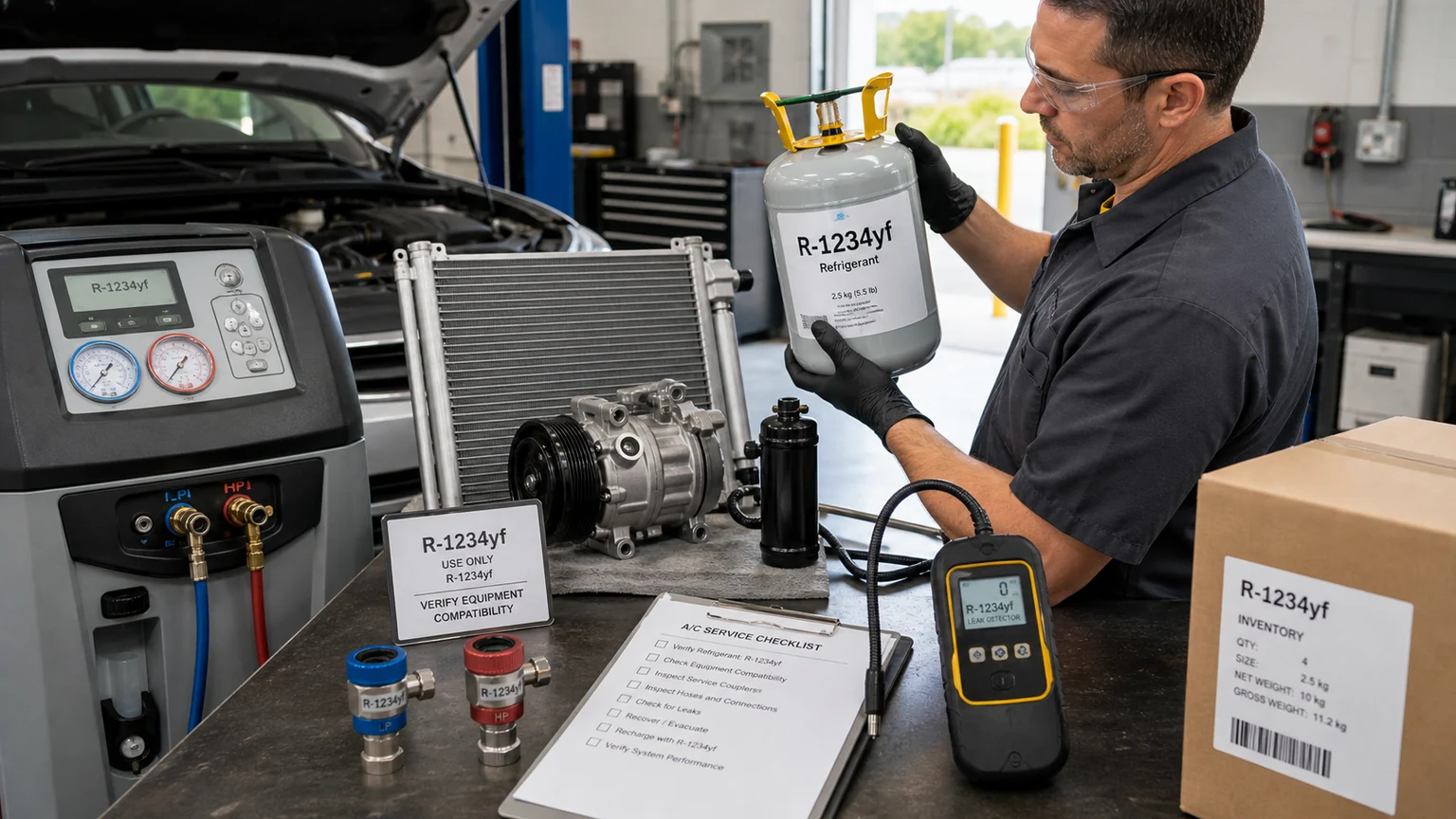
R-1234yf service depends on dedicated equipment, correct identity and controlled recovery.
R-1234yf, also called HFO-1234yf, is the unsaturated fluorinated refrigerant 2,3,3,3-tetrafluoroprop-1-ene. It has a much lower 100-year global-warming potential than R-134a. The European Commission’s mobile-air-conditioning table, based on Annexes I and II of Regulation (EU) 2024/573, gives HFO-1234yf a GWP100 of 0.501, while the US EPA MVAC page gives HFO-1234yf a GWP of 4 under its referenced basis. Different legal and assessment documents can use different scientific assessment values; always retain the source, assessment basis and date instead of treating one number as timeless.
Its A2L safety classification means mildly flammable. Vehicle systems incorporate defined safety features, labels, pressure controls, relief devices and unique fittings. In the United States, the EPA SNAP MVAC listings identify HFO-1234yf as acceptable subject to use conditions for specified newly manufactured passenger, light-, medium-, heavy-duty and nonroad vehicle categories. The exact end use, new-versus-retrofit status, vehicle category and use condition matter.
Do not use hydrocarbon products marketed as substitutes merely because a can mentions R-1234yf. Current EPA guidance on hydrocarbon refrigerants says they are not acceptable MVAC alternatives under SNAP; HFO-1234yf itself is not a hydrocarbon. Product name, composition, SNAP end use and intended new-versus-retrofit use must be checked independently.
The EU Mobile Air Conditioning Directive 2006/40/EC drove the move away from R-134a in new passenger-car systems by limiting refrigerant GWP. European Commission guidance identifies R-1234yf as the main substitute used in new vehicle models. That history should not be rewritten as a requirement that every vehicle or mobile application must use R-1234yf.
Regulation (EU) 2024/573 on fluorinated greenhouse gases entered into force in March 2024. Annex II lists the substance by its chemical name, 2,3,3,3-tetrafluoroprop-1-ene, commonly known as HFO-1234yf or R-1234yf. The regulation establishes rules across placing on the market, use, emissions prevention, recovery, labelling, reporting, trade and other areas according to substance, equipment and actor. The exact obligation must be mapped; inclusion in an annex is not identical to a product ban.
The Commission’s current air-conditioning guidance explicitly says the F-gas Regulation does not impose specific bans on mobile air conditioning. It also notes the broader HFC phase-out pressure on higher-GWP refrigerants. Do not copy stationary-air-conditioning prohibition dates into a vehicle A/C quotation: stationary systems, mobile systems and vehicle MAC rules have different entries.
Article 35(3) of Regulation (EU) 2024/573 requires the Commission, by 1 July 2027, to publish a report assessing whether cost-effective, technically feasible, energy-efficient and reliable alternatives exist that make replacement of fluorinated greenhouse gases possible in mobile refrigeration and mobile air-conditioning equipment, and, where appropriate, to put forward a legislative proposal to amend Annex IV. A required report is not a predetermined ban.
Parts programmes should monitor the report, any legislative proposal, impact assessment and transition provisions. Record which applications are passenger cars, buses, trains, ships, heavy equipment or other mobile refrigeration because alternatives and safety constraints differ. Do not turn a review date into a product phase-out date.
Use the period before the report to improve data: fleet population by refrigerant, annual component demand, service infrastructure, refrigerant emissions and recovery, technical alternatives, energy performance, safety, tooling, training and investment. Evidence supports a controlled response regardless of the policy outcome.
Five national authorities submitted a broad PFAS restriction proposal under REACH in 2023. ECHA’s scientific committees evaluated many sectors, including applications of fluorinated gases and transport. According to ECHA’s official PFAS status page, the Risk Assessment Committee adopted its opinion on 3 March 2026, the Socio-Economic Analysis Committee agreed its draft opinion on 11 March, and the consultation on that draft ran from 26 March to 25 May 2026.
As of 24 August 2026, that broad restriction process is not a final adopted Commission restriction. ECHA states that SEAC is expected to adopt its final opinion by the end of 2026. The committee opinions inform the next stage; the European Commission, together with Member States through the REACH restriction process, determines the final regulatory outcome. Scope, derogations, transition periods and conditions can change between proposal, committee opinion and adopted legal text.
Therefore, “PFAS proposal includes a refrigerant use category” is not equivalent to “R-1234yf is prohibited today.” Equally, the absence of a final restriction is not a reason to ignore environmental or supply risk. Treat it as proposal/evaluation status and update when the final ECHA package and Commission action are official.
Environmental discussion around R-1234yf often focuses on atmospheric degradation and trifluoroacetic acid (TFA), a very persistent and mobile substance. ECHA’s PFAS work and separate classification activity have increased attention to TFA. A sourcing article should not convert this concern into unsupported claims about local concentrations, toxicity, immediate vehicle risk or a final legal outcome.
Ask chemical suppliers for current safety data sheets, regulatory statements, impurity specifications, lifecycle/emissions information and product stewardship guidance. Distinguish the refrigerant molecule, degradation products, process chemicals, seals/coatings and packaging. A compressor assembly may involve several fluorinated substances beyond the charge refrigerant.
When making environmental comparisons, state the boundary and evidence: direct refrigerant emissions, energy use, manufacturing, leakage, recovery and end of life. Low GWP addresses one climate metric; it does not by itself answer persistence, air-quality, safety, energy or total lifecycle questions.
A cooling-part bill of materials can include elastomer seals, hose liners, wire insulation, connector seals, coatings, lubricants, process aids, adhesives, labels and packaging treatments. Some may use fluorinated chemistry for temperature, chemical, electrical or friction performance. A refrigerant-status review alone does not describe the complete article.
Ask suppliers for material or substance declarations at a level appropriate to the regulation and commercial risk. Define the PFAS definition or reporting list used, concentration basis, homogeneous material or article boundary, intentionally added status, confidential-data route and date. “PFAS-free” is ambiguous without a definition, analytical limit and supply-chain scope.
Prioritise critical materials: wetted seals and hoses, electrical insulation in high-voltage compressors, controller coatings, valve seats and process residues with plausible release. Do not demand formula disclosure unrelated to the decision. Use a secure declaration process and allow suppliers to identify information through qualified third parties when necessary.
EU F-gas and REACH processes apply through their own territorial and supply-chain rules. US SNAP listings and Section 609 servicing apply in the United States. Other countries may use type-approval, refrigerant, technician, cylinder, import, chemical or waste rules with different dates. A product can be technically identical yet require different label, documentation or sale controls.
Create a country/application matrix rather than one “global compliant” column. Record new vehicle versus service part, refrigerant-containing versus uncharged component, professional versus consumer sale, and vehicle category. Confirm who is manufacturer, importer, distributor, service shop or end user. The obligated actor may change across the transaction.
For cross-border orders, check refrigerant cylinder and dangerous-goods transport separately from the component. A dry compressor or condenser is not automatically regulated like a charged system, while a pre-filled or contaminated returned unit can create additional transport and waste questions. Obtain specialist review for the exact shipment.
An R-1234yf A/C compressor must match architecture, oil, displacement/control, ports, speed/operating envelope, mounts, connector and vehicle application. An R-134a compressor with similar casting is not automatically suitable. Electric compressors add system voltage, high-voltage connector, insulation, communication and firmware/calibration dependencies.
The condenser, receiver-drier, expansion device, evaporator, hoses, seals, service ports and pressure controls also belong to the designed system. Unique fittings and labels help prevent mixing. An A/C pressure switch or sensor can have different ranges, signals and control logic despite a matching thread.
A receiver-drier or integrated drier protects against moisture and debris within its intended system, but it cannot make mixed or unknown refrigerant acceptable. Keep ports capped, barriers intact and stock segregated. Record refrigerant compatibility from controlled supplier or application evidence.
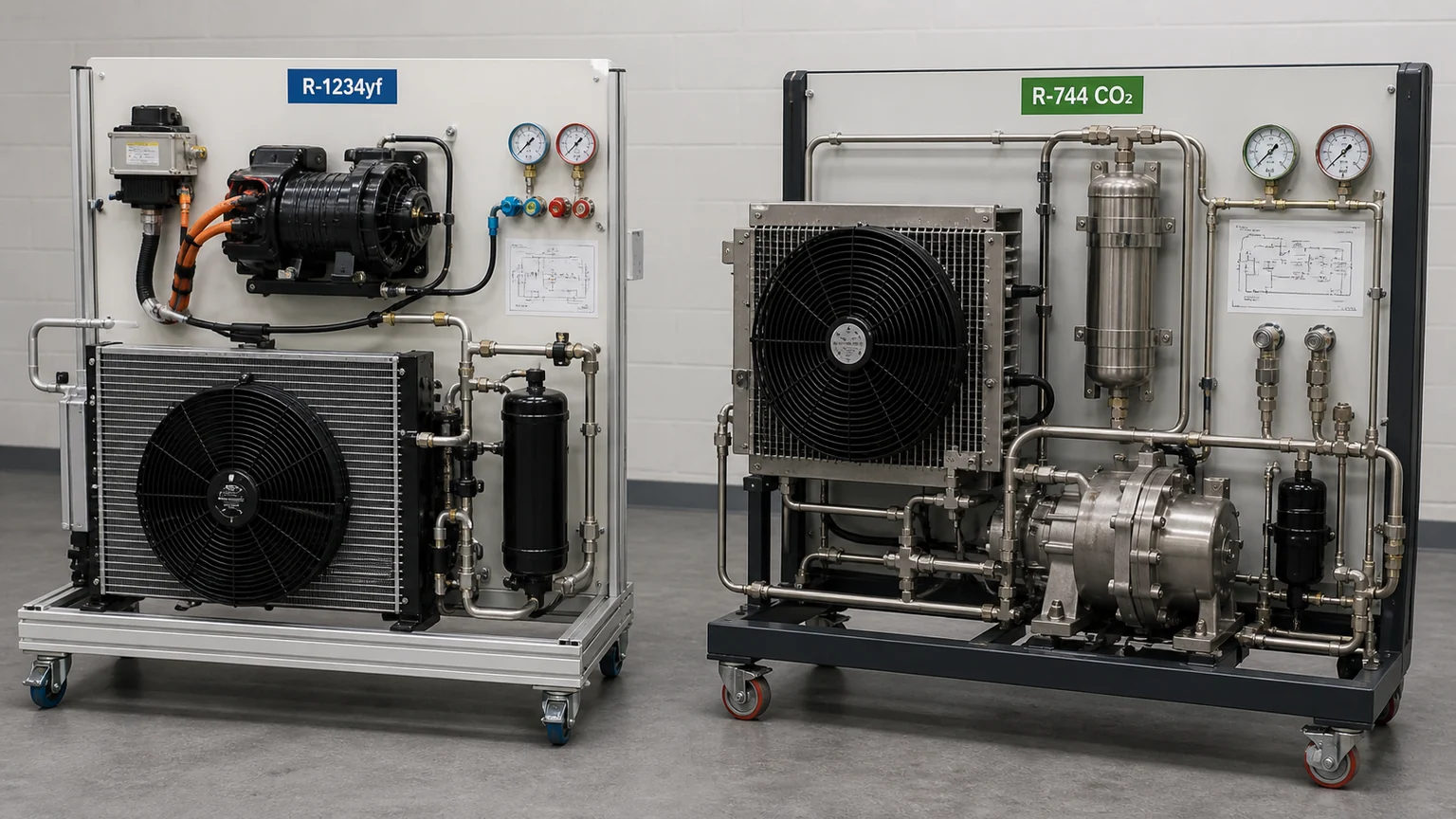
R-1234yf and R-744 systems use different architectures, pressure regimes and service connections.
R-744 (carbon dioxide) is a non-fluorinated refrigerant with very different operating pressures, components, controls and service equipment. Vehicle systems designed for it can offer technical and policy advantages in some applications, including heat-pump operation, but the architecture must be engineered and validated.
A distributor considering R-744 should map vehicle platforms and supply chains, not cross-reference an R-1234yf condenser or compressor by dimensions. Pressure ratings, heat exchangers, valves, seals, sensors, compressor, relief, hoses, ports and service procedures change. Training and workshop investment change too.
Other proposed refrigerants or blends also require approved application, safety, material, performance and service evidence. “Lower GWP,” “PFAS-free” or “natural refrigerant” is not a compatibility certificate. Avoid marketing an alternative before the specific vehicle system and market allow it.
Evidence group | Questions | Update trigger |
|---|---|---|
Substance | Exact refrigerant, CAS/composition, SDS revision, impurities, GWP source and classification | Formula, supplier, SDS or legal annex change |
Application | New or retrofit, vehicle category, market, approved use and system architecture | New platform, country or use |
Component | Refrigerant/oil compatibility, ports, pressure, controls, tests, label and lot/serial | Part/material/process revision |
Operations | Leak prevention, recovery, equipment, training, cylinder/storage and return process | Equipment, facility or service-rule change |
Legal | Instrument, article/annex, actor, status, date and official source | Opinion, adopted act, guidance or national measure |
Continuity | Capacity, lead time, market restrictions, allocation, alternate and change notice | Shortage, price/lead-time change or supplier notice |
Current orders: meet the vehicle, refrigerant and destination requirements that apply now. Verify supplier identity, sealed/clean components, correct labels and service capability. Do not stop legitimate R-1234yf supply because a proposal headline predicts a ban.
2027 monitoring: follow the EU Commission mobile-alternatives report and any resulting proposal. Update installed-base demand, refrigerant recovery capability and platform pipeline. Ask suppliers how they manage change, but do not demand a fictional compliance certificate for rules that do not yet exist.
Longer-term architecture: assess R-744 and other systems at vehicle/platform level with safety, energy, climate, environmental, service and supply evidence. Maintain obsolescence and training plans for the existing fleet, which may require R-1234yf parts for years even if new-platform choices evolve.
Scenario A: targeted derogations and long transitions. R-1234yf service demand continues while suppliers improve emissions, recovery and material evidence. The buyer maintains current parts, monitors conditions and prepares alternative platforms without premature write-off.
Scenario B: tighter conditions for certain uses or materials. Some components or applications require substitution, reporting or transition by defined dates. The distributor maps affected SKUs and countries, validates revised materials, updates labels and preserves support for legally serviceable fleets.
Scenario C: rapid customer-policy change before law. A fleet or OEM requests defined PFAS exclusions or R-744 architecture. Treat this as a contractual technical programme: obtain the definition, scope, test/declaration and transition, quote separately, and avoid advertising the customer requirement as universal law.
Scenario D: no near-term broad legal change. Monitoring still has value because leakage, recovery, training, contamination, supplier concentration and misinformation create current risk. Readiness work should improve present operations rather than exist only for a ban scenario.
Start with cabin heating/cooling, battery or equipment thermal loads, ambient envelope, energy, pressure, safety, weight, packaging, noise, service and recovery. Compare refrigerant performance across relevant modes, including heat-pump heating and hot idle where applicable. Do not select solely by GWP.
Identify which components change and which factory/service infrastructure follows: compressor, heat exchangers, valves, hoses, seals, sensors, relief, ports, controls, software, production charge, leak detection, tools and training. Estimate installed-base support and parts availability. A new architecture can reduce one regulatory exposure while creating capital and obsolescence risks.
Set stage gates: feasibility, component bench, loop, vehicle, durability, production and service launch. Each gate should include safety and compliance review. An aftermarket distributor should not introduce a refrigerant conversion kit without vehicle, market and system evidence from responsible qualified parties.
Flag “R-1234yf banned in Europe,” “PFAS-free vehicle A/C,” “drop-in R-744,” “universal 1234yf conversion” and “F-gas certified part” for compliance review. Require the exact legal or technical basis, date, product and market. Remove or qualify claims that merge proposal and law.
A component can be compatible with an R-1234yf vehicle without containing refrigerant when sold; the product page should say what is included. A pre-filled compressor needs exact refrigerant/oil and shipping evidence. Do not imply a refrigerant cylinder, service machine or technician certification is included with a bare component.
Keep claims versioned. When a regulator updates an acceptable-use list, annex value, guidance or restriction outcome, identify affected pages and quotations. Preserve the previous wording for claim chronology but remove it from active sales use.
When a customer forwards a “ban” headline, acknowledge the concern and check the primary source. Identify whether the item is a proposal, committee opinion, adopted regulation, guidance, court decision or national measure. Name the product/use and date. Do not dismiss the issue or amplify it before verification.
Issue a short dated note with five fields: what changed, what did not, products/orders affected, action required now and next official milestone. State uncertainty. Route compliance interpretation to legal specialists and product changes to engineering/quality. Update customer-facing wording only after approval.
Monitor operational effects even when law has not changed. Rumours can cause sudden ordering, cylinder price movement, supplier allocation or cancelled programmes. Use demand and lead-time data, set fair allocation if necessary and avoid speculative lifetime buys without a service-horizon and storage plan.
For an inquiry or claim, collect vehicle/application, market, refrigerant label, OE and supplier references, component label/lot, ports/connectors, service facility and equipment, recovered refrigerant identity/condition, oil, leak or debris evidence, pressures/temperatures/current and replaced components. Follow applicable law and vehicle procedures.
Cross-contamination can spread from one vehicle to service equipment and cylinders. Maintain dedicated or approved multi-refrigerant equipment under its procedures, refrigerant identification where required, separate fittings and clear storage. Do not release unknown or contaminated refrigerant into a normal recovery stream.
Cause-code warranty results: confirmed product defect, wrong application/refrigerant, contamination, external airflow/control, installation, shipping or insufficient evidence. Regulatory change and product failure are different events; do not use a future proposal to reject a current technical claim.
Check the official European Commission F-gas pages and EUR-Lex for Regulation (EU) 2024/573 implementation, the mobile review and amendments. Check ECHA’s restriction registry for RAC/SEAC and Commission stages. For the United States, check EPA SNAP and MVAC service pages. Add destination-country authorities where Elecdura sells.
Record “no material change” with date; otherwise create an impact note naming substance, products, orders, inventory, contracts, training, web claims and effective date. Route legal interpretation to qualified counsel and technical changes to engineering/quality. Do not rewrite the entire catalogue from an unverified social post.
Elecdura can help buyers organise the parts side of this watchlist. Send the vehicle/application, destination, refrigerant and oil, OE/component references, labels, quantity and supplier documentation. The defensible approach is to source the correct current architecture, control emissions and contamination, and prepare for verified policy changes without presenting an unfinished PFAS process as a completed ban.