English
Views: 0 Author: Elecdura Publish Time: 2026-08-05 Origin: Elecdura
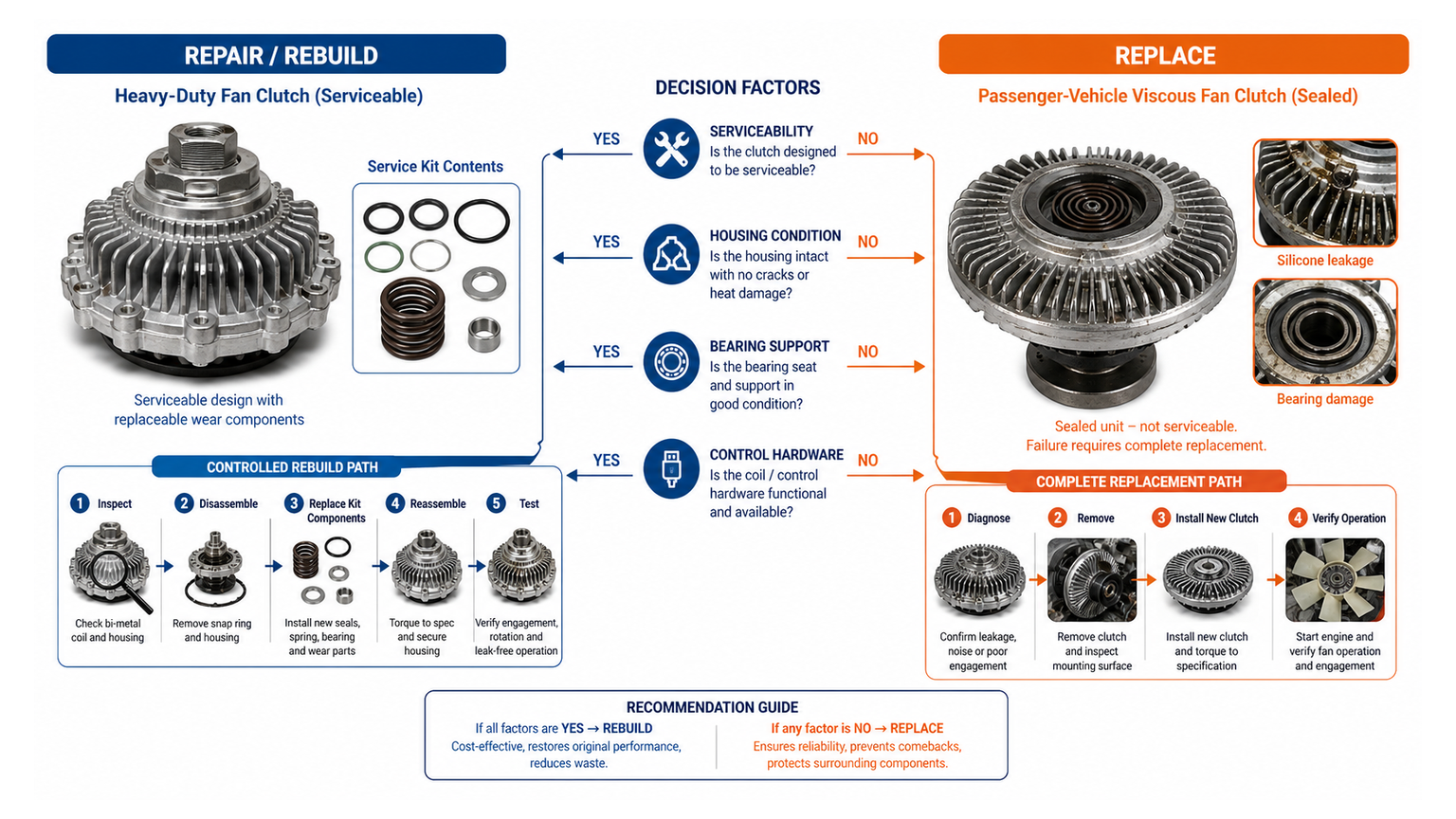
A fan clutch can be repairable, rebuildable, or effectively non-serviceable depending on its design and the failed element. A replaceable bearing or electronic control component does not make every unit a good rebuild candidate. If the hub is distorted, the mounting flange is damaged, silicone fluid has escaped from a sealed thermal clutch, or the fan has contacted the shroud, complete replacement is usually the lower-risk decision. The correct answer comes from identifying the clutch type, locating the actual failure, and measuring the surrounding mechanical condition before parts are ordered.
This distinction matters to workshops and distributors because "fan clutch repair" covers very different operations. Refilling an unserviceable passenger-vehicle viscous clutch, replacing a bearing in a documented rebuildable drive, and diagnosing a heavy-duty electronic fan clutch are not equivalent jobs. Elecdura's fan clutch product range includes mechanically and electronically controlled configurations, so the repair boundary must be established by the original design rather than by outward appearance.
Evidence | Likely decision | Reason |
|---|---|---|
Loose bearing, damaged seal, and a documented service kit for that exact heavy-duty drive | Rebuild may be reasonable | The manufacturer or qualified rebuilder defines the parts and validation process. |
Failed solenoid, speed sensor, or connector on a serviceable electronic clutch | Diagnose before choosing | The electrical part may be replaceable, but the mechanical drive must also pass inspection. |
Silicone-fluid leakage from a sealed thermal viscous clutch | Replace | Fluid quantity, internal clearances, sealing, and calibration cannot be verified through an improvised refill. |
Wobble, flange runout, cracked housing, or blade contact | Replace and inspect related parts | A repaired control fault would not restore safe geometry. |
Fan does not engage, but command or temperature input is missing | Do not order yet | The clutch may be responding correctly to an upstream control problem. |
Clutch is locked, noisy, and overheated after a water-pump or belt failure | Inspect the complete drive | The fan clutch may be secondary damage rather than the original cause. |
The purpose of this guide is not to encourage unnecessary replacement. It is to prevent an attractive low-cost repair from creating a second failure, a damaged radiator, or a rejected warranty claim. Readers who are still determining whether the clutch is faulty should begin with the existing guide to bad fan clutch symptoms. This page starts at the next decision: the failure is suspected or confirmed, but the service scope is not.
A fan clutch transfers torque from the engine-driven hub to the cooling fan. It must transmit enough torque to create radiator airflow under heat load while allowing slip when maximum airflow is unnecessary. That apparently simple function is controlled through a tightly related set of surfaces, fluid passages, bearings, seals, springs, and - in some applications - electronic actuators. A repair that changes one of those relationships can alter engagement speed, fan load, noise, and durability.
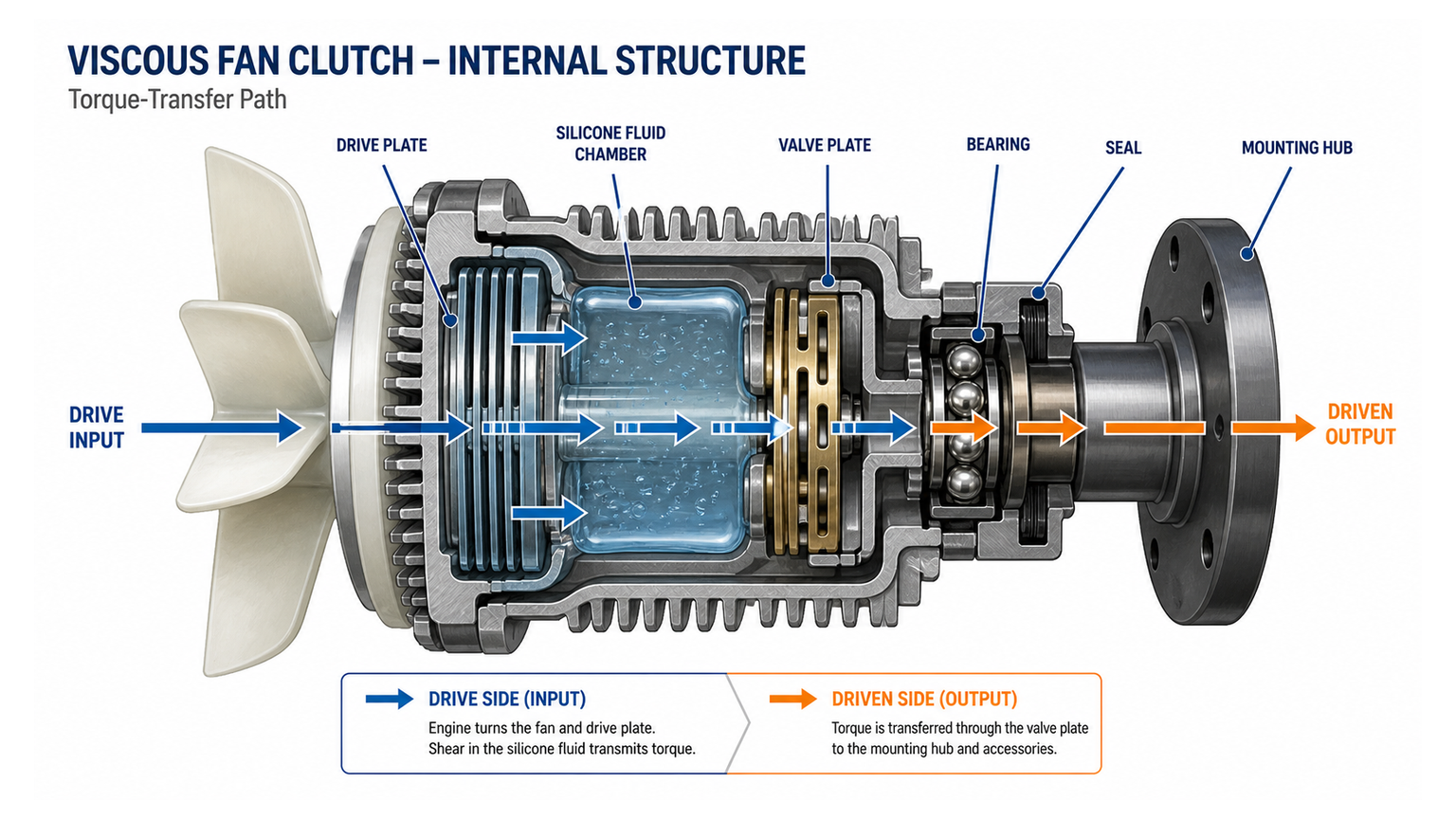
A common thermal clutch contains silicone fluid, a drive plate, working and reservoir chambers, and a temperature-responsive valve. The bimetal element senses air temperature after the radiator rather than coolant temperature directly. When the valve changes fluid distribution, viscous shear transfers more or less torque to the fan.
In a sealed unit, the operating fluid is only one part of the calibration. Fill quantity, fluid viscosity, internal plate clearance, valve travel, seal condition, and thermal response all influence torque transfer. Adding fluid through a drilled hole may make the fan feel more engaged, but it does not prove that engagement occurs at the intended temperature or that the housing will remain sealed at speed. For most sealed light-vehicle clutches, that uncertainty favors replacement.
Cold drag felt by hand is affected by residual fluid position and bearing friction. A clutch that feels firm when stopped can still fail to transmit sufficient torque when hot. Conversely, a healthy cold unit may turn relatively freely after fluid drains back. A hand-spin observation can reveal gross seizure or roughness, but it cannot measure hot torque capacity or engagement timing.
Some commercial-vehicle and equipment fan drives are designed for controlled rebuilding. Their service ecosystem may include bearings, seals, solenoids, friction components, sensors, or complete rebuild kits. The presence of a kit is not universal permission to rebuild every similar-looking unit. The kit must match the exact drive reference, and the rebuilder needs inspection limits, assembly procedures, and post-build tests.
This distinction is especially relevant for fleets and distributors using the broader on-highway cooling application range. Downtime cost can make a rebuild program attractive, but only if cores are screened consistently and the rebuilt drive has a traceable acceptance process.
An electronic clutch may contain a solenoid or valve controlled by the engine management system. The visible connector introduces new failure possibilities: coil resistance outside specification, open or shorted wiring, damaged pins, low supply voltage, poor ground, incorrect duty-cycle command, or a speed-feedback problem. None of these proves that the mechanical clutch body is damaged.
Before replacing an electronic clutch, compare commanded state, electrical input, and actual fan response. A missing command can originate in coolant-temperature data, intake-air temperature, A/C pressure, engine load logic, or a harness fault. Parts managers should keep this product separate from an electric fan control module; the two may share diagnostic language but use different power and control architectures.
Repairability is not determined by the price of a new clutch. It is determined by whether the repaired assembly can safely hold the fan on its intended axis and reproduce the required thermal or electronic response. The following evidence moves the decision toward complete replacement.
Cracks, bent mounting ears, damaged threads, or flange runout compromise alignment. A fan blade has significant diameter and rotating inertia; a small hub error becomes larger at the blade tip. If the fan has already contacted the shroud, inspect the blade, water-pump shaft, brackets, and the fan shroud geometry before installing another clutch.
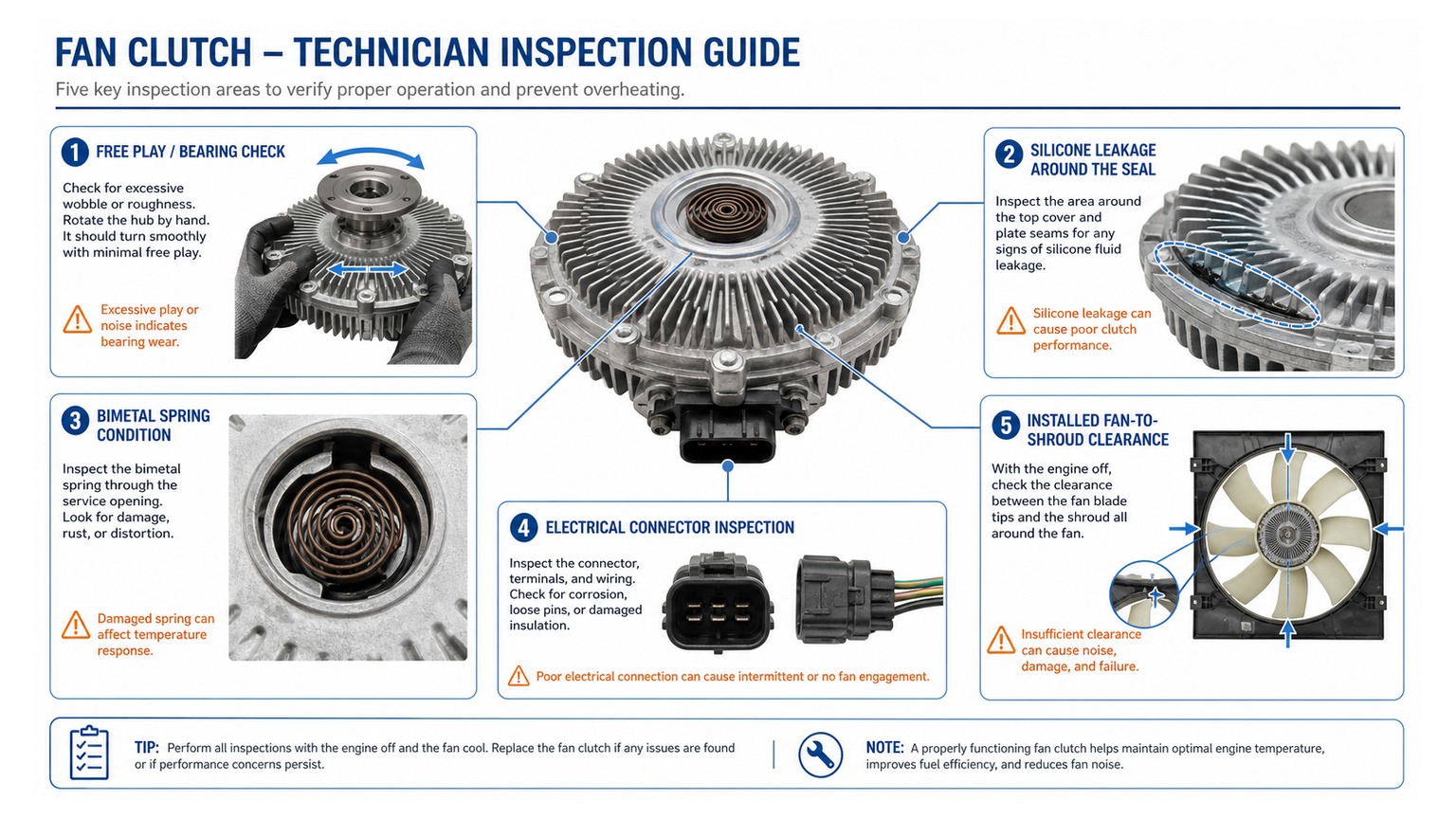
A rough bearing, detectable radial movement, axial looseness beyond the service information, or discoloration from heat indicates a mechanical integrity problem. Bearing replacement may be valid in a documented rebuildable unit, but a sealed clutch with a staked or integrated bearing is normally replaced as an assembly. Do not assume that pressing in a dimensionally similar bearing restores the designed internal preload or sealing.
A light film of road residue should not be confused with active clutch-fluid leakage. Clean the area, identify the source, and look for a fresh track from the shaft seal or housing joint. If a sealed viscous clutch has lost working fluid, its torque-transfer behavior is no longer predictable. Replacement is safer than estimating the lost amount.
A clutch that remains fully engaged can impose continuous load on the belt drive, increase fan noise, and stress the water-pump bearing. Heat can also damage fluid and seals. If the unit has operated locked for an unknown period, repairing only an external spring or valve may leave internal damage unaddressed.
A rebuild is defensible when four conditions are all satisfied: the exact model is designed for service; the failed components are positively identified; the structural core passes inspection; and the rebuilt unit can be tested against defined criteria. Missing any one of these conditions turns a rebuild into an experiment.
Start with the complete part number, application, and manufacturer identification on the original unit. A rebuild kit described only as "heavy-duty fan clutch kit" is not enough. Compare seal dimensions, bearing arrangement, valve or solenoid design, connector, mounting flange, and fan pilot. Similar castings can contain different internal control systems.
A rebuildable core should have an undamaged housing, acceptable shaft and flange geometry, intact threads, and no evidence of severe overheating or impact. Corrosion around seal lands or electrical cavities can also disqualify a core. Core acceptance should happen before labor and kit cost are committed.
Surface oxidation on an external steel fastener is not equivalent to pitting on a sealing land or bearing seat. Record where corrosion exists and whether it changes fit, sealing, electrical contact, or material thickness. A visual grading standard with photographs reduces inconsistent decisions between technicians.
A finished drive should be checked for smooth rotation, correct play, leakage, electrical continuity where applicable, connector integrity, and response under the approved test method. A vehicle road test alone may not expose a marginal clutch, particularly in cool ambient conditions. Heavy-duty rebuild programs may require bench testing or controlled thermal activation.
For off-road machines, dust loading, vibration, and long low-speed duty cycles change the validation risk. The off-highway cooling system application page shows why an agricultural or construction-equipment clutch should not be accepted solely by passenger-car inspection habits.
A fan clutch can be blamed for a system problem it did not create. Repair decisions improve when airflow faults, coolant-flow faults, and drive faults are separated.
The bimetal element responds to air leaving the radiator. If the radiator has cold sections from internal restriction, external debris blocks airflow, or a missing seal allows air to bypass the core, the clutch may receive a misleading temperature environment. Compare inlet and outlet conditions and inspect the radiator range and configuration before concluding that the clutch's temperature response is wrong.
Water-pump bearing play can move the entire fan and clutch assembly. Belt slip can reduce fan and pump speed. A damaged tensioner can create intermittent noise or vibration. Installing a new clutch on a moving pump shaft may lead to blade contact or early clutch damage.
Blade diameter, pitch, offset, rotation direction, and mounting pilot affect load. An incorrect blade may pull too much torque or sit at the wrong depth. If the vehicle uses an electric assembly rather than an engine-driven clutch, compare the radiator cooling fan assembly instead of trying to adapt fan-clutch logic.
Record the OE reference, complete drive number, vehicle or equipment model, engine, model year, and whether control is thermal, mechanical, pneumatic, or electronic. Photograph the front, rear, label, connector, mounting flange, fan pilot, and surrounding installation.
Document whether the complaint is under-engagement, constant engagement, noise, leakage, vibration, or electronic fault. Record coolant temperature, road speed, engine load, A/C operation, fan command, and actual fan behavior where measurement is supported. Do not work near a rotating fan or rely on improvised stopping tests.
With the engine off and secured, inspect blade condition, fasteners, hub play, shaft movement, clutch leakage, flange alignment, water-pump condition, belt, tensioner, and shroud clearance. Structural damage ends the repair discussion even if the control component is serviceable.
For a thermal unit, compare temperature conditions with clutch response using the vehicle maker's method. For an electronic drive, inspect the connector, supply, ground, command, feedback, and applicable diagnostic codes. A functioning clutch cannot compensate for missing control input.
Confirm the exact rebuild kit and the inspection, assembly, and test information. If only generic internet instructions or an unreferenced seal kit are available, replacement provides a more controllable result.
After repair or replacement, verify fan clearance, fastener security, wiring routing, leakage, noise, temperature response, low-speed cooling, and A/C condenser airflow. The engine cooling product structure helps keep airflow components distinct from thermostats, radiators, and oil coolers during follow-up diagnosis.
For distributors, the cost of a wrong fan clutch includes return freight, workshop labor, radiator or shroud damage, and loss of confidence in the catalog. Matching must go beyond bolt pattern. A purchasing team can compare program requirements through the wholesale fan clutch range and use the fan clutch supplier comparison to distinguish OE-integrated, fleet-rebuild, and private-label sourcing routes.
Information | What it prevents | Evidence to retain |
|---|---|---|
OE and complete clutch reference | Mixing visually similar internal calibrations | Label and catalog screenshots |
Engine and vehicle/equipment application | Wrong duty cycle or mounting family | VIN/application data where available |
Thermal, electronic, pneumatic, or fixed control | Incorrect operating principle | Front/rear and connector photos |
Mounting flange, pilot, thread, and rotation | Installation failure or loosening | Dimensioned sample record |
Fan offset and surrounding clearance | Blade-to-shroud or radiator contact | Installed sample photographs |
Connector and pin layout | Electronic control incompatibility | Macro connector image and pin count |
Packaging support and flange protection | Bent pilots, damaged fins, and impact loads | Pre-shipment packaging standard |
A sample should be compared with the retained original for label, dimensions, mounting, connector, rotation, and installed clearance. If a fleet rebuild program is planned, agree on core rejection criteria and traceability before volume processing. Elecdura's aftermarket supply route and cooling parts product center provide context for mixed-SKU programs, but each clutch reference still requires its own approval record.
Check cartons for impact, verify protective caps and flange support, compare label and quantity, sample critical dimensions, rotate units for roughness, inspect leakage, and examine connectors. Do not treat stiff cold rotation as proof of performance; the inspection should catch shipping damage and obvious assembly variance, not substitute for functional testing.
The fan pilot, bimetal spring, electrical connector, and thin fins should not carry carton impact. Packaging should support the robust flange or housing surfaces, isolate units from one another, and prevent moisture exposure. Reference catalogs and handling material can be distributed through the Elecdura download center.
Only when the exact clutch is designed for that service and the approved fluid specification, quantity, sealing method, and validation procedure are available. Drilling and refilling a sealed thermal clutch may change drag without restoring calibrated temperature response. For an unserviceable unit with confirmed leakage, replacement is the safer decision.
Some rebuildable heavy-duty drives have serviceable bearings. Many sealed passenger-vehicle clutches integrate or retain the bearing in a way that is not intended for field replacement. Identify the exact design and service information before pressing the assembly apart.
First determine why it is locked. Internal seizure, overheated fluid, bearing damage, or housing distortion generally favors replacement. An electronically commanded clutch may remain engaged because of a control strategy or electrical fault, so command and wiring should be checked before condemning the drive.
Not automatically. Replace or reject the blade if it is cracked, bent, unbalanced, has damaged mounting holes, or does not match the required diameter, pitch, offset, or rotation. Always inspect it after clutch wobble or shroud contact.
Send the OE number, complete clutch label, vehicle or equipment model, engine, model year, control type, connector and pin photos, mounting and fan-side photos, target quantity, destination market, and packaging requirement. For an RFQ review, use the Elecdura contact page and state whether the request is for new replacement units, service kits, or a rebuildable heavy-duty program.
Repair a fan clutch only when its exact design supports service, the core remains structurally sound, the failed part is confirmed, and the rebuilt assembly can be validated. Replace a sealed clutch when it has lost fluid, developed unsafe play, suffered heat or impact damage, or cannot be calibrated and tested after opening. The best purchasing decision is the one that restores controlled fan engagement without transferring unmeasured risk to the water pump, blade, shroud, radiator, or warranty process.
For replacement matching, send Elecdura the full fan clutch reference, engine and application, control type, mounting and connector photographs, fan offset details, quantity, and destination market. That information allows a product-specific review before a wholesale order is quoted.