English
Views: 0 Author: Site Editor Publish Time: 2026-08-03 Origin: Site
Hydraulic oil cooler back pressure is easy to underestimate because the cooler looks like a passive heat exchanger. In a mobile hydraulic machine, however, the cooler sits inside a live circuit. Oil must pass through the core, ports, fittings, hoses, bypass valve, return filter, tank connection, and sometimes a fan shroud or mounting cavity that affects temperature. If the replacement cooler, hose routing, or fitting package creates too much restriction, the machine may run hotter after repair, hydraulic response may become slow, seals may be stressed, and operators may blame the pump or valve block when the real restriction is in the cooling return path.
This article is written for parts distributors, repair workshops, and fleet maintenance teams that need to decide whether a hydraulic oil cooler can be replaced directly or whether the circuit should be checked first. It explains the common symptoms of excessive back pressure, the causes that usually appear in construction equipment, and the sizing evidence a supplier should request before quoting a cooler. Elecdura supports replacement hydraulic oil coolers for construction equipment, but the safest quote is always based on machine data, cooler dimensions, port layout, operating conditions, and failure evidence rather than part name alone.
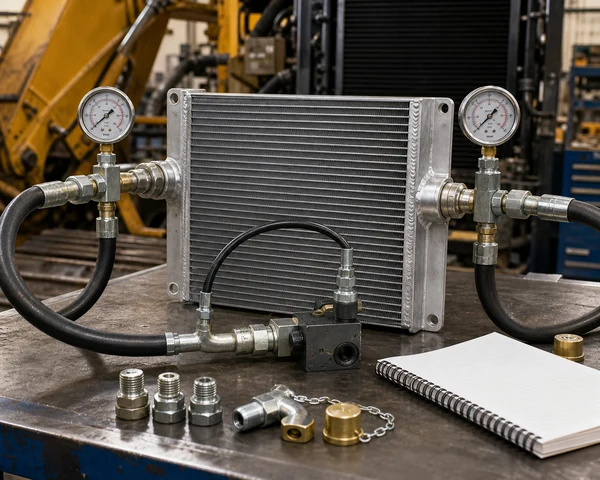
Back pressure checks should compare the cooler inlet path, outlet return path, fittings, bypass valve, and return-to-tank route together.
Back pressure is resistance against the oil flow as it returns through the cooling path. Every cooler creates some pressure drop. That is normal. The problem begins when the pressure drop is higher than the machine can tolerate at working flow, oil viscosity, and temperature. A cooler may appear correct by length and width but still be wrong if the internal passage, tube count, port diameter, or fitting arrangement is not compatible with the circuit.
Construction equipment makes this more complicated than a stationary hydraulic power unit. Excavators, loaders, cranes, compactors, and drilling machines work through cold starts, dusty radiators, blocked fins, high duty cycles, uneven fan performance, and field repairs using substitute fittings. Oil viscosity changes with temperature. A return line that seems acceptable after warm-up may produce high restriction during a cold start. A small adapter may look harmless in the workshop but become a bottleneck when the boom, swing, travel, and auxiliary circuits are working at high flow.
The most obvious symptom is hydraulic oil overheating after the cooler has already been cleaned or replaced. A new cooler should improve heat rejection, but if the core is undersized internally or the fittings are restrictive, temperature may climb again during heavy use. The operator may report that the machine is acceptable at idle but overheats during trenching, lifting, hammer work, high-speed travel, or long continuous cycles. That pattern suggests heat load and flow should be checked together.
Another symptom is slow or inconsistent hydraulic response, especially when oil is cold. Thick oil increases resistance. If the cooler circuit has small ports, crushed hoses, a blocked return filter, or a bypass valve that is not opening correctly, the system can feel heavy until the oil warms. Some machines may show return-line hose movement, whining noise, foaming in the tank, seal leakage, or repeated cooler cracking. These signs do not prove the cooler is the only cause, but they justify a pressure drop check before another replacement is sold.
Field Symptom | Possible Cause / Hydraulic Direction | What to Check First |
|---|---|---|
Oil overheats after cooler replacement | Restriction or insufficient heat rejection | Core size, internal design, fan airflow, port diameter, debris in cooling stack |
Slow hydraulics during cold start | High viscosity plus return restriction | Oil grade, bypass valve, return filter, hose bends, cooler pressure drop |
Cooler cracks or leaks repeatedly | Pressure spike or mounting stress | Bypass function, blocked line, bracket alignment, vibration isolation |
Foaming or aeration in tank | Return flow disturbance | Return path, tank inlet, suction conditions, oil level, restrictions |
Many replacement mistakes happen because the buyer measures the outside envelope and assumes the hydraulic behavior is the same. Core height, width, and thickness matter, but they are not the whole story. Passage size, fin density, oil-side tube count, header construction, port thread, port angle, and internal cleanliness all affect pressure drop. A cooler designed for a lower-flow return line may fit in the frame and still restrict the circuit when installed on a higher-flow machine.
Adapters are another hidden cause. A buyer may accept a cooler with a different thread and use reducing adapters to make the hose fit. That can work in some low-flow applications, but it is risky on high-flow construction equipment. Each reducer, elbow, and sharp bend increases restriction. A 90-degree fitting near the cooler port may also force the hose into a tight bend, adding pressure loss and vibration stress. When the old part has large ports and smooth hose routing, the replacement should not be selected only because the bracket holes line up.
Fan-cooled hydraulic oil coolers add one more variable. If the fan motor voltage, blade direction, shroud clearance, or airflow direction is wrong, the cooler may receive less airflow and the operator may increase engine speed to compensate. Higher flow through a restrictive cooler can increase pressure drop while heat rejection remains poor. This is why Elecdura asks for fan voltage, connector photo, airflow direction, and installation photos when quoting fan-assisted cooler assemblies.
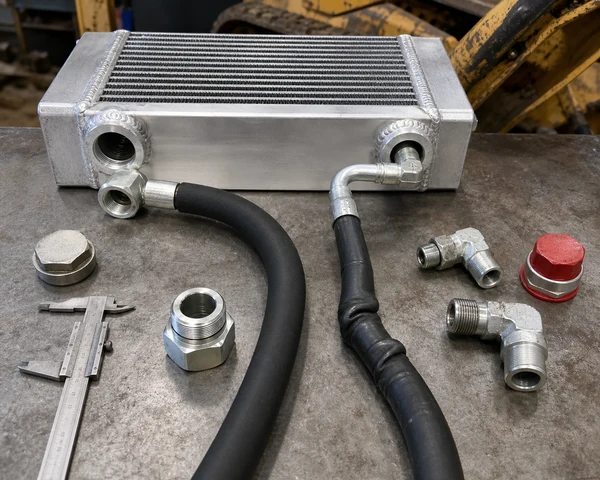
Reducers, sharp elbows, small ports, and tight hose bends can make a correct-looking cooler restrictive under working flow.
The first cause is undersized oil-side passage. A cooler may have a similar face area but a different internal path. If the oil must pass through narrower passages or fewer channels, the pressure drop can rise sharply at high flow. The second cause is wrong port size or thread conversion. A small adapter may reduce the effective flow area even when the hose nut fits. The third cause is hose routing. A hose that is too short, twisted, kinked, or forced against a bracket can act like a restriction and can also transmit vibration into the cooler tank.
The fourth cause is contamination. Old cooler failure often releases debris, sludge, metal particles, or degraded hose material. If the circuit is not flushed and the return filter is not replaced, the new cooler can be contaminated quickly. The fifth cause is a stuck or incorrect bypass valve. Many systems use bypass protection so thick cold oil or sudden flow changes do not force full flow through the cooler. If the bypass is blocked, missing, set incorrectly, or installed in the wrong orientation, the cooler may see pressure it was not designed to handle.
The sixth cause is treating overheating as a cooler-only problem. A blocked radiator stack, weak fan clutch, damaged fan blade, dirty oil, worn pump, incorrect oil viscosity, or overloaded attachment can create more heat than the cooler can reject. In that situation, a larger cooler may help only if airflow and system condition are corrected. Elecdura's supporting article on excavator hydraulic oil overheating causes is useful when the buyer needs to separate heat generation from heat rejection.
Buyers often ask for a larger cooler when a machine overheats. Larger face area can improve cooling, but it does not automatically reduce back pressure. A dense core with narrow oil passages may reject heat well in a lab but create more restriction in a dirty field environment. Conversely, a low-restriction cooler may not remove enough heat if the core area, fin design, fan airflow, or oil dwell time is insufficient. The right replacement balances both heat rejection and acceptable pressure drop.
For sourcing, ask two questions at the same time: how much heat must the cooler reject, and how much pressure drop can the system tolerate at the relevant oil flow and temperature? If those numbers are not available, use practical evidence: machine model, engine power, pump flow, attachment use, original cooler dimensions, port size, failure symptoms, oil temperature readings, and photos of installation space. A supplier can make a better recommendation from incomplete but real evidence than from a part name with no context.
When a workshop can measure pressure, the useful question is pressure drop across the cooling path, not only pressure at one convenient port. A simple field note can record it as Delta P = inlet pressure before the cooler path minus outlet pressure after the cooler return path. Measure at operating temperature and, when safe, during the work condition that creates the complaint. If the reading is taken only at idle, the restriction that appears during hammer work, lifting, travel, or cold-start operation may be missed.
Start with the old cooler. Record the OE number or casting mark if visible, but do not stop there. Measure core height, width, thickness, port center distance, port thread, fitting direction, bracket pitch, fan size, shroud depth, and connector type. Photograph the cooler from all sides before removal, including hose routing and nearby brackets. Check whether the old cooler has signs of external impact, cracked welds, oil stains at the tank, swollen hoses, or rubbed areas where vibration may have caused damage.
Next, check the circuit. Replace or inspect the return filter according to the machine condition. Look for crushed hoses, internally collapsed hoses, overly tight bends, incorrect adapters, and plugged fittings. If the machine uses a bypass valve, confirm that it is present and functional. When possible, measure pressure before and after the cooler at operating temperature and during the condition that creates the complaint. A single idle reading may hide the restriction that appears under heavy work.
Evidence to Collect | Why It Matters | Useful Detail for Supplier |
|---|---|---|
Machine model and serial range | Cooling packages vary by year and region | Brand, model, engine version, attachment use |
Old cooler photos | Confirms ports, brackets, fan, shroud, damage | Front, back, side, port close-ups |
Port and hose data | Controls restriction and installation stress | Thread, port angle, hose ID, adapter type |
Temperature and pressure readings | Separates heat load from restriction | Cold start, warm idle, working load |
Failure history | Shows whether this is fitment, contamination, or system fault | Leak location, time since last replacement, oil condition |
A practical quote should include dimensional and hydraulic checks. Dimensions protect installation. Hydraulic checks protect performance. The most important dimensional checks are core size, overall size, bracket location, port center distance, port direction, shroud clearance, and fan mounting. The most important hydraulic checks are port size, expected flow, oil viscosity, allowable pressure drop, bypass arrangement, and whether the cooler is installed in a return line or a separate cooling loop.
If the buyer cannot provide flow data, the supplier should still ask about machine type and duty cycle. A compact loader used intermittently in a yard has a different heat profile from an excavator running a hydraulic breaker all day. A forestry or mining machine needs more attention to debris impact, vibration, fan protection, and cleaning access. For private-label distributors, the quotation should also confirm whether the cooler will be sold with plugs, caps, pressure-test documentation, foam protection, carton labels, and application cross-reference.
The article on hydraulic oil cooler sizing mistakes expands this point: the cheapest cooler is rarely cheap if it increases returns, installation complaints, or repeat overheating. For replacement business, the winning product is the one that fits the machine, survives shipping, controls pressure drop, rejects heat under real conditions, and can be identified quickly by the next buyer.
Warranty disputes are common when a cooler leaks again after installation. The buyer sees a failed new part. The supplier may see pressure spikes, contamination, wrong mounting, or missing bypass protection. The best way to reduce conflict is to document the installation environment before shipment and before installation. A distributor can require photos of the old part, measurements, and failure symptoms before confirming the replacement. That process may feel slower at the quoting stage, but it prevents the worst outcome: a customer receiving a part that fits physically but fails operationally.
For fleet customers, the cost of repeated failure is not only the cooler. It includes oil loss, cleaning, downtime, labor, missed work, and possibly pump or seal damage. A procurement team should evaluate supplier support based on how well the supplier helps prevent those secondary costs. Elecdura can support cross-reference checks for Komatsu hydraulic oil coolers, Caterpillar hydraulic oil coolers, and other machine families when the buyer provides evidence beyond a short description.
A hydraulic oil cooler replacement may need supporting parts. Hoses should be replaced if they are hardened, swollen, cracked, internally collapsed, or forced into a tight bend. Fittings should be replaced if thread damage, corrosion, or reducers create a restriction. Fans and motors should be checked on fan-cooled assemblies. Filters should be serviced when contamination is suspected. Seals and mounting isolators should be inspected when vibration caused the original failure.
Replacement bundles are especially useful for distributors serving remote jobsites. If a machine is far from the parts warehouse, sending the cooler alone may save freight on the first shipment but cost much more if the customer later needs hoses, fittings, or fan components. A good quote can separate mandatory parts from recommended checks so the buyer remains in control without losing important information.
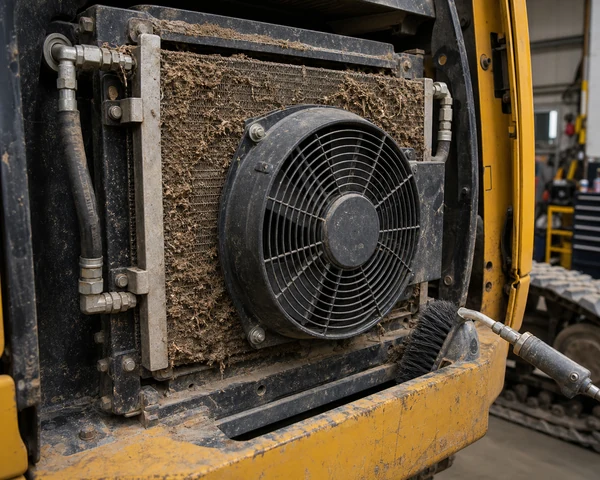
Airflow, debris, fan performance, and mounting clearance can make a correct hydraulic cooler perform poorly in the field.
Confirm whether the complaint is overheating, leak, slow hydraulics, pressure warning, or repeated cooler failure.
Collect machine model, serial range, engine version, attachment use, and duty cycle.
Measure core size, overall size, port thread, port angle, bracket pitch, fan size, and shroud depth.
Check hoses, adapters, return filter, bypass valve, oil condition, and cooling stack cleanliness.
Ask whether the replacement must match OE appearance, improve durability, or solve a known overheating issue.
Request pressure-test, packaging, labels, plugs, caps, and application notes for bulk orders.
Consider a mid-size excavator that receives a replacement cooler after the original unit leaks at the tank seam. The new cooler has almost the same face size, so the shop installs it quickly. During light work, the machine seems normal. During breaker use, oil temperature rises and the return hose becomes harder than expected. The old cooler used large straight ports, but the replacement required reducing adapters and a sharp elbow because the port angle was different. The cooler face matched, yet the flow path changed.
In this kind of case, the solution may not be a bigger cooler. The first correction is to remove unnecessary reductions, restore smooth hose routing, confirm bypass function, and check the return filter. If pressure drop remains high, then a cooler with different internal passage or port arrangement should be selected. This is a sourcing issue as much as a repair issue. A distributor that asks for port photos and hose routing before shipment can prevent the wrong replacement from becoming a field failure.
Customers do not always use the phrase back pressure. They may say the machine runs hot, the hose is swelling, the cooler keeps cracking, or the hydraulic system feels weak. Sales teams should translate those complaints into practical questions. When does the symptom appear? Cold start or full load? After cooler replacement or before? Was the return filter changed? Were any adapters used? Does the machine run a breaker, mulcher, crusher, or other attachment that increases heat load?
This conversation helps the buyer feel supported rather than interrogated. It also protects the supplier from quoting a part into an unresolved system fault. If the customer cannot provide pressure readings, photos and operating history still help. A good quote can say, for example, that the cooler matches the measured dimensions but hose routing and bypass condition should be checked because repeated cracking suggests pressure or mounting stress. That is useful buying advice, not blame.
For an export or wholesale order, include a short evidence pack with each hydraulic cooler inquiry. The pack should contain the machine model, serial range, old cooler photos, measured dimensions, port thread and direction, fan voltage if fitted, failure location, and any known temperature or pressure readings. If the buyer is building stock rather than replacing one machine, add target machine families and expected monthly demand. This allows the supplier to decide whether a direct replacement, cross-reference item, or custom cooler path is more appropriate.
Elecdura can quote more accurately when the request shows how the cooler is used. A cooler for a standard excavator replacement, a hydraulic breaker machine, and a mobile power unit may require different attention even if the product name is similar. The more specific the request, the less likely the buyer is to receive a cooler that solves only the visual fitment problem while leaving the hydraulic restriction untouched.
Hydraulic oil cooler back pressure is a system problem, not just a cooler problem. A replacement cooler should be selected with both fitment and flow in mind. If the old cooler failed from impact and all other conditions are normal, a direct replacement may be enough. If the machine overheats again, cracks coolers, feels slow when cold, or uses reducers and tight hose bends, the buyer should slow down and collect pressure, temperature, routing, and bypass evidence before ordering.
For distributors and repair networks, this evidence-based process creates better quotes and fewer returns. Elecdura can help match hydraulic oil coolers by OE number, dimensions, photos, ports, bracket layout, fan data, and application context. The best request includes the failed part, the machine, the work condition, and the symptoms. That gives the supplier enough information to recommend a cooler that fits the machine and protects the hydraulic system.