English
Views: 0 Author: Elecdura Publish Time: 2026-08-05 Origin: Elecdura
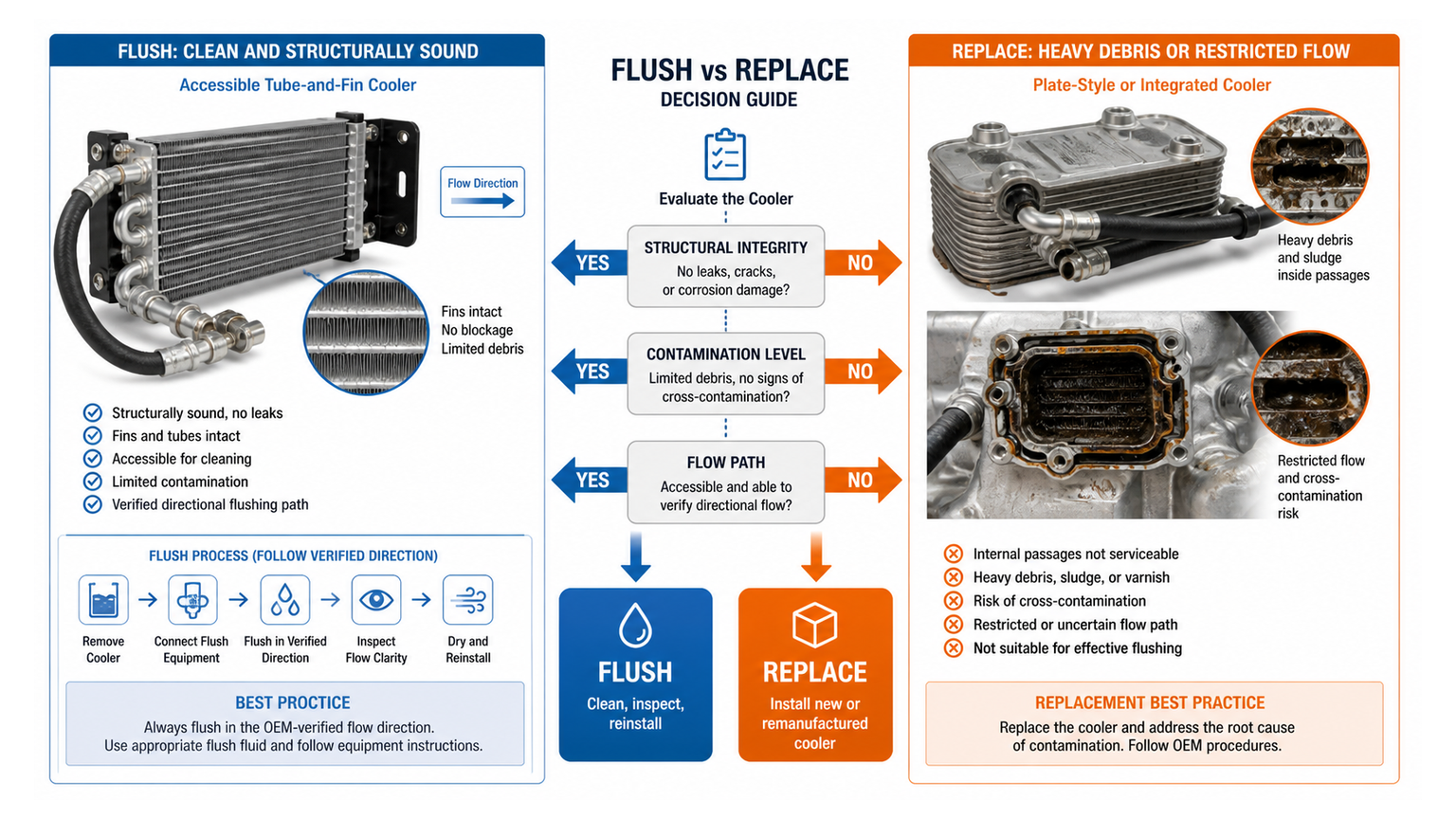
A transmission cooler should be flushed only when its construction permits effective cleaning, the contamination is limited, the lines remain sound, and the service procedure can prove both cleanliness and adequate flow. Replacement is the safer decision after severe internal transmission failure, heavy metal or clutch-material contamination, an inaccessible thermostatic bypass, a damaged heat exchanger, fluid cross-contamination, or a failed flow test. "Fluid comes out of the return line" is not enough evidence that a cooler is clean.
The decision matters because debris left inside a cooler or hose can return to a repaired transmission within minutes. A new or rebuilt transmission may then suffer valve-body sticking, solenoid contamination, bearing damage, or restricted lubrication even though the original internal parts were replaced correctly. Elecdura's oil cooler product range includes different heat-exchanger formats, and each format creates a different cleaning and replacement boundary.
Condition | Flush or replace? | Required evidence |
|---|---|---|
Routine fluid service with no internal failure and no debris | Flush may not be necessary; follow the vehicle procedure | Fluid condition, service history, and cooler flow remain normal |
Light varnish or old fluid in accessible metal lines and a serviceable cooler | Flush may be acceptable | Approved method, clean discharge, verified flow, and complete drying |
Torque-converter or clutch failure with visible friction material | Replace cooler or use a validated remanufacturing process | Debris type and cooler construction show that passages cannot be proven clean |
Metal fragments, bearing material, or gear damage | Replace | Hard particles can remain trapped and later damage the repaired unit |
Coolant and ATF mixed inside a radiator-integrated cooler | Replace the failed heat exchanger and service the complete system | Cross-leak source is confirmed and contamination is removed from transmission and lines |
Hose lining is swollen, delaminated, heat-hardened, or contaminated | Replace hose/line assembly | Flushing cannot restore hose structure or remove embedded debris reliably |
Flow remains below the manufacturer's requirement after cleaning | Replace | Restriction is still present regardless of visual fluid clarity |
If the original problem is not yet defined, first review the existing guide to transmission oil cooler failure and line leaks. That page identifies leak and overheating sources. This article addresses a later question: after contamination or transmission repair, can the cooler circuit be trusted again?
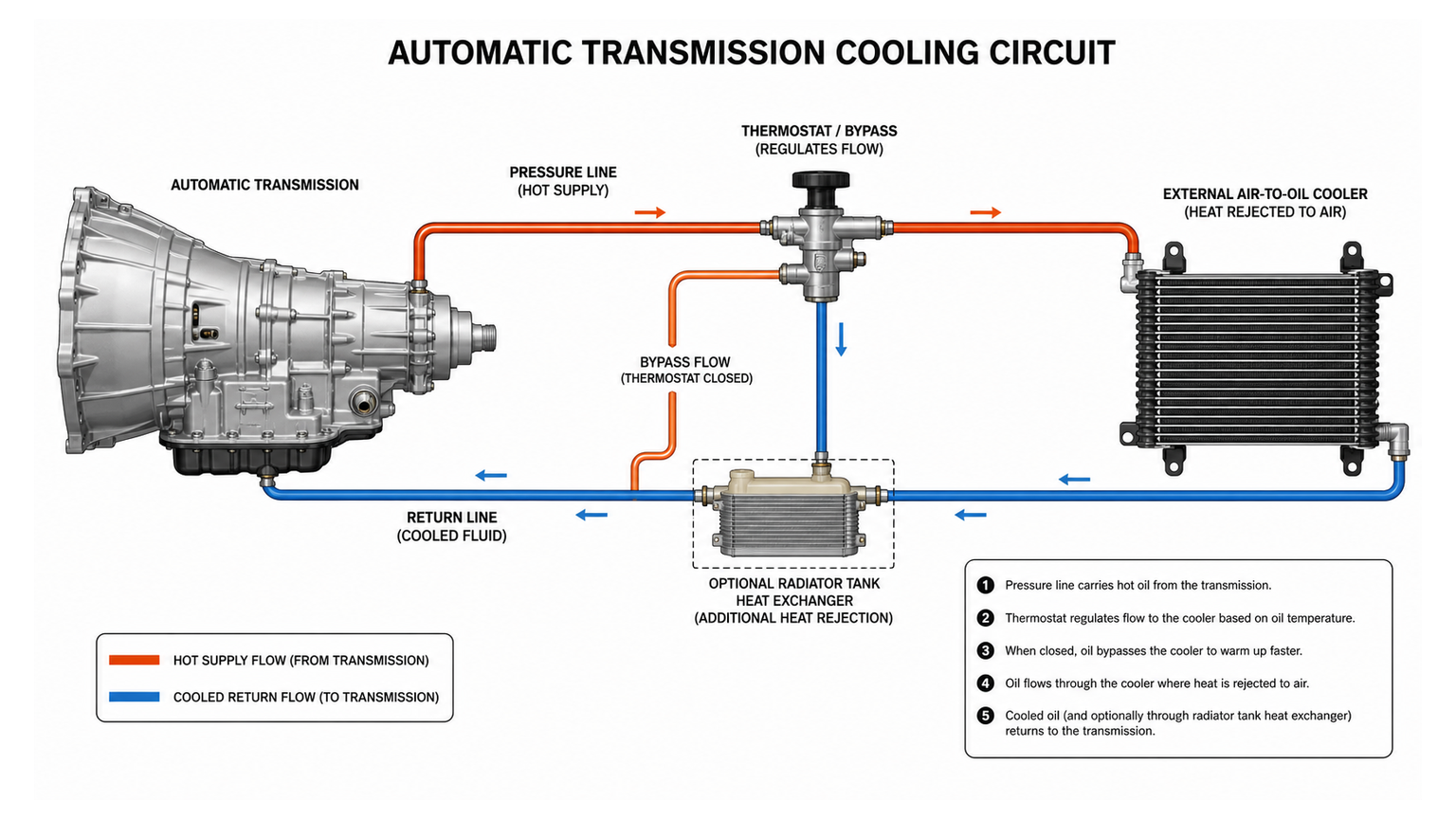
Automatic transmission fluid leaves the transmission carrying heat and any suspended contamination generated inside the unit. Depending on the application, it may pass through a radiator-integrated oil-to-coolant heat exchanger, an external air-to-oil cooler, a thermostat or bypass, rigid tubes, flexible hoses, quick-connect fittings, and sometimes an auxiliary filter before returning.
Every restriction, pocket, valve, and parallel passage can retain debris. A stacked-plate cooler may divide flow among many narrow channels. A tube-and-fin cooler may have long serpentine passages. A thermostatic bypass can close a cleaning path when cold. A flexible hose can hold particles in a damaged inner lining. The circuit therefore cannot be judged as one empty pipe.
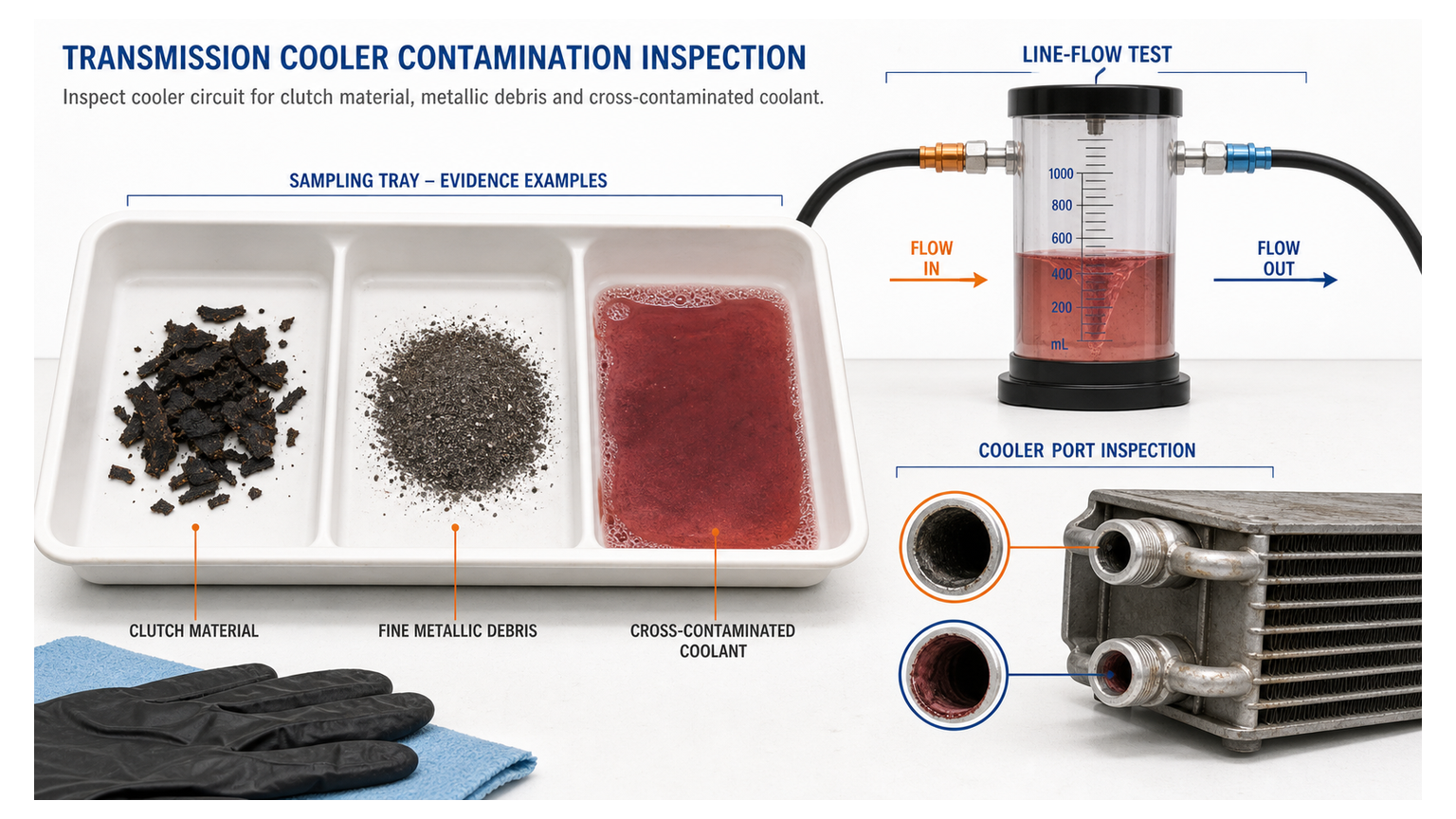
Clutch and band material can be fibrous, soft, and adhesive when mixed with oxidized fluid. It may settle in cooler plates or cling to varnished surfaces. Metal particles can be harder and more damaging; small fragments can migrate through a visually clean stream and score precision hydraulic parts. A magnet captures only ferrous material and does not prove that aluminum, bronze, or friction debris is absent.
Overheated ATF oxidizes and forms deposits. Varnish is not simply discoloration; it can narrow passages and hold additional debris. A cooler that passes cold solvent may behave differently with hot operating fluid, especially if a thermostatic element or partially collapsed hose changes position.
The flushing liquid can become visually clear after the easiest flow path is washed while low-flow branches remain contaminated. Acceptance needs more than color: direction changes where approved, captured-particle inspection, measured flow, pressure behavior, and knowledge of the cooler's internal path.
An integrated cooler transfers heat between ATF and engine coolant inside the radiator tank. If the internal barrier leaks, ATF and coolant can mix. This is not a normal flushing problem; the failed radiator or integrated heat exchanger must be replaced, and both fluid systems require assessment. Coolant can damage transmission friction materials and bearings, while ATF can contaminate the cooling system.
Even without a cross-leak, integrated cooler geometry may make debris removal difficult. Some vehicle makers specify replacement after certain failure modes. Their procedure takes priority over a generic flushing practice.
Tube-and-fin units often use a long tube path with external fins. Their accessibility can make flushing more predictable than a highly divided plate cooler, but a kinked tube, impact damage, corrosion, or heavy varnish still requires replacement. Inspect the core and mounting before investing in cleaning.
These designs provide high heat-transfer area in a compact package. They may also contain many narrow or parallel passages that trap failure debris. If severe clutch or metal contamination has entered a non-disassemblable stacked-plate cooler, replacement often gives better risk control than repeated flushing.
A thermostat can route cold fluid around part of the cooler. Unless the service method opens or accounts for the bypass, cleaning fluid may not reach the entire circuit. Do not remove or force a valve without approved information. A bypass stuck closed, open, or partially restricted also changes operating temperature and flow after service.
An auxiliary cooler may be installed before or after the radiator cooler according to the application design. The connection order affects warm-up and heat rejection. Record the original routing before disassembly and avoid assuming that port orientation alone reveals internal flow direction.
Darkened fluid during scheduled service does not automatically mean the cooler must be flushed or replaced. Confirm odor, debris, operating temperature, and transmission behavior. Some service methods exchange fluid through the normal circuit without a separate solvent flush. Follow the transmission and vehicle maker's process.
If the circuit is serviceable, the lines are intact, and no internal failure generated debris, an approved cooler flush may be reasonable. The process must be compatible with seals, hoses, aluminum or copper alloys, and the future ATF. Residual cleaning agent and moisture must be removed.
Visible friction material substantially increases the comeback risk. Determine whether the cooler can be replaced separately, is integrated into the radiator, or is part of a thermostatic module. A low-cost cooler replacement is usually easier to validate than an unmeasurable cleaning result. Lines and the torque converter may also require replacement or controlled cleaning according to the repair plan.
Bearing, pump, planetary, gear, or converter damage can distribute metal throughout the cooler circuit. Replace non-disassemblable coolers and questionable hoses. Inspect fittings, thermostats, filters, and the radiator-integrated section. Do not install the repaired transmission until the return path is controlled.
Water changes lubrication and friction behavior; coolant introduces additional chemistry. Identify the leak source before replacing parts. A radiator internal cooler failure requires a new radiator or approved integrated component, while flood exposure may require a different scope. Simply flushing until the fluid looks red does not prove that moisture is gone.
Use the service information for the exact transmission and vehicle. The sequence below defines evidence categories rather than universal pressure, solvent, or flow values.
Photograph the pan, magnets, filter, drained fluid, cooler ports, and any failed components. Separate ferrous from non-ferrous particles where practical. The evidence determines how aggressively the cooler circuit must be controlled.
Trace outlet and return lines from the transmission. Identify the radiator heat exchanger, external cooler, thermostat or bypass, filters, unions, quick connectors, and flexible sections. The broader engine cooling parts structure helps distinguish the transmission circuit from engine oil and coolant components that may share the radiator area.
Reject crushed tubes, damaged fins, corrosion, loose mounts, leaking seams, heat-hardened hoses, swollen lining, and damaged quick-connects. Applying pressure to a weakened component can create a new leak or dislodge material without removing it safely.
The method must suit the cooler materials, seals, hoses, and transmission requirements. Avoid shop air, uncontrolled pressure, water, or generic solvent assumptions. Some systems require dedicated equipment, pulsed flow, controlled direction reversal, filtration, or cooler replacement rather than cleaning.
Pass the discharge through an inspection screen or filter appropriate to the procedure. Continue only within the approved process and observe whether debris persists. Record photographs of captured material. A final clean-looking sample is stronger evidence when earlier debris quantity and flow trend are documented.
Flow is the functional acceptance test. Compare the result with the service requirement at the stated fluid temperature and test setup. Pressure alone can rise because of restriction; free discharge alone can exist through only part of a parallel cooler. If flow cannot meet the requirement, replace the restricted component.
High upstream pressure with low flow suggests restriction. Low pressure and low flow may indicate an equipment, supply, or bypass problem. Normal flow does not prove zero debris, but it does show that heat-transfer fluid can move through the tested path. Use particle evidence and flow together.
Remove residual cleaning material according to the approved method. Cap open ports immediately. Do not leave a cleaned cooler exposed to dust or humidity while the transmission is being installed. Replace seals and clips that are defined as single-use or damaged.
A new heat exchanger connected to contaminated or damaged lines is not a complete repair. Rigid steel or aluminum tubes may be cleanable if they are straight, uncorroded, and accessible. Flexible hoses require closer scrutiny because their inner lining can delaminate, trap particles, or collapse internally.
Reject swelling, blistering, cracking, heat hardening, soft spots, damaged crimps, internal delamination, or oil seepage. A hose that passes fluid on the bench may collapse under suction, bend under installation, or release embedded debris later.
The fitting body, tube bead, retainer, O-ring, and port condition work together. Corrosion, a spread retainer, damaged sealing land, or wrong replacement O-ring can create a leak that is incorrectly blamed on the cooler. Protect connectors during shipment and installation.
A kink changes section area and can initiate cracking. If the tube has been crushed or sharply bent, replacement is more reliable than reshaping. Confirm route and clearance so the new line does not contact the exhaust, suspension, steering, or body.
Repair scenario | Preferred cooler action | Related action |
|---|---|---|
Routine maintenance, no failure debris | Use normal service process | Confirm fluid specification and level procedure |
Transmission removed for a seal repair, fluid otherwise clean | Inspect; flush only if specified | Cap lines and prevent shop contamination |
Clutch pack failure with heavy friction material | Replace non-disassemblable cooler | Control converter, lines, thermostat, and filter |
Metal-producing internal failure | Replace cooler and questionable hoses | Inspect every return-path component |
External cooler impact leak | Replace damaged cooler | Inspect mounts, airflow, and line stress |
Radiator internal cross-leak | Replace radiator/integrated exchanger | Service both cooling and transmission systems |
Flow test fails after an approved flush | Replace | Find remaining restriction or bypass fault |
Aftermarket buyers should not quote a transmission cooler by approximate core size alone. Start with the OE reference, vehicle and transmission application, then confirm the heat-exchanger format and connections. Elecdura's wholesale oil cooler program can support mixed applications, while the replacement decision remains specific to each circuit.
Confirm whether the cooler is radiator-integrated, external, auxiliary, thermostat-equipped, or supplied with lines and brackets. Record port type, thread or quick-connect style, center distance, core dimensions, mounting points, airflow direction, and whether an electric fan is included.
Towing, delivery, taxi, off-road, high-ambient, and stationary work can increase heat load. An OE-style replacement and an auxiliary upgrade solve different problems. The on-highway application page and off-highway cooling page illustrate why operating conditions belong in an RFQ. Where an air-to-oil cooler shares the front stack, also inspect the radiator cooling fan assembly and the shroud airflow path; restricted stack airflow cannot be corrected by flushing the fluid circuit.
New cooler ports should be capped. Internal passages must be protected from machining chips, dust, moisture, and packaging debris. Fins and fittings need support against impact. Sample inspection can include visual cleanliness, leak testing evidence, critical dimensions, connector or fitting checks, and protected storage. Related technical catalogs are available through the download center.
An open port can admit carton fibers, foam fragments, metal dust, or humidity. Protective caps should fit securely without leaving material inside the port. Keep the cooler sealed until installation and cap removed lines during workshop service.
OE number and transmission code when available
Vehicle make, model, year, engine, and market
Radiator-integrated, external, or auxiliary configuration
Core, bracket, port, fitting, thermostat, and line photographs
Failure mode and whether metal, friction material, coolant, or water entered the circuit
Target quantity, annual demand, destination, and packaging specification
For broader category planning, buyers can review Elecdura's cooling parts product center, aftermarket supply capabilities, engine oil cooler category, and hydraulic oil cooler category. These are adjacent heat-exchanger families, not substitutes for a transmission-specific match.
No. Cooler design, debris type, thermostatic bypasses, hose condition, and manufacturer procedure determine whether cleaning can be validated. Severe friction debris, metal, coolant contamination, physical damage, or failed flow testing usually favors replacement.
Use the approved process and combine discharge-particle inspection with a specified flow test. Clear liquid alone is weak evidence because contamination may remain in low-flow passages. Record the debris and test result for the repair file.
It depends on the original failure and cooler design. After a metal-generating or heavy clutch-material failure, replacing a non-disassemblable cooler is often the most controllable choice. Follow the transmission rebuilder and vehicle maker requirements.
Do not use uncontrolled shop air as a universal method. Excessive pressure can damage a cooler or atomize solvent, and air flow does not prove cleanliness. Use equipment and limits approved for the exact service procedure.
Send the OE and transmission references, vehicle application, configuration, port and bracket photographs, core dimensions, thermostat or bypass details, failure contamination type, quantity, and destination. Submit these through the Elecdura contact page so the RFQ distinguishes the cooler from lines, radiator, and auxiliary components.
A transmission cooler flush is acceptable only when the circuit is structurally sound, contamination is within a serviceable level, every passage can be addressed by the approved method, and the result passes cleanliness and flow checks. Replace the cooler when debris severity, internal geometry, cross-contamination, physical damage, hose condition, or test failure makes cleanliness uncertain. The objective is not to save the old heat exchanger; it is to protect the repaired transmission from whatever the return line could carry back.
For a replacement quotation, send the cooler OE reference, transmission and vehicle application, configuration and port photographs, contamination type, line condition, required quantity, and packaging requirements. Those details allow Elecdura to review the correct replacement scope before a wholesale order.