Your Whole New Supply Chain For Cooling & AC Parts
Your Whole New Supply Chain For Cooling & AC Parts
Views: 0 Author: Site Editor Publish Time: 2026-11-18 Origin: Site
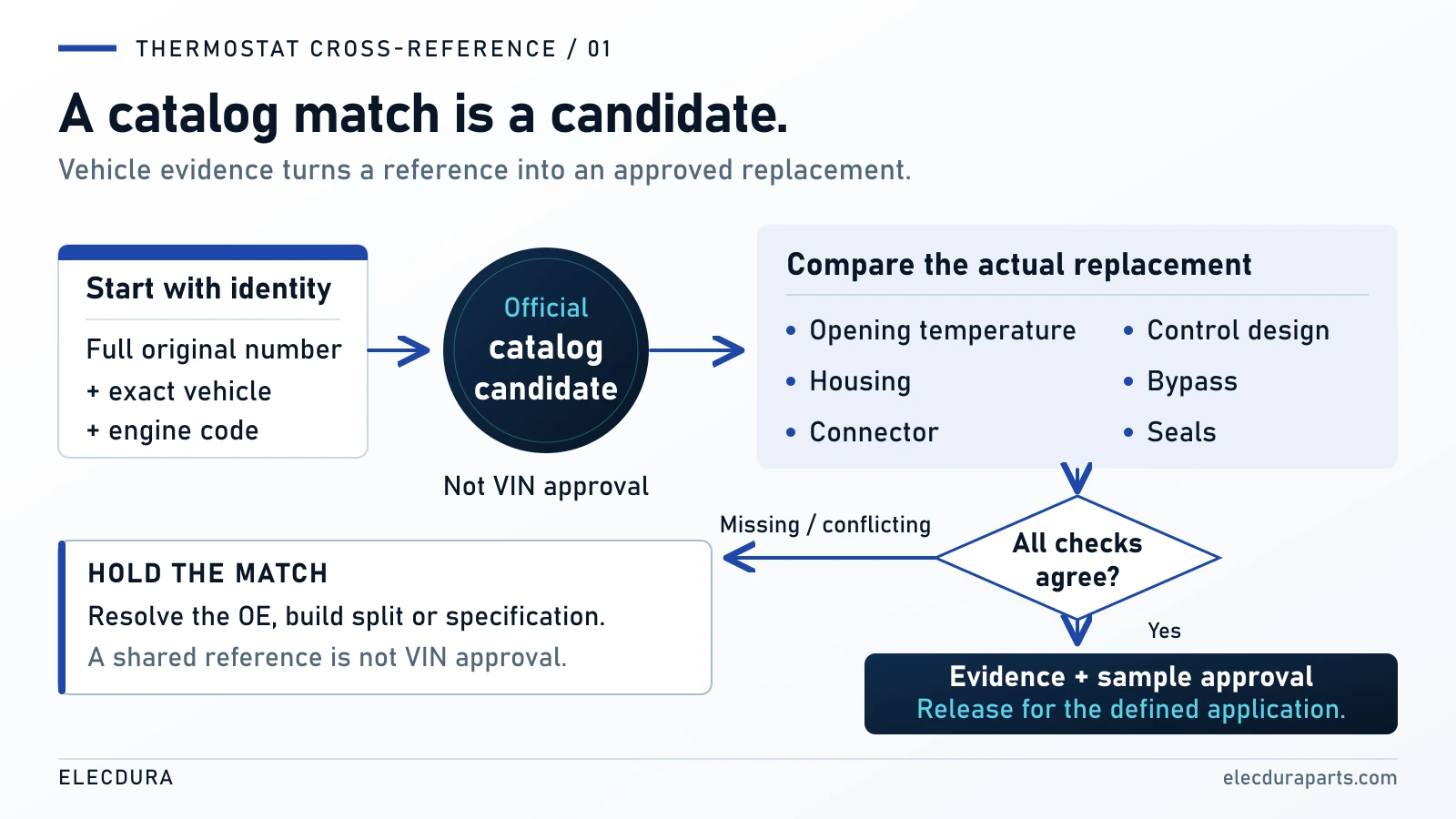
To cross-reference an automotive thermostat, start with the complete OE service number and exact vehicle application. Use an official aftermarket catalog to find candidate replacements, then compare the opening temperature, control design, housing, bypass, electrical connections, dimensions and supplied seals. Approve the reference only after the application notes and required sample checks agree.
A number match helps you find a part; it does not settle every fitment question. A bare thermostat and a complete housing may share an application reference while representing different purchases. Similar-looking valves can also have different temperature ratings or bypass arrangements. For distributors and wholesale buyers, the aim is to create a documented replacement record that another person can check before ordering.
Keep each number with its source and purpose. Putting every reference into one “equivalent numbers” cell loses information that may determine whether the part can be supplied.
Number or record | What it tells you | What still needs checking |
|---|---|---|
Vehicle-maker service part number | The number used in the vehicle-maker's parts record | Exact vehicle, engine, production split, original sales market and current replacement notes |
Aftermarket brand number | The brand's own orderable product reference | Its listed applications, technical specification and package contents |
OE reference in an aftermarket catalog | A comparison association recorded by that catalog | Whether the candidate covers the particular vehicle and the same component level |
Official supersession | A documented replacement of an earlier service number | Direction of replacement, effective vehicle range and any additional parts or instructions |
Casting, tooling or supplier marking | A clue to the installed component's identity | Whether the marking is actually an orderable service number |
A list of several OE references under one aftermarket number does not establish the order of an OE supersession. It also does not prove that every vehicle associated with one reference accepts all the others. Keep brand references separate from genuine service numbers when comparing OEM and aftermarket thermostat sourcing.
An official aftermarket catalog is official information from that parts brand; it is not automatically a vehicle-maker EPC. Use it to identify and compare candidates, and use the vehicle-maker's current parts information or parts department when a VIN-dependent service number or supersession remains unresolved.
Official resource | How to use it | Fields to retain | Limit of the evidence |
|---|---|---|---|
The page provides a product-number input for NRF, original or manufacturer references, and vehicle-selection fields. Open the candidate's detail page. | NRF number, listed OE references, opening temperature, housing type and any published vehicle data | Read the actual product record. A vehicle search form does not mean every product has a populated compatibility list. Prices require login. | |
Use the vehicle-manufacturer comparison list, then follow the MAHLE number into the application and installation-dimension sections. | Comparison reference, MAHLE number, engine designation, manufacturing period and dimensions | This is the 2016 edition. It is a useful lookup example and historical reference, not a current availability or supersession check. | |
Use the specification headings as a comparison checklist and obtain the exact candidate's current record. | Part number, product number, temperature, flange diameter, jiggle pin/check valve and type | The page's field headings alone do not confirm a specific vehicle application or an OE interchange. |
For the MAHLE PDF, the printed contents point to vehicle applications on page 36, installation dimensions on page 116, the vehicle-manufacturer comparison list on page 137 and competitor comparisons on page 142. Search a complete number in the relevant comparison list, then check the application row rather than stopping at the first text match.
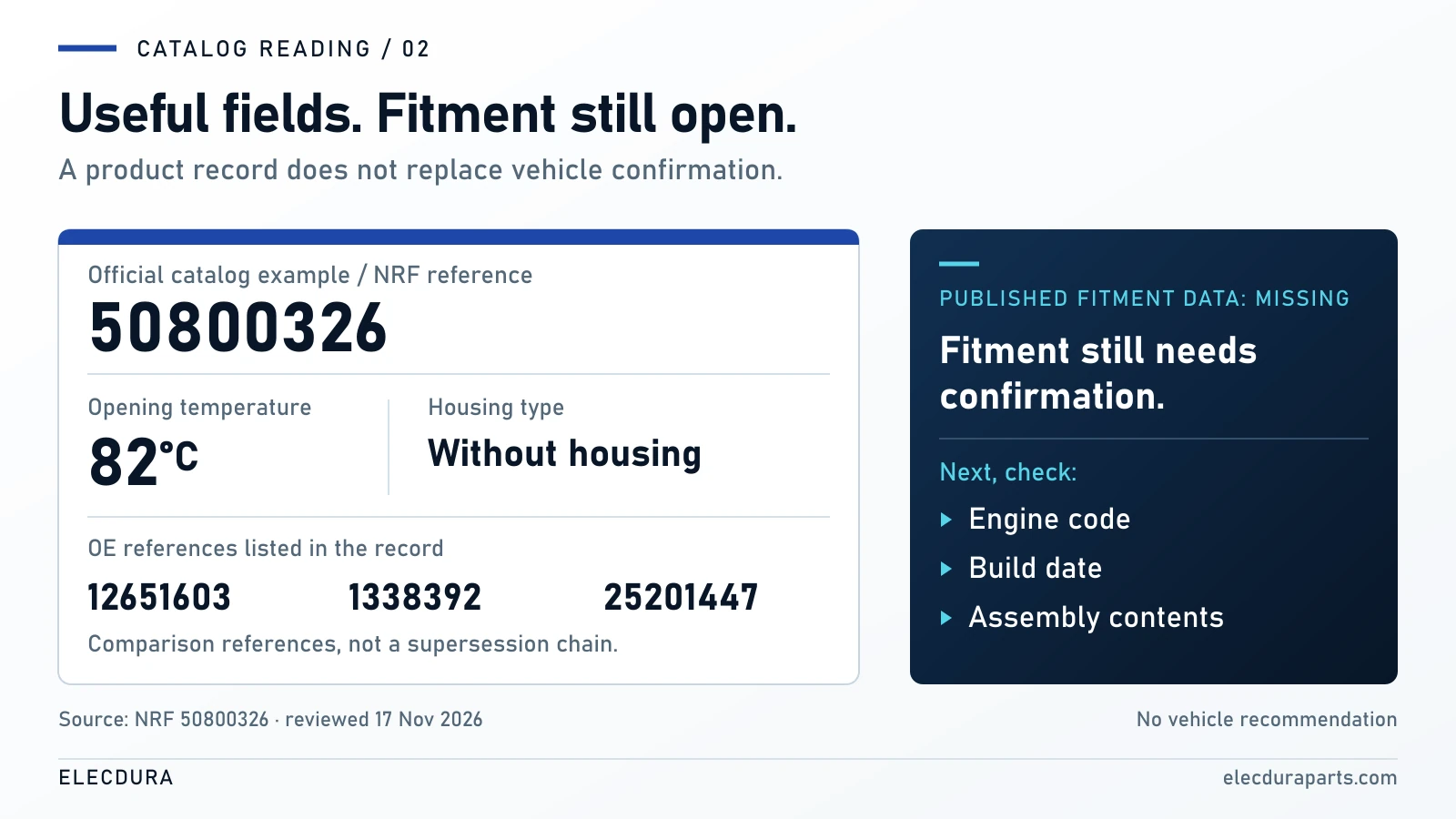
The NRF 50800326 record illustrates why those checks must stay separate. At the time of review, the page identified an OPEL Insignia 2.0 17- thermostat, showed an opening temperature of 82°C and specified “without housing.” Its visible OE-reference field included 12651603, 1338392 and 25201447. The vehicle-compatibility section stated that compatibility data had not yet been published.
NRF 50800326 illustrates the difference between published product fields and confirmed vehicle fitment. Catalog record reviewed 17 November 2026.
A buyer can record those product fields, but cannot treat the abbreviated model heading as a VIN-level approval. The next action is to obtain application confirmation for the exact engine and production date, then check the required housing and seals. This is an example of reading a catalog record, not a recommendation that these references fit an unspecified vehicle.
A catalog reference identifies a candidate. Resolve missing or conflicting evidence before approving the replacement for a defined application.
Record the full number from the parts record or removed part, preserving prefixes and suffixes. Label each marking by its location: valve, housing, sensor, label or previous invoice. Photograph the front, rear, sealing face, outlets, connector and mounting holes. A molded housing code needs identifying before it becomes an OE search input.
Retain both the number as seen and any normalized search version. Removing spaces may help a search, but shortening the actual reference can hide a revision or package distinction. If a result appears only after dropping a suffix, keep it as a candidate and investigate the difference.
Collect make, model, production date, engine code, displacement, fuel type, VIN or chassis details where available, and original sales-market specification. Add transmission, emissions or equipment information when the application record calls for it. The destination of the replacement shipment is not proof of the vehicle's original specification.
Compare the catalog's engine and date boundaries with that record. If two candidates divide at a production date or engine code, resolve that split before comparing price. When the public aftermarket record lacks sufficient application detail, ask the relevant parts department or supplier to document the missing match.
Record the specified opening temperature and unit, and establish whether the value describes initial opening or another test condition. Do not substitute an unrelated thermostat's test limits. A different temperature rating requires documented application approval; physical fit alone is not enough.
MAHLE's thermostat identification explanation provides a useful brand-specific example: THD 159 87 D identifies a sleeve-valve thermostat, 87°C opening temperature and an enclosed gasket. MAHLE also distinguishes TX inserts, TH housings, TI integral thermostats and TM map-controlled thermostats. Use this explanation for MAHLE references, rather than assuming every brand encodes temperature or seals in the same way.
Separate a conventional wax-element valve, a bypass or sleeve-valve design, an insert and an electrically heated map-controlled thermostat. The MAHLE resource explains that a map-controlled thermostat has an electrical heating resistor in its operating element, controlled according to an engine-control-unit map.
For such a candidate, check the control function, connector keying and pin count, applicable electrical specification, housing and coolant routing. Do not assume that a connector belongs to a coolant-temperature sensor merely because it sits on the thermostat assembly. Check the actual component description or service information.
For assemblies, compare bolt-hole count and spacing, mounting orientation, housing material, hose-outlet number and direction, bypass passages, sensor ports, connector location, brackets and sealing faces. Note the bleed valve or jiggle pin where fitted. A rotated outlet or different bypass arrangement is a reason to stop and investigate, even if the main flange appears to fit.
For an insert, compare flange diameter, overall height, valve diameter and the bypass valve's diameter and depth where applicable. Use the drawing's datum points so that the supplier and buyer measure the same feature. Photographs are useful for screening; they cannot supply a missing temperature or electrical specification.
Write the supplied configuration explicitly: insert only; thermostat with gasket; empty housing; thermostat and housing; housing with sensor; or electrically controlled assembly. Ask which O-rings, molded seals, flat gaskets, sensors and hardware are included. Do not infer the box contents from a family photograph.
When an alternative is supplied at a different assembly level, compare it as a different quotation line. A related internal valve does not make a complete assembly and an insert equal pack-for-pack replacements.
Save the source URL or catalog edition, access date, exact product number, application notes, drawing or label photographs, and unresolved questions. Where sources disagree, identify the conflicting field rather than averaging the information or selecting the cheaper option. Inspect a sample against the approved record before releasing a new interchange for a bulk purchasing program.
For a claimed supersession, ask for the vehicle-maker's replacement note or confirmation from its parts department. Record the old number, replacement number, direction of substitution, applicable VIN or production range, and any associated hoses, connectors, seals or installation instructions. A supplier's interchange spreadsheet is supporting information, not the manufacturer's replacement history.
Conflict | Purchasing decision |
|---|---|
Opening temperature or test definition differs | Hold the candidate until the application specification or an approved service alternative resolves it. |
Mechanical and map-controlled designs differ | Do not approve a direct interchange without documented vehicle-maker instructions. |
Insert, housing, sensor or seal contents differ | Create separate package lines and determine which parts are needed for the repair. |
Bolt pattern, bypass, outlet, connector or sealing interface differs | Stop approval and verify whether a documented replacement arrangement exists. |
OE references agree but application detail is missing | Retain candidate status; obtain engine and production-range confirmation. |
Supersession direction or additional parts are unclear | Obtain the current replacement note before releasing the order. |
Keep old numbers searchable in your own catalog, but link them to the approved replacement with the application limits intact. Do not overwrite the evidence trail when a reference changes.
Use one row per candidate and purchasing unit. If two brands list the same OE reference, keep two source-specific rows until each has been checked.
Field group | What to save |
|---|---|
Identity | Internal SKU; complete OE service reference; aftermarket brand and number; separately labeled casting or supplier markings |
Vehicle | Make, model, engine code, production date/range, original sales market and VIN/chassis confirmation where needed |
Function | Opening temperature with unit and definition; mechanical or map-controlled design; applicable electrical data |
Physical match | Dimensioned drawing, bypass arrangement, bolt pattern, outlet direction, connector and sealing interfaces |
Package | Insert/housing/assembly level and included seals, sensor and hardware |
Replacement history | Documented supersession direction, date/VIN limits and additional-parts requirements |
Evidence and release | Source and date; sample result; open questions; approver; approval scope and revision |
Use clear release statuses. Candidate means a reference has been found. Catalog-qualified means the recorded application and specification checks agree. Approved for the purchasing program means the required sample checks and buyer approval are complete. These are useful internal control labels, not certifications issued by a catalog provider.
Check identity and batch markings, label and barcode, supplied accessories and transit protection. Then compare the sample's mounting geometry, outlet direction, connector, bypass, sealing surfaces and dimensions with the approved evidence.
Define any opening-temperature, valve-travel, leak or electrical test using the exact product's agreed method and limits. A bench opening test checks one characteristic; it does not establish the complete vehicle application, ECU compatibility or service durability. Record the result and any deviation before changing the candidate's approval status.
Supplier selection follows that technical comparison. The engine thermostat brand comparison guide can help organize sourcing questions, but a brand name does not replace the application record for the part being ordered.
Compare the required configuration with the Elecdura engine coolant thermostat range. The Download Center also lists an engine coolant thermostat catalog for range review.
Send a thermostat sourcing enquiry with the full OE list, engine and production details, original-part photographs, temperature marking, required assembly contents, quantities and destination market. Ask the supplier to return its own product reference, proposed application, package contents and any unresolved fields. Keep those answers with the purchasing record so the quotation can be checked against the same specification as the sample.
It is a useful starting point. Confirm the exact engine and production application, current replacement notes and assembly contents, particularly when several candidates appear for the same reference.
Appearance cannot establish the temperature rating, bypass function or electrical design. Compare the technical and application records before approving the match.
No. An OE comparison list links references within that catalog. A supersession needs the vehicle-maker's documented replacement relationship and its conditions.
Save the fields it does show and leave vehicle approval open. Request confirmation against the exact engine, production date and VIN/chassis information where needed. Do not turn an abbreviated model description into a complete fitment claim.