Your Whole New Supply Chain For Cooling & AC Parts
Your Whole New Supply Chain For Cooling & AC Parts
Views: 0 Author: Site Editor Publish Time: 2026-11-21 Origin: Site
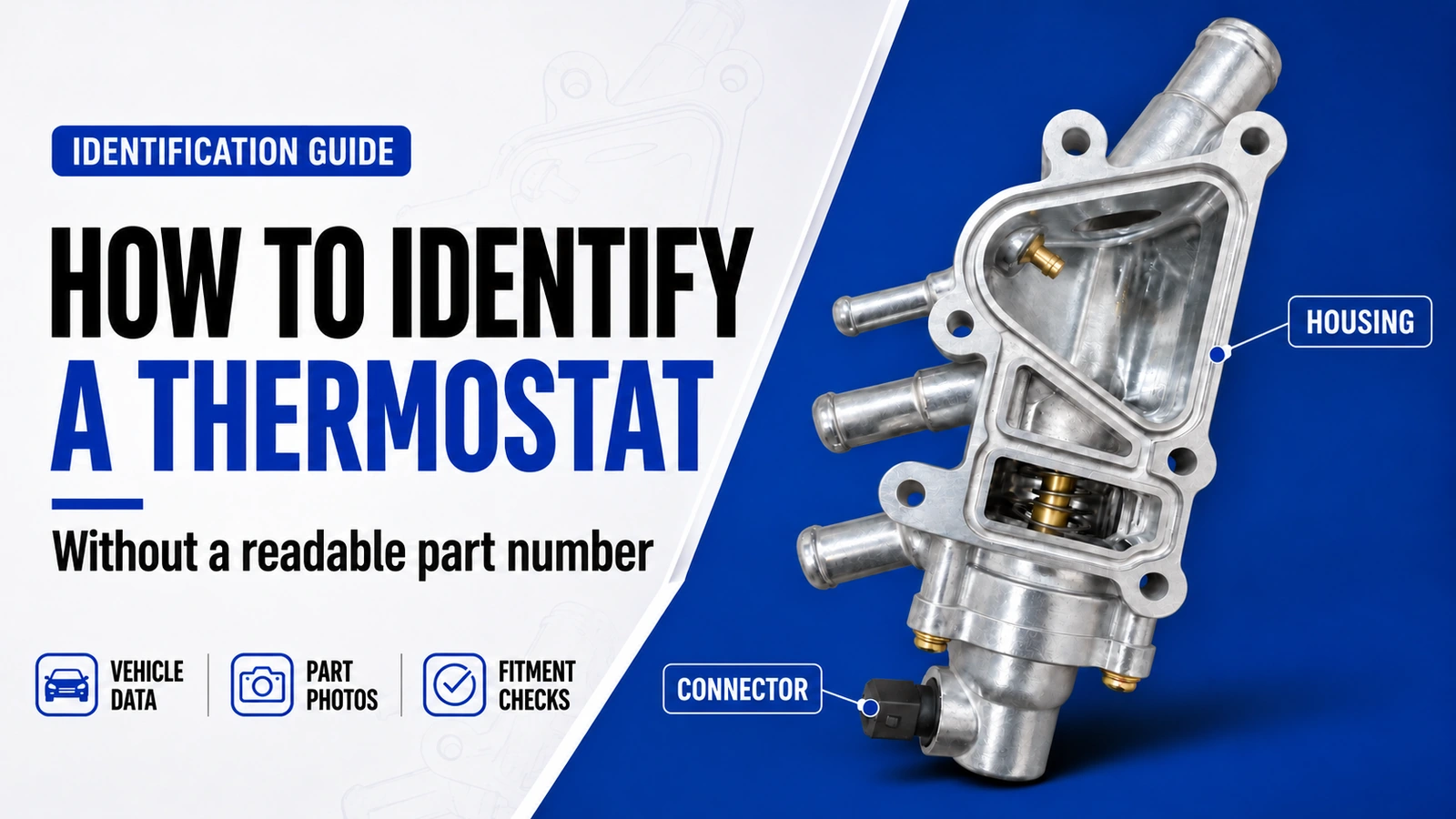
Photo-based editorial cover showing a thermostat housing and its visible connector.
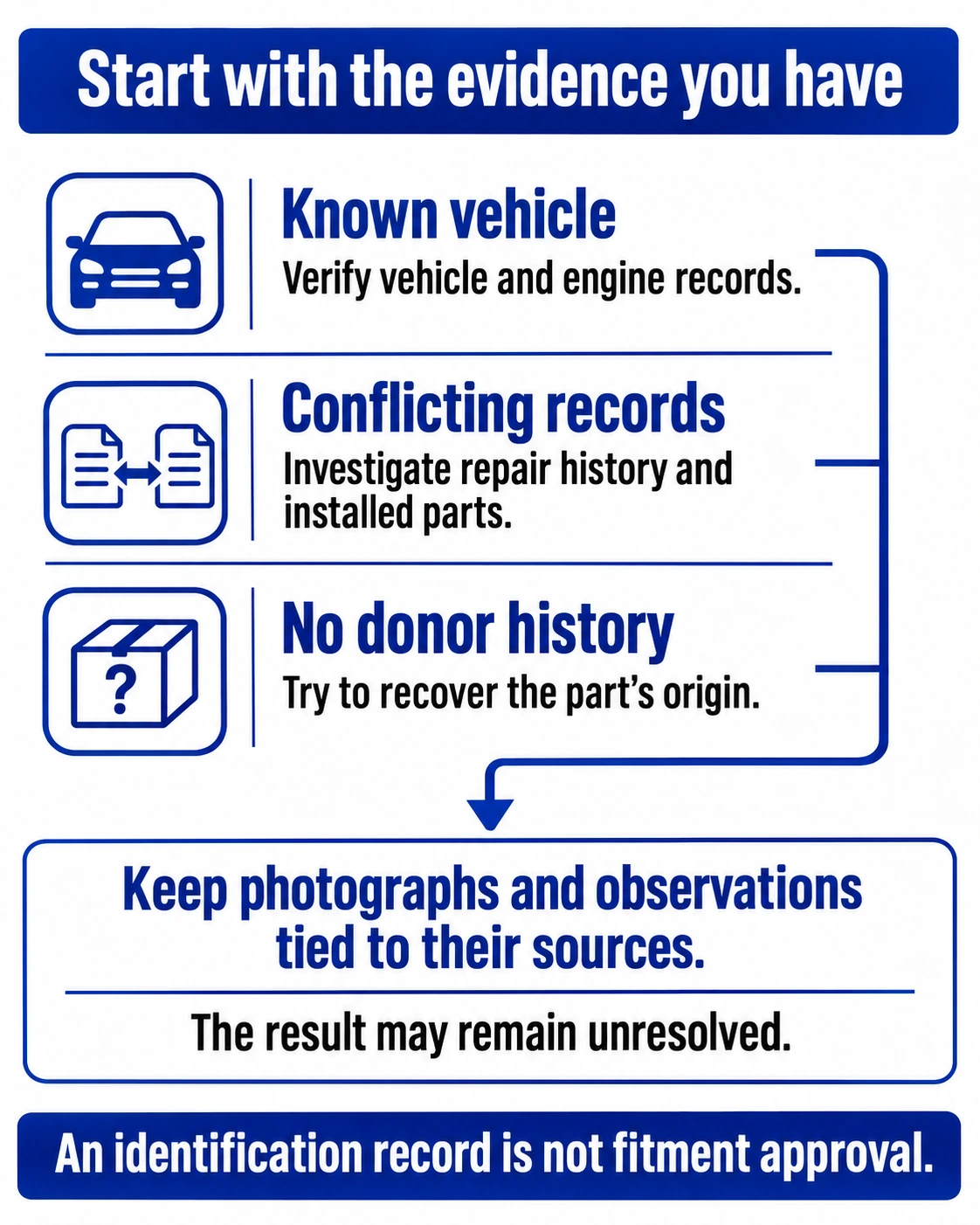
If you know the vehicle, look up the thermostat by its verified vehicle and engine application, then compare the catalog candidate with the removed part. If the part's donor history is missing, try to recover that history before assigning a replacement reference. Keep photographs, markings and measurements tied to their sources: a similar shape or matching housing code cannot establish temperature, electrical function or vehicle fitment on its own.
The useful result is a traceable identification record: which vehicle the part came from, what is actually installed, which replacement has been proposed and what still needs confirmation. For a U.S. repair network or parts distributor, that record lets the technician, parts counter and supplier work from the same evidence.
What you have | Where to start | What you can establish |
|---|---|---|
A known vehicle, but no readable thermostat number | Vehicle identification and the exact engine application | A catalog candidate to compare with the installed part |
A VIN, but the installed housing differs from the catalog | Vehicle records, previous repair information and photographs of the installation | The specific configuration conflict that needs resolving |
A loose thermostat with no reliable vehicle history | Its source, markings, construction and measured features | A physical identification record; vehicle fitment may remain unknown |
Choose the route that matches the available evidence. The result may remain an unresolved identity.
Do not treat these as the same search. A missing number on a part from a documented vehicle is often a vehicle-lookup problem. An unmarked component from a mixed stock bin may lack the information needed for a defensible application match.
Link the removed component to a repair order, vehicle or donor record. Collect the VIN where available, make, model, model year, engine identification, production date and original sales market. Keep model year and production date in separate fields. For imported vehicles, record the original specification as well as the country where the vehicle is now being repaired.
Check each detail against its source: a vehicle label, engine identification, service record or the vehicle-maker's parts information. Avoid copying an engine description from a previous supplier quote without checking it. If the engine or cooling assembly has been changed, the original vehicle record and the installed equipment need to be investigated together.
For example, the Toyota U.S. parts site provides a VIN entry and explains where to find the VIN. That is a vehicle-maker parts route, distinct from an aftermarket brand's application catalog. An undocumented engine change still requires separate investigation.
When vehicle details are incomplete, ask the person who removed the part to resolve that gap first. Recovering the repair-order number or a clear engine-label photograph can be more useful than taking another photograph of the same unmarked valve.
Keep an overall image of the installed location if it is available, followed by images of the removed component. Work with a cool, safely removed part; this identification process does not require opening a hot cooling system or dismantling a sealed assembly.
Use a consistent orientation and retain the uncropped originals. A practical photo set includes:
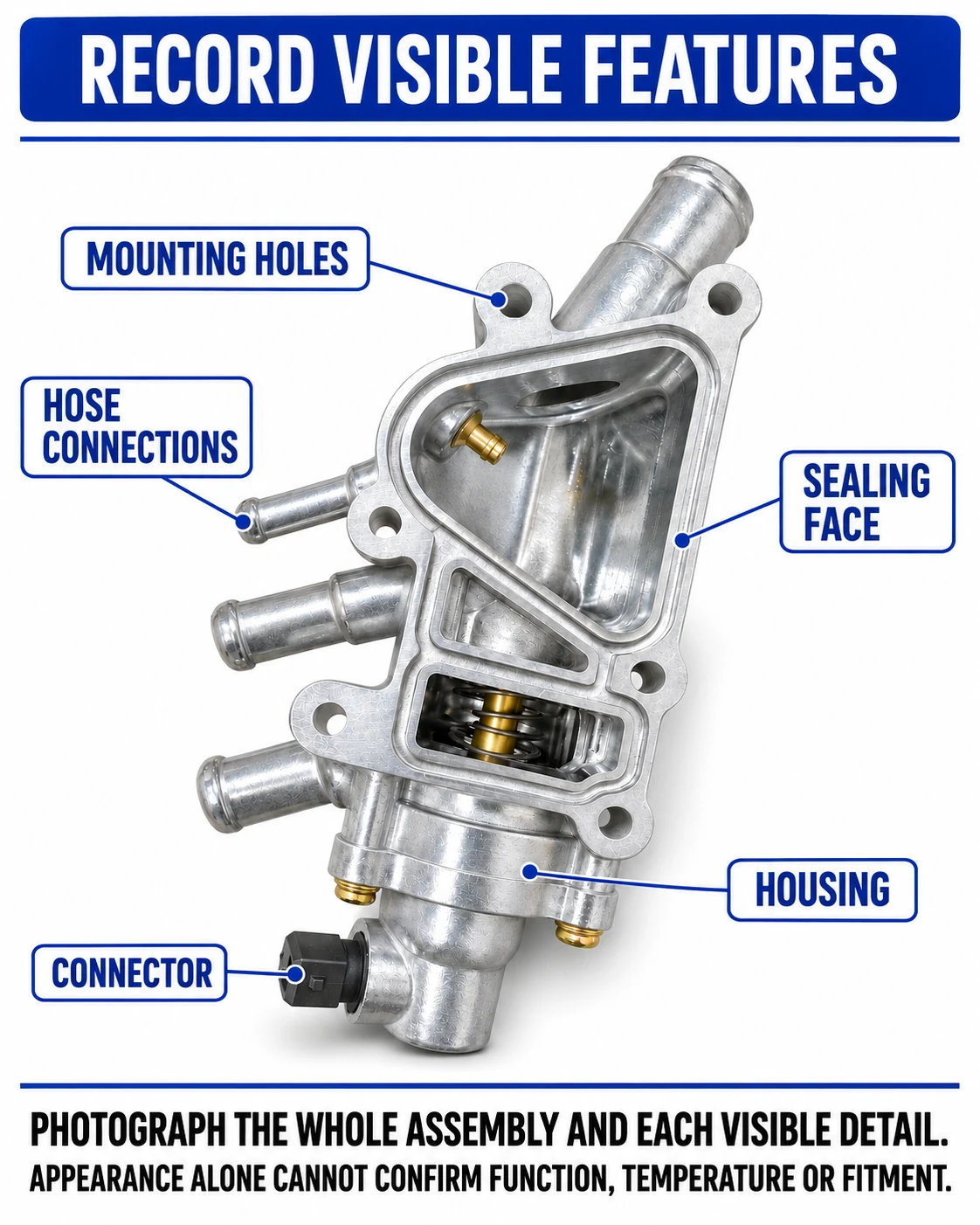
Complete component: show whether it is an insert, an empty housing or an assembly with the thermostat installed.
Sealing face: photograph square to the face so the gasket groove, locating features and mounting holes are visible.
Opposite face and side views: show the valve, bypass arrangement, outlet directions and features hidden in the first view.
Electrical connections: show the connector face, keying and its location on the assembly. Record pin count without assuming that equal pin counts mean equal functions.
Every marking: take a close-up and a wider view showing whether the mark is on the valve, housing, sensor or label.
Measured features: show the measuring points and instrument reading, rather than adding an unexplained dimension to a photograph.
Label the views so the supplier knows which face is being shown. A hose-outlet measurement should state whether it was taken across the sealing section or the retaining bead. Mounting-hole spacing should identify the hole centers used. Use one stated unit, preferably millimeters for the comparison record, and do not infer dimensions from a perspective photograph.
The assembly level matters from the beginning. MAHLE's North American thermostat information distinguishes thermostat inserts, integral thermostats, housing thermostats and map-controlled designs. A photograph of a housing is therefore insufficient to say what the replacement purchase must include.
Photo-based example of visible features to record; not a dimensional drawing or proof of vehicle fitment.
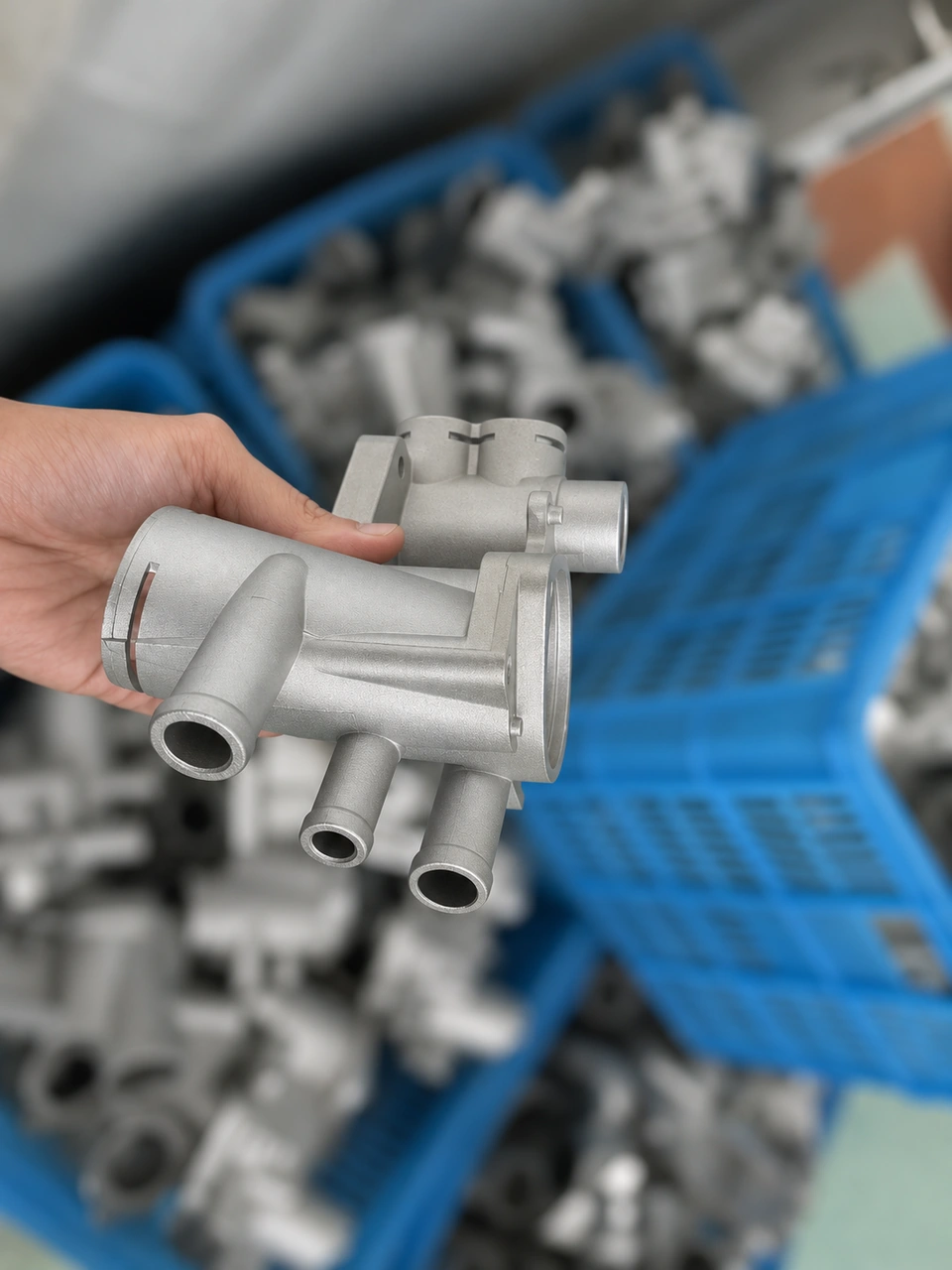
Retouched photo-based example of external outlets and their directions.
These retouched, photo-based examples show different products, not multiple views of one component or dimensional drawings.
Transcribe what can actually be read, preserving letters, prefixes, suffixes and separators. Keep a doubtful character unresolved and attach its photograph. Do not turn a possible letter into a certain digit just because it produces a search result.
Observation | How to record it | What it does not establish |
|---|---|---|
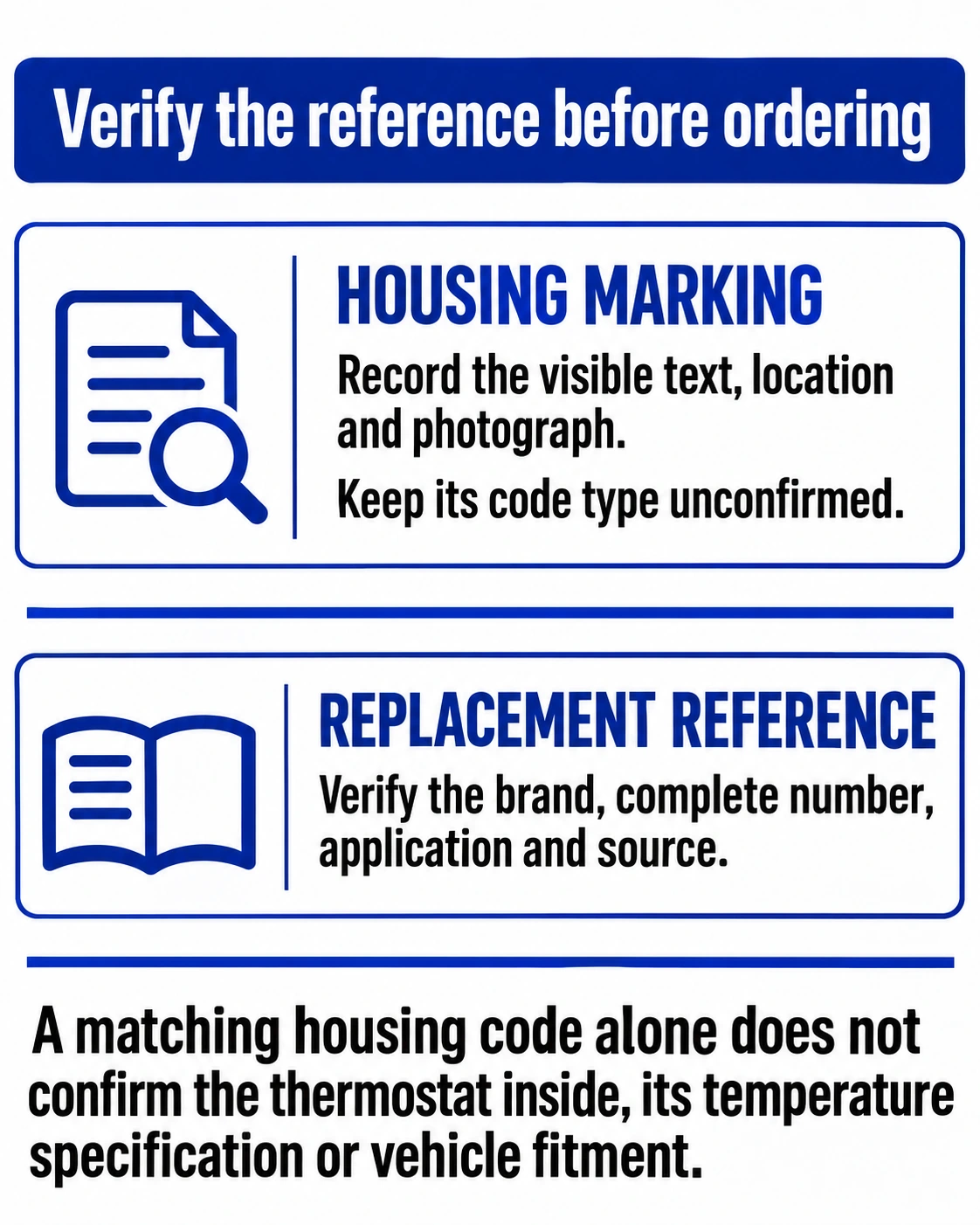
Molded or cast code on the housing | Exact visible text, location and photograph; code type unconfirmed | An orderable service part number or the identity of the valve inside |
Brand label or stamped reference | Brand, complete reference and the component carrying it | That it is a vehicle-maker OE number or applies to every similar assembly |
Temperature-like marking | Visible value, unit if shown and its location | The meaning of the value, a complete temperature specification or an approved substitute |
No legible marking | Unreadable or absent, with the inspected locations photographed | Permission to copy a number from a visually similar product |
An observed mark and a verified replacement reference are different kinds of evidence. Keep the source with each record.
Keep observed dimensions separate from catalog specifications too. A flange diameter can help reject a visibly different candidate; it cannot reveal an unreadable temperature rating. MAHLE's August 2026 technical note explains that opening temperature refers to the start of opening, rather than full opening. Ask for the required specification from the application record rather than choosing a common rating or assuming the old part was correct.
Without a trustworthy number, begin with vehicle application rather than a cross-reference box. The Gates U.S. catalog has a make/model/part-number search field and a VIN Decoder Search entry. Its cross-reference route instead asks for an OE or competitor reference. These are different starting inputs.
Select the U.S. region and enter the vehicle details you have verified. If using the VIN route, inspect the decoded vehicle information before continuing. The published VIN entry requires 17 characters and a vehicle year of 1981 or newer.
Where the catalog returns thermostat candidates, retain every engine, date or equipment qualifier shown; do not stop at a model-name match. If it cannot resolve the application, take the vehicle record to the appropriate parts channel.
Save the brand's candidate number, source URL, access date and the application information returned. Label the number as an aftermarket brand reference.
Compare the candidate record with the old-part photographs and observations. Record the first unresolved difference precisely, such as an unaccounted-for connector or a different assembly level.
The Gates U.S. thermostat category lists comparison fields including temperature, flange diameter and bleed/check-valve detail. These headings do not identify an unknown thermostat or confirm an application. Gates also cautions that illustrations may not represent the exact product. Obtain the exact candidate's data rather than relying on a family image.
If the application cannot be resolved, ask the vehicle-maker's parts channel to confirm the current service part and any relevant production or repair conditions. Send the vehicle details and photographs together. Until the response resolves the application, the candidate remains unconfirmed.
When the catalog candidate and removed part disagree, keep both records. First check whether the vehicle, engine and assembly level were identified correctly. Then investigate previous repairs, replacement housings or engine changes. The removed part is evidence of what was installed; it is not, by itself, proof of what should be installed next.
There is a documented reason to take repair history seriously. A Bentley service bulletin for 2011–2015 Mulsanne vehicles describes a thermostat change requiring a corresponding housing change, while some early replacement housings retained the earlier casting number. For affected earlier cars, the bulletin calls for checking whether the previous service change had already been carried out. This is a model-specific historical example, not a general interchange rule; it shows why the visible casting code and original vehicle identity may need additional service evidence.
A useful question is specific: “Does the service replacement for this vehicle include the housing and the connector shown in photo C?” That is easier to resolve than “Can you find something that looks like this?” If a supplier proposes an alternative arrangement, request the applicable replacement instructions and included components.
For a loose, untraceable part, first ask the supplying branch, dismantler or warehouse for its receipt, donor or original packaging record. An unlabeled photograph cannot restore that history. If the source cannot be recovered, send the observed features as an identification request and ask which additional evidence could distinguish the remaining candidates. Physical resemblance may be all that can be established. Keep the part segregated from stock approved for a vehicle application until its temperature, function and application can be substantiated.
Use one record per removed component. Keep the source of each fact alongside the value, so the next person can distinguish an observed feature from a catalog statement.
Record section | Information to include |
|---|---|
Origin | Repair-order or donor reference; vehicle and engine details; source of each detail; known repair changes |
Old-part evidence | Labeled photographs; separate valve/housing/sensor markings; measured features and units; unreadable or missing information |
Catalog candidate | Brand and proposed number; exact vehicle filters and application notes; URL or document edition; access date; assembly contents |
Unresolved question | The specific identity, temperature, connector, housing or application detail that still conflicts or lacks a source |
Response required | Confirmation against the stated application, supporting record and any conditions or additional parts; otherwise an explicit statement that identification remains incomplete |
Consider a hypothetical repair order where the vehicle is known, the housing code is readable, but the valve marking is not. The useful handoff is the verified vehicle record, the source-labeled housing code, the complete photo set and the candidate's application notes. The unanswered question is whether that candidate provides the required thermostat function and supplied assembly for this vehicle. Repeating the housing code as the “OE number” would hide the uncertainty.
Once a reliable service or brand reference has been established, continue with the automotive thermostat cross-reference checks. That next stage compares the proposed replacement and its application; the identification record preserves how you reached the starting number.
Review the Elecdura engine coolant thermostat range, then send a thermostat identification and sourcing inquiry with the vehicle record, any candidate references, required assembly contents, quantity and destination. Use the email listed on the contact page when sending photographs or documents. State which details remain unknown and ask which application record supports the proposed part. Keep the supplier's reply with the same record before moving to replacement approval or an order.