Your Whole New Supply Chain For Cooling & AC Parts
Your Whole New Supply Chain For Cooling & AC Parts
Views: 0 Author: Site Editor Publish Time: 2026-11-20 Origin: Site
A useful bespoke oil cooler RFQ connects four things: the heat the application must remove, the pressure loss the circuit can accept, the space and connections available, and the evidence needed to approve the supplied unit. A photograph and outside dimensions can start identification, but they cannot establish cooling performance.
For a replacement, first check whether an existing application-matched cooler is available. A new design brief becomes necessary when the duty, installation or specification differs from the original. This guide explains how buyers can prepare that brief, compare proposals and turn a sample approval into a repeatable purchasing specification.
State which of these routes describes the project:
Replacement by reference: provide the original part number, machine or vehicle identity and evidence of the installed configuration. Begin with the oil cooler product categories to distinguish engine, transmission, hydraulic and housing-integrated assemblies.
Build to drawing: identify the drawing owner, released revision, controlled dimensions and any performance specification that accompanies it.
Build to sample: identify what is known about the removed unit and what remains unverified. Damage, blocked passages, previous repairs or a different machine revision can make a used sample misleading.
Selection for a new duty: provide operating conditions and installation limits so a competent supplier or application engineer can assess a proposed configuration.
Keep dimensional and performance evidence separate. A sample may establish a mounting pattern without revealing internal construction. An approved drawing may control the envelope without defining the heat to be rejected. Mark each input as measured, taken from machine documentation or estimated, and identify who will confirm the unresolved items.
Describe normal operation, the most demanding sustained condition and cold start. For intermittent equipment, include the load duration and recovery period. A peak temperature without the corresponding load, flow and duration is difficult to use.
Input | Record with units | What it resolves |
|---|---|---|
Working fluid | Fluid product or specification, grade and viscosity at relevant temperatures where available | Compatibility and the basis for thermal and pressure-loss review |
Flow through the cooler | Minimum, normal and maximum in L/min or clearly identified US/Imperial gal/min | Actual cooler flow, including whether part of the circuit bypasses it |
Oil temperatures | Inlet and required outlet in °C or °F, with measurement locations | The operating target and temperature difference available |
Heat rejection | Required kW, or supporting measured data and duty cycle | The thermal duty, rather than the machine's total rated power |
Circuit pressure | Normal pressure, expected peaks and cycling, in bar or psi; identify gauge or absolute basis | The pressure environment the assembly must withstand |
Permitted pressure loss | Maximum differential pressure across the specified boundary, at stated flow and fluid condition | The restriction the system can tolerate |
Cooling-side condition | Air temperature entering the core, or secondary-fluid inlet temperature and flow | The actual heat sink available to the cooler |
Installation and duty | Stack position, airflow path, fan arrangement, altitude and continuous/peak load duration | Whether the rating represents the installed application |
Parker's industrial and mobile cooler catalogue provides a useful manufacturer example of a sizing input form. It requests heat dissipation, flow, oil condition, cooling-side conditions and allowable pressure loss. Its ratings and correction factors belong to the stated product series; they are not universal limits for another cooler.
If heat duty is unknown, say so. Supply the operating log, circuit diagram and existing cooler information, then agree how the missing duty will be established. Installed engine or motor power alone does not identify the heat passing through a particular oil circuit.
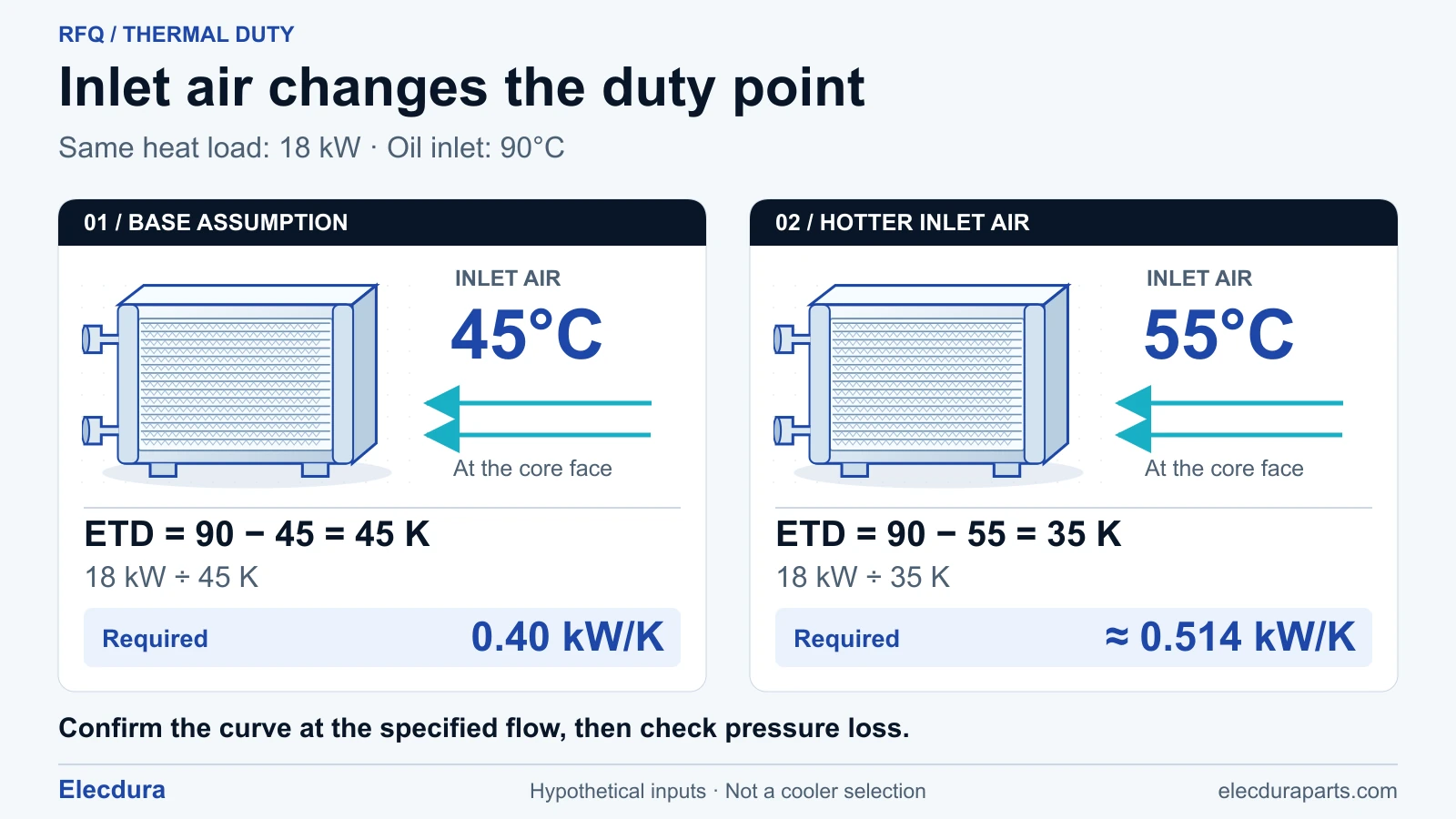
The same heat load requires a different specific heat-rejection duty when the air entering the core is hotter. Confirm the performance curve at the specified oil flow and check pressure loss.
For an air-to-oil cooler, distinguish outdoor ambient temperature from the air actually entering the matrix. A radiator stack, recirculated exhaust air or an enclosure can change the inlet condition. AKG's oil/air selection method relates heat rejection to the entering temperature difference, or ETD: oil inlet temperature minus cooling-air inlet temperature.
Illustrative RFQ calculation: suppose a project requires 18 kW of heat rejection with oil entering at 90°C and air entering the core at 45°C. ETD is 45 K, and the required specific heat rejection is 18 ÷ 45 = 0.40 kW/K. If the actual inlet air is 55°C, ETD falls to 35 K and the requirement becomes approximately 0.514 kW/K.
The example shows why two “18 kW” proposals may differ. It does not select a cooler model. The proposed unit still needs a suitable performance curve at the specified flow, plus the pressure-loss and installation checks.
These are three different entries in the specification. Circuit pressure describes the load the assembly must contain. Pressure drop describes the difference between the inlet and outlet under a stated flow condition. Bypass behaviour describes when fluid can take an alternative path.
Define where the pressure-loss allowance begins and ends. If the supplier quotes only the core, while the buyer's allowance includes hoses, fittings, a filter and valves, the figures are not directly comparable. Request a circuit sketch showing the cooler, bypass, measurement points and included components.
Cold-start review needs its own fluid condition. A viscosity grade is not a pressure-drop value, and a hot-oil curve does not establish the result at the cold-start viscosity. Ask the supplier to identify the applicable curve or calculation, its assumptions and the proposed bypass arrangement. Obtain confirmation from the system owner that this arrangement is compatible with the circuit; choosing a generic bypass setting is not a substitute.
For a replacement on mobile equipment, the hydraulic oil cooler sourcing page is a relevant application route. Keep original references and physical matching evidence alongside the duty data, so an existing replacement option can be assessed before a different configuration is considered.
Include a sketch of the cooler position, incoming and outgoing air paths, nearby heat exchangers and possible recirculation. Record the fan drive, voltage and control arrangement, and clarify whether a fan, shroud, guard and controller belong in the quotation. Free-air fan data should not be treated as a measured installed airflow through the core.
Allow room for inspection and cleaning as well as installation. AKG's technical FAQs discuss obstructions, enclosures and hot-air recirculation as installation concerns. Use the selected manufacturer's clearance instructions rather than imposing one spacing rule on every design.
Provide the second fluid's identity, concentration where relevant, inlet temperature, flow and pressure-loss allowance. Identify both circuits on the drawing. Water quality, fouling and the cleaning method belong in the application review; a clean-water rating does not establish suitability for another liquid or mixture.
Use photographs to explain the installation, then measure from fixed datums. Distinguish the active core from tanks, brackets, fittings, fan and other projections. Capture:
overall envelope and the clearance required for hoses, tools and service removal;
mounting-hole centres, offsets, bracket thickness and supported mounting faces;
port location and orientation, connection standard, thread details and sealing method;
fan, guard, connector and shroud positions where supplied;
fluid-circuit identification and any specified flow direction;
the dimensions that are critical to fit and the tolerances authorised by the project owner.
Include the supported installation arrangement and anticipated movement. The cooler's ports should not become the mounting structure or carry avoidable hose loads. Material, seal and coating requirements should describe the actual fluids and exposure: salt, dust, chaff, wash-down chemicals or abrasive contamination where applicable. A request for “heavy-duty” construction leaves these conditions undefined.
Send one revision of the RFQ to every supplier and request an explicit deviation list. A blank answer is unresolved, not acceptance. The following return format helps expose differences before price comparison:
Proposal section | Evidence to request |
|---|---|
Thermal selection | Proposed model/configuration, required operating point, rating basis and curve or calculation reference; label prediction separately from test results |
Hydraulic selection | Pressure capability and pressure loss with flow, fluid condition and included circuit boundary; bypass details where used |
Mechanical fit | Dimensioned drawing with revision, ports, brackets, assembly envelope and exceptions to the RFQ |
Supply boundary | Core-only or complete assembly; identify seals, fittings, fan, shroud, controller and other inclusions or exclusions |
Approval and repeat supply | Sample plan, proposed checks, available records, packaging, identification and change-notification terms |
For example, a bare core and a fan-equipped module are different purchasing scopes even if their external width matches. Similarly, capacity quoted at different oil temperatures or cooling-side conditions needs to be restated on the agreed basis. Resolve those differences before choosing the lower price. Elecdura's wholesale oil cooler sourcing information can help buyers organise replacement references, quantities and packaging requirements alongside that technical comparison.
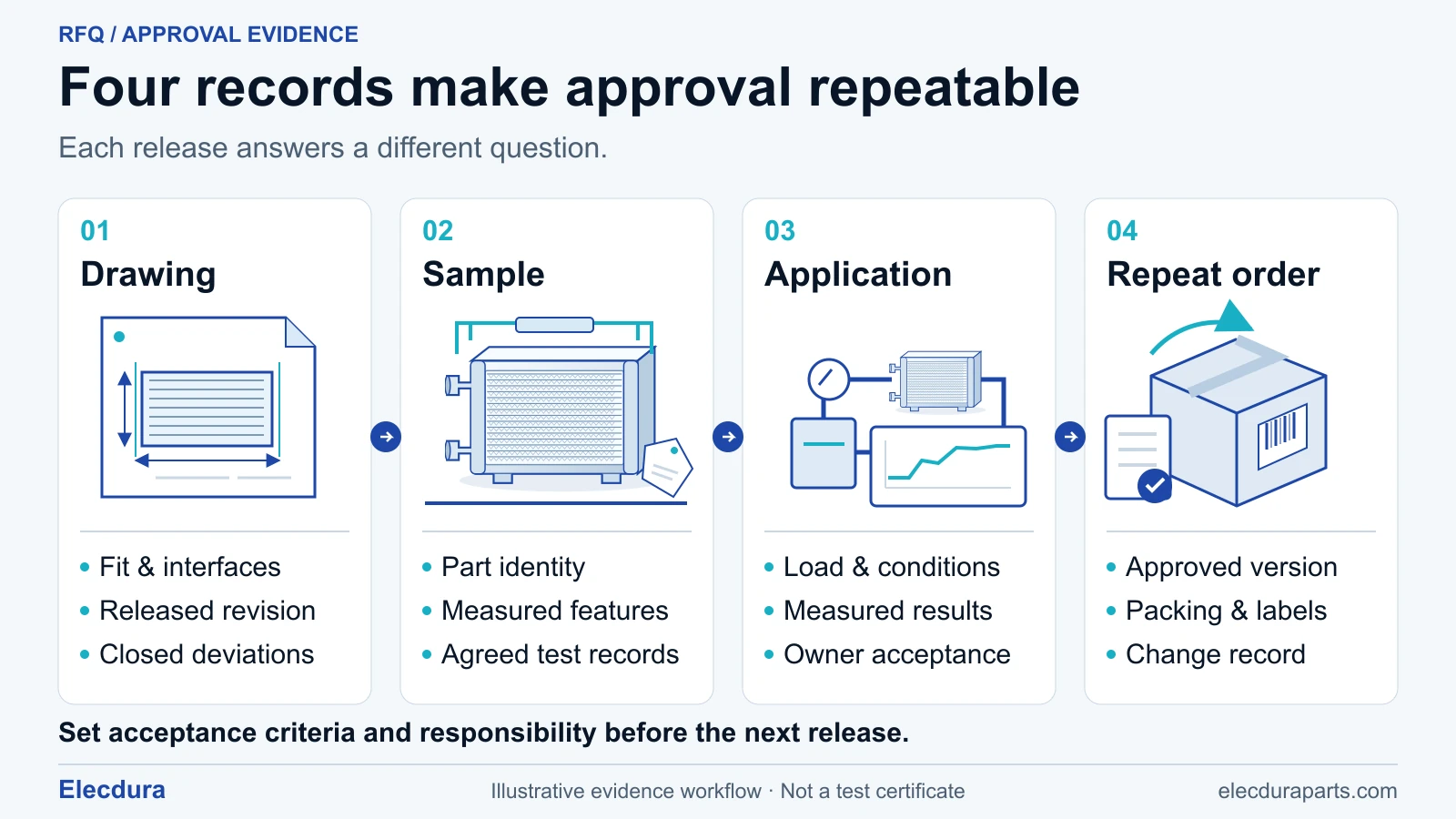
Approve the design definition, inspect the sample, validate the application and retain the accepted version for repeat orders as separate documented decisions.
A dimensional pass does not establish thermal performance, and a leak check does not establish suitability for every operating pressure cycle. Agree what each stage proves and who can release the next stage.
Stage | Review | Release record |
|---|---|---|
Drawing review | Fit, interfaces, supplied components, materials and the performance basis | Approved drawing revision and closed deviation list |
Sample inspection | Identity, critical dimensions, ports, sealing faces, cleanliness, workmanship and agreed test records | Inspection results linked to that sample and revision |
Application validation | Representative load and cooling conditions, temperatures, flow and pressure loss where measured, controls and bypass operation | Test conditions, results, exceptions and the project owner's acceptance |
Repeat-order release | Configuration, identification, packaging and notified changes | Purchasing specification and inspection plan tied to the accepted version |
Define the test medium, method, instruments, duration and acceptance criteria with the responsible engineer before testing. Working, proof and burst pressure describe different requirements; do not substitute one for another or invent a pressure multiplier for an unspecified cooler. The supplier should state which evidence is available and which validation remains the buyer's responsibility.
During an application trial, record the load and cooling conditions with the temperatures. An unloaded run in mild weather cannot substantiate continuous full-load performance in hotter inlet air. If a result falls outside the agreed condition, document the difference rather than calling the sample approved without qualification.
Retain the drawing revision, sample identification and photographs, accepted results, rating basis, included-component list and packaging specification. Agree which changes require notification or reapproval. A fan, port, bracket or core construction change can affect the accepted configuration even when the sales reference stays the same.
For the next purchase order, refer to that accepted revision and list any authorised changes explicitly. A reference to “same as last time” gives an inspector little basis for deciding whether a difference is acceptable.
They can support identification and dimensional review. Internal construction, duty and pressure-loss requirements still need evidence. State what is missing so the supplier can distinguish a provisional proposal from a configuration ready for approval.
No. Check the proposed performance at the required flow and inlet conditions, then review pressure loss, available airflow, mounting and service space. Overall size is not an acceptance criterion by itself.
Send the application, fluid, operating log, load cycle and existing circuit information. Ask what measurement or engineering review is needed before selection. An estimate should remain labelled as an estimate until the design basis is accepted.
Send the application, original references where available, clear photographs, measurements and quantity. Elecdura can review replacement references and sourcing options. Availability, the feasible supply route and any need for new engineering or tooling require separate confirmation before a project is agreed.
Prepare one file containing the application, original reference, duty conditions, pressure and pressure-loss requirements, drawing or measurements, supplied-component boundary, quantities, destination market and packaging needs. Separate confirmed values from open questions. Send the oil cooler sourcing brief to Elecdura so the next step can be based on the actual requirement and available supply options.