Your Whole New Supply Chain For Cooling & AC Parts
Your Whole New Supply Chain For Cooling & AC Parts
Views: 0 Author: Elecdura Editorial Team Publish Time: 2026-11-16 Origin: Site
Replacing only a failed compressor can leave moisture, debris, incorrect oil, or a restricted metering device in the circuit. But replacing every A/C component by default is not a sound rule either. A complete repair package should be built from the vehicle specification and the failure evidence.
For most compressor replacement jobs, the baseline package should include the correctly matched compressor, a new accumulator or receiver-drier, the correct expansion device when replacement is required by the repair procedure, new seals, and the specified lubricant. A condenser, hoses, evaporator, or additional lines belong in the package when contamination, construction, or damage makes cleaning unreliable. The vehicle manufacturer's service information remains the controlling reference.
U.S. service requirement: Motor-vehicle refrigerant must be recovered and handled with approved equipment. Technicians performing paid MVAC service must be trained and certified under Clean Air Act Section 609. See the U.S. EPA technician and shop resources.
“Complete kit” is a commercial label, not a technical diagnosis. Two vehicles using similar compressors may need different repair packages because one suffered a clutch or seal problem while the other scattered metal through a modern parallel-flow condenser.
Before choosing parts, record:
vehicle make, model, year, engine, VIN or chassis information;
original compressor and OE/reference numbers;
refrigerant type and specified charge;
compressor drive type: belt-driven, low-voltage electric, or high-voltage electric;
accumulator/orifice-tube or receiver-drier/TXV architecture;
oil type and total system quantity from current vehicle service data;
reason for failure and the appearance of recovered oil;
debris at the compressor ports, control device, drier, and condenser outlet;
leaks, hose restrictions, damaged connectors, and condenser airflow faults.
This information determines whether the job is a straightforward component replacement or a contamination repair.
Item | Why it belongs in the package | What must be matched |
|---|---|---|
Compressor | Replaces the failed pumping unit | OE/reference number, mounting, ports, pulley/clutch or electrical interface, refrigerant and oil compatibility |
Accumulator or receiver-drier | Contains desiccant and can retain moisture, oil, and contamination | System architecture, connections, mounting, pressure switch or sensor provisions |
Expansion device | Meters refrigerant; an orifice tube also acts as a screen, while a TXV can be restricted by debris | Orifice tube versus TXV, application, connections and calibration |
O-rings and seals | Opened joints require the correct replacement seals | Material, size, refrigerant compatibility and joint location |
Correct lubricant | Protects the compressor and circulates through the system | Exact oil type, viscosity and total quantity specified for the application |
Repair consumables | Support a controlled clean-and-assemble process | Approved flush where permitted, caps/plugs, labels and installation instructions |
Four Seasons states that its virtual compressor kits include a compressor, accumulator or receiver/filter drier, expansion device, proper oil, and flush. Its installation guidance also says the accumulator or drier should be replaced and the refrigerant control device inspected or replaced as the system condition requires. DENSO's compressor-replacement matrix likewise lists the compressor, seals, and drier/accumulator across its repair procedures, while adding other components for more severe contamination cases.
A kit should identify its exact contents. “Complete” without a bill of materials is not enough.
Not always—but it often becomes necessary after an internal compressor failure.
Modern condensers commonly use narrow flat or microchannel passages. Debris can lodge in passages that are difficult or impossible to clean reliably. Four Seasons compressor installation guidance says many modern condensers are difficult or impossible to flush and may require replacement. Sanden's compressor guide also distinguishes components that may be flushed from those that should not be flushed, and notes that condenser design and contamination determine whether replacement is necessary.
Add the condenser when:
the failed compressor released metal or dark contaminated oil;
the condenser has a non-flushable or poorly flushable construction;
debris remains after the approved cleaning procedure;
a restriction, leak, corrosion, bent core, or damaged fitting is confirmed;
the drier is integrated into the condenser and the approved repair procedure calls for condenser replacement;
the compressor supplier or vehicle service procedure requires it for the documented failure mode.
Do not add a condenser merely to make a kit look larger. For a clutch-only problem with clean oil and no internal damage, the approved procedure may not require it. Record the evidence and follow the current application-specific instructions.
An orifice tube meters flow and its screen can reveal debris. Four Seasons directs replacement of the orifice tube during compressor service in its installation guidance. A thermostatic expansion valve should be inspected; contamination, sticking, restriction, or inaccessible cleaning can make replacement the safer repair decision. Its technical note on TXV contamination explains that debris can restrict refrigerant and lubricant flow.
Do not put both an orifice tube and a TXV into a vehicle-specific kit unless the application actually uses both. First identify the circuit architecture, then supply the correct metering device.
The right oil type with the wrong quantity can still damage a replacement compressor. A new compressor may arrive prefilled, but that does not prove the amount matches every vehicle configuration that uses the compressor.
DENSO's compressor-oil guidance tells installers to check vehicle-manufacturer data when the new compressor's oil quantity differs from the vehicle specification or when one compressor serves different circuit configurations. The practical purchasing rule is:
record the specified oil type and total system quantity;
record whether the compressor is prefilled and with how much;
follow the component-replacement oil-allocation procedure in current service information;
do not add a generic bottle simply because the kit includes one;
use the specified refrigerant and charge by the approved service procedure.
For electric compressors, oil electrical properties and service isolation procedures are especially important. Do not substitute conventional compressor oil or treat high-voltage work as a belt-driven compressor job.
Part | Include when | Do not assume |
|---|---|---|
Suction/discharge hose | Internal lining has failed, a muffler/filter traps debris, fittings leak, or flushing is not permitted | Every hose must be replaced after any compressor fault |
Evaporator | It leaks, is restricted, or cannot be cleaned after severe contamination under the approved procedure | It is automatically part of a compressor kit |
Pressure sensor/switch | Testing confirms an incorrect signal or the application requires a new sensor with the replacement assembly | A high-pressure event proves the sensor is bad |
Belt, tensioner or clutch electrical parts | Wear, alignment, voltage, or drive testing identifies a fault | Every compressor failure originates inside the compressor |
Cooling fan or fan control part | Airflow testing finds insufficient condenser airflow | High head pressure always requires a new condenser |
Refrigerant lines | Damage, leakage, restriction, contamination traps, or service instructions require replacement | All lines are interchangeable if the fittings look similar |
Separating evidence-based replacements from optional parts prevents both incomplete repairs and unnecessarily expensive kits.
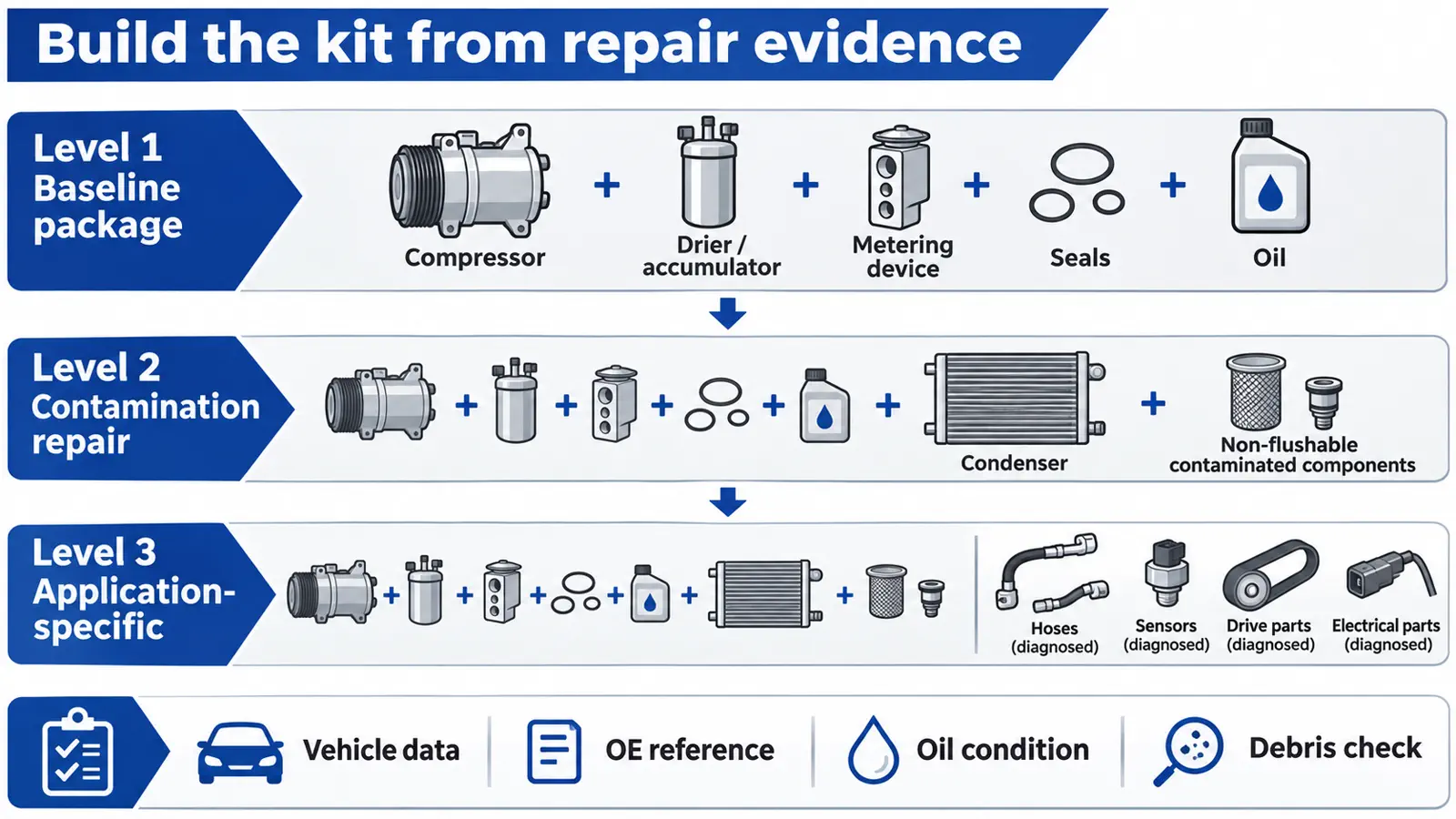
Distributors can make “complete” auditable by defining kit levels instead of using one vague label.
application-matched compressor;
accumulator or receiver-drier;
correct expansion device according to the approved procedure;
seals and required installation hardware;
identified oil specification and quantity instructions.
Everything in Level 1, plus the condenser and any non-flushable contaminated components identified during inspection. Include the approved flushing requirements for parts that may be cleaned.
Everything required by the vehicle or fleet specification, which may add hoses, sensors, switches, belt-drive parts, electrical connectors, or a second evaporator circuit. This level must be built from a VIN/application check and a documented failure report.
The levels are a purchasing framework, not a replacement for manufacturer service instructions.
For a repair shop, distributor, or fleet buyer, send the supplier:
vehicle make, model, year, engine, VIN/chassis and destination market;
compressor OE/reference number and clear label photos;
photos of the ports, connector, clutch/pulley, and mounting ears;
refrigerant type and compressor oil specification;
accumulator/drier and metering-device type;
failure description, recovered-oil condition, and debris findings;
condenser construction and whether it has an integrated drier;
list of components already replaced or approved for flushing;
exact required kit contents, quantity, packaging, and labeling needs.
For wholesale compressor sourcing, use Elecdura's AC compressor category. If the repair evidence requires a condenser, review the AC condenser range. Send the confirmed OE list and kit bill of materials rather than asking only for a “complete kit.” Elecdura can review the references and available component scope before a quotation; final installation and service decisions remain application-specific.
No. The condenser should be included when compressor debris, non-flushable construction, restriction, damage, or the approved repair procedure makes replacement necessary. A clean system with a non-internal compressor fault may follow a different procedure.
Yes, the reviewed compressor-manufacturer and aftermarket service guidance treats drier or accumulator replacement as part of compressor service because it contains desiccant and can retain contamination.
No. They are different refrigerant-metering devices used in different system architectures. Identify which device the vehicle uses before ordering.
No. Narrow-passage condensers and hoses with mufflers or filters may not be reliably flushable. Follow the component and vehicle service instructions and replace parts that cannot be cleaned to the required standard.
Provide the vehicle and engine, VIN or chassis information, compressor number, refrigerant and oil specifications, system architecture, failure evidence, required components, quantity, and photos of the old parts and connections.
A truly complete compressor repair kit is the smallest verified package that removes the failure cause, prevents retained contamination from reaching the new compressor, and matches the vehicle specification. Start with the compressor, drier or accumulator, correct metering device, seals, and specified lubricant. Add the condenser and other components only when failure evidence, construction, or the approved repair procedure requires them.