English
Views: 0 Author: Elecdura Publish Time: 2026-08-13 Origin: Site
No. Never choose or substitute compressor oil only by the broad label “PAG” or “POE.” Many high-voltage electric A/C compressors use POE because it provides electrical insulation, but some electrically driven compressors are factory-filled with a special PAG formulation. MAHLE's current oil guide explicitly warns that those special-PAG electric compressors must not be filled with POE. The correct lubricant is determined by the vehicle and compressor specification, refrigerant, exact oil product, viscosity, and fill quantity.
Cross-contamination can lower the refrigerant circuit's electrical resistance, trigger an isolation fault, damage motor windings or electronics, impair lubrication, and invalidate warranty. Moisture matters too: POE is hygroscopic, and increasing water content reduces its insulating performance. Before servicing or replacing an electric unit, verify the compressor label, OE information, and oil specification. Buyers comparing replacement units can begin with Elecdura's electric AC compressor range, but the application record—not a generic product family—must control the oil decision.
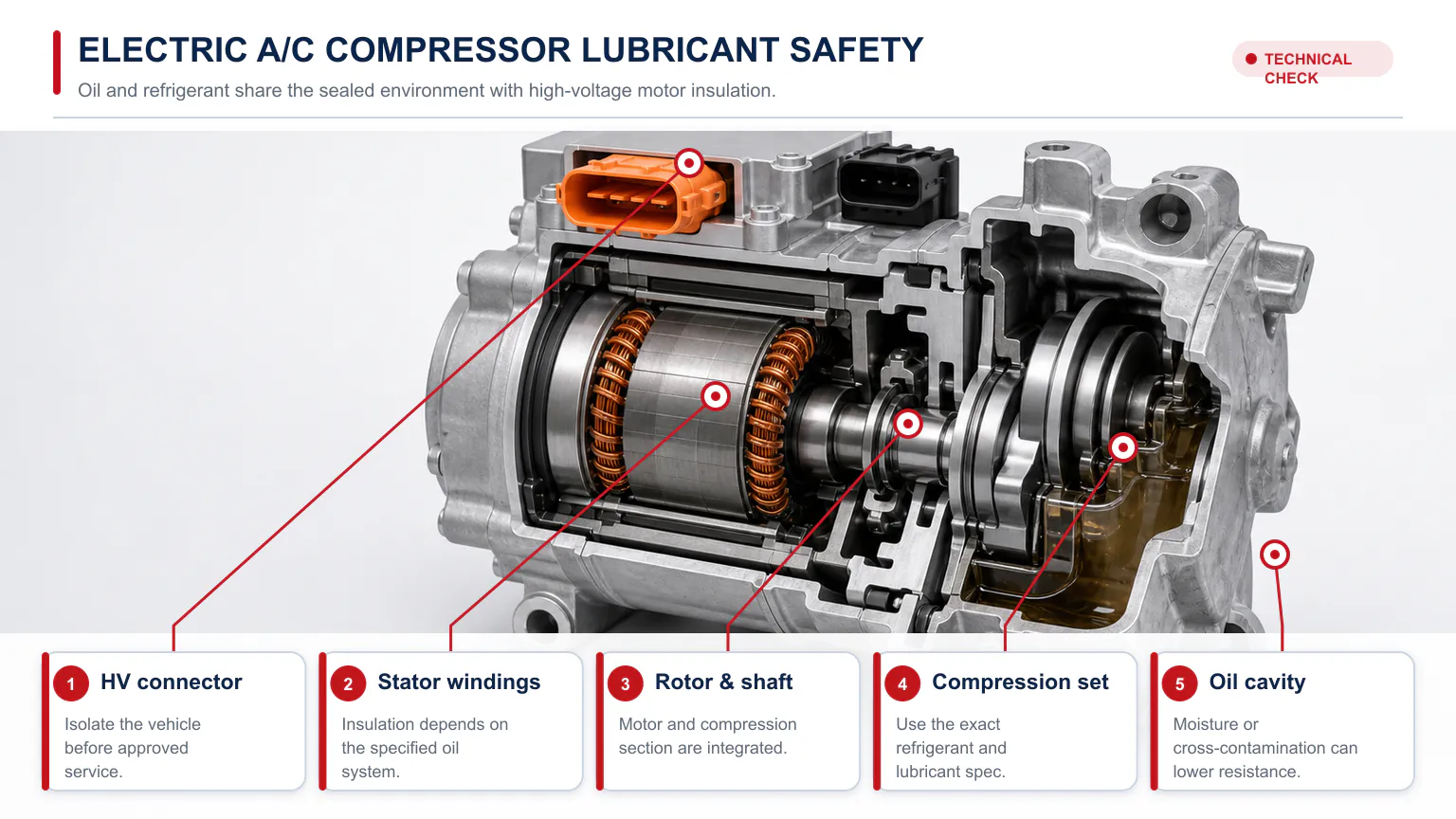
Electric-compressor lubricant shares the sealed environment with the high-voltage motor and its insulation system.
Property | PAG | POE |
|---|---|---|
Common automotive use | Many belt-driven compressors; selected special-PAG electric compressors | Many hybrid/EV electric compressors |
Electrical role | Conventional PAG products generally are not chosen for HV winding insulation; approved special formulations are application-specific | Selected for strong electrical insulating behavior in specified electric systems |
Moisture behavior | Hygroscopic | Hygroscopic; moisture reduces insulation quality |
Viscosity | Multiple ISO grades and specialized products | Multiple application-specific products/grades |
Selection rule | Use only the exact approved product | Use only where the compressor/vehicle is factory specified for it |
Safe substitution? | No substitution without explicit vehicle/compressor approval | |
The table is intentionally cautious. Statements such as “PAG is conductive” and “POE is nonconductive” are too crude for a service decision. Electrical behavior depends on the formulated oil, refrigerant, additives, contamination, moisture, temperature, and the complete circuit. The only reliable instruction is to use the approved product and keep it clean and dry.
A belt-driven compressor separates the engine-driven pulley/clutch from the refrigerant circuit. A hermetic electric compressor places an electric motor and compression mechanism inside a sealed housing. Refrigerant and circulating oil contact internal motor components, including insulation around high-voltage windings. That arrangement allows compact, variable-speed operation independent of engine speed, but makes lubricant dielectric performance part of electrical safety and control.
The vehicle's high-voltage monitoring system checks isolation between the HV circuit and chassis. If contaminated refrigerant/oil creates an unintended leakage path, the vehicle may store an isolation-related fault, restrict compressor operation, or disable parts of the HV system. A compressor winding or inverter fault can cause similar symptoms, so an isolation DTC does not by itself prove wrong oil. Diagnosis must follow the OEM procedure with correctly rated instruments and trained personnel.
POE is common because appropriate POE products provide electrical insulation and material compatibility for many electric compressors. MAHLE's technical guidance on electric-compressor oil explains the insulation requirement and sensitivity to moisture. Its 2025 documentation states that POE oil can be used on hybrid and electric vehicles whose electrically driven compressor was filled with POE at the factory, while some electrically driven compressors are factory-filled with a special PAG oil and cannot use POE.
That exception changes workshop practice. A technician cannot safely decide from vehicle propulsion, refrigerant, or connector color alone. Two EVs using R-1234yf may specify different oils. Two compressors that look identical may have different internal materials or factory oil. A universal “hybrid oil” label is not adequate evidence unless it lists the exact approval/application.
PAO also appears in aftermarket guidance. Certain approved PAO products may be suitable for specific refrigerants or electric compressors, but this does not create a universal third choice. Product-specific compatibility and vehicle-manufacturer information still control. Do not turn a lubricant supplier's defined application into a blanket rule for all PAO oils.
Oil control must cover the complete service path, including equipment, injectors, containers and additives.
Oil retained in hoses, separators, injectors, manifolds, or internal plumbing can transfer conventional lubricant from previous jobs. A machine marketed as “hybrid ready” should have the specified contamination-control design and be operated and maintained according to its instructions. A purge cycle is not automatically proof that an unknown machine meets an OEM limit.
A clean-looking bottle or syringe can hold a film of the previous oil. Use dedicated, clearly labeled, sealed equipment for each approved oil family/product. Keep caps on and avoid topping a dedicated container from an unknown bulk bottle.
POE absorbs moisture from air. Repeatedly opening a large container increases exposure, especially in humid workshops. Follow the lubricant manufacturer's storage and shelf-life rules, use appropriately sized containers, and record opening dates where required. Oil that has absorbed water may no longer provide the intended insulation performance even though it looks normal.
Dyes and additives must be approved for the refrigerant, lubricant, compressor, and electric/HV system. A conventional dye injector can add both incompatible dye and residual oil. Do not use a product merely because its label says “universal.”
Lines and flushable heat exchangers can retain old lubricant, solvent, moisture, or debris. Some components—depending on design and manufacturer instructions—cannot be reliably flushed and must be replaced after internal compressor failure. Flushing does not clean the compressor itself, and it does not reverse chemical or electrical damage.
The new compressor may ship with a specified oil and quantity, a transport charge, or an amount intended for a complete system. Do not drain or add oil by habit. Obtain written information for the exact part number, then follow the vehicle procedure for balancing oil when components have been replaced.
Wholesalers can create contamination risk when visually similar compressors are stored or packed without oil identity. The unit, carton, database, and inspection record should agree on refrigerant, oil product, quantity, and application. If a supplier cannot state what is in a compressor, the buyer cannot approve it for an HV system.
The immediate cost may be a vehicle that refuses to operate the A/C or stores an isolation fault. The larger cost can include recovery and disposal, replacement of non-flushable components, repeated evacuation and charging, insulation testing, a replacement compressor, technician time, vehicle downtime, and a disputed warranty claim. If contamination spreads through a shared service machine, multiple later vehicles may be affected.
Lubrication mismatch can also cause mechanical failure. Oil viscosity, lubricity, refrigerant miscibility, and material compatibility influence bearing, scroll, or other compression-element life and oil return. Too much oil can reduce heat transfer and cooling; too little can starve moving parts. The goal is not simply “enough insulation” but the exact approved lubricant in the correct system quantity.
Verify the exact application record before selecting lubricant chemistry, product or quantity.
Identify the vehicle precisely: VIN, model year, market, powertrain, refrigerant, and option codes.
Identify the compressor: OE number, supplier number, label, voltage, and any supersession.
Use current service information: find the exact oil part number/specification, viscosity, system capacity, and component-replacement procedure.
Confirm the replacement unit: ask what oil and quantity it contains and whether that represents shipping, compressor, or system fill.
Check service equipment: verify that the recovery/charging machine, hoses, injector, dye, and containers meet the required segregation method.
Control moisture: use sealed approved oil, minimize exposure, and replace the drier/accumulator when the procedure requires it.
Follow HV safety: trained personnel must isolate, verify, and restore the high-voltage system using vehicle-specific procedures.
Document the job: record oil product, lot, quantity added/recovered, refrigerant charge, machine used, parts replaced, vacuum/hold results, and post-repair checks.
Do not “correct” the oil by color or smell. Different approved products may look similar, and contaminated oil may show no visible change.
Create a clearly separated HV A/C service path. Use dedicated equipment or a manufacturer-approved machine function with documented residual-control capability. Mark hoses, injectors, oil containers, and dye equipment so that they cannot be confused with conventional service tools. Store oils sealed and away from moisture and contamination.
Train service advisors and parts staff as well as technicians. A correct workshop procedure can still fail if a parts person supplies the wrong pre-charged compressor or a service advisor authorizes an unapproved “universal oil.” Build the oil part number into the work order and parts picking record.
Quarantine returned electric compressors with intact port caps where possible, and do not pour their oil into general waste or a diagnostic comparison container. If failure analysis is required, preserve a representative oil sample using the laboratory or manufacturer's specified container and chain of custody.
Begin with the complete vehicle fault report. Record DTCs from the HVAC, power electronics, hybrid/EV control, and battery systems. Determine whether the fault appears only when the compressor is commanded, whether insulation resistance changes with temperature or pressure, and whether recent A/C service introduced risk.
Use only the OEM-approved measurement method and correctly rated equipment. Do not megohm-test connected electronics or compressor terminals unless the procedure explicitly instructs it; an inappropriate test voltage can damage an inverter or control circuit. High-voltage diagnosis is outside the scope of untrained general service.
If wrong oil is confirmed or strongly suspected, follow the manufacturer remediation plan. There is no universal flush recipe or acceptable contamination percentage that applies to every vehicle. Some systems may require extensive component and line replacement; others provide a defined cleaning procedure and resistance validation. Improvised repeated refrigerant charging is not a controlled remedy.
Vehicle VIN, market, refrigerant, and HV system.
OE compressor number and current supersession.
Approved oil manufacturer/product, viscosity, and vehicle service part number.
Oil quantity shipped in the replacement and how it should be handled.
Electrical connector, communication/control interface, voltage, and mounting.
Port design and seals; refrigerant/material compatibility.
Factory dryness, sealing, cleanliness, insulation, leak, and functional test records.
Label and carton identification of refrigerant/oil/application.
Batch or serial traceability and change notification.
Warranty installation, contamination, and documentation requirements.
When comparing the broader automotive AC compressor range, separate mechanical and electric products in the purchasing database. Do not let a generic oil field or copied specification migrate across both categories.
The refrigerant circuit distributes oil through the compressor, hoses, heat exchangers, and drier or accumulator. When one component is replaced, some oil leaves with that component while some remains elsewhere. This is why simply pouring the full published system capacity into a new compressor can overfill a partially serviced system, while installing a dry replacement can underfill it.
Use the vehicle procedure to determine how recovered oil is measured and how much is added for each replaced component. Read the replacement compressor instructions before draining anything. If the new unit must be drained and measured, use dedicated clean equipment and protect it from moisture. Some procedures specify adding the same quantity removed from the old compressor; others use fixed component allowances or a total system balance. These approaches are not interchangeable.
Rotate or orient a compressor only as instructed to distribute oil before startup. A procedure written for a belt-driven compressor—such as manually rotating a pulley—may not apply to an electric hermetic unit. Do not energize an electric compressor outside the vehicle control and refrigerant environment unless the manufacturer provides dedicated test equipment and instructions.
Wholesalers and workshops should inspect the part before it enters clean stock. Confirm that the compressor and carton carry the same supplier and OE references. Check that refrigerant and oil identification is present and consistent with the purchasing record. Port caps should be intact and properly seated; missing caps can allow moisture and debris into a hygroscopic-oil system.
Inspect the housing, HV connector, low-voltage/control connector, mounts, and ports for impact damage. Do not remove port caps for casual photography or leave the unit open while comparing fittings. If cap removal is required for controlled inspection, minimize exposure and follow the supplier's resealing requirements. Weighing a unit may detect major packing or configuration errors but cannot verify oil type or exact internal quantity.
For volume orders, sample the batch under an agreed inspection plan. Check label accuracy, critical dimensions, connector keying, mounting, port geometry, sealing, insulation/leak/functional test records, and serial or lot traceability. Preserve approved packaging because moisture-barrier and cap quality affect the product, not just presentation.
When a replacement fails, record the sequence before recovering the system: warning messages, DTCs, commanded compressor speed, voltage and current data available through the scan tool, pressures and temperatures, and the timing of the isolation fault. Photograph labels and connections. Identify all previous A/C service and the equipment/oils used.
Do not open the compressor or mix its oil with other recovered fluids if a supplier teardown is required. Seal ports, label the unit, retain oil/refrigerant service records, and follow dangerous-goods or return instructions. Ask the analysis to distinguish electrical insulation failure, winding/electronics failure, mechanical wear, contamination, lubrication, installation, and system causes. A statement such as “compressor defective” is not a root cause.
Feed verified findings back into purchasing and workshop controls. If multiple claims share a batch, quarantine stock and trace customers. If unrelated batches show the same contamination signature, audit service equipment and oil handling. Warranty data is most valuable when it can separate a product change from a process problem.
No. POE is common, but some electric compressors are factory-filled with a special approved PAG oil. Use the exact vehicle/compressor specification.
Only if the vehicle and compressor specify that POE product. Electrical insulation is one requirement; lubrication, material compatibility, refrigerant compatibility, viscosity, and quantity also matter.
Opening begins exposure to ambient moisture, but usable life depends on the product, container, humidity, handling, and manufacturer instructions. Minimize exposure, reseal immediately, use appropriate container sizes, and follow the specified storage period.
Only if its manufacturer and the vehicle procedure confirm the required refrigerant, oil-contamination control, and HV service suitability. A conventional machine with unknown residual oil should not be assumed safe.
No. It can result from compressor windings, inverter/electronics, HV cables, connectors, other HV components, moisture, or contamination. Follow the vehicle diagnostic isolation procedure.
Do not improvise. Compatibility and remediation are vehicle-specific, some components cannot be flushed adequately, and POE may not be the specified oil. Use the OEM procedure.
Safe electric-compressor service begins before the vehicle enters the bay. The purchasing record must identify the exact compressor and factory oil; storage must protect sealed lubricant; service equipment must prevent cross-contamination; the technician must follow HV and oil-balance procedures; and final records must show what entered the system.
For an application-specific electric compressor quotation, send the VIN/OE list, refrigerant, required oil specification, quantities, label/packing needs, and quality documents through the Elecdura contact page. The supplier response should explicitly state the oil product and shipped quantity—never just “suitable for EV.”