English
Views: 0 Author: Elecdura Publish Time: 2026-08-07 Origin: Elecdura
An AC compressor clutch not engaging can mean the control system is intentionally withholding the command, the command cannot reach the coil, the magnetic force cannot close the air gap, or the compressor cannot turn safely. Low refrigerant pressure, implausible pressure-sensor data, excessive engine temperature, wide-open-throttle logic, a failed fuse or relay, high circuit resistance, an open coil, excessive clutch air gap, a slipping hub, or an internally seized compressor all lead to the same visible result: the pulley turns but the hub does not.
Do not jump the relay as the first test. A forced clutch can operate a dry or empty system, defeat pressure protection, overload wiring, or drive a seized compressor. First confirm that the vehicle actually uses a belt-driven magnetic clutch. A high-voltage electric AC compressor and some clutchless variable-displacement designs require different procedures.
Observed state | Primary question | Typical evidence |
|---|---|---|
No clutch command | Why is the controller inhibiting operation? | Pressure, temperature, request, engine, or HVAC input outside enable conditions |
Command present, no coil power | Where is the open or voltage drop? | Fuse, relay, connector, wire, ground, or driver fault |
Coil energized, hub does not pull in | Is magnetic force overcoming the air gap? | Weak coil, low voltage, excessive gap, rust, distorted hub |
Hub engages but slips, cycles, or stalls | Is compressor load or refrigerant control abnormal? | Seizure, contamination, bearing drag, pressure problem, incorrect charge |
This four-state model keeps diagnosis centered on evidence. The AC compressor category contains many mechanical and control configurations, so the same symptom does not imply the same replacement boundary.
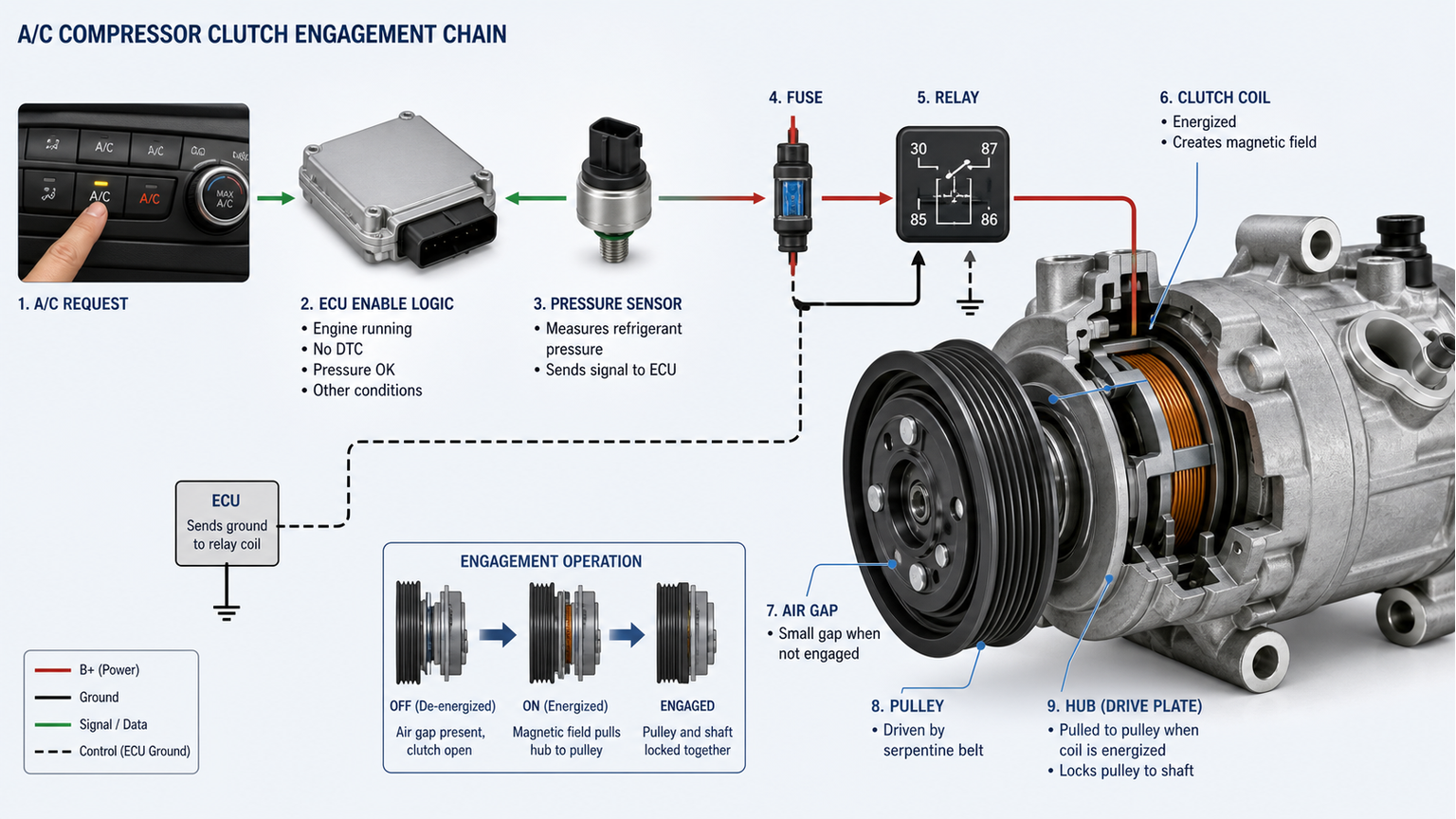
A conventional clutch has a pulley and bearing that rotate with the belt, a stationary electromagnetic coil, and a hub or armature attached to the compressor shaft. When energized, the coil pulls the hub against the pulley friction surface. The air gap must be large enough to release cleanly and small enough for the available magnetic force to close.
Some belt-driven compressors rotate continuously and regulate pumping with an internal control valve. There may be a breakaway element or torque limiter but no clutch that cycles in the familiar way. Diagnosing "no click" on this design wastes time. Use scan data, control-current tests, pressure behavior, and the correct compressor application data.
An electric compressor integrates a motor and inverter and may operate with the engine stopped. It has high-voltage safety requirements and no belt clutch. Only trained personnel using the manufacturer procedure should test it. Do not apply mechanical-clutch jump methods to orange high-voltage cables or inverter connectors.
Record AC request, compressor enable, clutch command, refrigerant pressure, evaporator temperature, ambient temperature, engine coolant temperature, engine speed, throttle or load, battery voltage, and relevant fault codes. The control head may request cooling while the engine controller refuses the clutch because one enable condition is not satisfied.
The dashboard button or climate controller creates a request. Another module may validate pressure, temperature, engine load, and fault status before sending a clutch command. If the request is present but the command is absent, inspect the enable inputs and communication path. Replacing the clutch cannot correct an intentionally missing command.
A system may inhibit the clutch when pressure is too low to maintain lubricant circulation or too high for safe operation. Compare scan pressure with calibrated service gauges under the specified static conditions. An implausible sensor, damaged connector, pressure switch, empty system, restriction, or overcharge can all change the command. Do not release refrigerant or connect equipment unless trained and permitted.
Engine overheating can cause the controller to shed compressor load. A failed cooling fan, incorrect coolant-temperature signal, high intake temperature, low system voltage, engine-control fault, or wide-open-throttle request may also inhibit operation. The radiator cooling fan assembly and engine cooling system must be diagnosed as separate causes rather than assumed compressor faults.
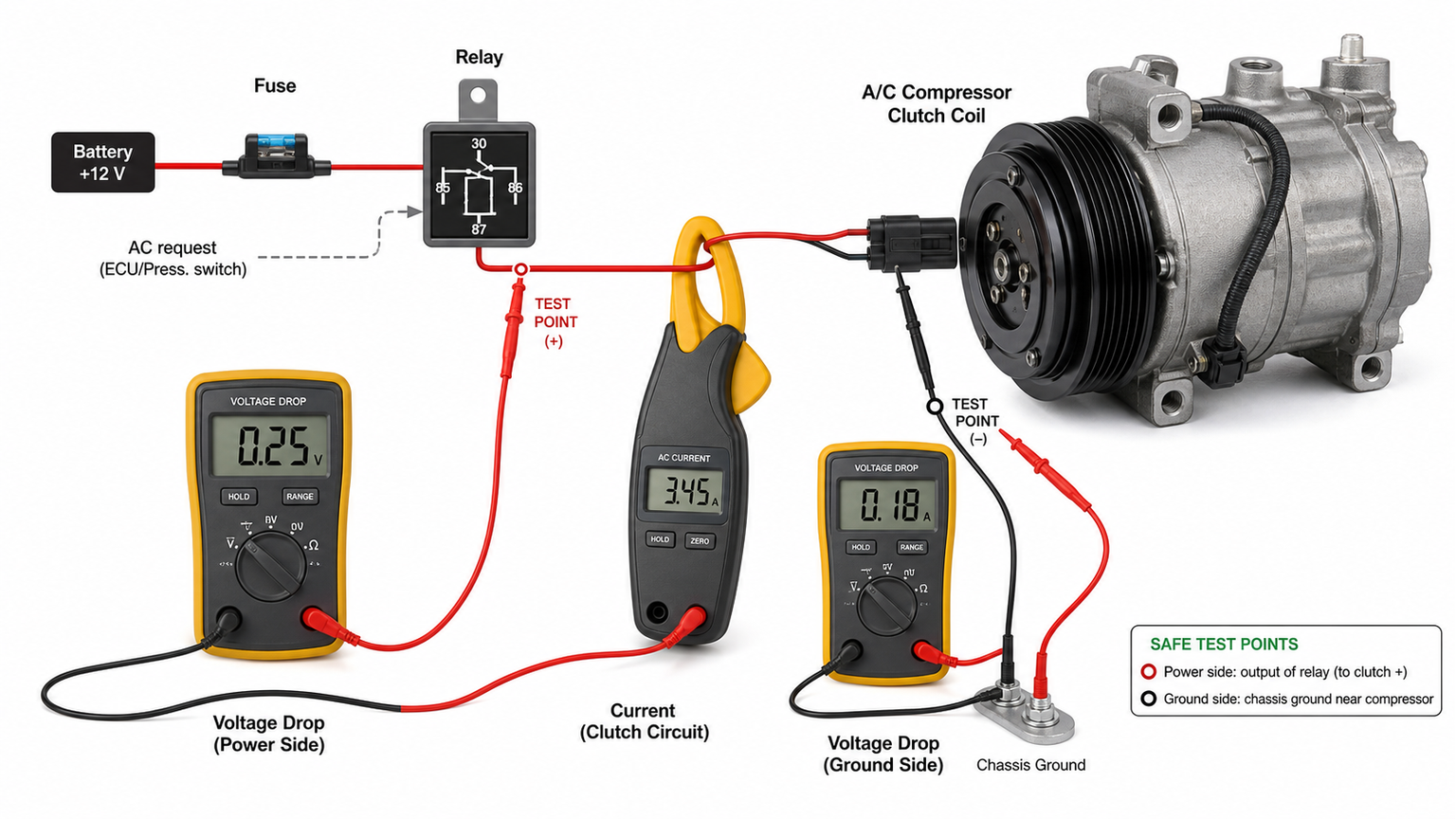
Use the wiring diagram to identify the correct fuse and feed. Check voltage on both test points while the clutch is commanded. A fuse that fails again indicates an overcurrent or short that must be located. Installing a larger fuse is unsafe.
Confirm coil power, coil control, contact input, and switched output. Some controllers switch the relay ground; others provide power. A relay with an internal diode or resistor must be replaced with the correct type and polarity. If an approved identical relay is substituted for testing, confirm the terminal pattern and rating first.
Back-probe with approved tools and compare clutch-coil voltage with battery voltage while commanded. Then measure the power-side and ground-side voltage drops. A connector can display battery voltage when unplugged but collapse under coil current. Inspect terminals for oil intrusion, green corrosion, loose grip, or heat damage.
A current clamp shows whether the coil draws current under command. Resistance can identify an open or shorted winding when compared with the correct temperature-based specification, but it does not reveal every intermittent fault. Disconnect the circuit as directed before resistance testing. Do not apply power directly to a coil unless the service procedure specifies a fused method.
Use the specified feeler-gauge locations and compare multiple points around the hub. Uneven readings may indicate a warped armature, burr, corrosion, bearing movement, or incorrect assembly. Air-gap specifications vary by compressor and clutch. Do not import a Denso, Sanden, or other brand value into a different model simply because the pulley diameter looks similar.
Friction surfaces wear as the clutch engages, increasing clearance. Heat cycles, hub distortion, incorrect shims, bearing condition, and prior repairs can also change the gap. When the magnetic field is marginal, the clutch may engage cold but fail after the coil heats, or engage only when the hub is tapped. Tapping is not a repair and creates a safety risk near a moving belt.
With the engine off and safe access established, inspect pulley rotation, bearing noise, wobble, heat discoloration, friction dust, glazing, and evidence that the hub contacted unevenly. A rough pulley bearing can exist even when the compressor internals are sound. Conversely, a smooth pulley does not prove the compressor shaft will turn under clutch engagement.
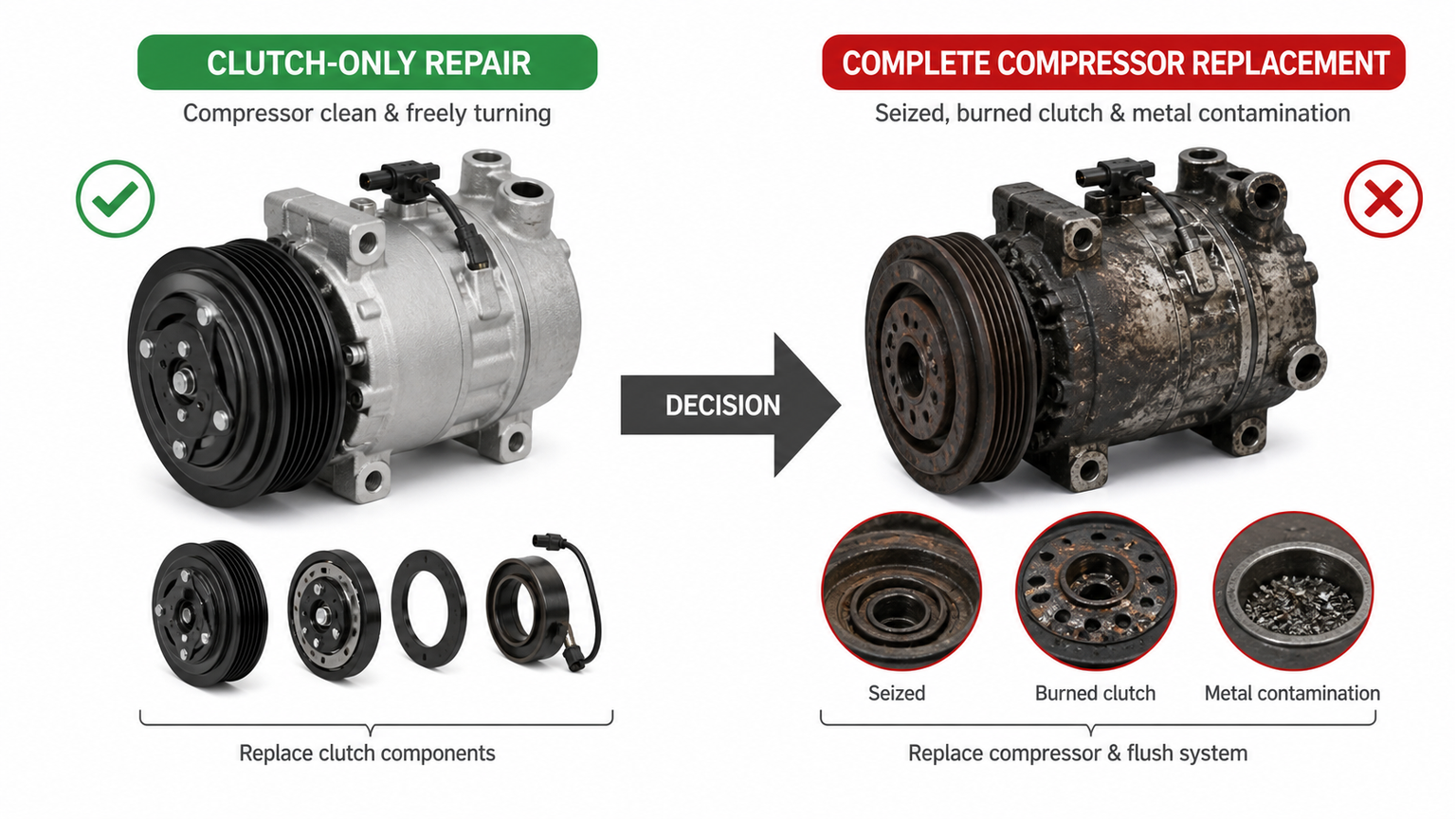
Follow the manufacturer procedure to determine whether the compressor shaft turns and whether internal seizure or contamination is present. Do not force the hub with an unsuitable tool. Blackened oil, metal debris, a locked shaft, severe belt event, or repeated clutch overheating changes the repair from a coil or clutch job to a system-contamination decision.
Rapid cycling can result from low charge, pressure-sensor or switch behavior, evaporator freeze protection, overheating, excessive pressure, unstable voltage, or a clutch coil that opens when hot. Observe command state at the moment of release. If command disappears, trace the control reason. If command remains but current stops, investigate the electrical path and temperature-sensitive coil.
Event | Command state | Diagnostic direction |
|---|---|---|
Hub never moves | No command | Enable logic, pressure and temperature inputs, codes |
Hub never moves | Command and coil voltage present | Air gap, coil magnetic force, hub condition |
Engages cold, releases hot | Command remains | Coil current, connector drop, hot resistance, gap |
Engages then belt squeals | Command present | Compressor load, pulley alignment, belt drive |
Cycles with abnormal high pressure | Command removed | Airflow, fan, charge, restriction, sensor plausibility |
The compressor pumps normally and turns without abnormal load.
The refrigerant circuit is clean and pressures are appropriate.
The fault is isolated to the coil, pulley bearing, hub, or air-gap hardware.
The correct clutch components and service procedure exist for the exact compressor.
Shaft, nose, mounting, and connector condition support reliable assembly.
The shaft is seized, rough, leaking, or internally damaged.
Metal or degraded oil indicates internal wear.
The clutch overheated because compressor torque is excessive.
The clutch is not a separately supported service part.
The housing, nose, connector, mounting ears, or control valve is damaged.
A compressor failure may also require flushing where approved, replacement of the receiver drier or accumulator, inspection of the AC condenser, and correction of the original airflow or lubrication cause. A compressor kit versus bare compressor decision should be based on system contamination and included parts, not package size.
Match the compressor OE number, vehicle, year, engine, market, refrigerant, pulley diameter, groove count, clutch connector, mounting ears, port orientation, manifold type, control valve, oil specification, and prefilled quantity. Similar housings can hide different displacement, valve logic, sensor provision, or pulley alignment. Use catalog resources and authoritative application data rather than a single photograph.
Confirm whether the unit includes the clutch, coil, pulley, hub, control valve, oil, seals, and shipping plugs. State whether it is new or remanufactured and define the inspection basis. For a wholesale compressor order, request label traceability, protected ports, clean oil, correct shaft protection, connector protection, mounting inspection, and packaging that cannot load the clutch hub.
Passenger and commercial road vehicles can use many clutch-control variations, while off-highway machines may add long hoses, dusty condensers, high vibration, cab relays, and field-service harness repairs. Agricultural and construction compressor matching requires the equipment model, engine, cab HVAC configuration, and connector/port evidence in addition to the visible compressor label.
Do not install another fuse until the circuit is isolated. Disconnect the clutch coil only as directed and determine whether the short remains in the harness, relay output, diode, connector, or coil. Inspect areas near the belt, compressor bracket, exhaust heat, and previous splice repairs. A shorted suppressor diode can create different readings by meter-lead polarity. The replacement must restore the original fuse rating and circuit protection; a larger fuse shifts damage to the harness or controller.
Overheating means the clutch slipped or cycled under abnormal load. Measure supply voltage, air gap, bearing condition, hub flatness, and compressor torque. Review high-side pressure and condenser airflow. A restricted or damaged condenser can increase operating load, while a failed fan or debris layer can raise pressure even when the compressor itself initially turns. Replacing only the visible clutch can hide the cause until the new friction surfaces overheat.
If the compressor is removed, inspect the recovered oil and approved circuit locations for discoloration or metal. The appearance should be interpreted with the service history, compressor design, dye use, and refrigerant-recovery process. Do not expose the system longer than necessary; moisture entry can change the required receiver-drier or accumulator scope. The broad aftermarket selection does not replace a contamination-specific repair plan.
Engagement proves only that the hub coupled the pulley to the shaft. It does not prove correct refrigerant mass flow, displacement control, valve operation, condenser heat rejection, expansion-device performance, evaporator airflow, or blend-door position. Observe low- and high-side pressures, vent temperature, line temperatures, compressor command, and fan operation under defined ambient and engine-speed conditions. A worn compressor can turn without producing adequate pressure difference; an overcharged or restricted system can produce pressure without useful cooling.
Recheck the original enable fault instead of assuming the replacement is defective. Confirm that shipping protectors were removed, the connector and ground are correct, the clutch gap is within the exact part specification, the pulley aligns with the belt, and the control module sees plausible pressure. Verify the correct oil specification and installation procedure. A wrong connector adapter or compressor revision may fit mechanically while the coil, diode, valve, or sensor logic differs.
Before closing the work order, clear codes only after recording them, evacuate and charge the refrigerant circuit by the approved method when it was opened, and verify stable clutch engagement without abnormal slip or noise. Measure vent temperature and pressures at specified ambient temperature, engine speed, airflow setting, doors or windows, and recirculation mode. Confirm condenser-fan operation and engine temperature. Recheck for refrigerant, oil, and electrical connector leaks.
A heat-sensitive coil or excessive air gap may pass a cold idle check. Operate the system long enough to reach the original temperature, then repeat low-speed idle, restart, and road-load conditions where safe. Observe command, coil current, voltage drop, cycling rate, pressure, and hub engagement. A repair is not verified until the clutch remains synchronized with the command and the original complaint is absent.
Record the old and new part numbers, recovered refrigerant, specified charge, oil amount and method, contamination findings, clutch air gap where applicable, coil current, circuit voltage drop, pressure and temperature test conditions, and replaced supporting parts. This evidence distinguishes an installation, system, or application problem if the vehicle returns. For repeated fleet orders, connect the documentation to the catalog reference and approved sample so later purchases use the same verified configuration.
The system may still be undercharged, overcharged, leaking, restricted, carrying air, or reporting implausible pressure. The clutch circuit may have an unrelated fault. Compare gauge readings and scan data using approved equipment before forcing engagement.
Bypassing the control can defeat pressure and temperature protection and can damage wiring, belt drive, or a seized compressor. Start with request, command, pressure, and loaded circuit tests.
Measure the gap at the specified points and compare with the exact compressor procedure. Also verify coil voltage, current, hub condition, and pulley bearing; gap is only one part of magnetic engagement.
The pulley can rotate around a stationary compressor shaft. The compressor may still be seized, internally damaged, or unable to pump. Assess shaft load, pressures, oil, noise, and contamination.
Send the OE number, vehicle or equipment model, engine, refrigerant, pulley grooves and diameter, connector, ports, mounting views, control-valve details, required included parts, quantity, and failure evidence through Elecdura's contact channel.
If testing confirms a clutch or compressor fault, send Elecdura the OE reference, application, clutch connector, pulley dimensions, port orientation, refrigerant and oil requirement, control-valve details, contamination findings, required accessories, and order quantity. These inputs let the quotation distinguish a clutch-capable mechanical compressor from a clutchless or electric design and prevent a visually similar unit from entering a bulk order.