Your Whole New Supply Chain For Cooling & AC Parts
Your Whole New Supply Chain For Cooling & AC Parts
Views: 0 Author: Site Editor Publish Time: 2026-11-17 Origin: Site
Before ordering an automotive AC repair kit, approve an itemized bill of materials for the exact vehicle and repair job. Each line should identify the component, manufacturer or supplier reference, quantity, application, included seals and installation information. State which parts are excluded and whether oil is already inside the compressor. A kit photograph and the word “complete” cannot establish those details.
This checklist is for distributors, repair chains and fleet buyers turning a technician's repair decision into a purchase order and receiving record. If you are still deciding which components the failure requires, start with the compressor repair kit component and contamination guide. Once that scope is settled, the task is to ensure that the quotation, carton contents and installation documents describe the same package.
The repair plan lists everything needed to return the system to service. The purchased kit may supply only some of those items. Refrigerant, approved flushing materials, workshop equipment, additional diagnosed electrical parts and labor may sit outside the kit even when the seller calls it complete.
Four Seasons' official PAC-Kit range distinguishes service kits, pre-packaged complete kits, virtual kits and Super PAC-Kits. This illustrates why buyers should check the specific offering: a commercial kit name is not a universal bill of materials. Ask whether the quotation is for one packed SKU or a group of separately supplied components.
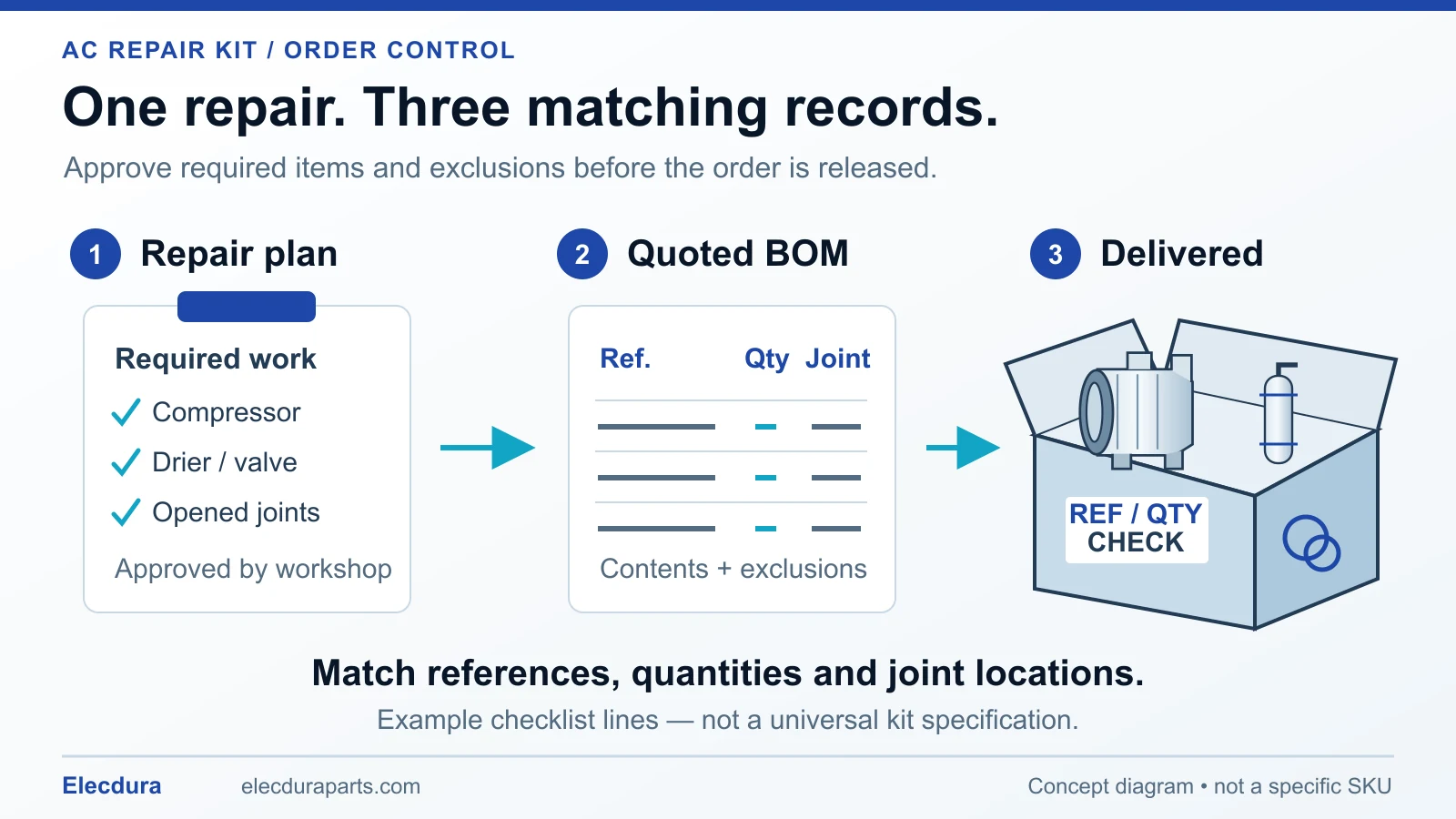
Create two linked records: the approved repair scope from the workshop and the supplier's proposed contents. Every required item must either appear in the supplier's list or have a named alternative supply route. That comparison exposes omissions before the vehicle is dismantled.
Record make, model, year, engine, original sales market, VIN or chassis information, refrigerant and HVAC configuration. Add the complete numbers on the removed compressor and clear photographs of its label, ports, connector, mounting ears and belt-drive arrangement where applicable. A chassis identification alone may not resolve a separately installed commercial-vehicle HVAC system; record its equipment maker and model as well.
Carry this application record through the compressor, drier, expansion device and condenser checks. A compressor cross-reference does not prove that every supporting part in a bundled kit matches the same configuration. Front-and-rear HVAC, an integrated condenser drier or a production-date split can change the supporting parts and service information.
For sourcing individual units, use the Elecdura AC compressor range to identify candidate references, then compare the original unit and vehicle information. A matching photograph is useful evidence of layout, but is not final fitment approval.
The repair plan, quotation and receiving record should agree. The example line items do not define a universally required AC kit.
Use a separate row for each supplied item. Avoid descriptions such as “all necessary accessories” when the supplier can list those accessories explicitly.
Item | What the quotation must identify | What to resolve before approval |
|---|---|---|
Compressor | Part reference, quantity, condition and application; ports, mounting and drive/control configuration | Whether clutch, pulley, control valve or other pictured items are included |
Receiver-drier or accumulator | Correct type, reference, connections and quantity | Whether it is a separate component, cartridge, or included within another assembly |
Expansion device | TXV or orifice tube reference, application and quantity | Which circuit it serves; any additional device required for rear HVAC |
Condenser, when required | Reference, ports, mounting and supplied assembly boundary | Whether the drier, sensors, brackets and seals are included or separate |
Seal pack | Seal identities, quantities and intended joint locations | Which opened connections the pack covers and which remain outside it |
Lubricant | Specified type/grade, compressor factory fill and any separately supplied quantity | How the installer will reconcile that supply with the vehicle's oil-balance procedure |
Additional diagnosed parts | Individual references for hoses, lines or electrical components actually required | Whether these are kit contents or separately priced order lines |
Instructions and identification | Application instructions, labels, revision and traceable component references | Which installation records and supporting documents the seller requires for a claim |
The reference column should distinguish the supplied brand number from its OE reference. If a vendor uses an internal bundle code, retain the component numbers underneath it. Otherwise a later substitution can change the package while leaving the bundle name unchanged.
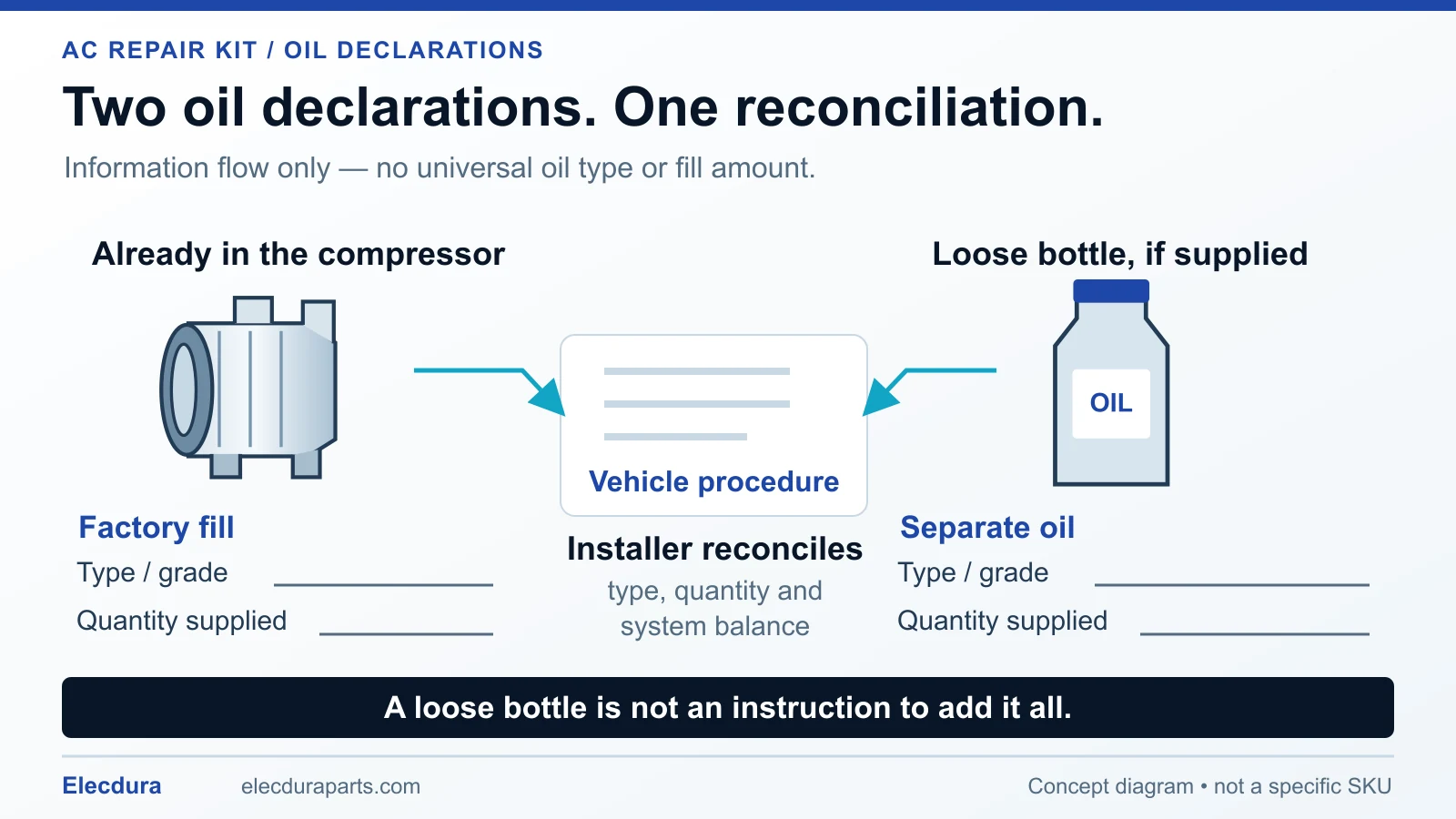
Record factory-fill type and quantity separately from loose oil. The installer follows the vehicle-specific oil-balance procedure.
Ask two separate questions: how much and what type of oil is already in the compressor, and what oil is supplied loose in the carton? Do not combine these into a single “oil included” tick box. Record the label information and the applicable installation instruction; an oil bottle in the package is not an instruction to add its entire contents.
DENSO's compressor-oil guidance explains that the new compressor's label identifies its oil type and quantity, and that vehicle-manufacturer data must be checked when the quantity or system configuration differs. This supports a purchasing control: require a declared fill condition and an installation reference rather than a universal oil quantity for every kit.
For an electric compressor, retain the exact application-specific lubricant requirement. Do not accept a generic substitute on the basis of similar viscosity alone. Any discrepancy between the carton label, compressor label and instructions should be resolved before installation, with the corrected declaration retained against the order.
Normalize quotations to the same repair scope. Compare the cost of the complete required order, not a headline kit price that leaves essential lines unspecified.
Condenser: identify it as included, separately supplied or not required under the workshop's approved procedure. If needed, compare the condenser reference and assembly configuration, not core dimensions alone.
Drier: distinguish a new integrated assembly, a serviceable cartridge and a separate receiver-drier. Do not count the same item twice or assume that a pictured cylinder is included.
Seals and hardware: request a joint-by-joint list. Identify any original brackets, fasteners or sensors that are intended to be transferred.
Service supplies: state who provides refrigerant, permitted flushing materials and other workshop consumables. Their absence from the carton must not be mistaken for permission to omit the service step.
Documents: obtain the actual installation and claim requirements for the supplied product. One brand's requirements should not be presented as every supplier's warranty policy.
For United States service work, the EPA Section 609 training and certification requirements apply to paid motor-vehicle A/C servicing. A parts order does not establish workshop qualification or replace the required refrigerant-service process.
The workshop has already specified condenser replacement, but the proposed kit lists only a compressor and service components. The procurement issue is the missing order line. Obtain a matched condenser reference and update the complete order comparison. Do not accept a verbal promise that it can be added later without checking availability, fitment and shipment timing for that particular order.
A virtual bundle may arrive through separate cartons. Link every parcel and component reference to the same purchase-order line, and define what constitutes a complete receipt. Receiving the compressor first is not the same as receiving the approved kit. This matters when a workshop schedules a vehicle against the delivery date.
Compare the shipping documents and labels with the approved bill of materials before releasing stock to the workshop. Photograph damaged packaging, missing labels and reference mismatches. Keep protective caps and moisture-sensitive packaging intact during receiving checks; opening a sealed component simply to count a feature can create an avoidable handling problem.
Reconcile every component reference and quantity, including separately shipped items.
Compare accessible mounting points, ports, connectors and drive features with the approved record.
Check that the drier configuration and seal pack correspond to the listed assemblies.
Match oil declarations and instructions to the exact compressor supplied.
Record shipping damage, bent connections or missing protective packaging for supplier review.
Separate accepted items from unresolved items, with a reason and order reference for each hold.
Receiving inspection confirms identity, condition and completeness. It does not prove system performance. Functional testing belongs to an agreed procedure with appropriate equipment and application-specific limits; the purchasing checklist should not invent a universal pressure or running test.
If a supplier proposes a different compressor, drier or valve, ask for the revised component number and the evidence supporting its application. Recheck the affected interfaces and included accessories. An approved substitute should produce a revised bill of materials, not just a handwritten change to a shipping label.
Keep the accepted bundle reference, component list, oil declaration, instructions, sample findings and revision together. For repeat purchases, ask the supplier to identify changes before dispatch. This makes an earlier sample approval useful without assuming that all future cartons have identical contents.
No. Confirm the itemized contents and exclusions. A condenser must follow the approved repair scope, while refrigerant and workshop supplies may be sourced separately.
Only where the component supplier's application information supports those configurations. Check each component and relevant vehicle split; a shared compressor reference alone does not validate the whole bundle.
Yes. Record the compressor fill separately from any loose oil, then retain the vehicle-specific instructions for the installer to determine the correct system balance.
Its listed seals cover the connections opened in the approved repair. Counts, locations and references make that check possible; assorted colors or a generic photograph do not.
For an Elecdura sourcing inquiry, send the vehicle/application record, original compressor number and photographs, the workshop's required components, quantities and destination market. Separate the parts you need quoted from those already sourced. Send the component list for sourcing review and request written confirmation of the proposed references and supply scope; do not assume a complete pre-packed kit is available because individual component categories are listed.