English
Views: 0 Author: Site Editor Publish Time: 2026-08-10 Origin: Site
A bad A/C pressure switch or pressure sensor can make the compressor stay off, cycle too quickly, run at the wrong time, trigger poor cooling, or set pressure-related fault codes. The tricky part is that the same symptoms can also come from low refrigerant, an overcharged system, a weak condenser fan, a restricted condenser, a failing compressor clutch, damaged wiring, or a control-module fault. Before replacing the compressor, a technician should confirm actual system pressure, switch or sensor signal, connector condition, and fan operation.
This article explains the common bad A/C pressure switch symptoms, how high-side and low-side protection behave, how a switch differs from a pressure transducer, and what buyers should confirm before ordering replacement parts. It is written for repair shops, distributors, fleet maintenance teams, and importers who need fewer misdiagnoses and cleaner parts matching. For related A/C parts, Elecdura also supports wholesale A/C compressors, A/C condensers, radiator fans, and fan control modules.
The most common symptom is an A/C compressor that does not engage even when the cabin control requests cooling. The switch may be open because pressure is genuinely too low or too high, or it may be faulty and reporting an unsafe condition when the pressure is actually acceptable. Another common symptom is short cycling, where the compressor turns on and off too quickly. This can happen when the low-pressure switch opens and closes rapidly, but it can also happen with low refrigerant charge or poor airflow across the condenser.
Other symptoms include warm air from the vents, intermittent cooling, cooling that works at highway speed but not at idle, cooling that cuts out on hot days, condenser fans that do not respond correctly, and diagnostic trouble codes related to refrigerant pressure sensor voltage or A/C request inhibition. On vehicles that use a pressure transducer, the scan tool may show implausible pressure, a fixed pressure value, or a voltage outside the expected range.
Symptom | Possible Pressure Switch Link | Other Causes to Rule Out |
|---|---|---|
Compressor does not engage | Low-pressure switch open or sensor reports unsafe pressure | Low refrigerant, blown fuse, clutch gap, relay, control module |
Compressor short cycles | Switch opens and closes rapidly near threshold | Low charge, expansion valve issue, icing, airflow problem |
A/C cuts out at idle | High-side pressure rises and protection opens | Weak fan, dirty condenser, fan module fault |
Pressure code stored | Transducer voltage is missing or implausible | Wiring, ground, reference voltage, ECU input fault |
Fans behave strangely | Pressure signal may command fan speed incorrectly | Fan motor, resistor, module, fuse, relay, coolant-temperature input |
A low-pressure switch protects the compressor from running when refrigerant pressure is too low. Low pressure often means low refrigerant charge, which also means poor oil circulation. If the compressor runs without enough refrigerant and oil movement, it can suffer internal damage. That is why bypassing a low-pressure switch for a quick test should only be done carefully and briefly by a qualified technician, not as a repair.
A high-pressure switch protects the system when pressure becomes excessive. High pressure can occur from overcharging, blocked airflow, a dirty condenser, a weak cooling fan, a restricted condenser, or a blockage elsewhere in the system. In hot climates or stop-and-go traffic, a high-pressure cutout may appear only after the vehicle idles with the A/C on. If the switch opens because pressure is truly high, replacing the switch will not fix the cause.
Some vehicles use separate low and high switches. Others use a trinary switch that combines pressure protection and fan control. Many newer vehicles use a three-wire pressure transducer that sends a variable voltage signal to the control module. The diagnostic approach changes depending on which design is fitted.
A traditional pressure switch is usually an on/off device. It opens or closes at a calibrated pressure threshold. A two-wire low-pressure switch may show continuity when pressure is acceptable and open when pressure is too low. A high-pressure switch may work in the opposite logic depending on system design. The service information for the vehicle should be checked before interpreting the result.
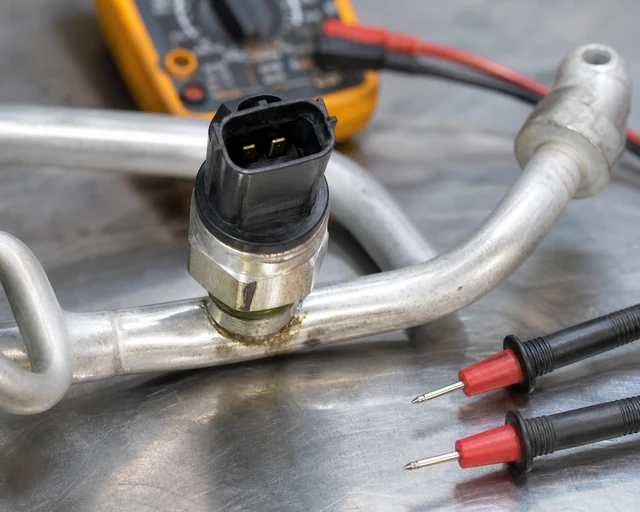
A pressure sensor or transducer is different. It usually has a reference voltage, ground, and signal wire. Instead of simply opening or closing, it reports pressure as a changing voltage. A scan tool may show refrigerant pressure in psi, bar, or kPa. If the sensor signal is wrong, the control module may prevent compressor operation even if the mechanical pressure is acceptable. Replacing a transducer without checking reference voltage and ground can miss a wiring fault.
Part Type | Typical Wires | Test Method | Buying Risk |
|---|---|---|---|
Low-pressure switch | 2 wires | Continuity and actual low-side pressure | Wrong thread or threshold |
High-pressure switch | 2 wires | Continuity and actual high-side pressure | Misdiagnosing fan or condenser fault |
Trinary switch | 3 or 4 wires | Pressure function and fan-control circuit | Wrong pin layout or fan logic |
Pressure transducer | 3 wires | Reference, ground, signal voltage, scan data | Connector shape and voltage range mismatch |
A compressor that does not engage is often blamed first because it is visible and expensive. But the compressor may be healthy and simply not being commanded on. Before replacing it, confirm whether the A/C request reaches the control system, whether the compressor clutch or variable-control valve receives a command, and whether the pressure switch or sensor is allowing operation. If the system has no refrigerant or extremely low static pressure, the switch may be doing exactly what it should do.
Start with a visual inspection. Look for oily residue at hose crimps, condenser edges, service ports, compressor body, evaporator drain, and pressure switch threads. Check that the connector is fully seated and not full of oil, water, corrosion, or broken terminal tension. On many vehicles, a pressure sensor mounted near the condenser or receiver drier can be damaged during front-end repair or condenser replacement.
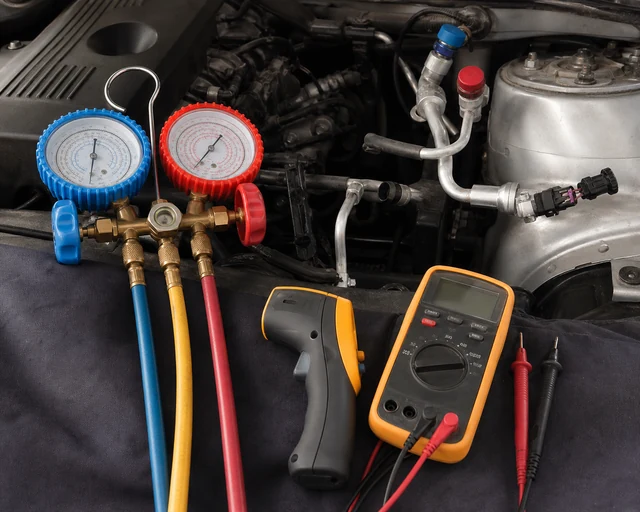
Next, connect manifold gauges or approved service equipment and compare static pressure to ambient temperature. Static pressure that is far too low suggests refrigerant loss. Static pressure that is normal but the scan tool shows an impossible pressure points toward sensor, wiring, or module interpretation. Dynamic pressure readings with the A/C running can reveal airflow, condenser, expansion valve, or charge problems.
Confirm the customer complaint: no cooling, intermittent cooling, short cycling, or idle-only failure.
Inspect fuses, relays, visible wiring, connector damage, and obvious refrigerant oil stains.
Read scan-tool data for A/C request, compressor command, pressure value, and stored codes.
Measure actual low-side and high-side pressure with proper service equipment.
Compare sensor data to gauge pressure. A large mismatch indicates sensor or circuit trouble.
For a switch, test continuity only after confirming the actual pressure is in the expected range.
For a transducer, test reference voltage, ground integrity, and signal voltage.
Check condenser fan operation because high pressure from poor airflow can mimic a bad switch.
Confirm the replacement part by OE number, port thread, connector shape, pin count, and pressure range.
Low refrigerant is one of the most common reasons a low-pressure switch prevents compressor operation. In that case, the switch is not bad; it is protecting the compressor. Adding refrigerant without finding the leak may make the A/C work temporarily, but the symptom will return. A shop should leak-test the system, repair the leak, evacuate, and recharge by weight according to the vehicle specification.
Low charge can also cause short cycling. The compressor starts, low-side pressure drops quickly, the switch opens, the compressor stops, pressure rises, and the cycle repeats. Replacing the switch may change nothing. The correct repair is to diagnose the leak, confirm charge amount, and verify that the system maintains pressure. For distributors, this distinction matters because a returned pressure switch may have been sold into a low-charge vehicle.
High-side pressure can rise when condenser airflow is poor. The cooling fan may be weak, the fan module may not command the right speed, the condenser fins may be blocked, or debris may sit between the condenser and radiator. In this case, the high-pressure switch or sensor may cut compressor operation correctly. The symptom may look like A/C failure at idle or on very hot days.
Before replacing the pressure switch, check whether the fan comes on with A/C request. Inspect fan speed, shroud fit, condenser face, and radiator stack cleanliness. If the vehicle cools while driving but not at idle, airflow is a strong suspect. Related parts such as radiator fan assemblies and fan control modules should be checked when high-side pressure is excessive.
Pressure switches are small parts, but wrong matching is common. Confirm the OE number, thread type, sealing method, connector shape, pin count, pressure threshold or voltage range, and whether the part is mounted on the high side, low side, or receiver drier. A visually similar switch may not have the same calibration. A transducer with the wrong signal range can make the control module read pressure incorrectly.
For wholesale buyers, request clear photos of the connector, threads, sealing face, and label. If the part includes an O-ring, confirm material and size. If the switch is packed without a cap, dust and moisture can enter the port during storage. Small details affect warranty rates because A/C systems are sensitive to contamination and sealing problems.
OE number and vehicle application list.
High-side, low-side, trinary, or transducer design.
Connector shape, lock tab, pin count, and terminal layout.
Thread size, sealing face, and O-ring inclusion.
Pressure threshold or voltage output range where available.
Packaging cap to keep the pressure port clean.
Warranty evidence requirements: gauge readings, scan data, and installation photos.
Related fan, condenser, compressor, and refrigerant-charge checks before approving claims.
The switch is probably not the main problem when static pressure is too low, when there is visible refrigerant oil at a leak point, when high-side pressure rises because the fan does not run, or when the scan tool shows the compressor is blocked by another input such as engine temperature or control-module strategy. It is also not the main suspect when the connector has no reference voltage on a three-wire sensor. In that case, the circuit must be repaired before the sensor is condemned.
For fleets and repair networks, documenting these cases helps reduce unnecessary parts replacement. A pressure switch is inexpensive compared with a compressor, but repeated misdiagnosis damages trust. A good parts program helps the technician ask the right question: is the switch reporting a real pressure problem, or is the switch itself reporting incorrectly?
Pressure readings should always be interpreted with ambient temperature, engine speed, fan operation, and refrigerant type in mind. A static reading that is very low compared with ambient temperature usually points toward refrigerant loss. A low-side reading that drops quickly after the compressor starts can suggest low charge, restriction, or evaporator-side issues. A high-side reading that climbs rapidly at idle often points toward airflow trouble, overcharge, or condenser restriction rather than a bad switch.
The pressure switch is only one messenger in the system. If the actual high-side pressure is excessive and the sensor reports excessive pressure, the sensor is probably doing its job. If the gauge shows reasonable pressure but the scan tool shows an impossible value, then the pressure transducer, reference circuit, ground, or signal wire deserves attention. This comparison between physical pressure and reported pressure is one of the fastest ways to avoid unnecessary compressor replacement.
Gauge / Data Pattern | Likely Direction | Next Check |
|---|---|---|
Very low static pressure | Refrigerant leak or empty system | Leak test before condemning switch |
Normal gauge pressure, scan data reads zero | Sensor signal or circuit issue | Check reference, ground, and signal wire |
High-side pressure rises at idle | Airflow or overcharge issue | Check condenser fan and condenser face |
Switch continuity changes near threshold | Switch may be operating normally | Compare with service information |
Fixed sensor voltage | Sensor or wiring fault | Back-probe and wiggle-test connector |
Older vehicles may use a simple pressure switch in series with the compressor clutch circuit. Newer vehicles may use the pressure signal as one input to a body control module, engine control module, HVAC module, or fan control module. The module may decide not to engage the compressor because of pressure, engine temperature, wide-open throttle logic, evaporator temperature, battery voltage, or a stored fault. That means the symptom may be compressor no-start even when the pressure switch is not the only condition being evaluated.
Variable-displacement compressors add another layer. Some do not use a traditional clutch cycling pattern. The compressor may be commanded through a control valve, and the pressure sensor helps the module regulate output. A technician who expects old-style clutch behavior may misread a normal strategy as a failed switch. Shops should use scan data to confirm A/C request, compressor command, pressure reading, and fan request before replacing parts.
Pressure switches and sensors are often installed near hot, vibrating, or exposed areas of the engine bay. The connector may suffer from broken locks, spread terminals, corrosion, oil contamination, previous collision repair, or harness tension after condenser replacement. A sensor can be replaced and still show the same fault if the connector has poor terminal contact.
For a two-wire switch, check the harness side for continuity path and module input according to the wiring diagram. For a three-wire transducer, confirm reference voltage, ground voltage drop, and signal voltage. Wiggle the harness while watching scan data. If the pressure reading jumps, drops out, or becomes fixed when the connector is moved, the part may not be the root cause. For distributors, asking for connector photos before selling a replacement can reduce wrong orders caused by similar-looking sensors.
Pressure switch warranty claims are often difficult because the part is inexpensive and easy to blame. A distributor should request basic evidence: original complaint, gauge readings, scan-tool pressure value, connector photo, part number installed, and whether refrigerant charge was confirmed. If the claim says the new switch did not fix the A/C, that does not prove the switch is defective. It may mean the system had a leak, fan issue, wiring fault, or compressor control problem.
Clear evidence protects both sides. Workshops get better diagnostic support, and suppliers avoid replacing good parts repeatedly. If a batch has multiple true defects, the evidence will also reveal a pattern such as wrong connector, incorrect pressure threshold, poor sealing, or damaged threads. That pattern helps the importer improve the next order instead of treating every complaint as random.
Example one: a sedan arrives with no compressor engagement. The low-side static pressure is near zero, and there is oily residue at the condenser edge. The low-pressure switch is open, but it is not bad. The system has lost refrigerant. The correct repair is leak repair, evacuation, and recharge, with replacement of contaminated or damaged parts as required.
Example two: an SUV cools on the highway but stops cooling at idle. High-side pressure climbs quickly, and the condenser fan does not reach high speed. The pressure sensor reports high pressure and the module cuts compressor operation. The sensor is reporting correctly; the repair direction is fan motor, fan resistor, fan control module, wiring, or airflow restriction.
Example three: a truck shows a pressure-sensor circuit code. Gauge pressure is normal, but scan data shows a fixed low value. Reference voltage is present, but the signal wire has intermittent contact near the connector. Replacing the compressor would be completely unnecessary, and replacing the sensor without repairing the harness may also fail.
Bad A/C pressure switch symptoms include compressor no-start, short cycling, intermittent cooling, fan-control irregularities, pressure codes, and cooling that fails under certain conditions. But the part should only be replaced after actual pressure, sensor signal, wiring, and airflow have been checked. Low refrigerant and high condenser pressure are common reasons the switch protects the system correctly.
When ordering replacement pressure switches or sensors, send the OE number, vehicle model, connector photo, thread photo, pin count, mounting location, and any pressure or voltage data available. Elecdura can help buyers match pressure switches and related A/C components so the repair targets the real fault instead of turning a small sensor problem into an unnecessary compressor replacement.