English
Views: 0 Author: Site Editor Publish Time: 2026-08-03 Origin: Site
Heavy-duty truck AC condenser replacement looks simple until two condensers with the same general size create different installation results. The condenser may fit the front module but place the port at the wrong angle. It may include or omit a receiver drier. It may use a different pressure switch port, bracket pitch, tube path, or line connection. On a truck fleet, those small differences can create hose stress, refrigerant leaks, blocked airflow, repeat compressor failure, and costly downtime during hot weather.
This article gives distributors, fleet buyers, and repair networks a practical checklist before ordering a replacement AC condenser for heavy-duty trucks. The aim is not to make every buyer an HVAC engineer. The aim is to prevent the common purchasing mistake: buying by model name or approximate photo while ignoring drier configuration, port direction, bracket layout, line routing, and the condition of the cooling stack. A condenser should be quoted from evidence, not from a title alone.
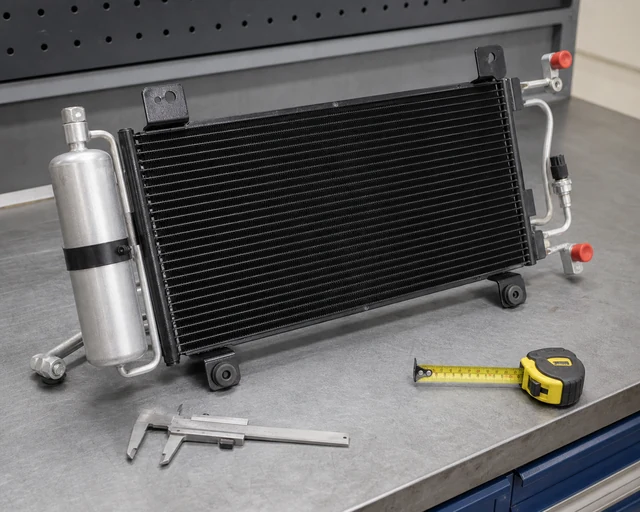
Truck condenser replacement should verify core size, receiver drier style, brackets, port direction, and line routing before shipment.
Core height, width, and thickness are important, but they do not guarantee fit. Heavy-duty trucks may use different cooling packages across engine, cab, region, emission package, and production year. The same model family can have different mounting brackets, line exits, drier designs, pressure switch locations, and fan shroud clearance. A condenser that looks close on a screen can create a difficult installation when the technician is standing in front of the truck.
Replacement risk is higher on fleets because downtime is expensive and multiple trucks may be repaired from the same purchase. If the first condenser is wrong, the mistake may repeat across the order. The best way to reduce this risk is to require old-part photos, OE numbers where available, measured dimensions, port close-ups, bracket measurements, and cooling-stack context before confirming a batch. The same evidence package also helps decide whether the condenser order should be paired with related truck AC compressors checks.
The receiver drier is one of the easiest details to miss. Some truck condensers have an integrated drier cartridge or canister. Some use a separate receiver drier elsewhere in the system. Some replacement condensers are sold with the drier included, while others require it to be ordered separately. If the quote does not specify the drier arrangement, the repair can stop halfway through installation.
Replacing a condenser after compressor failure or system opening should also raise the question of moisture and contamination. A drier is not a decorative add-on. It helps control moisture and debris in the refrigerant circuit. If the old compressor failed internally, the condenser may contain debris and the drier may be saturated or contaminated. A fleet buyer should ask whether the repair requires a drier, expansion valve or orifice tube, O-rings, flushing, and oil balance. Selling a condenser alone can be acceptable for impact damage, but it may be incomplete for contamination repairs.
Drier Situation | Ordering Risk | What to Confirm |
|---|---|---|
Integrated drier canister | Wrong canister location or missing cartridge | Canister side, service cap, cartridge inclusion |
Separate receiver drier | Buyer assumes it is included with condenser | Separate part number, mounting location, fittings |
Condenser after compressor failure | Debris remains in system | Flushability, drier replacement, expansion device check |
Fleet bulk order | Mixed drier configurations in same model family | VIN range, photos, OE cross-reference, sample approval |
Port direction is a small detail with a large effect. The inlet and outlet must connect to existing refrigerant lines without pulling, twisting, or forcing the hose against nearby parts. A port that points slightly upward, downward, forward, or rearward can decide whether the line sits naturally or carries constant stress. Constant stress can damage the condenser tube, loosen O-rings, or create a leak that appears after the truck returns to service.
Thread and fitting style should be confirmed from close-up photos. Do not rely only on the hose nut appearance. Some condensers use different fitting sizes, sealing surfaces, or pressure switch ports. Adapters are not always a good solution because they can change line position and create service-access problems. When the old condenser is available, photograph both ports with a ruler or thread gauge reference. For remote customers, ask for port center distance and port orientation photos before quoting.
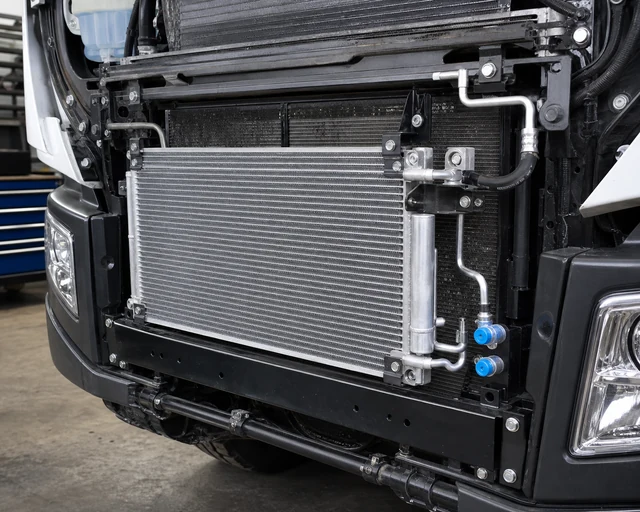
Pressure switch ports, bracket pitch, and line clearance should be checked while the condenser is viewed in the full front cooling stack.
Truck condensers are mounted in a busy front-end cooling stack. The condenser must sit in the correct plane relative to the radiator, charge air cooler, fan shroud, hood structure, grille, and line supports. If bracket pitch is wrong, technicians may enlarge holes, bend tabs, add washers, or force the condenser into place. Those field modifications can make the core vibrate, rub, or crack later.
Bracket checks should include hole spacing, tab direction, rubber isolator position, upper and lower support shape, and any side brackets. If the condenser mounts with the radiator or charge air cooler, check whether the stack has been repaired before. Bent supports and previous collision damage can make a correct condenser seem wrong. A good supplier should ask for enough photos to separate part mismatch from truck structure damage.
Line routing is often the difference between a fast repair and a repeat leak. Refrigerant lines need clearance from belts, fan blades, sharp brackets, hot exhaust components, moving cab mounts, and high-vibration areas. The replacement condenser should place ports so the existing lines follow the original route. A hose that must be twisted to fit may seal during vacuum testing but leak after road vibration and thermal cycling.
Repair networks should inspect line supports and clamps during condenser replacement. Missing clamps let lines vibrate. Hardened hoses may crack when moved. Corroded fittings may not seal even with a new condenser. For fleet programs, it is useful to stock O-ring kits, line seals, common switches, and driers together with condensers so the technician does not reuse damaged sealing parts.
If the condenser leaked from impact or stone damage and the rest of the system is clean, replacing the condenser, seals, and drier may be enough. If the compressor failed internally, the job is different. Debris can remain in the condenser, lines, expansion device, and drier. Installing a new condenser without addressing contamination may lead to restricted flow, high head pressure, poor cooling, or damage to the new compressor.
Fleet buyers should ask what failure evidence exists. Was there black oil, metal debris, burned clutch material, seized compressor, or unusually high pressure? Did the technician recover refrigerant and inspect oil condition? Was the expansion valve or orifice tube checked? The answers decide whether the quote should include only a condenser or a broader repair package. The repair scope should follow evidence rather than the lowest single-part quote.
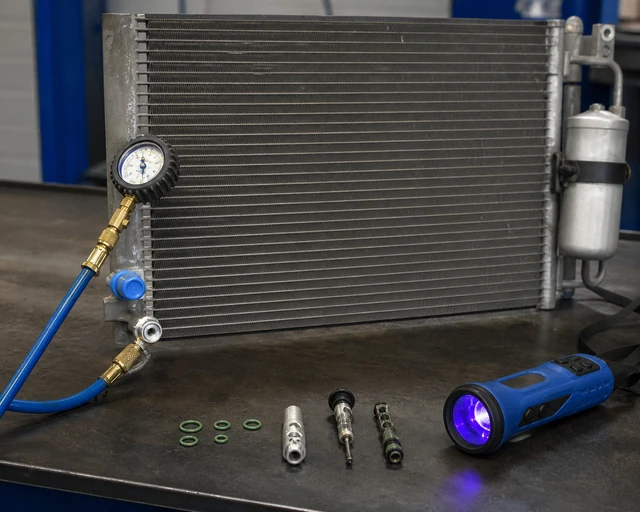
Leak testing should happen before and after replacement. A visible oil stain on the condenser may identify the leak, but it does not prove there are no additional leaks at hose joints, evaporator, compressor shaft seal, pressure switches, or service ports. Nitrogen pressure testing and proper vacuum hold testing can reduce repeat comebacks. Dye can help locate slow leaks, but dye should not replace pressure and vacuum checks.
The article on AC condenser leak test methods is useful when a customer keeps replacing parts without finding the leak source. For B2B procurement, leak evidence also protects warranty decisions. If a condenser is returned for leakage, photos of the leak location, installation marks, pressure readings, and packaging condition help decide whether the problem was manufacturing, shipping damage, installation stress, or system pressure.
Truck condensers are large, thin, and easy to damage in transit. A core that arrives with bent fins, twisted side plates, or port damage may still look usable but create airflow loss or leak risk. For bulk orders, packaging should protect corners, ports, brackets, and flat core surfaces. Caps should stay on ports. Cartons should be strong enough for stacking conditions, and inner protection should prevent the condenser from moving inside the box.
Distributors should define packaging expectations before buying. Ask for carton photos, label format, sample packaging, and whether palletization is available. A cheaper condenser can become expensive if transit damage creates claims, delays, and customer frustration. This is especially important for export orders, mixed SKU shipments, and parts that travel through several warehouses before reaching the repair shop.
Condenser replacement after compressor failure should include contamination checks, drier replacement, and seal planning.
For fleets, stocking decisions should be based on failure rate, truck family, climate, seasonal demand, and repair lead time. A fleet that operates in hot regions may need condensers, driers, O-rings, pressure switches, and common line seals before summer. A distributor serving many truck models should avoid assuming that one condenser covers all vehicles in a family. Build the stock list from verified VIN ranges, old-part photos, and past repair records.
When two condenser versions are close, keep clear labels and photos in the inventory system. Include port-side photos, bracket measurements, and drier notes. This reduces picking mistakes and helps sales teams ask better questions. If a buyer asks only for a truck model, the sales team can request the missing evidence before shipping the wrong part.
Confirm truck make, model, year, engine, VIN range, and cooling package if available.
Photograph the old condenser front, back, ports, brackets, drier area, and line routing.
Measure core size, overall size, bracket pitch, port center distance, and drier canister position.
Confirm whether the repair follows impact damage, corrosion, compressor failure, or poor cooling.
Check whether the quote should include receiver drier, O-rings, pressure switch, expansion device, or related compressor parts.
Review packaging requirements for large condenser shipments.
A repair network may order a condenser for a group of similar trucks after one unit is damaged by road debris. The replacement core slides into the front stack, but the outlet port sits several degrees lower than the original. The technician can connect the line only by pulling the hose downward and rotating the fitting. The vacuum test may pass in the bay, but the line is now loaded against the port. After vibration and heat cycling, the O-ring begins to leak and the customer sees an oily stain near the fitting.
This is not a simple defective-condenser story. It is a matching failure that should have been caught before shipment. Port angle, fitting direction, and line support should be treated as required details for truck condenser quotes. When a fleet has multiple trucks, approve the first sample with installation photos before releasing a larger batch. That one step can prevent repeated labor and warranty confusion across the fleet.
Heavy-duty truck platforms often carry mixed cooling packages. The same badge may cover day cab, sleeper cab, different engines, different radiator stacks, regional specifications, and production changes. A buyer who says the truck model only gives the supplier a starting point. The final condenser choice should still be confirmed by the old part. This is especially important for distributors selling across North America, Latin America, the Middle East, and export fleets where model names can overlap while installed cooling modules differ.
For wholesale stocking, label each condenser with visual identifiers: drier side, port orientation, bracket layout, and approximate core size. Sales teams should keep those identifiers in the product notes. If two SKUs are very similar, do not rely on SKU numbers alone. Add front and rear product photos, port close-ups, and bracket measurement notes. This makes the catalog easier for counter staff and online buyers, and it reduces returns from lookalike parts.
The condenser helps reject heat and can also trap contamination. If a truck AC compressor fails internally, the condenser may contain debris that cannot be fully removed depending on its construction. Installing a new compressor while leaving contaminated parts in the circuit can shorten compressor life. Conversely, replacing a condenser after impact without checking the compressor may be enough if the system stayed clean and was repaired quickly.
A professional repair decision should connect the condenser to the system history. Was the old condenser punctured externally? Did the compressor seize? Was the drier open to air for a long time? Did the system show high head pressure before failure? Was the fan operating correctly? These questions turn a simple part order into a repair plan. For B2B buyers, that repair plan is valuable because it reduces claims and helps the customer understand why the quote may include seals, drier, switch, or compressor-related parts.
A good condenser quotation should include the product photo, core dimensions, port photos, drier information, package contents, compatible references, and any notes about related parts. If the condenser has a pressure switch port, identify whether the switch is included or transferred. If a drier is integrated, identify whether the cartridge is included. If the product is a replacement for a known truck family, state which visual checks the buyer should verify before installation.
This level of detail is especially important for online inquiries. A buyer may compare several suppliers quickly, and the clearest quote often wins even when the price is not the lowest. A complete quote signals that the supplier understands the repair, not only the part number.
Truck AC condenser demand rises quickly before and during hot weather. Fleets do not want to wait for a condenser after drivers begin reporting poor cooling. Distributors should review previous summer sales, common truck families, condenser variants, drier demand, pressure switch demand, and O-ring usage before peak season. Stocking only the condenser may not be enough if the repair usually requires seals, driers, and leak-test supplies.
For export buyers, lead time matters even more. A delayed condenser order can immobilize trucks in a hot region where cabin cooling is a driver comfort and safety issue. The best seasonal plan verifies fast-moving variants early, approves packaging before bulk shipment, and keeps clear photos in the ordering system so urgent replenishment does not create wrong-SKU pressure.
Seasonal planning should also include return preparation. Keep one failed sample, one approved replacement sample, and clear measurement notes for the most common condenser families. When a customer reports a mismatch, the team can compare evidence quickly instead of guessing from memory. That speed matters during peak AC season.
A heavy-duty truck AC condenser should be purchased as a fitment and system component, not only as a radiator-like core. The right replacement matches the cooling stack, drier arrangement, ports, brackets, line routing, pressure switch details, and repair cause. This protects the installer from forced fitting and protects the fleet from repeat downtime.
Elecdura can help distributors and repair networks source truck condensers when the request includes OE number, photos, dimensions, port details, and failure evidence. A clear request makes the quotation faster, reduces returns, and helps the final repair solve the real problem rather than simply replacing the most visible part.