You are here:Home » Resources » Blog » Industry Insights » Hydraulic Oil Cooler Port Thread Identification: BSPP, BSPT, NPT, JIC, and Metric O-Ring
Hydraulic Oil Cooler Port Thread Identification: BSPP, BSPT, NPT, JIC, and Metric O-Ring
Views: 0 Author: Elecdura Publish Time: 2026-08-31 Origin: Site
Identify five things before naming a hydraulic oil-cooler port: male or female form, measured major diameter at the correct point, thread pitch or threads per inch, parallel or tapered geometry, and the surface that actually seals. Diameter alone cannot reliably distinguish BSPP, BSPT, NPT, JIC, SAE O-ring boss, ORFS or metric systems, and trial-fitting the wrong adapter can permanently damage a welded cooler boss.
For a cooler quotation, send Elecdura straight-on photographs with a scale, caliper and pitch-gauge readings, taper check, sealing-seat view, machine model, OE number and hose-end details through the hydraulic oil cooler programme.
Safety before identification
Hydraulic oil can remain hot and pressurized after shutdown, and a pinhole jet can penetrate skin. Park and isolate the machine, lower implements, release stored pressure by the equipment maker’s procedure, verify zero-energy state and allow components to cool. Clean around the connection before opening it and cap both sides against contamination. Suspected injection injury requires immediate emergency medical treatment.
Similar-looking adapters can use different thread forms and entirely different sealing locations.
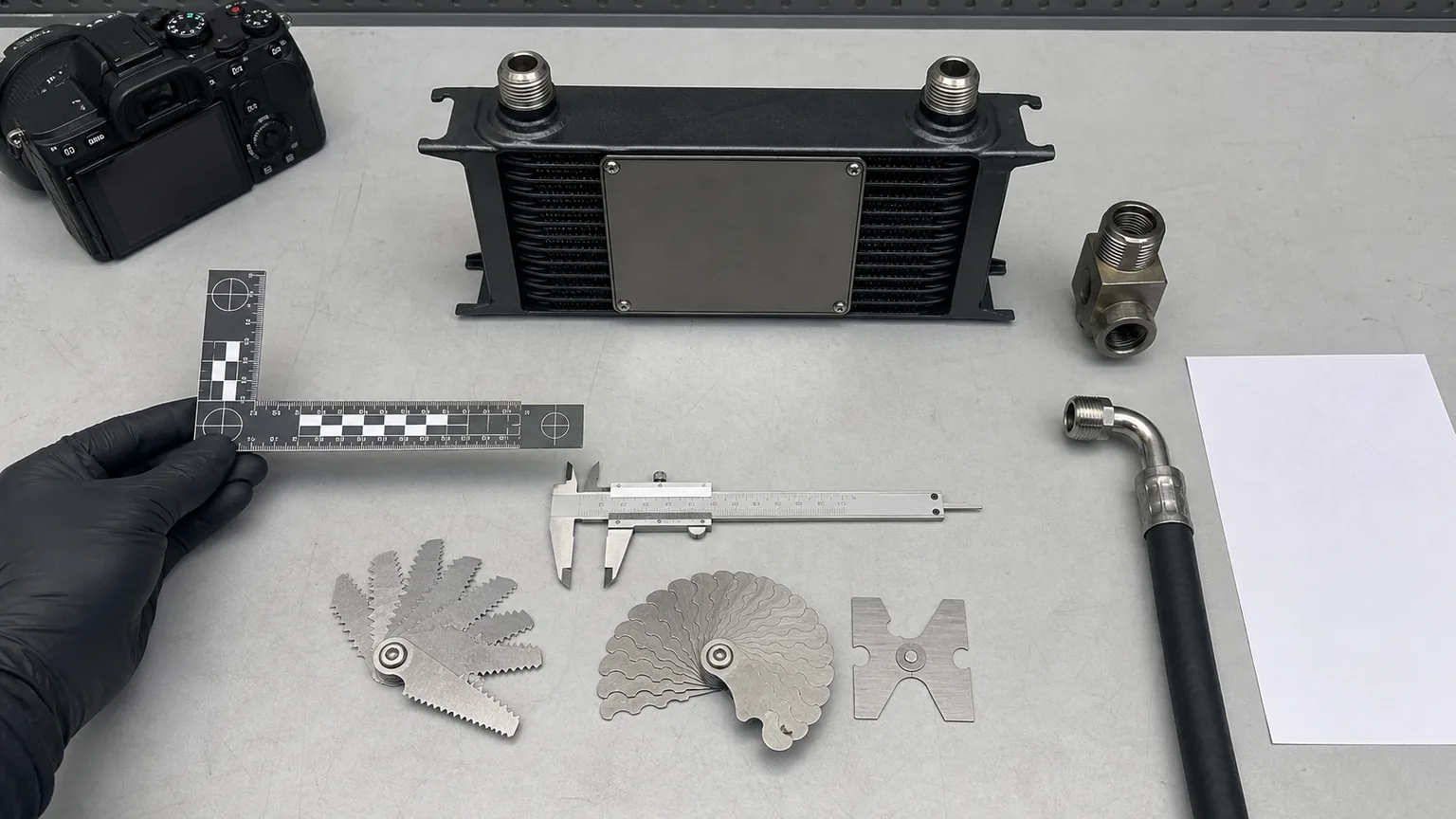
Tools that make identification defensible
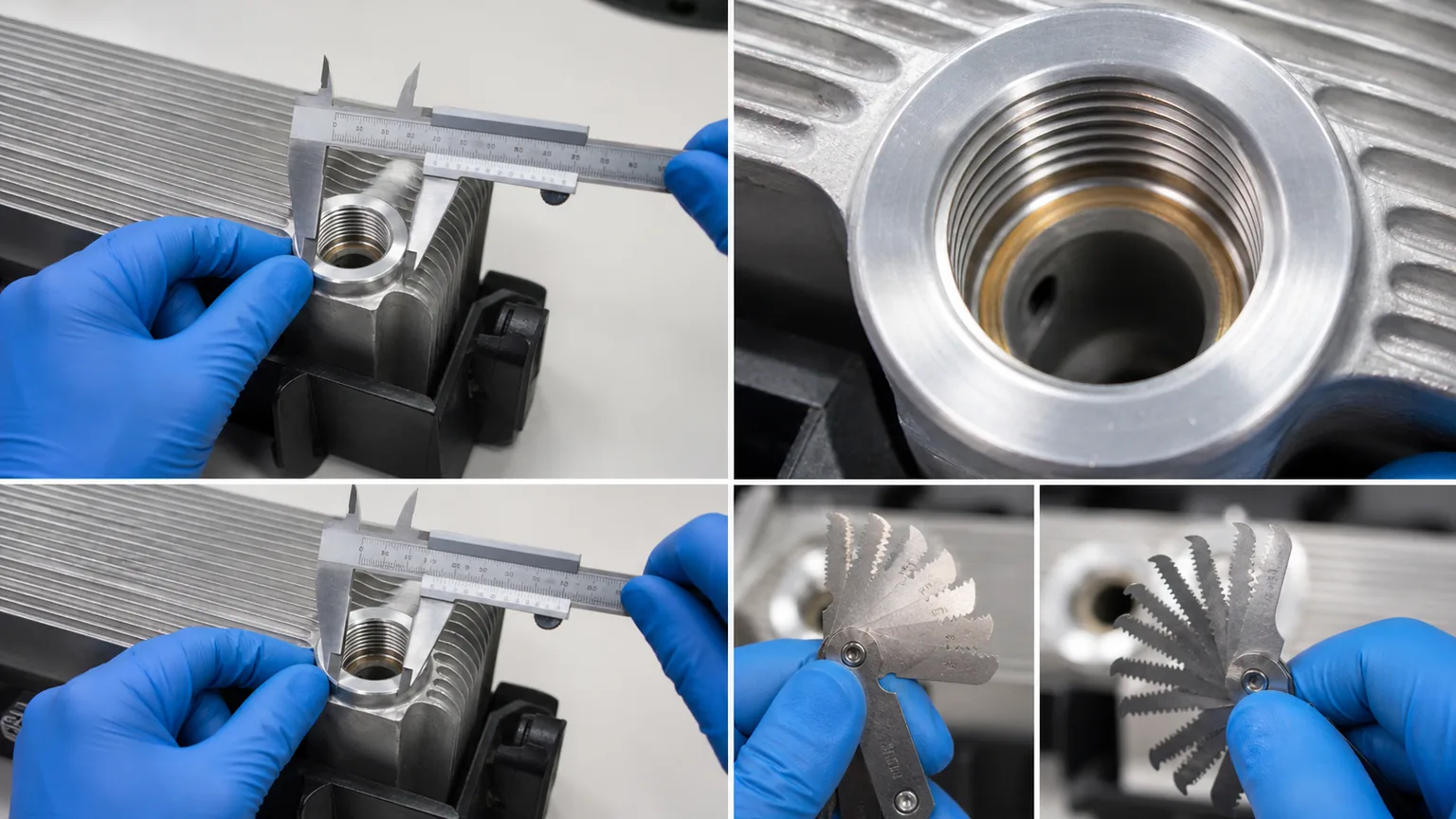
clean vernier or digital caliper;
inch and metric thread-pitch gauges;
good lighting, magnification and inspection mirror;
straightedge or controlled diameter measurements for taper;
seat-angle gauges designed for hydraulic fittings;
known, labelled identification plugs or gauges—not installation adapters;
camera, scale and record sheet;
current manufacturer/standards dimension tables.
Do not use a hose fitting as a destructive go/no-go gauge. A partly engaging thread can gall or reform soft aluminium while still being the wrong standard.
The five-step cooler-port workflow
1. Record gender and connection layers
State whether the cooler has an internal female port, external male stud, welded adapter, removable adapter or hose swivel. Photograph the bare cooler port and the removed mating end separately. A hose nut may hide the sealing nose, while a removable adapter can make the cooler appear to have the hose-end standard.
2. Measure the thread correctly
Measure outside major diameter on a male thread and the appropriate inside thread diameter on a female port without forcing caliper jaws. Record the actual millimetre value; do not immediately round it to a nominal pipe size. Pipe sizes are often nominal and do not equal measured outside diameter.
3. Measure pitch or TPI
Fit a clean gauge leaf over several undamaged crests with no daylight. Record millimetres per thread for metric pitches or threads per inch for inch systems. When access is short, photograph the gauge and count over the greatest usable length. Damage, coating and dirt can mislead a one-thread check.
4. Determine taper
Parallel threads keep essentially the same diameter along their length; tapered threads change. Visual impression is only screening. Compare controlled diameters at two axial locations or use the specified gauge and table. BSPT and NPT are both tapered families but have different thread geometry and pitches in many sizes.
5. Find the seal
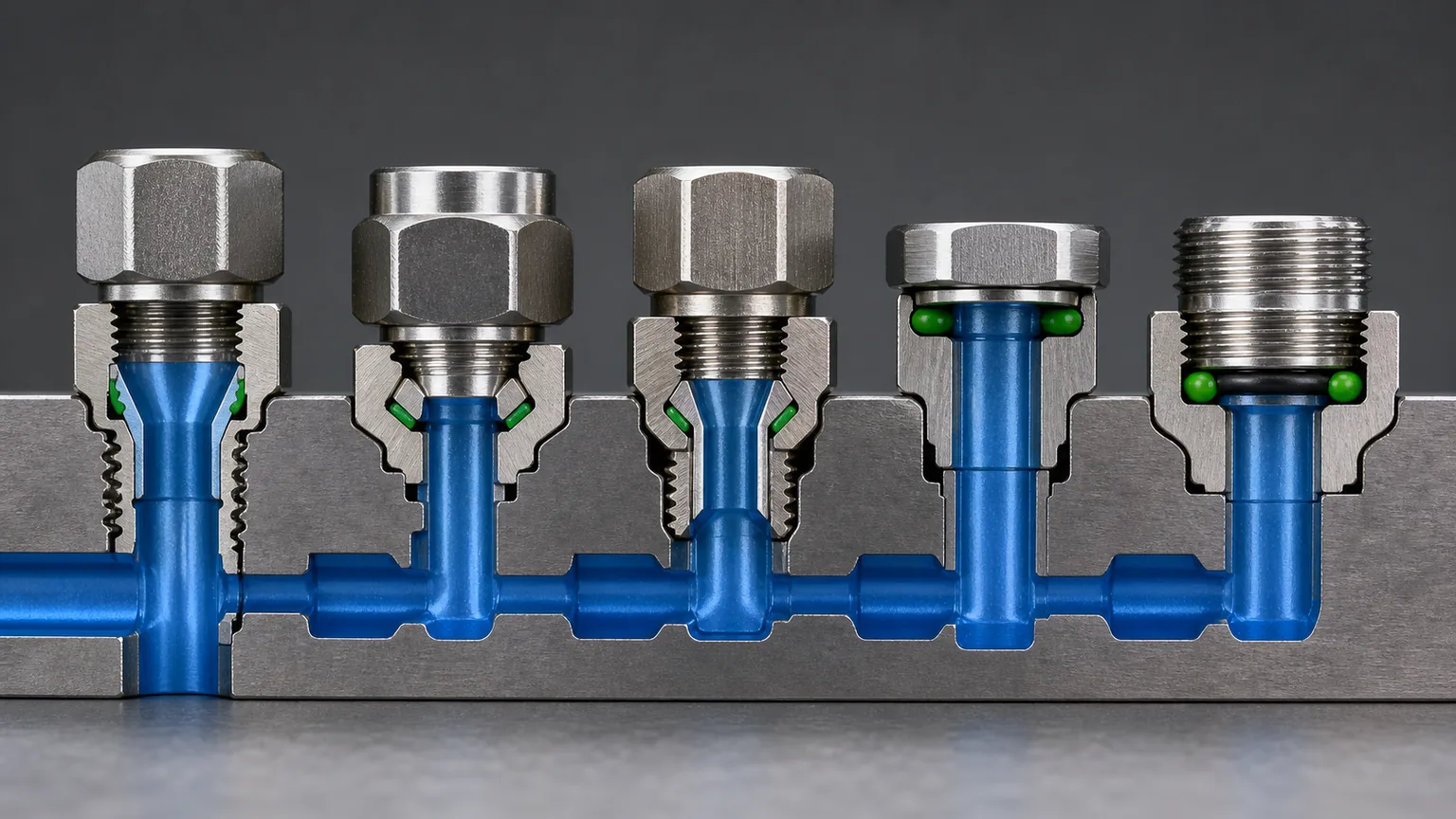
Look beyond the thread: 37-degree flare, 24-degree cone, 60-degree cone, flat face with O-ring groove, O-ring under a straight-thread stud, bonded washer/spotface, or tapered thread. The thread may provide clamping while a separate face provides sealing. Two connections can share a similar straight thread but fail because their sealing surfaces never meet.
Record diameter, pitch and taper instead of matching an adapter by eye.
Where common thread families seal
Family
Thread behaviour
Primary sealing location
Common cooler risk
BSPP (G)
Parallel, Whitworth form
Bonded washer/O-ring/approved cone arrangement
Assuming the parallel thread seals with tape
BSPT (R)
Tapered, Whitworth form
Mating tapered thread with approved sealant practice
Driving it into an incompatible straight port
NPT/NPTF
Tapered, 60-degree form
Thread interference, with specified sealing practice
Confusing it with BSPT of similar diameter
JIC
Parallel UN/UNF
37-degree metal flare
Calling it a pipe thread or confusing 37/45-degree seats
SAE ORB/UNO
Parallel UN/UNF
O-ring at straight-thread boss spotface/chamfer
Using a JIC end because the thread fits
ORFS
Parallel UN
Flat face with captured O-ring
Scratched face or missing/wrong O-ring
Metric DIN
Parallel metric
Often 24-degree cone arrangement
Assuming all metric ports seal the same way
Metric O-ring port
Parallel metric
Specified O-ring and port geometry
Confusing it with SAE ORB or cone systems
This table is a screening aid. Final identification requires the relevant standard, manufacturer data and verified geometry. BSPP can use more than one approved sealing arrangement, and machine makers may use proprietary or regional variants.
The correct name follows the thread plus the sealing surface, not the thread alone.
Why wrong fittings damage oil coolers
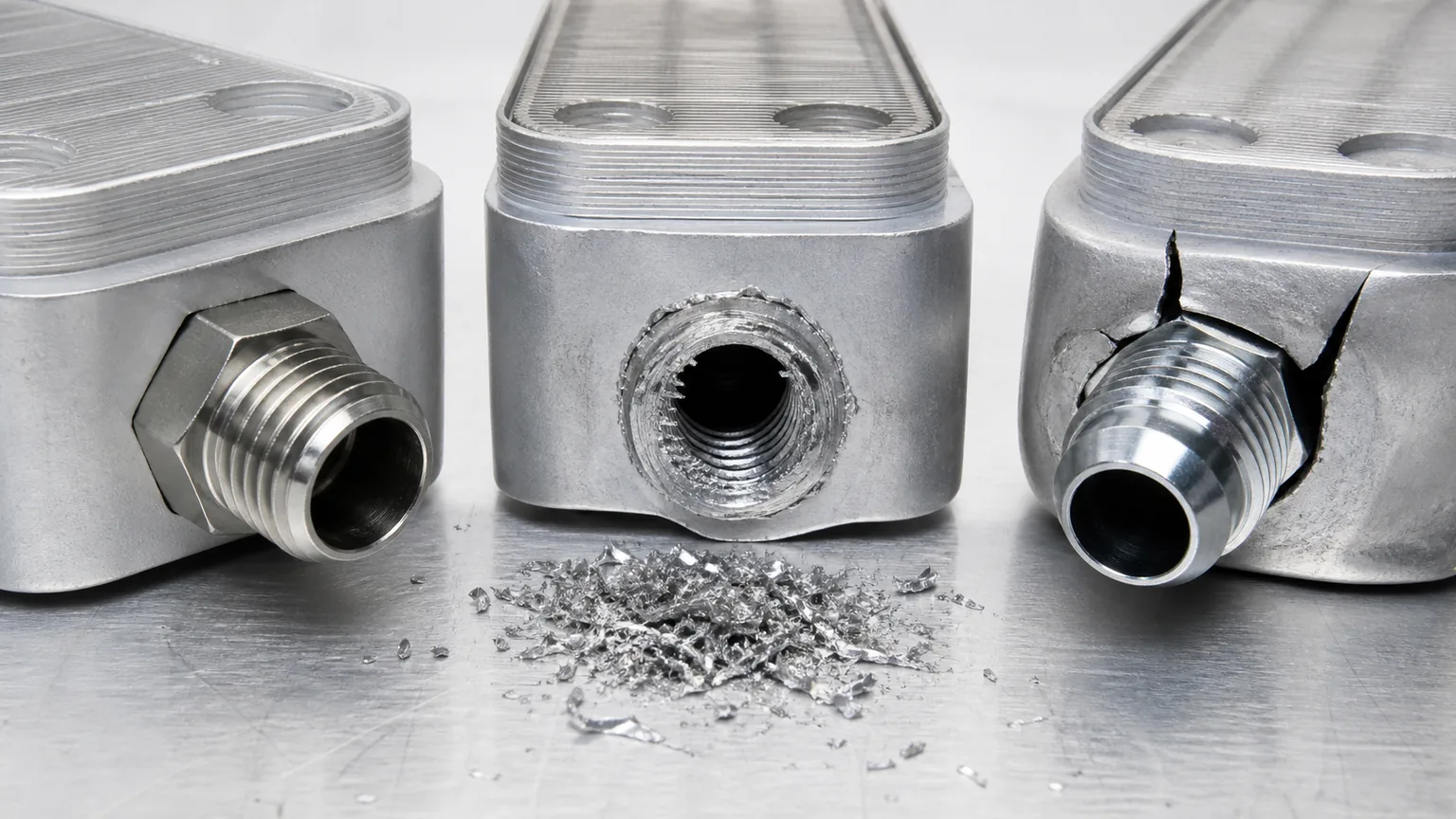
A tapered fitting driven into a parallel aluminium port can expand or split the boss, distort a header or create a crack beside a weld. A near-match can cross-thread, shed metal into the hydraulic circuit or bottom before its seal engages. Excess sealant can enter the cooler; an O-ring of wrong size or material can extrude, cut or degrade. An adapter that seals statically may still loosen or fatigue under hose load, pressure pulsation and machine vibration.
Stop immediately if engagement becomes tight earlier than specified, the fitting rocks, thread crests shave, the sealing face does not approach squarely or the adapter bottoms incorrectly. Do not “correct” uncertainty with more torque or sealant. Preserve the original fitting, cap the circuit and identify the system.
Partial engagement is not proof of compatibility and can destroy a replaceable cooler.
Cooler-specific RFQ evidence
Include machine make, model and serial range; full cooler and equipment OE numbers; overview and label photos; port straight-on and side views; thread gender, diameter, pitch and taper results; sealing-seat close-up; port centre positions and orientation; original adapter and hose-end photos; oil type; pressure requirements; and whether the adapter is removable or welded. A complete cooling-system RFQ prevents the port question from being separated from thermal duty and fitment.
A repeatable evidence layout lets engineering verify the port without guessing from one cropped image.
BSPP versus BSPT
BSPP uses a parallel British pipe thread; BSPT uses a tapered British pipe thread. Both use a Whitworth thread form, but that family relationship does not make every male and female combination interchangeable. BSPP commonly relies on a bonded seal, O-ring or specified cone/seat outside the threads. BSPT develops a thread seal in an approved tapered connection.
Nominal BSP size is not the measured thread outside diameter. Use an official table to compare diameter and TPI, then inspect taper and seal. On a cooler, also inspect the spotface: scratches, weld spatter, corrosion or an uneven boss can prevent a bonded washer or O-ring from sealing even when the thread is correct.
BSPT versus NPT
BSPT and NPT can look close at some nominal sizes because both taper and are named by pipe size. They use different thread forms and may have different pitches. A few turns of apparent engagement do not establish compatibility. Mixing them can produce poor flank contact, galling, leakage and cracked ports when additional torque is used to chase a seal.
Identify form and pitch with proper gauges and tables and confirm the equipment’s origin and OE documentation. Apply only the fitting maker’s approved thread preparation, sealant and assembly method. Keep sealant away from the first threads and fluid passage as directed; excess material can contaminate valves and pumps.
JIC 37-degree flare
A JIC connection uses straight UN/UNF threads to draw a male 37-degree flare into its mating seat. The metal sealing faces—not the threads—create the primary seal. Record the thread and inspect the flare for circumferential scoring, dents, cracks, corrosion or a line cut across the sealing path. A reused damaged swivel can make a correct new cooler appear defective.
Do not confuse JIC 37 degrees with SAE 45-degree flare or with other cone systems. Eyeballing the angle is unreliable; use the correct seat gauge or manufacturer data. Tightening cannot make mismatched angles safe, and lapping or modifying a cooler seat without approval changes the engineered connection.
SAE O-ring boss and metric O-ring ports
SAE straight-thread O-ring boss connections use the thread to retain the fitting and an O-ring at the boss to seal. Metric straight-thread O-ring systems can look similar. Both require verification of thread diameter/pitch, port chamfer or spotface, O-ring location, fitting style and governing standard. The fact that an adapter screws in is not sufficient.
Use the specified O-ring size, material and hardness for the oil, temperature and pressure. Inspect for cuts, flattening, extrusion and chemical change. Adjustable stud ends also require the approved backup washer, locknut position and orientation procedure. Never stack random washers or tape over an O-ring design to hide a damaged face.
Metric cone, ORFS and regional variants
Metric hydraulic connections may use a 24-degree cone with cutting ring or elastomeric seal, but “metric” describes the thread system, not the whole connection. JIS and equipment-maker connections can introduce 30-degree or other seat geometries with BSP or metric threads. Identify both ends of any adapter and keep the machine maker’s service reference in the record.
ORFS uses a flat sealing face with a captured O-ring and straight threads that provide clamping. Inspect face flatness and groove condition, and protect it during storage. ORFS, JIC and SAE O-ring boss can use related straight-thread sizes in certain cases while sealing in different places, which is why thread fit alone can be dangerously persuasive.
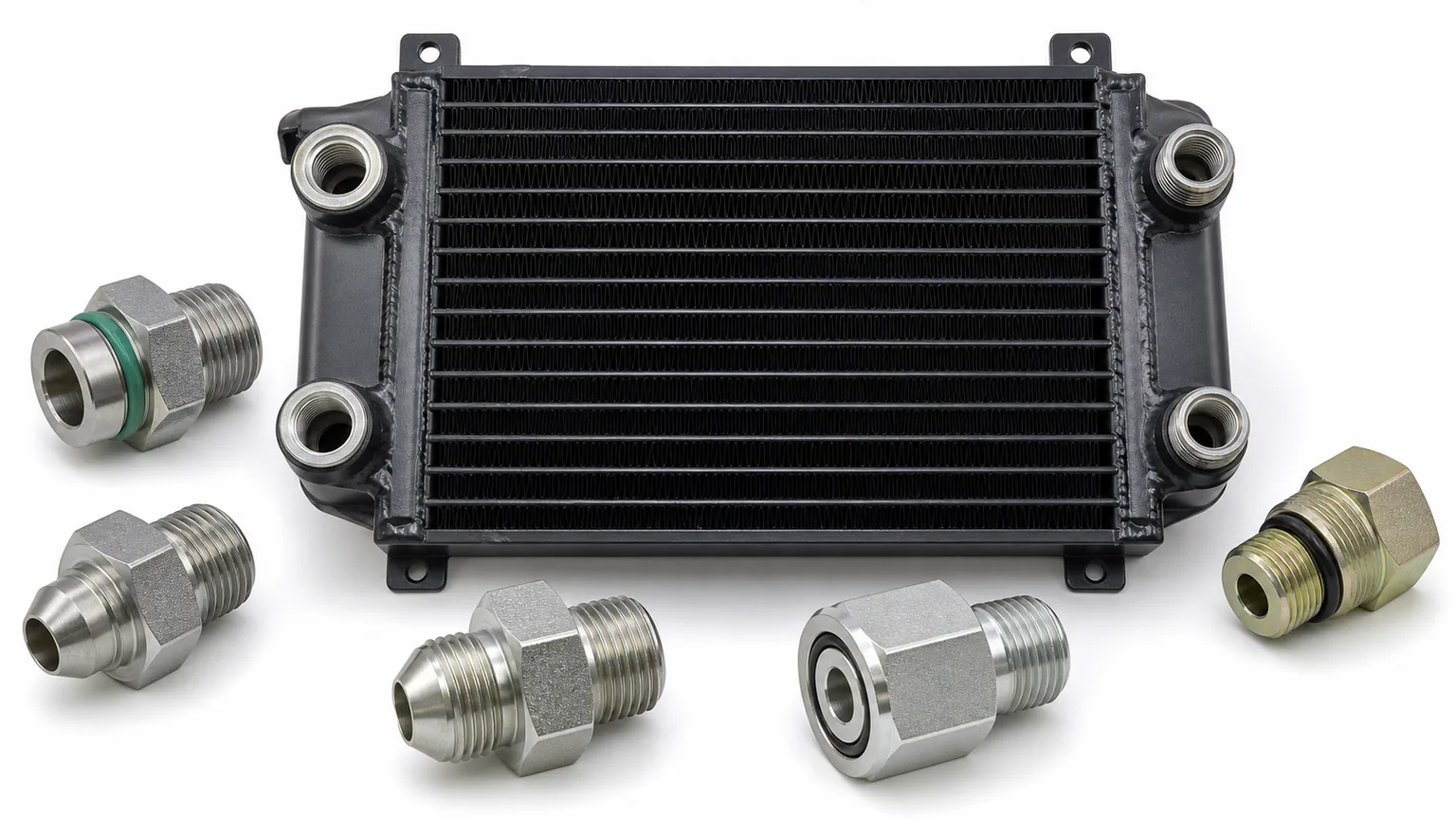
Adapters: useful only when engineered
An adapter can preserve an available cooler when hose and port standards differ, but it changes length, hose position, bend radius, lever arm, clearance and possible pressure drop. It adds two sealing interfaces and can move a rigid hose into contact with a frame, fan or hot surface. A long heavy stack screwed into a thin welded boss can magnify vibration stress.
Specify port end, hose end, material, pressure and temperature rating, corrosion compatibility, flow passage, orientation and sealing elements. Support hoses independently and keep fittings accessible for correct torque. Do not use nested adapters as a substitute for ordering the right cooler in a high-vibration mobile application.
Inspect the welded boss and header
The correct thread will still leak if the cooler boss is cracked, distorted or poorly welded. Clean and inspect the circumference, root, header and nearby tubes for dye tracks, corrosion, contact marks and previous repair. Check boss orientation and stand-off against the approved drawing; forcing the hose into place can load the weld continuously.
If the old fitting was overtightened or cross-threaded, examine the female threads and sealing face with magnification. Metal displaced into the passage must not enter the circuit. Thread inserts, welding or machining are engineering repairs requiring cooler-specific approval, pressure validation and cleanliness control—not field improvisations.
Installation without cross-threading or contamination
Keep caps in place until final connection. Clean the mating fitting and replace seals as specified. Align the fitting squarely and begin by hand; if the expected free engagement is absent, stop. Use the correct backup wrench so hose torque does not twist the cooler boss or header. Follow the connection maker’s torque or flats-from-finger-tight method for that exact family.
After assembly, route and support the hose so pressure movement and machine articulation cannot load the cooler. Restore clamps, guards and abrasion sleeves. Fill, bleed and filter under the equipment procedure and perform the approved leak and functional check from a protected position. Reinspect after a representative heat and pressure cycle.
Warranty and traceability
When a new cooler leaks at a port, record machine application, OE and supplier numbers, lot/serial, port and fitting identification, seal part number, assembly procedure and torque, hose alignment, operating time and exact leak coordinates. Photograph the port before disassembly, during removal and after cleaning. Preserve fitting and seal with the cooler.
Separate a porous weld, cracked boss, damaged thread, scratched seat, wrong adapter, wrong O-ring, hose strain and no-fault-found result. Link confirmed patterns to lot and drawing revision through the cooling-parts traceability process. A generic “leaks from thread” note cannot support corrective action.
Troubleshoot a connection that still leaks
First clean and identify the exact escape point without tightening a live pressurized joint. Oil emerging between fitting and hose crimp is not a cooler-port leak. Oil from the boss weld, header or a nearby tube can travel along the adapter. At a confirmed interface, check that both halves belong to the same standard and size and that the intended sealing surfaces actually contact.
For a flare or cone, inspect face angle, concentricity, scratches, dents and contamination. For ORFS, check face flatness, O-ring groove and specified seal. For a straight-thread boss, examine O-ring damage, chamfer, spotface, backup hardware and adjustable-stud procedure. For a tapered thread, confirm family, engagement and approved sealant practice. Never combine extra torque, tape and washers indiscriminately.
Verify hose routing with the system depressurized. A hose that is twisted, too short, poorly clamped or moved through an articulation can pull the fitting sideways. Heat growth and pressure impulse can open a connection that looks dry at idle. Support and reroute it to the equipment maker’s requirements, then perform the specified guarded leak test.
If threads or faces are damaged, replace the serviceable fitting and assess the cooler port. Do not chase, tap, weld or insert-repair an aluminium boss without engineering approval, debris control and proof testing. A superficially restored thread can conceal a crack or alter wall thickness and port alignment.
Create a controlled port library for repeat orders
Distributors handling multiple excavator brands should build a photo-and-measurement library tied to machine serial range and OE cooler number. Store the bare port view, adapter both ends, hose end, thread gauges, dimensions, sealing diagram and approved part number. Record whether adapters ship with the cooler and whether their orientation is fixed.
Use physical master samples or certified gauges under calibration control for incoming inspection. A label saying “3/4 port” is ambiguous; data should state the complete standard and size plus seal. Require supplier change notification for boss, adapter, thread machining, weld fixture, seal source and protective caps. Incoming inspectors can then detect a changed port before inventory reaches the field.
When sourcing a new cooler, include port coordinates and clocking on the approved drawing and inspect them from fixed datums. Verify gauge acceptance, sealing face and internal cleanliness on the sample. The cooler may pass an air leak test with temporary factory plugs while still having the wrong customer interface, so product validation must use the approved mating connection.
Frequently asked questions
Can BSPP and BSPT be used together?
Only where the governing standard and manufacturer explicitly approve that male/female combination and sealing method. Do not infer compatibility from partial engagement.
Can I identify NPT by using thread tape?
No. Tape is a sealing material, not an identification test. Determine taper, diameter, pitch, form and documentation first.
Why does a JIC fitting leak when the thread is correct?
The 37-degree faces may be mismatched, scratched, cracked, contaminated or misaligned, or the connection may actually use a different seat system.
Should I measure a female port with the same outside-diameter chart?
Use the measurement method and female-port data specified by the reference. A female minor/inside reading is not directly the male major diameter.
Can a hydraulic shop confirm the port from a photo?
A photo can narrow candidates, but reliable confirmation normally needs dimensions, pitch, taper, sealing geometry and equipment/OE context.
Name the seal, not just the thread
A correct oil-cooler connection is a complete system: thread form and size, gender, taper, sealing face, seal material, adapter design, pressure rating and installation. Measuring only diameter invites near-matches that damage expensive coolers and contaminate machines.
Send Elecdura the full evidence set and thermal/pressure duty. We can verify the cooler interface, drawing and supply package before production or replacement.