
English
Views: 0 Author: Site Editor Publish Time: 2026-08-10 Origin: Site
Mercedes A2035001793 is searched as a radiator fan reference, and buyers usually want to know whether the replacement fan assembly will fit, run correctly, and solve overheating or A/C performance complaints. Before ordering, confirm the OE number, vehicle application, fan diameter, shroud shape, mounting points, connector style, control module or resistor design, and whether the replacement is a complete assembly or only the motor/fan component. A fan that spins on a bench can still be wrong if the shroud does not fit or the control signal is different.
This article explains how repair shops, distributors, and fleet buyers should evaluate a Mercedes A2035001793 radiator fan replacement. It covers symptoms, 12V test limits, connector and shroud checks, airflow diagnosis, and wholesale sourcing controls. Elecdura supports radiator fans, cooling fan assemblies, fan control modules, and related radiators for buyers building European thermal-management stock.
The OE number is the starting point, not the complete fitment decision. Mercedes vehicles in the same broad chassis family can vary by engine, year, market, A/C equipment, and fan-control design. A replacement fan may differ in shroud depth, blade count, connector, resistor pack, or module interface. If the old fan assembly is still available, use it as the reference for physical comparison.
Check Field |
Why It Matters |
Evidence to Request |
|---|---|---|
Fan diameter and blade design |
Airflow and shroud fit depend on size |
Front photo and measurement |
Shroud outline and mounting tabs |
A similar fan may not clip into the radiator support |
Rear photo and tab spacing |
Connector and pin count |
Control logic and wiring must match |
Connector close-up |
Module or resistor layout |
Some failures are control-related, not motor-only |
Module photo and part label |
Complete assembly contents |
Motor-only supply may require old parts |
Kit-content confirmation |
A failing radiator fan can cause overheating at idle, A/C that works while driving but not in traffic, high refrigerant pressure, fan noise, intermittent operation, blown fuses, or fan-related fault codes. The symptom often appears when road speed is low because natural airflow is not enough. At highway speed, the vehicle may cool normally because air is forced through the radiator and condenser.
On Mercedes applications, fan control can be more complex than a simple on/off motor. The fan may be controlled by a module, pulse-width signal, temperature inputs, A/C pressure input, or engine control strategy. If the fan does not run, the motor may be bad, but the command path must be checked before replacing the assembly.
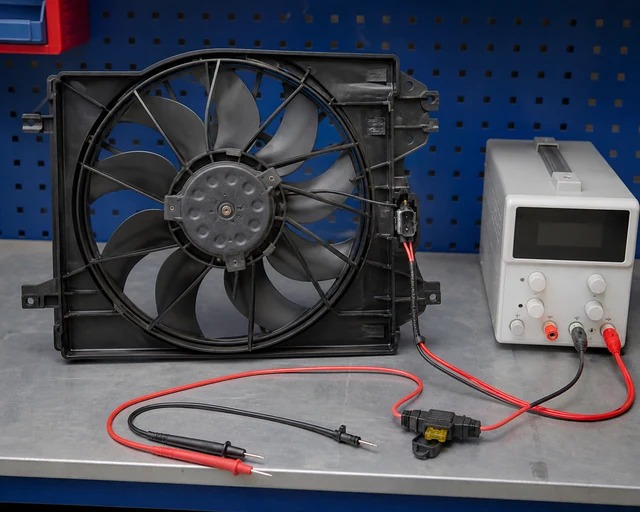
A 12V bench test can show whether a simple fan motor spins when powered directly. It can reveal a dead motor, seized bearing, damaged brush system, or severe internal open circuit. However, it does not always prove that a controlled fan assembly will work correctly in the vehicle. Some fans require a control signal, module logic, or specific wiring pattern. Applying power incorrectly can damage electronics.
If the fan assembly includes a control module, follow service information before bench testing. Check connector pinout, power supply, ground, and control signal. A fan may spin at one speed during a crude test but fail to respond to variable control in the vehicle. For buyers, this means a supplier's "tested running" claim should be understood carefully. Ask what was tested: motor only, full assembly, module response, or load behavior.
Confirm the complaint: overheating at idle, A/C poor at idle, no fan operation, noise, or intermittent fan.
Check fuses, relays where applicable, harness damage, and connector condition.
Use scan data to check coolant temperature, A/C pressure, fan command, and fault codes.
Command the fan with a diagnostic tool if the vehicle supports active testing.
Measure power and ground under load, not only with the connector unplugged.
Inspect the fan blades, shroud, radiator, condenser, and debris between cooling-stack layers.
Compare the old assembly with the proposed replacement before installation.
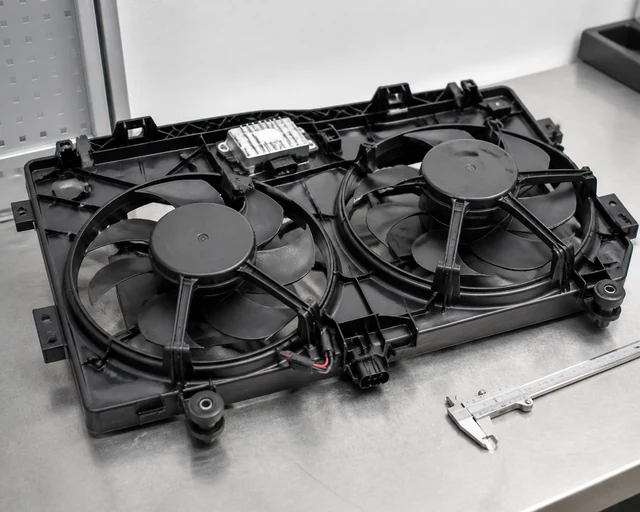
The fan shroud directs airflow through the radiator and condenser. If the shroud does not seal correctly, airflow can bypass the heat exchangers. A replacement fan that runs but sits too far from the radiator, leaves gaps, or does not mount securely can create poor cooling. This is why physical shroud matching matters for A2035001793-style replacements.
Check the overall shroud height, width, depth, mounting tabs, clip positions, rubber seals, and clearance to hoses or wiring. If the vehicle has had front-end repair, the radiator support may be bent. A correct fan may appear not to fit because the surrounding structure is damaged. Take photos before removal so the installation position can be compared.
Connector mismatch is a common cause of wrong orders. The plug may look similar but use different pin count, lock position, terminal size, or control function. If the old connector is burned or corroded, the replacement fan may fail again unless the harness side is repaired. High-current fan circuits need clean terminals and solid ground.
If the assembly includes a control module or resistor, confirm whether it is included with the replacement. Some suppliers sell a complete fan assembly, while others sell motor and blade only. If the old module is reused and it is faulty, the new motor may not operate correctly. If the new assembly includes a module with a different control strategy, the vehicle may set codes or fail active tests.
The radiator fan also supports A/C condenser airflow. If the fan does not run at low speed or high speed when the A/C is requested, high-side pressure can rise and the compressor may be disabled. The driver may report warm air at idle but acceptable cooling while driving. This symptom often points toward fan operation, fan control module, condenser blockage, or A/C pressure signal rather than compressor failure.
When A/C performance is the complaint, check condenser fan response, high-side pressure, condenser face cleanliness, and fan command. Replacing an A/C compressor without confirming fan operation can lead to repeated failure. A strong radiator fan parts program should therefore connect with A/C diagnostic knowledge.
Aftermarket radiator fan assemblies vary in motor quality, blade balance, shroud accuracy, module durability, and packaging. A fan that vibrates can damage mounts or create noise complaints. A weak motor may run but not move enough air under heat load. A poor module may fail intermittently. A thin shroud can crack during installation or shipping.
Before approving bulk supply, inspect samples for blade balance, bearing noise, connector fit, shroud stiffness, mounting hole accuracy, and load operation. Ask the supplier how the fan is tested and whether cartons protect blades and tabs. Large plastic fan assemblies can break in transit if packed too loosely.
Fan warranty claims should include the complaint, vehicle application, old and new part photos, connector condition, fuse status, fan command data, power and ground measurements, and whether the fan was obstructed by debris. If the fan burned out because the harness connector was loose or melted, replacing the fan alone may not solve the issue.
For distributors, this evidence helps distinguish product defect from system fault. If many fans fail with similar motor noise or module failure, review supplier quality. If claims come from overheated vehicles with blocked condensers or bad wiring, improve diagnostic notes and sales support. Warranty data should improve the program, not only close individual claims.
Confirm OE number A2035001793 and any valid supersessions.
Confirm Mercedes model, year, engine, and market specification.
Measure fan diameter, shroud outline, depth, and mounting tab spacing.
Compare connector shape, pin count, wire gauge, and lock tab.
Check whether module, resistor, motor, blade, and shroud are included.
Ask for load-test or functional-test information from the supplier.
Inspect packaging for blade and tab protection.
Require diagnostic evidence for overheating or A/C-related claims.
Many overheating and A/C complaints appear because the fan does not operate at the correct speed. A fan may run at high speed during an emergency condition but fail at low speed when the A/C first requests airflow. Or it may run at low speed but never reach the higher airflow needed in hot traffic. This distinction matters because a simple "fan spins" observation is not enough.
Use scan data and active tests where available. Watch commanded fan percentage, actual response, coolant temperature, and A/C pressure. If the module commands higher speed but airflow does not increase, the fan assembly, module, power supply, ground, or connector should be checked under load. If no command is sent, the issue may be sensor input, A/C pressure signal, engine temperature data, or module strategy.
Mercedes radiator fans are often replaced after overheating, A/C complaints, or front-end collision repair. After a collision, the surrounding radiator support, condenser, radiator, shroud mounts, and wiring path may be slightly distorted. A correct replacement fan can be difficult to install if the support is bent. Conversely, a visually similar wrong fan may be forced into place and later rub, vibrate, or restrict airflow.
Before approving a claim that the fan does not fit, compare the old fan, new fan, and vehicle support. Check whether mounting tabs align without force, whether the shroud sits flat, whether blades clear the shroud, and whether the connector reaches naturally. If a workshop must pull the harness tightly or bend a tab, the installation is not acceptable. For distributors, photos of the vehicle mounting area help separate part mismatch from vehicle damage.
A fan assembly can pass an electrical test and still fail quality expectations because of noise or vibration. Blade imbalance, weak motor bearings, warped shroud, or poor motor mounting can create noise that customers notice immediately. On a premium vehicle, noise complaints can damage trust even if cooling performance is acceptable.
During sample inspection, run the fan securely and listen for bearing roughness, scraping, clicking, or excessive vibration. Check blade runout and clearance. Inspect whether balancing clips or molded blade features are consistent. If the supplier ships fans with loose inner supports, blades can distort during transport and create vibration later. Packaging and mechanical quality should be reviewed together.
Radiator fan assemblies are bulky and easy to damage. Shroud tabs, blades, connectors, and modules need protection. A carton that allows the fan to move during shipping can break mounting ears. If the connector is not protected, terminal damage may cause intermittent operation. If the fan is stored under heavy parts, the shroud can warp.
For wholesale stock, label the carton with OE number, application group, connector type, and whether the module is included. Similar fan assemblies should not be stacked without clear labels because warehouse picking errors are common. A photo label can help staff distinguish two shrouds with similar outlines but different connector positions.
Example one: a Mercedes overheats at idle but cools on the highway. Scan data shows high coolant temperature and the fan command increases, but the fan does not respond. Power is present and ground voltage drop is high. The real fault is a ground or connector issue, not necessarily the fan motor. Replacing the fan without repairing the ground may create a repeat complaint.
Example two: A/C stops cooling in traffic. High-side pressure rises and the fan runs only at low speed. Active testing shows the fan cannot reach high speed. The replacement direction may be a complete fan assembly or module depending on design. The compressor should not be replaced until condenser airflow is restored.
Example three: a replacement fan arrives and spins on the bench, but the shroud tabs do not align with the radiator support. Old and new part comparison shows a different shroud depth. The supplier must correct fitment data. A motor-only test did not prove the assembly was correct.
A complete assembly reduces transfer labor and can solve problems involving shroud, blade, motor, and module together. It costs more and ships in a larger carton, but it reduces uncertainty. A motor-only replacement may be cheaper and useful when the shroud is intact and the control module is separate or reusable. However, motor-only supply can create problems if the old blade is damaged, the shroud is warped, or the module is the actual fault.
Buyers should decide which version fits their customer base. Professional repair networks often prefer complete assemblies for speed and reduced comeback risk. Price-sensitive markets may accept motor-only supply if the application is simple. The product listing must be clear so the workshop knows what will arrive.
Area |
Pass Standard |
Fail Warning |
|---|---|---|
Fitment data |
OE number, model, engine, year, photos |
Only broad Mercedes model name |
Electrical match |
Connector, pin count, module status confirmed |
No connector close-up |
Mechanical quality |
Smooth motor, balanced blade, rigid shroud |
Noise, wobble, weak tabs |
Testing |
Load or functional test explained |
Only "tested" with no method |
Packaging |
Blade, tab, connector, and module protected |
Fan moves inside carton |
When replacing a radiator fan, inspect the radiator, condenser, fan control module, temperature sensor data, A/C pressure sensor data, fuses, relays, and harness. If the fan failed because of debris, check the shroud and cooling stack. If the vehicle overheated severely, inspect coolant condition and pressure-test the system. A new fan should not be used as the only repair when surrounding problems remain.
For A/C complaints, inspect condenser cleanliness and refrigerant pressure. High pressure caused by a blocked condenser or overcharge can trigger fan and compressor behavior that looks like an electrical fault. For cooling complaints, verify thermostat and water pump operation. This system-level approach reduces unnecessary fan returns.
A useful quotation for A2035001793 should state whether the part is a complete fan assembly, motor-only item, or fan with integrated control module. It should include OE cross-reference, connector photo, shroud dimensions, fan diameter, blade count, voltage, test method, carton size, minimum order quantity, and warranty terms. If the supplier cannot show the connector and module side, the quote is not ready for bulk approval.
For importers, the quote should also state whether private-label packaging is available and how the fan is protected inside the carton. A radiator fan is too large and fragile to treat as a generic electrical part. The buyer should know how it will be shipped, stored, and identified before negotiating only on price.
Mercedes A2035001793 radiator fan replacement should be based on OE number, physical shroud matching, connector verification, control-module understanding, and in-vehicle diagnostic evidence. A fan that fails can cause overheating, poor idle A/C cooling, high-side pressure problems, noise, and intermittent operation. But fan replacement should follow power, ground, command, airflow, and connector checks.
When requesting a quotation, send the OE number, vehicle data, old fan photos, shroud measurements, connector close-up, module details, and target order quantity. Elecdura can help buyers match Mercedes radiator fan assemblies and related thermal parts so the replacement fits physically, runs correctly, and supports stable cooling and A/C performance.


