You are here:Home » Resources » Blog » Industry Insights » R-744 vs R-1234yf EV Heat Pumps: Compressor, Gas Cooler, Pressure, and Parts-Matching Differences
R-744 vs R-1234yf EV Heat Pumps: Compressor, Gas Cooler, Pressure, and Parts-Matching Differences
Views: 0 Author: Elecdura Publish Time: 2026-08-31 Origin: Site
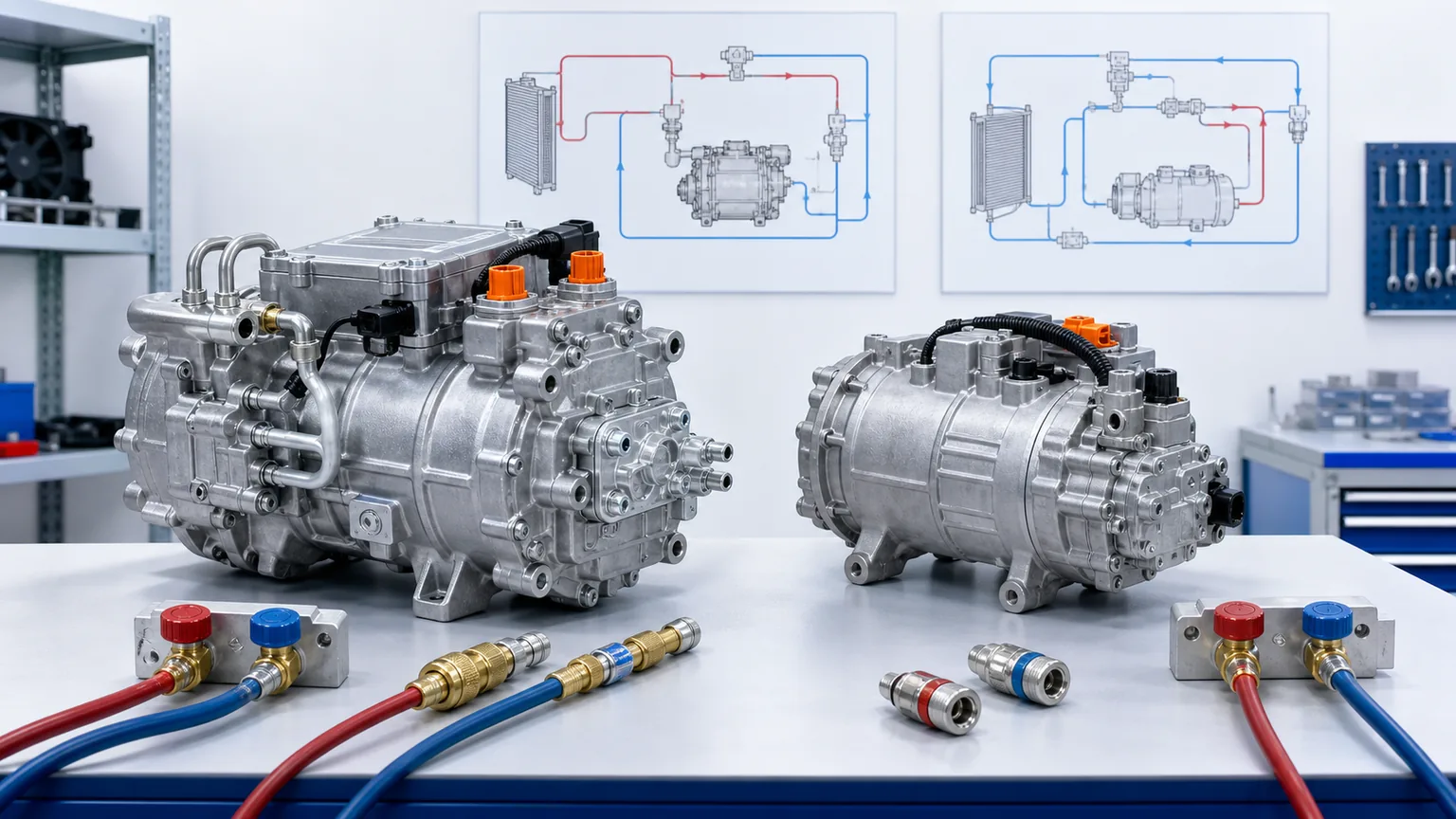
R-744 and R-1234yf heat-pump parts are not conversion substitutes. An R-744 system uses carbon dioxide at a much higher pressure class and may replace the familiar condenser function with a gas cooler. Its compressor, lubricant, pipes, fittings, valves, sensors, service ports, and workshop equipment must all be approved for that architecture. Before a distributor quotes any EV heat-pump component, the safe starting point is the vehicle identification, refrigerant label, OE part number, voltage, connector, and clear photographs of every port. Similar size or mounting geometry is not proof of compatibility.
This distinction matters because the modern EV thermal circuit does more than cool the cabin. Depending on the vehicle and operating mode, it may heat the cabin, cool or warm the battery, condition the power electronics, and recover heat from several sources. Elecdura’s guide to EV heat pumps and PTC heating explains the wider system purpose. The focus here is narrower and more practical: how R-744 and R-1234yf change the parts-matching evidence an aftermarket buyer needs.
Keep the two architectures physically and digitally separated from identification through service and warranty handling.
The short comparison buyers should understand
Decision field
R-744 EV heat pump
R-1234yf EV heat pump
Buying consequence
Refrigerant
Carbon dioxide, normally identified as R-744 or CO₂
Hydrofluoroolefin refrigerant R-1234yf
Never infer the refrigerant from vehicle type or model year; read the label and service data.
Pressure class
Much higher system and component pressure class
Lower than R-744, although still application-specific
Compressor housings, pipes, joints, valves, sensors, gauges, and test equipment must match the approved pressure class.
High-side heat exchanger
Often described as a gas cooler because heat rejection may occur without conventional condensation above the critical point
Normally described as a condenser, although heat-pump mode changes circuit routing
A “condenser-looking” core is not enough to identify the part.
Compressor
Dedicated R-744 design, displacement/control strategy, voltage, insulation, and lubricant requirements
Dedicated R-1234yf mechanical or electric design depending on vehicle
Do not cross by connector, mounting ears, or apparent displacement alone.
Service connection
Dedicated R-744 equipment, couplers, hoses, gauges, and procedures
Dedicated R-1234yf equipment and contamination controls
Workshop tooling must remain refrigerant-specific and pressure-rated.
Best identification evidence
VIN/application data, underhood refrigerant label, OE number, component label, voltage, connector, port form, pipe routing, and service information
A complete evidence pack is safer than a visual match.
Why R-744 changes the hardware
Carbon dioxide has attractive thermal properties and a very low global-warming potential, but the engineering advantage comes with a different pressure regime. The exact pressure at any moment depends on ambient temperature, operating mode, control strategy, and where the measurement is taken. For parts sourcing, the useful conclusion is not one headline pressure number. It is that an R-744 component, joint, service hose, gauge, sensor, and test fixture must be designed and validated for the applicable R-744 envelope.
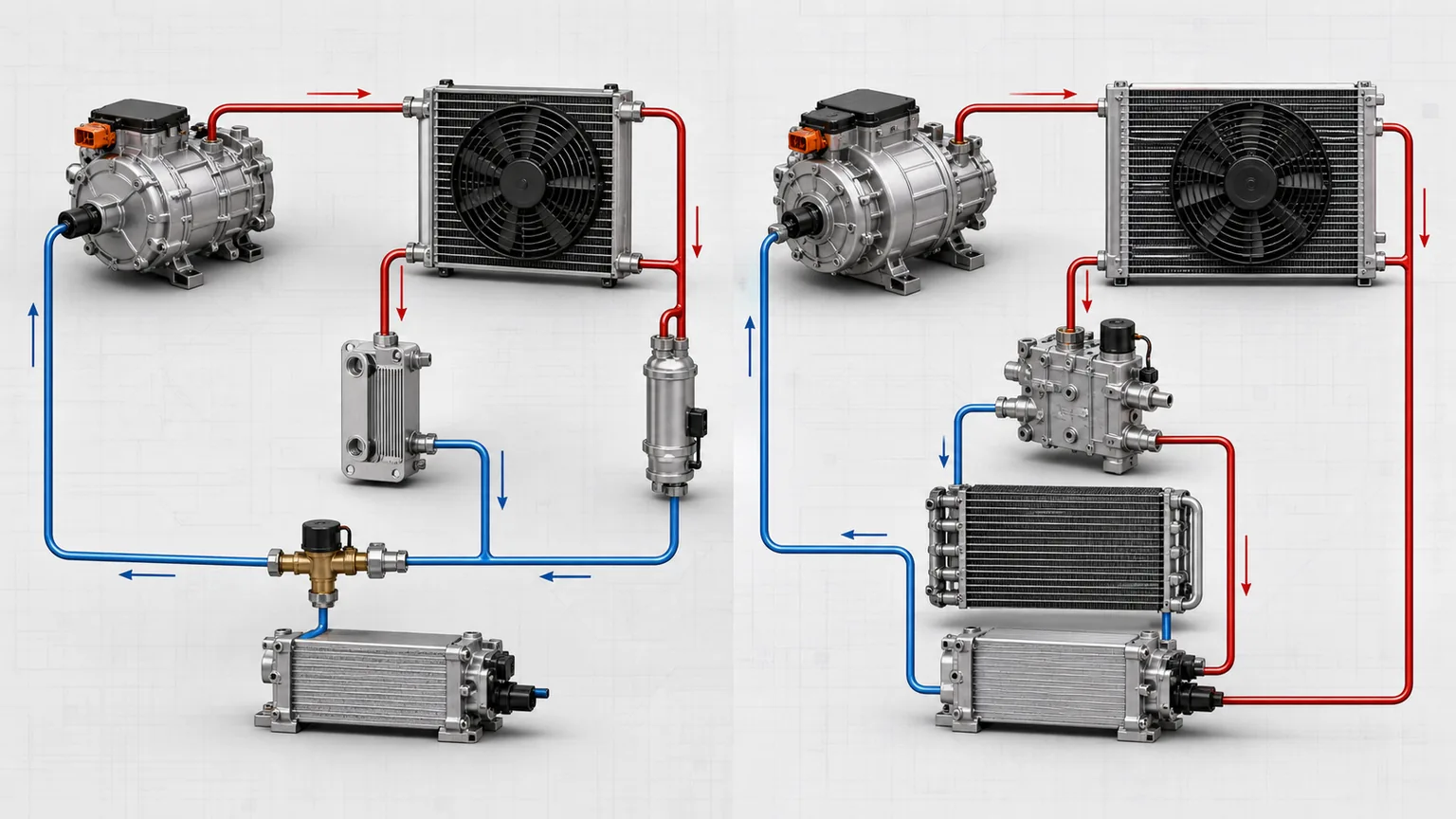
This is also why an R-744 heat exchanger may be called a gas cooler rather than a condenser. In portions of normal high-side operation, the refrigerant can reject heat while remaining above its critical point instead of changing phase in the familiar way. That changes how engineers manage outlet temperature, high-side pressure, internal flow, heat-exchanger strength, and control logic. It does not mean every R-744 vehicle uses an identical circuit. Reversible valves, internal heat exchangers, accumulators, chillers, water-cooled heat exchangers, and refrigerant-side valve blocks vary substantially between platforms.
R-1234yf systems are also application-specific. A heat-pump-equipped EV may route refrigerant through multiple heat exchangers and valves, and the compressor can be a high-voltage electric unit with strict insulation and oil requirements. The difference is that familiar R-1234yf terminology should not create false confidence. A compressor approved for one R-1234yf platform is not automatically suitable for another, and no R-1234yf unit should be treated as an R-744 substitute.
The drawing is an identification aid, not a universal plumbing diagram; actual valves and loop routing follow the vehicle service information.
Compressor matching starts with more than refrigerant
The refrigerant is the first gate, not the final part number. A high-voltage electric compressor contains a motor, inverter or drive electronics, compression mechanism, electrical insulation system, temperature protection, and control interface. A replacement must work with the vehicle’s electrical and refrigerant architecture as a system.
For an R-744 or R-1234yf electric compressor, collect at least the following:
complete OE number, including suffixes and supersessions;
vehicle model, production date, VIN or chassis range, and market specification;
refrigerant and specified charge from the vehicle label;
compressor voltage and any readable power or current information;
high-voltage and low-voltage/control connector photographs, keying, and pin count;
mounting-ear positions, body orientation, and bracket details;
suction and discharge port form, orientation, sealing method, and pipe relationship;
label details for manufacturer code, software/hardware revision, and lubricant;
the original fault evidence, including isolation results and diagnostic codes.
Suffixes matter because a physical housing can remain similar while the inverter, connector, control protocol, internal displacement, relief strategy, or software calibration changes. When the original number has been superseded, the buyer needs a verified replacement chain for the exact vehicle rather than a generic cross-reference assembled from appearance.
High-voltage safety is also part of the match. A compressor that fits mechanically but has the wrong insulation system, voltage range, connector, or control interface can create a no-start condition, isolation fault, or hazardous failure. Insulation testing should follow the compressor and vehicle maker’s procedure; a general-purpose test voltage applied without instructions can damage electronics. See the dedicated electric A/C compressor sourcing page for the basic purchasing fields.
Lubricant cannot be selected by habit
Technicians may associate conventional belt-driven compressors with PAG oil, while many high-voltage electric compressors require a lubricant selected for electrical insulation and the particular refrigerant system. That rule of thumb is not precise enough for procurement. R-744 compressors can use dedicated oils, and R-1234yf electric compressors can have application-specific oil requirements. The exact type and quantity must come from the component label or approved service information.
Using the wrong oil can affect lubrication, chemical stability, material compatibility, and dielectric performance. Cross-contamination can occur through recovery equipment, charging hoses, flush equipment, open containers, or a replacement component supplied with an unknown pre-charge. A distributor should therefore ask whether the compressor is shipped dry or oil-filled, what lubricant and amount are inside it, how that information is documented, and how the ports are sealed.
Do not drain an unknown compressor merely to compare oil color. Do not add a “universal” oil to correct uncertain quantity. Instead, quarantine the part, preserve labels and seals, and obtain the supplier’s written oil specification. Elecdura’s guide to PAG and POE oil in electric compressors explains why electrical and refrigerant compatibility must be treated together.
Gas cooler, condenser, chiller, and internal heat exchanger
Names can be misleading when a buyer works from a translated catalogue or a cropped product photograph. The front heat exchanger in an R-744 system may be called a gas cooler, while an R-1234yf part in a similar location is normally called a condenser. Some catalogues use “condenser” as a familiar commercial term even when the thermodynamic role is more specific. The label must therefore be supported by dimensions, ports, brackets, sensor provisions, and application data.
A battery chiller is different again. It exchanges heat between refrigerant and a coolant loop, often using a compact plate construction. A water-cooled condenser may also resemble a plate heat exchanger and can be integrated into a thermal module. An internal heat exchanger transfers heat between refrigerant lines and may be built into a pipe assembly. Ordering by the word “heat exchanger” without mapping the connected circuits is a reliable way to receive the wrong part.
For each heat exchanger, identify:
which fluid enters each port;
the high-pressure or low-pressure side of the refrigerant circuit;
whether the part is air-cooled or coolant-cooled;
port sealing type and pipe retention method;
sensor, valve, receiver/drier, or accumulator integration;
core dimensions, thickness, fin arrangement, brackets, and protective shields;
flow direction if specified;
pressure and leak-test requirements for the exact part family.
The broader relationship among EV battery chillers, condensers, and radiators is covered in Elecdura’s EV thermal-loop comparison. For an R-744 quote, the critical additional question is whether every refrigerant-side component and connection is approved for the R-744 pressure envelope.
Service ports, fittings, hoses, and sensors are deliberate barriers
Dedicated service couplings and equipment help prevent refrigerant mixing and unsafe connections. A workshop should not defeat these barriers with improvised adapters. R-744 service equipment requires the appropriate pressure rating, hoses, couplers, gauges or sensors, recovery/charging method, and training. R-1234yf also needs dedicated equipment and contamination control. Equipment that has handled another refrigerant or an unknown sealant must not be assumed clean.
The same discipline applies to installed pipes. A tube may have the correct route but the wrong wall, material, fitting, seal, or pressure approval. A sensor may share a connector shape yet have a different pressure range and output calibration. A valve can be mechanically installable while its orifice, flow direction, actuator, or control is wrong. Buyers should treat the complete pipe or valve assembly number as the primary evidence and measurements as verification, not use dimensions to invent an interchange.
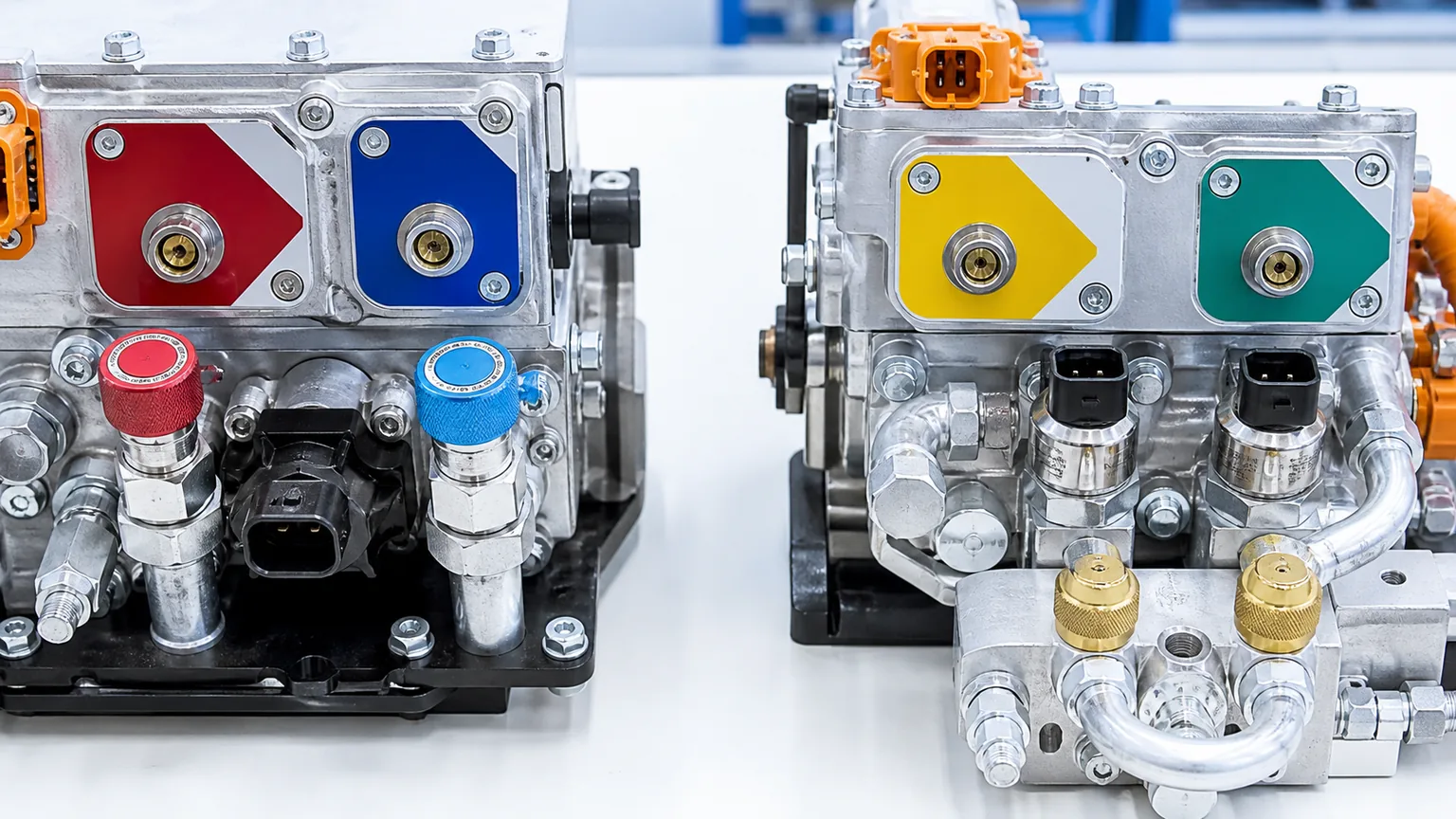
Labels, fitting geometry, connector keys, and OE references form one evidence set; none should be used in isolation.
A practical identification workflow
1. Establish the vehicle and system version
Record the VIN, production date, model derivative, destination market, and any thermal-system option code available in the catalogue or service information. A platform can change refrigerant or module design during production, so model name and year alone may be insufficient.
2. Photograph the vehicle refrigerant label
The photograph should be sharp enough to read refrigerant, charge quantity, oil note, and any safety information. Include a wider image showing where the label is installed. If the label is missing or unreadable, do not infer the refrigerant from cap color or internet photographs; use authoritative vehicle data.
3. Record the original component before removal
Photograph the label, connectors, ports, brackets, pipe routing, sensor and valve locations, and the part in its installed orientation. Mark suction/discharge or circuit connections only if the service information identifies them. Preserve any barcode, QR code, serial number, batch number, and revision.
4. Verify the OE chain
Check whether the original number has a suffix, supersession, software dependency, or required companion part. Verify the replacement against the exact VIN range. A cross-reference should explain the scope of interchange rather than merely list two numbers.
5. Compare the physical and electrical interfaces
Measure mounting points and overall envelope. Compare port position and seal type, not just diameter. Compare every connector’s key, latch, pin count, wire side, and orientation. Confirm compressor voltage and the part’s refrigerant approval in writing.
6. Confirm handling and installation requirements
Ask about oil pre-charge, shipping plugs, moisture exposure limit, required receiver/drier or desiccant replacement, contamination inspection, flushing restrictions, software procedures, and approved service equipment. R-744 and R-1234yf instructions are not interchangeable.
How distributors should control cross-contamination
Cross-contamination control begins before the workshop. Warehouse locations, product data, return labels, and quarantine rules should identify the refrigerant architecture. An opened return should never re-enter saleable stock because the ports look clean. Moisture, incorrect oil, sealant, particles, or another refrigerant may already be present.
A useful receiving and return process includes:
scan and record the serial or lot identifier;
check that every factory cap and seal is present and undamaged;
compare the box label and component label;
photograph ports before any cap is removed;
keep R-744 and R-1234yf items in clearly separated locations;
quarantine opened, incorrectly connected, or oil-contaminated returns;
record installation evidence and service-equipment type for warranty review.
This protects both the distributor and the next technician. A component that was briefly installed in the wrong system may no longer be new, even if it was never operated.
Incoming inspection for a bulk order
A bulk approval should begin with a verified golden sample. For a compressor, compare labels, castings, mounting positions, connectors, ports, caps, supplied oil statement, package protection, and traceability. Any rotation or electrical test must follow the supplier’s procedure. Never energize an unknown high-voltage compressor on an improvised bench.
For a gas cooler, condenser, chiller, or pipe assembly, inspect dimensions, bracket positions, port faces, sealing surfaces, sensor threads, protective plugs, fin damage, welds or brazed joints, cleanliness, and packaging. Leak and proof tests must use a safe fixture, appropriate medium, guarding, and a specification agreed before the order. The purchase agreement should state sampling level, pass/fail criteria, disposition of failed lots, and the records supplied with each batch.
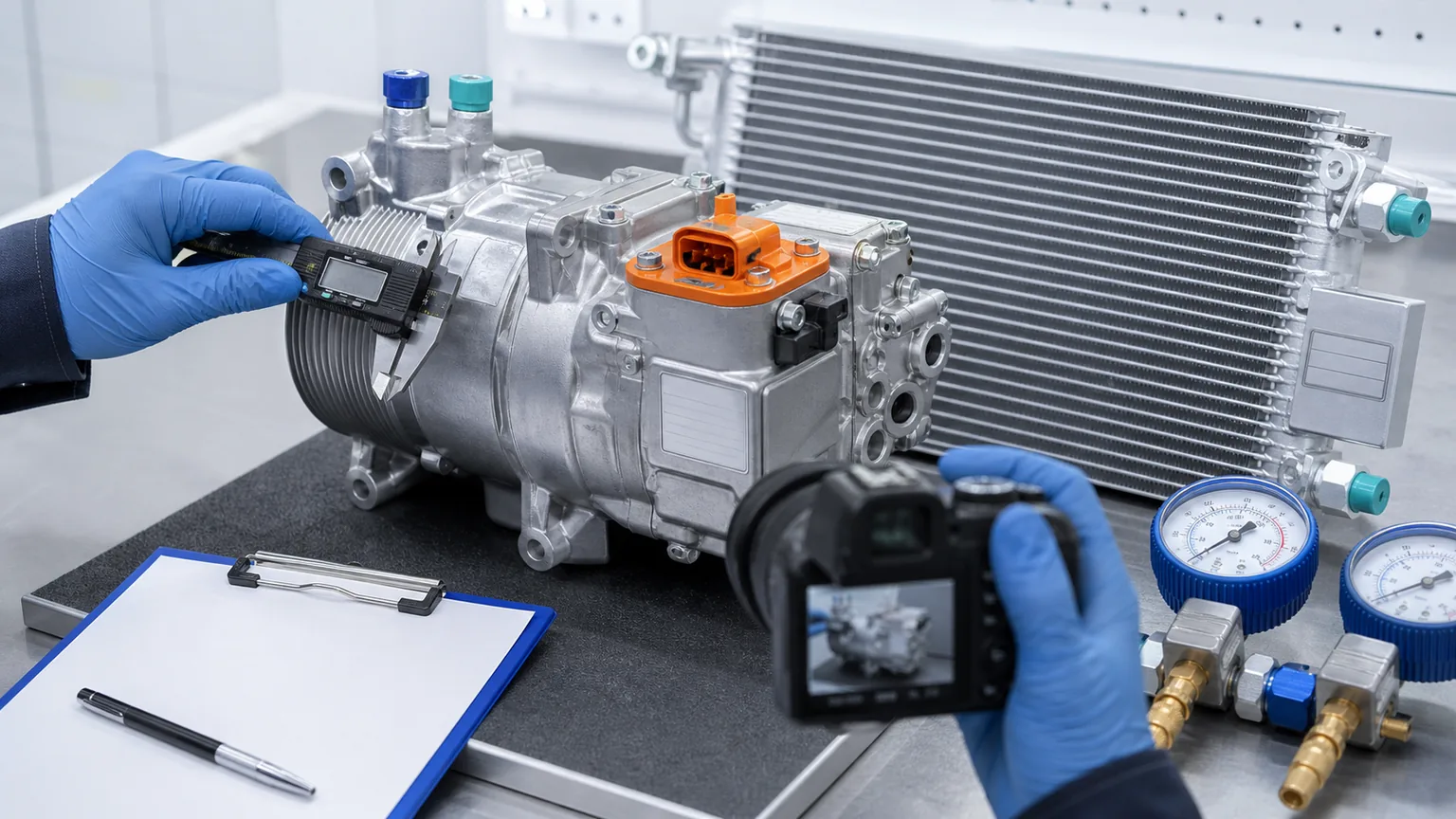
A golden sample links physical interfaces, documented specifications, test evidence, and traceability before bulk approval.
Common sourcing mistakes
Quoting by vehicle model only. Production changes and regional options can alter refrigerant and module design.
Treating “CO₂ compatible” as a complete specification. Pressure class, port design, material, control, and application approval still matter.
Crossing a compressor by body shape. Internal displacement, voltage, electronics, connectors, oil, and control can differ.
Calling every front heat exchanger a condenser. R-744 terminology and function may require gas-cooler identification.
Allows a usable B2B quotation and validation plan.
Frequently asked questions
Can an R-1234yf compressor be used with R-744 if the mounts fit?
No. The refrigerant, pressure class, lubricant, internal compressor design, electrical/control characteristics, fittings, and application approval differ. A mechanical fit does not establish safe compatibility.
Is a gas cooler simply a stronger condenser?
That description is too simplistic. It is a high-side heat exchanger designed for the R-744 system’s thermodynamic and pressure requirements. Construction strength is important, but flow design, heat-transfer performance, ports, sensors, mounting, and control integration also matter.
Can a workshop use the same recovery machine for both refrigerants?
Use only equipment explicitly approved for the refrigerant and application, with the required couplers, hoses, pressure range, procedures, and contamination controls. Current Nissens new-energy vehicle service guidance emphasizes dedicated R-744 service tools and connections.
Does an R-744 label confirm every replacement part?
No. It confirms the vehicle refrigerant architecture. You still need the exact component OE number, revision, electrical data, ports, mounting, and verified application cross-reference.
What evidence should accompany a warranty claim?
Include vehicle and component identity, installation date, refrigerant and oil information, port-cap condition, diagnostic codes, pressure/temperature or approved test records, insulation results where applicable, contamination findings, service-equipment identification, photographs, serial/lot, and the returned part protected from further contamination.
Make the refrigerant architecture the first buying gate
R-744 and R-1234yf heat pumps can perform similar vehicle functions, but they reach those functions through parts engineered for different refrigerants, pressure envelopes, lubricants, service interfaces, and controls. The safest aftermarket process is evidence-led: establish the vehicle version and refrigerant, verify the OE chain, compare every physical and electrical interface, confirm oil and handling requirements, and validate a golden sample before bulk approval.
For an Elecdura fitment review, send the vehicle refrigerant label, VIN or exact application, original OE number, full component label, voltage, connector and port close-ups, installed orientation, dimensions, and order requirement. The more complete the evidence, the faster the team can separate a true match from a visually similar but incompatible part.