Your Whole New Supply Chain For Cooling & AC Parts
Views: 0 Author: Site Editor Publish Time: 2026-11-23 Origin: Site
A salt-spray hour count alone cannot approve the corrosion protection of a skirt-mount AC condenser assembly. The evidence must relate to the configuration being purchased, the specimens exposed, the test conditions and the properties actually evaluated. A finish assessment can leave refrigerant containment, fan operation or connector performance unresolved.
Start with the precise purchase requirement, then decide which evidence supports it. The checks below are a purchasing review framework: the applicable product specification and agreed test plan supply the acceptance criteria.
Write down what the supplier is claiming. Is the claim about the coil coating, the frame finish, or the corrosion resistance of a complete assembly? Attach it to the quoted reference and configuration, including the core, frame, brackets, fasteners, fans and electrical connections that are actually supplied.
Nissens' condenser corrosion guidance identifies road-salt water spraying exposed condensers as a corrosion risk. For the installation under review, record the relevant exposure: road spray, moisture, cleaning practices and the protected or exposed areas. Installation position belongs in that description; the skirt-mount and roof-mount comparison covers that earlier choice.
A real product sheet shows why claim scope matters. RedDot's RD-4-7850-0P / 77R1642 sheet identifies a skirt-mount condenser with three fans and lists zinc coating for corrosion protection among its features. Use the leaflet to identify the advertised feature, then request the applicable report and specimen description to establish which supplied parts and corrosion requirements the evidence covers.
Keep corrosion qualification separate from the commercial-vehicle condenser fitment checks. A matching mounting pattern cannot establish the finish or functional outcomes assessed in a corrosion test.
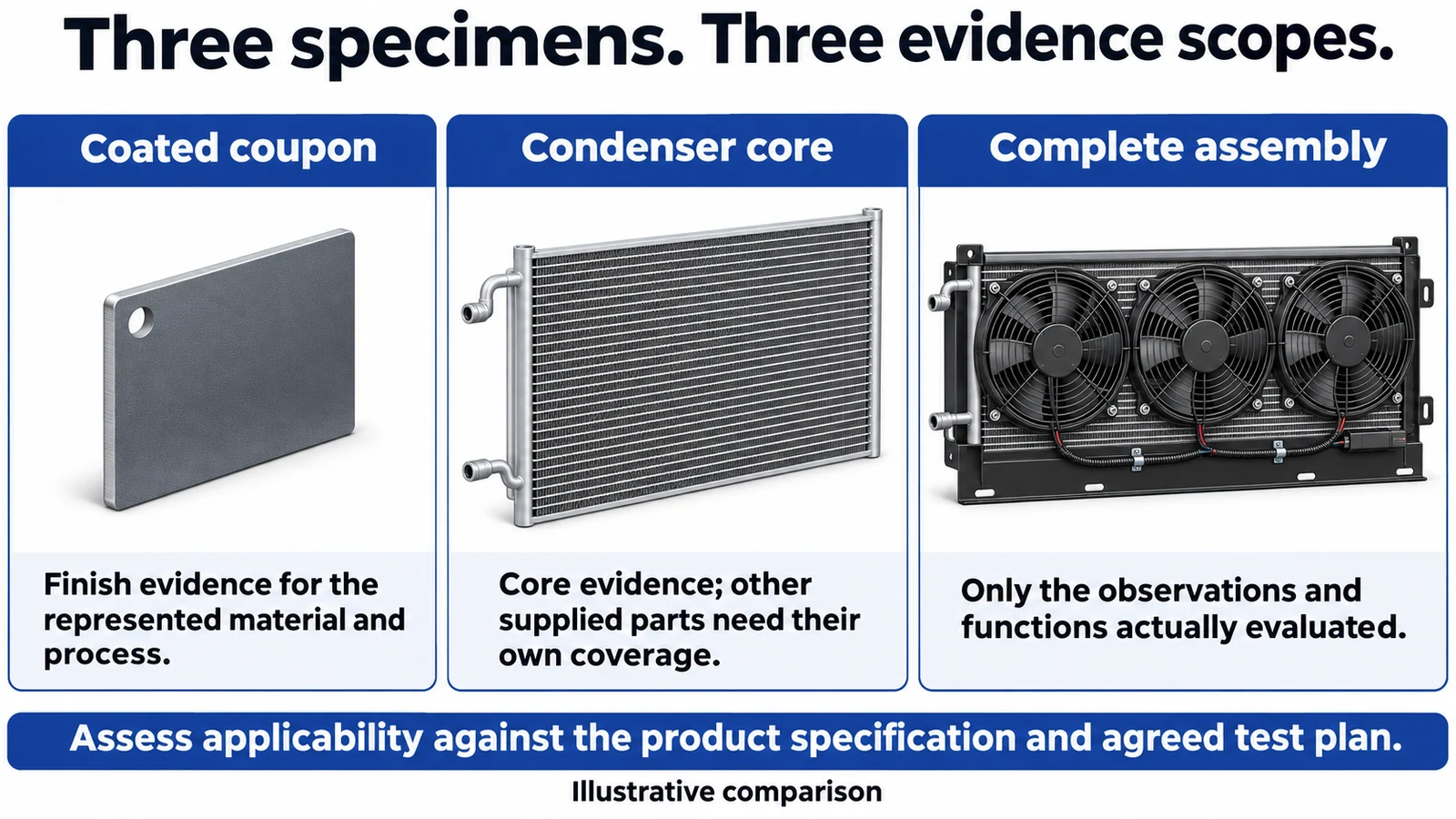
A coupon, a coated core and a complete assembly answer different questions. None is automatically representative of every part in the order. Review the tested material, preparation, coating process, construction and configuration before applying a result.
Illustrative comparison. Assess the represented specimen and evaluated properties against the product specification and agreed test plan. Open full-size illustration.
Test article | Recorded evaluation | Potentially supportable decision | Boundary to check |
|---|---|---|---|
Coated coupon | Appearance or a defined corrosion rating on the specimen | Accept evidence for a specific finish requirement when the material, process and applicability are justified. | Edges, joints and assembled interfaces can differ. The record does not establish coil containment or electrical operation. |
Coated condenser core | Core corrosion observations and any separately documented functional checks | Assess the represented core against its agreed criteria and measured endpoints. | Confirm the tested core matches the proposed construction. Frame, fasteners, fans and wiring require their own evidence coverage. |
Complete assembly | The observations and functions actually included in the test plan | Use the results for the represented configuration and evaluated properties. | Placing an assembly in a chamber does not automatically verify every function, operating condition or service-life claim. |
Assess any proposed combination of component and assembly records against the applicable product specification and agreed test plan. Ask the responsible approval authority to document which requirements and interfaces the combined evidence addresses, and whether additional validation is needed.
ASTM B117's published scope describes operation of the salt-spray environment but does not choose the specimen, exposure duration or result interpretation for a particular product. Its significance section also cautions against predicting natural-environment performance from salt-spray results alone; appropriate long-term atmospheric evidence is needed for such correlation or extrapolation.
The public scope of ISO 9227:2022 covers neutral salt spray (NSS), acetic acid salt spray (AASS) and copper-accelerated acetic acid salt spray (CASS) procedures. Product-specific specimens, exposure periods and interpretation belong in the appropriate product specifications. The scope also limits using these methods to rank different materials or predict long-term corrosion resistance.
Neither a method name nor an isolated duration defines the purchase decision. Read the report and controlling specification together:
Identity: test article, material, finish, configuration and the link to the quoted item.
Method: exact designation, edition, exposure type and any recorded departures.
Exposure: duration, relevant specimen preparation, orientation and test conditions.
Evaluation: inspected areas, measurement procedure, acceptance criteria and results.
Authority: who issued the record, its date and the approval basis for using it.
If two offers cite different methods, specimens or criteria, their hour counts do not establish a meaningful ranking. Ask for the missing comparison basis before selecting the apparently longer exposure. Do not convert chamber hours into years on the road without a defensible, application-specific correlation.
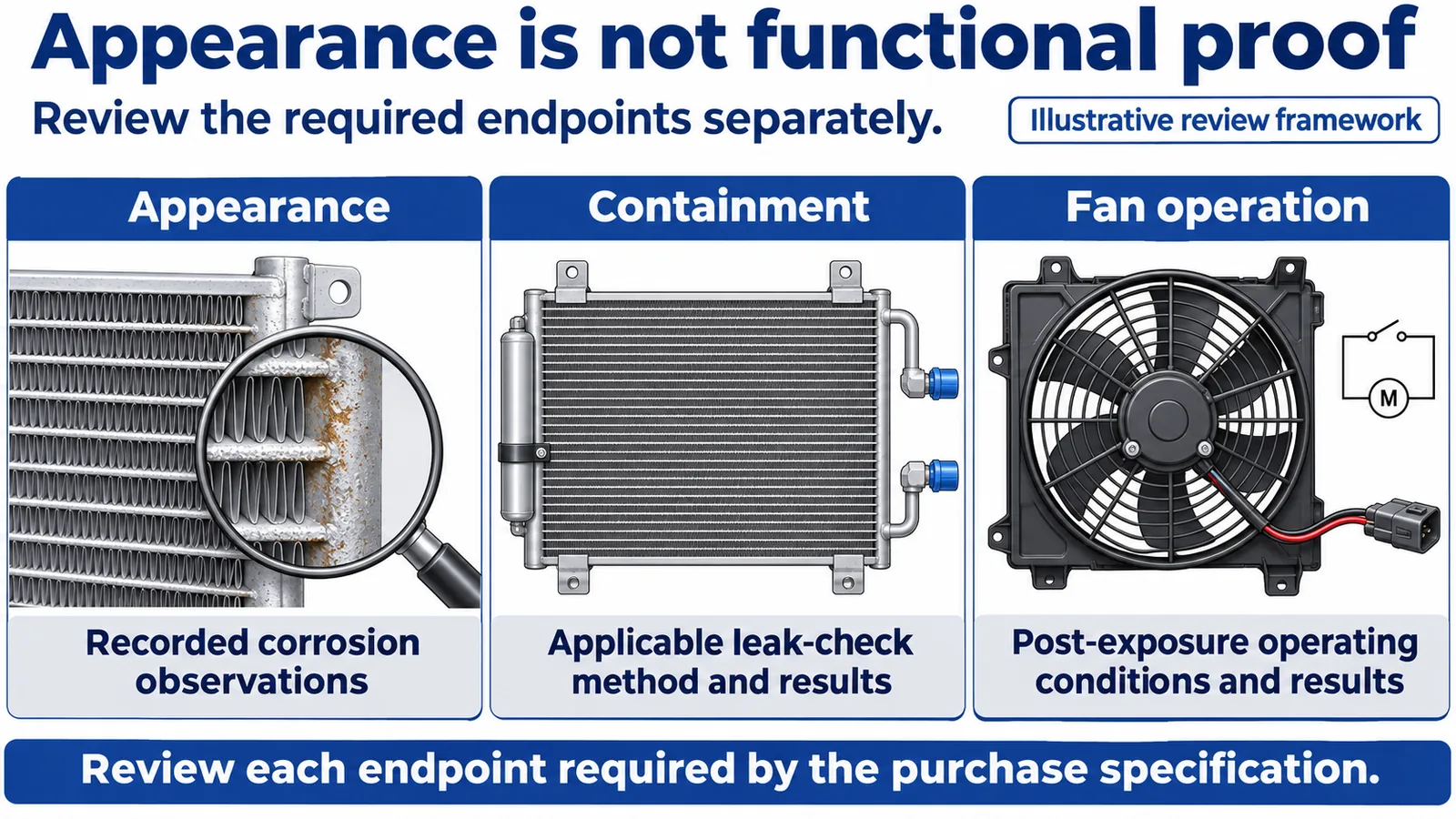
Identify the required endpoint for each claim. An appearance rating answers an appearance question. If the purchase requirement includes refrigerant containment after exposure, locate the applicable leak-check procedure, criteria and results. A photograph of an intact coating cannot supply that measurement.
Apply the same discipline to the fan and electrical parts. Where post-exposure operation is required, check what was operated, under which conditions and against which limits. An unpowered assembly exposure cannot by itself establish successful powered operation afterward. If thermal performance retention is claimed, identify the thermal assessment supporting that claim.
Keep these conclusions separate in the approval record. This avoids treating one acceptable endpoint as blanket acceptance of the entire unit. It also allows useful, relevant component evidence to be accepted within its justified scope while other requirements remain open.
Illustrative comparison. Evidence for one endpoint does not automatically resolve the others. Open full-size illustration.
Consider a hypothetical order for a skirt-mount condenser supplied with a coated core, frame and fan assemblies. The purchase requirement includes an agreed finish condition, refrigerant containment and fan operation after the specified exposure. The submitted package contains a coupon report and a process description linking its material and coating preparation to the proposed finish. It provides no identified post-exposure containment or electrical evaluation.
Limited acceptance: if the coupon meets the agreed finish criteria and its applicability is accepted, record acceptance for that defined finish requirement. List the represented parts and the basis for accepting the coupon. Do not extend this decision to unassessed assembly functions.
Hold: keep assembly qualification open for the containment and fan-operation requirements. Request the relevant traceable records, or an agreed validation plan addressing those endpoints. Existing component qualification and a justified applicability assessment may resolve part of the gap; use the agreed test plan and approval authority to determine any additional testing.
Compare the proposed supply with the configuration represented by the accepted evidence. Changes in substrate, pretreatment, coating process, construction, fasteners, fan or connector configuration can affect different parts of the assessment.
Ask the responsible party to evaluate the change and document which evidence remains applicable. A reasoned assessment may support carrying evidence forward, targeted checks or additional testing. Avoid assuming either that the old report covers every change or that every change requires repeating every test. Link the decision to the supplied revision and relevant batch records; the cooling-parts traceability guide addresses that identity trail.
Send the quoted assembly reference and configuration, the exact corrosion-related requirement, the records reviewed and the unresolved endpoint. Ask the supplier to identify the represented parts, explain applicability and propose evidence for the remaining requirement. Agree the acceptance basis before authorizing the order.
For replacement sourcing, review the Elecdura AC condenser range and contact Elecdura with the existing assembly reference, configuration, available drawings or photographs, quantity and destination. Ask about suitable replacement options and documentation available for any unresolved corrosion or functional requirement.